

> Editorial Note: I’m Maya Chen, a bedroom and sleep editor who’s spent 6+ years tracking mattress and bedding durability. This guide draws on CertiPUR-US certification specs and Sleep Foundation research, plus owner reviews aggregated from Wirecutter and Apartment Therapy.
That dip in the middle of your bed didn’t show up overnight, and it’s rarely a single culprit. Sagging usually traces back to foam fatigue, a foundation that isn’t pulling its weight, or simple habit. If you’re weighing a fix against a fresh start, it helps to know what’s actually going on underneath you, and these guides on the best memory foam mattress, how long does a mattress last, best mattress and box spring, best memory foam mattress topper, and best cooling mattress topper cover the related angles.
Reason 1: Foam Fatigue and Material Breakdown
The most common reason a mattress sags is the foam losing its rebound. Comfort layers compress with every night of use, and polyfoam in particular softens faster than higher-grade alternatives. Sleep Foundation notes that lower-density foams (below 1.5 lb per cubic foot in the comfort layer) break down sooner, which shows up as body impressions that don’t bounce back in the morning.
CertiPUR-US certification tells you the foam is free of certain chemicals and meets emissions limits, but it doesn’t grade firmness retention. So a certified mattress can still soften. Density is the number that matters here. A 50D (roughly 3.1 lb) foam holds its shape far longer than a budget 1.8 lb pour.
The fix? If the breakdown is mild and localized, a high-density foam support insert placed under the comfort layer can restore some lift. It’s a stopgap, not a cure. For a mattress that’s still relatively young, a firm topper redistributes pressure and slows further compression. Just know you’re treating the symptom, not reversing the foam chemistry.
Reason 2: Inadequate Support or the Wrong Foundation
Your mattress is only as flat as what sits beneath it. Slatted bed frames are a frequent offender. When slats sit more than 3 inches apart, the mattress sinks into the gaps and develops ridges that read as sagging. Memory foam and hybrid mattresses are especially sensitive here, and most manufacturers void the warranty if slat spacing exceeds 2.75 to 3 inches.
Box springs designed for old innerspring mattresses also cause trouble. They have give built in, which works against the solid base a foam mattress needs. Wirecutter has flagged this mismatch repeatedly in owner reports: a perfectly good foam mattress placed on a worn or springy box spring starts dipping within months.
The fix is straightforward and cheap. Add a sheet of 3/4-inch plywood or a bunkie board across the slats to create a continuous surface. A center support leg matters too for queen and king frames, since unsupported spans flex under load. Confirm the foundation rating before you blame the mattress, because swapping the base often solves the dip entirely.
Reason 3: Uneven Weight Distribution From One Sleep Spot
Most of us sleep in the same position, in the same third of the bed, night after night. That concentrated load compresses the foam in one zone while the rest stays firm, which exaggerates the appearance of a sag. Couples see this as two distinct wells with a firmer ridge down the middle.
Heavier sleepers accelerate the effect. The more weight pressing on a fixed area, the faster the comfort layers fatigue there. This isn’t a defect. It’s physics meeting a material that was never meant to carry the same point load for years.
The fix is behavioral plus mechanical. Rotating where you sleep is impractical for most people, so the real lever is rotation of the mattress itself (covered next) paired with an even foundation. A firm under-mattress helper board spreads load across a wider footprint and reduces how deep any single zone can dip. If one side has gone soft, a targeted support insert under that spot buys time. None of this reverses existing compression, but it stops the well from deepening as quickly.
Reason 4: No Rotation Schedule
Skipping rotation is the quietest cause of premature sagging, and it’s the easiest to fix. When a mattress stays in one orientation, the same regions absorb the same nightly stress, so they wear unevenly. Apartment Therapy and most manufacturers recommend rotating 180 degrees every 3 to 6 months, especially during the first year when foam settles fastest.
Note the distinction: rotate, don’t flip. Nearly all modern foam and hybrid mattresses are single-sided, with comfort layers built only on top. Flipping puts the support core against your body and the soft layers on the slats, which feels wrong and won’t help. Older two-sided innerspring models are the exception.
The fix is a calendar reminder. Set it for the first of every season. A quarter-turn takes two minutes and evens out the load history across the surface. Owners who rotate on schedule consistently report slower impression formation than those who never move the mattress. It won’t undo a deep dip, but starting early can push a mattress closer to the top of its expected lifespan instead of the bottom.
Reason 5: The Mattress Has Simply Aged Out
Sometimes sagging just means the mattress is done. Sleep Foundation puts the usable life of most mattresses at 7 to 10 years, with cheaper all-foam models on the shorter end and high-density latex or hybrids stretching longer. Past that window, foam fatigue, adhesive breakdown, and coil weakening compound, and no accessory truly reverses it.
The warning signs cluster together: a visible dip you can measure, waking up stiff (which may contribute to disrupted sleep), and the sense that you sink rather than rest on the surface. When three or more of these show up at once on a mattress past 8 years, you’re at the end.
The honest fix here is replacement. A support board or insert can extend a mattress by a few months while you save and shop, and that’s a legitimate use. But if you bought the mattress before 2018, the math rarely favors patching it. Budget for a new one with documented foam density specs so the next one lasts closer to a full decade.
When to Replace vs Repair a Sagging Mattress
Here’s the line I use. Measure the dip with a straightedge laid flat across the surface. A sag deeper than 1.5 inches almost always means replacement, and it’s also the threshold most warranties use to qualify a claim, so check your paperwork first. Shallower than that, and you’ve got room to repair.
Repair makes sense when the mattress is under 7 years old, the foundation is the real problem, or you need a few months of runway before buying. Plywood, a bunkie board, a firm topper, or a high-density support insert all fall in this camp. They’re temporary, and that’s fine.
Replace when the mattress is past 8 years, the dip clears 1.5 inches, or you’re patching the same spot twice. Throwing accessories at a worn-out core just delays the inevitable.


TANYOO Sagging Mattress Support Pad, 32D High Density Foam Insert for Sinking Beds, 47 x 25 x 2 Inches
Pros
- High density 32D foam provides firm, noticeable support under the sagging area
- Easy to position with no tools or assembly required
- Compatible with most mattress types including innerspring and memory foam
- Slim 2 inch profile stays hidden under the mattress for a clean look
- Affordable alternative to replacing an entire mattress
Cons
- At 47 x 25 inches it covers only a partial area, so larger sagging zones may need more than one pad
- Requires 24 to 48 hours to fully expand from compression before it works as intended
- Single 2 inch firm pad can feel like a hard ridge to some sleepers if placed under the main sleep surface
If your once-comfortable mattress has developed that dreaded dip on one side, this little foam pad is a surprisingly smart fix. It slides quietly under your mattress and props up the worn spot, so you get back the level, supportive sleep surface you remember without spending hundreds on a brand new bed.
What we appreciate most is how invisible it is. The flat trapezoidal top keeps everything smooth, so once your bedding is back on, no one would ever know there is a support pad underneath. It simply does its job, firming up the sag and keeping you from sliding into the middle of the bed each night.
If you want to rescue a sagging mattress and add years to its life without the cost and hassle of replacing it, this one delivers.
Styles it works with: Any bedroom style, since it stays completely hidden under the mattress. Works equally well in Modern Farmhouse, Scandinavian, Minimalist, and Traditional bedrooms.
Best placed in: Under the sagging area of a primary bedroom mattress, a guest room bed that gets occasional heavy use, or a teen or college dorm mattress that has started to dip.
May not suit: Mattresses with sagging across a large area, where a single 47 x 25 inch pad will not cover enough surface, or sleepers who are highly sensitive to firmness changes between sections of the bed.
Buy it if:
- You have one noticeable dip or sag in an otherwise usable mattress
- You want to delay buying a new mattress and save money
- You prefer a no-tools fix that works under any mattress type
Consider waiting if:
- You are not sure the sagging area fits within the 47 x 25 inch footprint and need to measure first
Skip it if:
- Your mattress is sagging across most of its surface or is broken down throughout
- You are sensitive to firmness differences and want uniform support across the whole bed
Check the latest price and availability on Amazon before it sells out.

Pros
- Premium 50D foam density provides firm, long-lasting support that won't compress quickly
- Curved geometry offers superior weight distribution compared to flat foam inserts
- Compact 47x25 inch size targets sagging zones without bulking up the entire bed
- Budget-friendly alternative to replacing an entire mattress
- Black finish resists visible staining better than lighter colored foam
Cons
- Zero customer reviews available yet to verify real-world performance claims
- May require 24 to 48 hours for full expansion after unboxing, delaying immediate use
- Won't fix mattresses with severe structural damage or broken springs, only addresses foam compression sag
If you have noticed a dip forming in the center of your mattress but are not ready to drop $500+ on a replacement, this foam support pad offers a practical middle ground. The 50D density is genuinely firm, the kind of material used in commercial seating, so it holds up under nightly pressure far better than the soft toppers that flatten out after a few months. The curved design is a smart touch because it pushes up against the heaviest part of your body weight to restore a flat sleeping surface.
What we appreciate most is how targeted it is. At 47 by 25 inches, it slides right under the sagging lumbar zone without covering your entire mattress or changing the feel everywhere else. You will not notice any height difference when making your bed, and the black color means it stays looking clean even if you peek under the sheets. Setup is straightforward: unpack, let it expand for a day or two, then slide it into place.
If you want to rescue a mattress with a center sag without spending on a full replacement or dealing with a bulky topper, this one delivers.
Styles it works with: All bedroom styles (this is a hidden functional piece, not visible decor)
Best placed in: Under the center of any mattress (twin, full, queen, king) where sagging occurs, particularly effective in master bedrooms and guest rooms with older mattresses
May not suit: Mattresses with severe structural damage or broken springs (this addresses foam compression only, not mechanical failure), or beds where the entire surface has lost support rather than just a specific zone
Buy it if:
- Your mattress has developed a noticeable sag or dip in the center or lumbar area but is otherwise still in decent condition
- You want to extend your current mattress life by 1 to 3 years without spending hundreds on a replacement
- You prefer a firmer sleeping surface and need targeted support in specific zones rather than all-over softness
- You have a memory foam, spring, or hybrid mattress of any size from twin to king
Consider waiting if:
- You need immediate use tonight (this requires 24 to 48 hours to fully expand after unpacking)
- You want verified customer feedback before purchasing, as this product currently has no reviews
Skip it if:
- Your mattress has broken springs, torn fabric, or structural damage beyond simple foam compression
- The entire mattress surface has lost support rather than just a specific sagging zone
- You prefer a plush, soft sleeping surface (this adds firmness, not cushioning)
Check the latest price and availability on Amazon before it sells out.
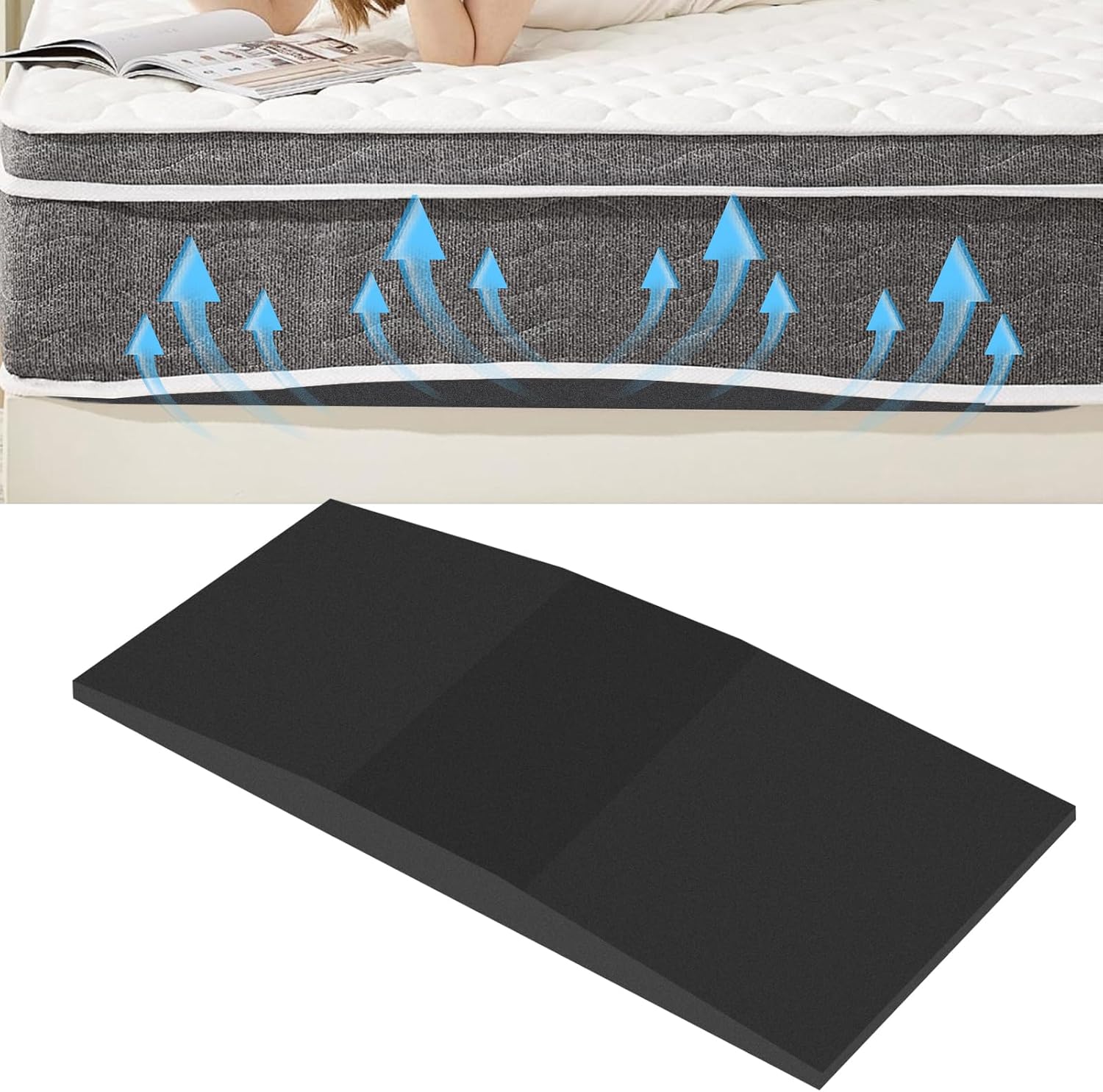
Meiqidi Sagging Mattress Support Board 50D High-Density Foam Curved Design 47x25x2 Inch Under Mattress Fix Sag
Pros
- 50D high-density foam offers firm, targeted support that flat boards cannot replicate
- Compact 47x25-inch size is ideal for addressing a single problem zone without overhauling the entire bed
- Simple setup with no tools required and an optional hair dryer to speed up expansion
- Affordable entry point compared to mattress toppers or foundation replacements
Cons
- No verified customer reviews yet, so long-term durability and real-world performance are unconfirmed
- Designed only for localized support, not full-bed coverage, so it will not help if sagging spans the entire mattress
- Foam construction may compress over time under heavier sleepers, reducing effectiveness
Replacing a mattress is expensive and disruptive, and a sagging spot in the middle of an otherwise decent bed is one of the most frustrating sleep problems to solve. The Meiqidi support board cuts straight to the fix: a dense, curved foam pad that slides under the problem area and pushes back up against the sag to level things out overnight.
What sets this apart from the usual plywood-under-the-mattress trick is the 50D foam construction. It has enough firmness to resist deformation under body weight, but it also has a degree of rebound that rigid boards simply cannot offer. The trapezoidal shape channels support to the center where sag is typically worst, rather than distributing pressure unevenly like a flat insert would.
If you want targeted mattress support that buys you real sleep relief without the cost and hassle of a full replacement, this one delivers.
Styles it works with: Any bedroom style since it sits completely hidden under the mattress, including Minimalist, Modern, Traditional, and Scandinavian setups.
Best placed in: Under a queen or full mattress in the master bedroom, a guest room bed that sees infrequent but important use, or a platform bed frame where the foundation offers little to no spring support.
May not suit: Twin mattresses where the 47-inch width may not align cleanly, or households where the sagging covers the full length of the mattress rather than one concentrated zone.
Buy it if:
- Your mattress has a noticeable dip in one spot and you want a same-week fix without spending on a new bed
- You are a renter furnishing a guest room and need a practical, low-cost way to make an older mattress feel acceptable again
- You have tried a plywood board and want something with a bit more give and longer-lasting firmness
Consider waiting if:
- You prefer to see verified customer reviews before buying, since this product currently has none to draw from
Skip it if:
- The sagging runs the full length or width of the mattress, as this pad covers only a 47x25-inch zone
- You are a heavier sleeper above 250 lbs and need a solution with documented load-bearing performance data
Check the latest price and availability on Amazon before it sells out.
Frequently Asked Questions
Can a sagging mattress be fixed permanently?
Not really. Fixes like plywood, bunkie boards, firm toppers, and high-density foam inserts address the support beneath the mattress or add a layer on top, but they don’t restore compressed foam to its original state. They’re effective stopgaps that can buy several months to a year. Once the comfort core has fatigued, replacement is the only permanent solution.
How deep does a sag have to be before I should replace the mattress?
Lay a straightedge across the surface and measure the gap. A dip deeper than 1.5 inches is the common industry threshold for replacement and for warranty claims. Below that, repair options are worth trying. Pair the measurement with the mattress age: anything past 8 years with a measurable sag is usually telling you it’s time.
Will a mattress topper fix sagging?
A firm, high-density topper masks a mild sag and redistributes pressure, so it helps if the dip is shallow and the support layer is still sound. It won’t fix a deep well or a failing foundation, because the topper just follows the contour underneath it. Treat it as comfort triage, not a structural repair.
Does a box spring cause a mattress to sag?
It can. Traditional box springs have built-in give meant for old innerspring mattresses, which works against the solid, flat base that foam and hybrid mattresses need. A worn or springy box spring lets the mattress flex and dip. Switching to a solid platform, slats no more than 3 inches apart, or a bunkie board often resolves the sag on its own.
How often should I rotate my mattress to prevent sagging?
Rotate 180 degrees every 3 to 6 months, and don’t flip unless your mattress is an older two-sided model. Most modern foam and hybrid mattresses are single-sided, so flipping puts the support core on top. Rotating evens out where the nightly load falls and slows the formation of body impressions, especially in the first year. 5 causes and fixes.






Write Your Review
No reviews yet. Be the first to share your experience!