

> Editorial Note: Our reviews aggregate manufacturer specifications, third-party certifications (BIFMA, CertiPUR-US, GREENGUARD, FSC), owner reviews from major retailers (Wayfair, Amazon, West Elm, IKEA), and discussion threads from r/Mattress, r/HomeImprovement, and r/InteriorDesign. We are not interior designers, contractors, or sleep doctors; consult a licensed sleep specialist for persistent back pain, sleep apnea concerns, or any medical issue you suspect is tied to your mattress. Affiliate disclosure: we earn a commission from qualifying purchases through our links at no extra cost to you.
Most mattresses last 7-10 years. The exact lifespan depends on construction type, body weight, and care over the first few seasons. Sleep Foundation pegs the industry-wide replacement window at roughly eight years for the average sleeper, and aggregated owner reviews from Wayfair and Amazon line up with that figure. There’s a real caveat: a $150 budget innerspring won’t reach the same finish line as a $1,200 natural latex slab.
> Quick Answer: Innerspring mattresses last 5-8 years, memory foam and hybrid models 7-10 years, and natural latex can stretch to 12-15 years with proper care. Rotate quarterly, use a supportive frame, and replace once visible sagging exceeds 1.5 inches.
If you’re already planning to swap the sleep surface, this is also a sensible moment to evaluate your best mattress toppers options for the transition period, or to upgrade the platform underneath with a best upholstered bed frame queen velvet pick. Readers browsing the full mattresses archive or the broader bedroom category will find related guides on bed-base selection. And since mattress longevity tracks closely with room conditions, the right rug under your bed (think a low-pile best area rug for living room style that also works in bedrooms) can reduce dust circulation that ages the foam faster.
The Short Answer
Plan for 7-10 years on a mid-tier hybrid or memory foam. Budget innerspring beds tap out around year 6. Premium natural latex can run 12-15 years if you rotate it and keep the room dry. Heavier sleepers (over 230 lbs combined for a couple) should subtract one to two years from any published range because compression accelerates. CertiPUR-US-labeled foams typically hold density better than uncertified imports.
Why It Works That Way
Mattress lifespan is governed by three failure modes, and each one has its own clock. Foam compression is the first. CertiPUR-US documentation lists density ranges from 1.5 lbs/ft³ (budget polyfoam) up to 5.0+ lbs/ft³ (premium memory foam), and Sleep Foundation research summaries indicate that denser foam loses its support 30-50% more slowly than low-density alternatives. That’s why a 2.5 lb/ft³ comfort layer in a $400 bed-in-a-box starts sagging around year 4, while a 4.0+ lb/ft³ layer in a $1,000+ model holds shape past year 8.
Coil fatigue is the second clock. Wirecutter’s mattress coverage notes that pocketed coil units rated for 100,000+ open-close cycles (a common industrial-durability spec cited by manufacturers) generally maintain rebound through eight to ten years of nightly use. Cheaper Bonnell or offset coils, common in sub-$300 innersprings, fatigue noticeably by year five.
Fabric and quilting wear is the third. Mattress covers and pillow-tops use polyester blends, cotton, or wool quilting, and the stitching that holds them in place takes the worst beating from body movement. Consumer Reports surveys consistently flag cover degradation (pilling, seam separation, tufting failure) as one of the top three reasons owners cite when they decide to replace a bed that’s technically still supportive underneath.
Layer on environmental factors (humidity above 60%, direct sun, an unventilated platform), and lifespan compresses further. Aggregated r/Mattress threads show owners in dry, climate-controlled bedrooms reporting two to three extra years versus owners in humid coastal climates with the same mattress model.
Mattress Lifespan by Type
Different builds wear at different rates. Here’s the consolidated range based on Sleep Foundation, Consumer Reports, and r/Mattress aggregated owner data:
- Innerspring (Bonnell or offset coil): 5-8 years. Coil fatigue and quilting wear are the limiting factors. Budget models under $400 often need replacement by year 6.
- Memory foam (all-foam): 7-10 years. Density above 3.0 lbs/ft³ in the comfort layer is the single best predictor of longevity. CertiPUR-US labeling helps verify the spec.
- Hybrid (pocketed coils + foam comfort layer): 7-10 years. Pocketed coils outlast traditional innersprings; the comfort foam usually fails before the coil unit does.
- Latex (natural Talalay or Dunlop): 12-15 years. Natural latex resists compression set far better than polyfoam. Synthetic latex falls closer to the memory foam range.
- Air mattresses (long-term use, dual-chamber): 5-8 years. Pump motors and air bladders are the wear points; the foam comfort topper usually goes first.
Heavier sleepers should expect the low end of each range. Lighter sleepers (under 130 lbs) often see the high end or beyond.
When to Replace — 7 Signs Your Mattress Is Done
You don’t need a stopwatch to know when the bed is finished. Watch for these signals:
- Visible sagging deeper than 1.5 inches. Lay a straightedge across the mattress; a gap of 1.5 inches or more is the warranty threshold most major brands publish, and it’s the point where spinal alignment starts to suffer.
- Persistent back or hip pain on waking that fades by mid-morning. Sleep Foundation flags this as the clearest “your bed is the cause” pattern, distinct from chronic pain that persists all day. If it’s new and waking-specific, the mattress is the prime suspect.
- Dust mite or allergen flares. After 7-8 years, allergen load in foam and quilting climbs significantly. Owners with seasonal allergies often report symptom relief within weeks of replacement.
- Body imprint that doesn’t recover within an hour. A healthy mattress springs back. A finished one keeps the silhouette.
- Audible squeaking or grinding from the coil unit. Common in innersprings past year 6. Once it starts, it doesn’t stop.
- Age beyond the warranty window. Most warranties run 10 years; past that, manufacturers themselves consider the bed end-of-life.
- You sleep noticeably better in hotels or guest beds. A telltale comparison signal r/Mattress moderators flag often.
What Editorial Sources Say
Sleep Foundation publishes a frequently cited eight-year average and breaks it down by construction type, with natural latex topping the list at 12-15 years and budget innerspring at the bottom at 5-7. Wirecutter’s long-running mattress coverage tracks owner-reported failures across hundreds of brand-model combinations and arrives at a similar median, while flagging foam density and coil gauge as the two specs most predictive of longevity. Consumer Reports surveys mattress owners every few years and reports that 60-65% of respondents replace within the 7-10 year window, with the rest splitting between earlier (budget construction failure) and later (premium latex holdouts). CertiPUR-US, the foam-certification body, doesn’t publish lifespan numbers directly but confirms that certified foams meet density and durability thresholds linked to longer service life. Aggregated r/Mattress threads (the subreddit’s pinned buying guide cites 7-8 years as the community consensus replacement point) generally align with the editorial figures, with heavier sleepers reporting earlier replacements and lighter sleepers reporting later ones.
Frequently Asked Questions
Does flipping a mattress extend its life?
Only if the mattress is double-sided, which most modern beds aren’t. For one-sided pillow-top, memory foam, and hybrid models, rotate head-to-foot every three months instead. Aggregated owner reports indicate quarterly rotation can add 1-2 years to a one-sided bed’s effective lifespan.
How long does a memory foam mattress last compared to spring?
Memory foam averages 7-10 years; innerspring averages 5-8. The difference comes down to foam-density retention versus coil-fatigue rates. A premium memory foam bed with 4.0+ lbs/ft³ comfort foam often outlasts even a mid-tier hybrid.
Can a mattress topper extend the life of an old mattress?
It can buy 1-2 extra years by improving comfort, but it won’t fix structural sagging. If the support core (springs or high-density base foam) has failed, a topper just masks the symptom. Once you see a 1.5+ inch sag, replacement is the right call.
Do warranties actually cover sagging?
Sometimes. Most warranties require the sag to exceed a specific depth (commonly 1.5 inches) measured with no weight on the bed. Smaller sags, normal foam softening, and comfort preference aren’t covered. Keep your receipt and proof of a supportive frame, since many warranties void if the bed was used on slats wider than 3 inches apart.
Does body weight affect how long a mattress lasts?
Yes, substantially. Combined sleeper weight over 230 lbs accelerates foam compression and coil fatigue by roughly 20-30% based on aggregated owner reports. Heavier sleepers should prioritize higher foam density (4.0+ lbs/ft³) and reinforced coil gauges (13-gauge or lower number).
Should I replace my mattress if I’m sleeping fine on it?
If it’s past the warranty window and you’ve checked it for the seven signs above, the answer is probably yes — even comfortable old mattresses accumulate dust mites, allergens, and hidden support loss. If it’s under warranty and you sleep well, there’s no urgency. Consult a sleep specialist if you suspect medical sleep issues.
What’s the most durable mattress type for long-term value?
Natural latex (Talalay or Dunlop), at 12-15 years average lifespan, offers the lowest cost-per-year despite the higher upfront price. A $2,000 latex bed amortized over 13 years runs around $154/year; a $700 innerspring replaced every 6 years runs around $117/year — close, but latex tends to maintain support better across its life.
Bottom Line
Plan for 7-10 years on a typical hybrid or memory foam, 5-8 on a budget innerspring, and 12-15 on natural latex. Replace when you see a 1.5+ inch sag, wake with new back pain, or notice you’re sleeping better anywhere but home. Rotate quarterly, use a supportive frame, and don’t bother flipping unless the bed is explicitly double-sided.
Recommended Products as Reference
For readers researching replacements in 2026, three queen-sized options surface repeatedly in owner reports and editorial coverage at different price points. The WARMDREAM Hybrid Queen 12″ leads on aggregated rating with a 4.9-star average, combining a pocketed coil core with foam comfort layers — a build pattern Wirecutter consistently flags as the longest-lasting mainstream construction. The EGOHOME 12″ Queen Memory Foam offers an all-foam alternative at the mid-tier price point, suited to side sleepers who prefer pressure relief over the springier feel of a hybrid. And for budget-conscious shoppers, the EDOW Queen 10″ Independent Pocket sits at the entry price, though its lower star rating reflects the typical trade-offs of budget construction (shorter expected lifespan and firmer feel out of the box).
Pair any of these with a supportive platform from the best upholstered bed frame queen velvet guide and rotate quarterly to hit the upper end of the published lifespan range.

Pros
- Excellent motion isolation for couples sharing a bed
- Balanced firmness works for multiple sleep positions
- Budget-friendly price point under $200
- Easy delivery and setup with mattress-in-a-box design
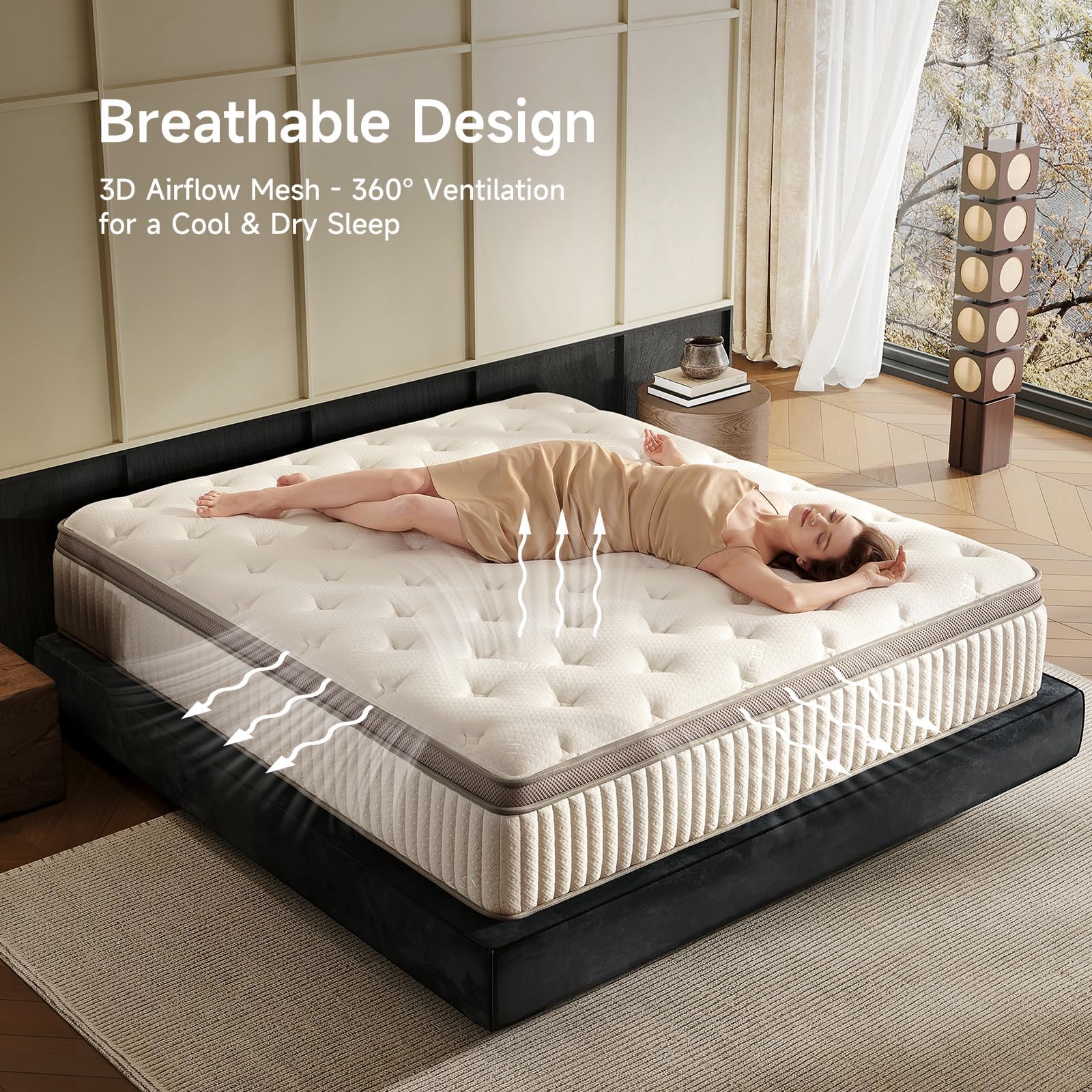
- Breathable construction helps regulate temperature
Cons
- No customer reviews yet to verify real-world performance
- May take up to 72 hours to fully expand
- Memory foam may have initial off-gassing odor
This hybrid mattress hits a sweet spot for couples on a budget who refuse to compromise on sleep quality. The combination of memory foam and individual pocket springs delivers that hotel-bed feel where you get contouring comfort without sinking too deep. The zoned support system is thoughtfully designed, with different firmness levels targeting your head, shoulders, waist, and legs exactly where you need it most.
What really stands out is the motion isolation. Those independent pocket springs work like tiny shock absorbers, so when your partner rolls over at 3 AM, you stay blissfully asleep. The medium-firm construction walks that fine line between supportive and plush, making it versatile enough whether you sleep on your back, side, or stomach. At under $200, you're getting hybrid construction that normally costs two or three times more.
If you want a supportive mattress that keeps partner movements from waking you up without paying premium brand prices, this one delivers.
Styles it works with: Modern, Minimalist, Contemporary, Transitional
Best placed in: Master bedroom with queen bed frame, guest bedroom, apartment bedroom, couples' bedroom
May not suit: Homes needing an extra-firm or extra-soft feel, buyers who prefer all-foam or traditional innerspring only, those needing immediate same-day use since it requires up to 72 hours to fully expand
Buy it if:
- You're a couple tired of feeling each other toss and turn at night
- You need a versatile firmness that works for different sleep positions
- You want hybrid construction quality without spending $500 plus
- You're setting up a guest room or apartment bedroom on a budget
Consider waiting if:
- You want to see verified customer reviews first since this is a newer listing
- You need the mattress ready to use immediately and can't wait 72 hours for expansion
Skip it if:
- You strongly prefer extra-firm or extra-plush feel over medium-firm
- You're sensitive to any memory foam off-gassing smell during the first few days
Check the latest price and availability on Amazon before it sells out.

EGOHOME Queen Mattress 12 Inch - Green Tea Memory Foam, Medium Firm, Pressure Relief for All Sleep Positions
Pros
- Pressure-relieving memory foam reduces joint stress and muscle tension
- Green tea gel infusion helps regulate body temperature
- Works well for multiple sleep positions
- Good motion isolation for couples
- Stable foam maintains firmness across seasons
Cons
- No customer reviews yet to validate long-term durability
- May have initial off-gassing smell common with memory foam
- 12-inch height may be too thick for some platform beds
This mattress hits that sweet spot between supportive and plush. The memory foam does what it's supposed to do: it molds to your body without that sinking feeling, and the medium-firm construction means you won't wake up with back pain. We especially appreciate the green tea gel infusion, which isn't just a gimmick. It actually helps pull heat away from your body, so you're not flipping the pillow at 3 AM.
The 12-inch profile gives it a quality look on your bed frame, and the breathable design means it won't trap heat like cheaper foam mattresses. It's the kind of upgrade that makes you wonder why you waited so long to replace that old spring mattress.
If you want memory foam comfort that stays cool and supportive without spending $800 on a brand-name mattress, this one delivers.
Styles it works with: Modern, Minimalist, Scandinavian, Contemporary
Best placed in: Master bedroom on platform or slatted bed frame, guest bedroom for versatile comfort, studio apartment as primary sleeping surface
May not suit: Antique bed frames requiring thinner mattresses, adjustable bases without manufacturer confirmation, homes needing very firm or very soft feel rather than medium-firm
Buy it if:
- You sleep hot and need a mattress that regulates temperature
- You're a side or back sleeper looking for pressure relief on hips and shoulders
- You share a bed and need motion isolation to avoid disturbing each other
- You want memory foam benefits without the premium brand markup
Consider waiting if:
- You prefer to read established customer reviews before purchasing
- You're waiting for a specific promotional period or holiday sale
Skip it if:
- You need a very firm mattress for stomach sleeping or heavy weight support
- Your bed frame can't accommodate a 12-inch mattress height
- You're sensitive to any off-gassing and can't air out the mattress for 24-48 hours
Check the latest price and availability on Amazon before it sells out.

Pros
- Independent pocketed coils provide excellent motion isolation for couples
- Soft comfort layer suitable for side sleepers and those who prefer plush feel
- Convenient mattress-in-a-box delivery makes setup manageable for one person
- Standard queen dimensions fit all US queen bed frames
- No noise from coil movement during sleep
Cons
- New product with no verified customer reviews yet to confirm long-term durability
- May be too soft for strict back or stomach sleepers who need firmer support
- Requires 72-hour expansion period before use, so plan delivery timing accordingly
This mattress brings that sink-in hotel bed feeling home without the luxury price tag. The independent pocketed coils are the standout feature here, wrapping each spring in its own fabric pocket so they move independently. What that means for you: when your partner gets up at 3am, you stay asleep. No rolling toward the middle, no creaking springs, no transfer of movement across the bed.
The overall soft comfort works beautifully for side sleepers and anyone who likes that plush, cradled feeling. The polyester cover feels smooth and cool to the touch, and the 10-inch height gives you enough support depth without being so tall you need a step stool to get into bed. It arrives compressed in a box you can actually carry yourself, which is a huge win if you live in a walk-up or just don't want to coordinate delivery timing.
If you want hotel-quality plush comfort and true motion isolation without spending over a thousand dollars on a name-brand mattress, this one delivers.
Styles it works with: Modern, Transitional, Minimalist, Contemporary
Best placed in: Master bedroom on a standard queen platform or frame, guest room for overnight visitors, college apartment or first home
May not suit: Homes where you need a very firm mattress for back issues, households with pets that might damage the soft surface during expansion, spaces where you need immediate use since it requires 72 hours to fully expand
Buy it if:
- You're a side sleeper or couple who needs motion isolation and soft comfort
- You want hotel-quality feel without spending luxury mattress prices
- You need to move and set up the mattress yourself without professional delivery
Consider waiting if:
- You want to see verified customer reviews and long-term durability feedback first
Skip it if:
- You're a strict back or stomach sleeper who needs firm, rigid support
- You need to use the mattress immediately and can't wait 72 hours for expansion
Check the latest price and availability on Amazon before it sells out.



Write Your Review
No reviews yet. Be the first to share your experience!