

> Editorial Note: I’m Hannah Lin, an Interior Living Researcher who’s spent 9+ years analyzing the home furniture market. This guide draws on BIFMA, GREENGUARD, and FSC certifications, plus owner reviews aggregated from Wirecutter, Apartment Therapy, and the major home design subreddits.
Most hardwood floor damage starts before anyone notices it: one sandy entryway, one dining chair without felt, one sofa dragged 6 inches during cleaning. Protecting wood isn’t about babying the room. It’s about building boring habits that stop scratches, dents, moisture swings, and furniture marks before they become permanent. If you’re also planning nearby updates, keep best area rugs for living room, best coffee tables for small spaces, how to arrange living room furniture, best accent chairs for living room, and living room decor ideas 2026 on your shortlist.
The Ground Rules Before You Start
Hardwood needs three protections working together: stable air, clean entry points, and soft contact under furniture. Miss one, and the other two have to work harder.
The National Wood Flooring Association recommends 30% to 50% indoor humidity for wood floors. Big swings create gaps, cupping, squeaks, and finish stress. BIFMA guidance around furniture movement and concentrated load points matters at home too because chairs, desks, and storage pieces still push weight through small feet.
Start with pieces that move daily: dining chairs, desk chairs, ottomans, bar stools, and entry benches. Then work outward to sofas, beds, bookcases, and media cabinets. The quiet stuff matters too.
Step 1: Hold Indoor Humidity at 30% to 50%
Wood floors don’t fail because of one humid day. They struggle when rooms swing from 25% winter air to 60% summer air for weeks. That repeated movement stresses the finish and opens seams between boards.
Aim for 30% to 50% relative humidity. Use a $10 to $20 digital hygrometer in the room with the most hardwood, not in a hallway 30 feet away. No guesswork.
If winter humidity drops below 30%, add a room humidifier and keep it several feet from the floor so mist doesn’t settle on boards. If summer humidity climbs above 55%, run air conditioning or a dehumidifier until the room settles back down.
Watch the floor itself. Narrow seasonal gaps are normal. Curling board edges or cloudy finish near doors point to moisture trouble, not decor choices.
Step 2: Put 1-Inch Felt Under Every Moving Contact Point
The fastest hardwood scratch often comes from harmless-looking furniture. A chair leg with a hard plastic foot can cut through finish like a tiny scraper, especially when grit gets trapped underneath. Felt spreads pressure and gives each leg a softer glide.
Use at least a 1-inch felt pad on standard dining chair legs. Wider legs need pads that cover the whole contact point, not just the center. If the chair foot measures 1.25 inches across, choose a 1.5-inch pad and trim it cleanly.
Don’t mix old pads with new ones on the same chair. Replace all 4 pads at once, then press each one for 20 to 30 seconds so the adhesive bonds across the full surface.
Clean the chair foot before you stick anything on it. Dust, old glue, and furniture polish weaken the bond. A dry cloth handles most legs; a small amount of rubbing alcohol helps on glossy plastic or metal feet. Let it dry first.
Check pads every 3 months in high-use rooms. If the felt is flat, gritty, or peeling, replace it. Cheap maintenance. Expensive floor.
Step 3: Build Doorway Defense With Rugs and Shoe Rules
Most scratches aren’t from the furniture. They’re from grit. Sand, driveway dust, tiny stones, and dried soil behave like loose abrasive under shoes and chair legs.
Place a coarse mat outside every main door and a washable rug inside the first 3 to 5 feet. Apartment Therapy makes the same point often: good hardwood rooms need a practical landing zone before the pretty part begins.
Use rug pads under every entry rug. A rug without a pad can shift, bunch, or trap grit against the finish. Choose a pad labeled safe for hardwood, and avoid rubberized backings that aren’t rated for finished wood.
Set a simple shoe rule where hardwood starts. Shoes off is best; if that’s not realistic, add a boot tray at least 24 inches wide for wet days. Water belongs in the tray, not under the rug edge.
Vacuum entry rugs weekly with suction, not a beater bar. The goal isn’t spotless. It’s fewer hard particles traveling 20 feet into the room.
Step 4: Size Chair Glides Before the First Scratch
Chair glides and felt pads only work when they match the leg. Too small, and the edge of the chair foot still touches the floor. Too slick, and it shoots backward every time someone sits down.
Measure the bottom of the chair leg. Round legs often need 1-inch or 1.5-inch pads; narrow square legs may need 3/4-inch pads; larger accent chairs often need 2-inch pads.
For dining chairs, cover at least 90% of the contact surface. For metal sled-base chairs, use wraparound protectors made for tubular frames because stick-on felt won’t hold well along a curved rail. For rolling office chairs, use a hardwood-safe chair mat at least 36 by 48 inches if the chair rolls daily.
Wirecutter’s furniture and home office coverage often comes back to the same practical point: the part touching the floor matters as much as the main piece. That’s true here. A beautiful chair with the wrong glide is still a scratch machine.
Recheck glides after the first week. If one pad slides off-center, replace it; dusty adhesive won’t hold like new.
Step 5: Lift Heavy Furniture and Let Adhesive Cure for 24 Hours
Dragging ruins floors fast. A sofa moved 6 feet can leave a pale scuff line; a loaded bookcase dragged 2 inches can press grit into the finish.
Lift heavy furniture whenever possible. For anything over about 50 lb, use 2 people or felt sliders sized for the furniture foot. Slide only after every foot is protected, and move slowly in a straight line.
Empty storage pieces first. A bookcase with 80 lb of books behaves differently from the same case empty. Drawers, decor, and electronics add shifting weight, which increases the chance that one leg digs into the finish.
After applying adhesive pads, wait 24 hours before sliding furniture. You can set the piece down right away, but lateral movement can shear the pad off. Let the bond set.
Use sliders for layout changes, deep cleaning, and rug swaps. Don’t leave temporary plastic sliders under furniture long-term unless they’re designed as permanent floor protectors. Felt is safer for daily contact.
The Right Products Make It Easier
The products below were chosen for hardwood-safe felt coverage, owner ratings above 4.5, and useful size variety rather than decorative packaging. Start with the assorted pads if you’re covering a full room of chairs and tables. Use the large sliders when the job involves sofas, beds, or cabinets that shouldn’t be dragged bare across wood.


Pros
- 162-piece assorted value pack covers an entire household for under $8
- Self-stick adhesive requires no tools and takes seconds per pad to apply
- Works on multiple floor types including hardwood, tile, laminate, and vinyl
- Versatile enough for furniture legs, lamps, plant bases, and small decor items
Cons
- Beige color may stand out on dark-stained furniture legs where brown pads would blend better
- Adhesive can weaken over time on frequently moved furniture and pads may need replacing
- No heavy-duty variant included, so very heavy furniture like cast-iron pieces may benefit from the upgraded Scotch Heavy Duty line instead
If you have ever pushed a dining chair back and cringed at that scraping sound on your hardwood floors, these Scotch felt pads are the simple fix you have been putting off. For less than the cost of a coffee, you get162 pads in multiple sizes that can cover every chair, table, stool, and ottoman in your home in a single afternoon.
What makes this pack genuinely useful rather than just a stopgap is the variety. The assorted sizes mean you are not left hunting for the right fit or doubling up pads to cover an oddly sized leg. The self-stick backing holds firmly without any fuss, and the beige felt color is neutral enough to disappear against most natural wood and painted furniture finishes.
These pads are also quietly practical for the small things people overlook: lamp bases, ceramic plant pots, and decorative trays that shift every time you dust. If you want reliable floor protection across your whole home without buying three different products, this one delivers.
Styles it works with: Scandinavian, Modern Farmhouse, Minimalist, Transitional
Best placed in: Dining room chairs and tables, living room sofas and coffee tables, bedroom dressers and nightstands
May not suit: Homes with very dark espresso or black-stained furniture where beige pads may be visible, or households with young children who frequently dismantle items from furniture legs
Buy it if:
- You have hardwood, laminate, or tile floors and want to prevent scratching from everyday furniture movement
- You are setting up a new home or recently renovated and want to protect your investment from day one
- You need a cost-effective solution that covers multiple rooms and furniture types in one purchase
Consider waiting if:
- You specifically need brown pads to match darker furniture and want the color-matched option instead
Skip it if:
- You have extremely heavy furniture like solid cast-iron pieces that require the heavy-duty felt pad variant for adequate protection
- You need floor sliders rather than stationary protectors for regular large-scale furniture rearranging
Check the latest price and availability on Amazon before it sells out.
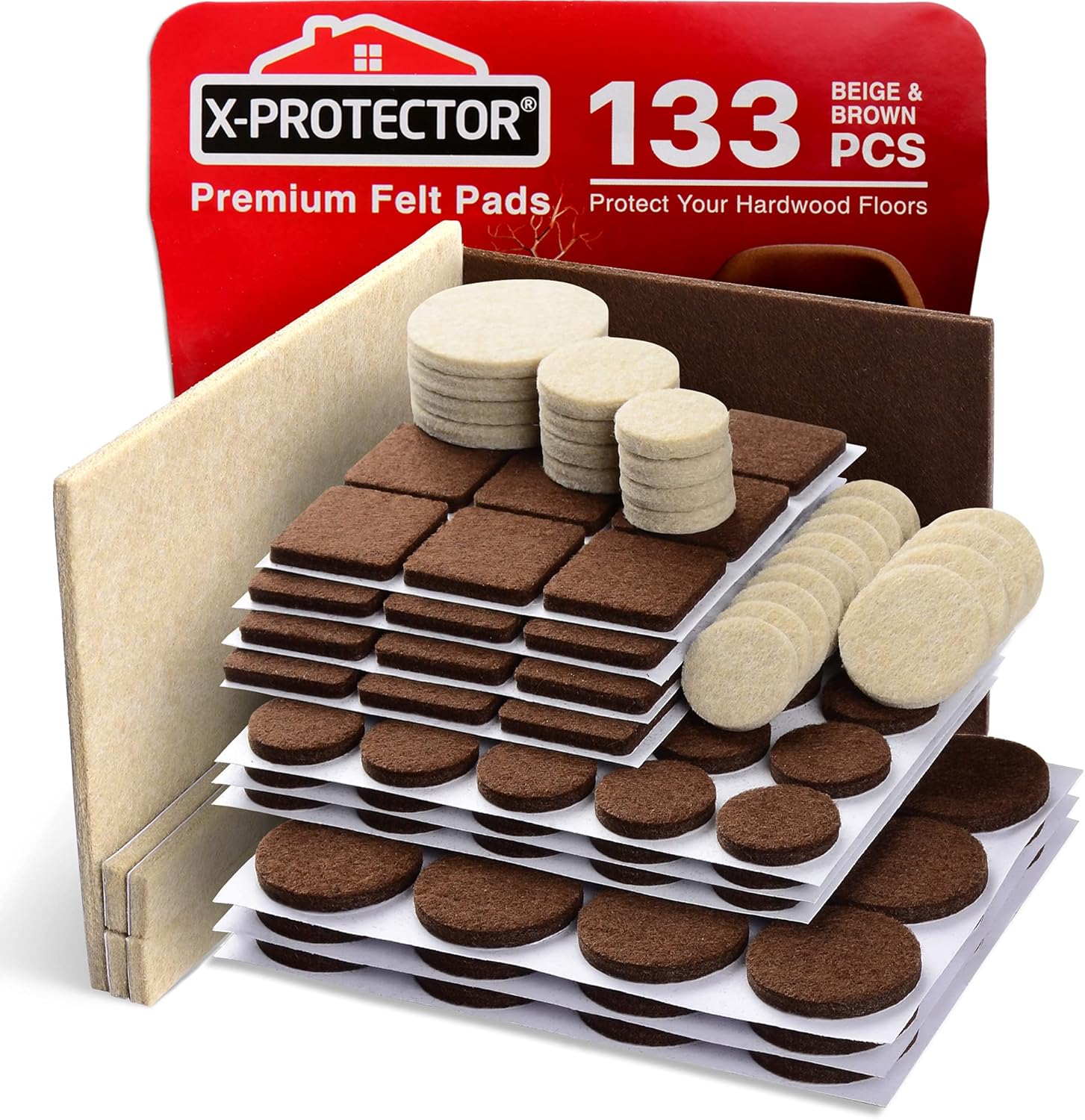
X-Protector 133-Piece Premium Felt Furniture Pads Set - Brown & Beige Floor Protectors for Hardwood & Laminate
Pros
- Generous 133-piece count with size variety covers an entire household in one purchase
- Dual color packs let you match pad color to furniture finish for a cleaner look
- Latex-free and chemical-free adhesive is safe for finished wood and painted furniture legs
- Self-adhesive application requires no tools and takes only seconds per pad
- 4mm thickness provides solid cushioning without lifting furniture legs noticeably off the floor
Cons
- Adhesive performance on heavily textured or rough-cut furniture legs may vary, requiring surface prep before application
- The large pack size means you may accumulate leftover pads in sizes that do not fit your specific furniture
- No transparent or black color option is included, limiting compatibility with dark-legged modern or industrial-style furniture
When you spend real money on hardwood or laminate floors, the last thing you want is a dining chair dragging a scratch across the finish every time someone scots back from the table. The X-Protector 133-piece set solves that problem before it starts, and does it in a way that actually makes sense for a whole house rather than just one room.
What stands out here is the thoughtfulness of the two-color approach. Most felt padacks give you one neutral tone and call it done. This set includes both brown and beige so the pads you stick under a walnut dining chair look intentional, while the ones under a white side table disappear just as cleanly. It is a small detail that adds up when you care about how your rooms look at floor level.
The variety of sizes means you are not hunting for a separate pack because your sofa feet are slightly wider than standard. Everything from small chair glides to larger rectangular pads is in the box. If you want full-home floor protection without the guesswork of sizing or color matching, this one delivers.
Styles it works with: Scandinavian, Modern Farmhouse, Minimalist, Traditional
Best placed in: dining room under chair and table legs, living room beneath sofa and coffee table feet, bedroom under bed frames and nightstands, entryway under console tables or coat rack bases
May not suit: Furniture with heavily textured, fluted, or unfinished raw wood legs where adhesive contact may be uneven; very modern or industrial spaces styled with all-black or chrome furniture where brown and beige tones may be noticeable if pads shift slightly
Buy it if:
- You have hardwood or laminate floors throughout your home and want one pack that handles every room in a single order
- You are moving into a new place and want to protect floors before furniture is even fully arranged
- You have a mix of light and dark wood furniture and need pad colors that blend rather than contrast
Consider waiting if:
- You only need pads for one or two pieces of furniture and do not need the full 133-piece quantity
Skip it if:
- Your furniture has non-flat, curved, or heavily carved leg bases where self-adhesive flat pads cannot make full contact
- You are looking for heavy-duty felt sliders designed to move furniture across floors rather than stationary floor protection
Check the latest price and availability on Amazon before it sells out.

X-Protector Felt Furniture Sliders 16-Pack 3.5" Heavy-Duty Floor Protectors for Hardwood Laminate Tile
Pros
- Thick dual-layer construction of felt and rubber foam provides genuine grip and glide in one product
- Generous 16-piece count handles multi-furniture room layouts in a single purchase
- Works across all major hard floor types including hardwood, laminate, linoleum, and tile
- Reusable and easy to remove and reaply without leaving residue or damage
- Backed by a satisfaction guarantee that removes purchase risk
Cons
- Rubber foam grip can wear down over time on very rough or unfinished floor surfaces with repeated heavy use
- 3.5-inch size may be too large for petite furniture legs on delicate accent pieces or narrow chair legs
- Not suitable for carpet or soft floor surfaces, limiting use to hard floors only
Rearranging a room should feel exciting, not like a workout followed by a floor repair bill. The X-Protector sliders solve both problems at once by letting you glide even a fully loaded bookcase or sleper sofa across hardwood or tile with a gentle push. The thick felt bottom does the heavy lifting while the rubber foam layer keeps the slider from spinning or popping off mid-move.
What stands out about this set beyond the basics is the reusable design. There is no peel-and-stick adhesive on the furniture side, so you can pop them off after a rearrange and tuck them in a drawer for next time. That matters for people who rotate furniture seasonally or deep-clean floors regularly. The 16-piece count is also genuinely useful since it covers a sofa, a coffee table, and a dreser in a single purchase without rationing.
For a home decor shopper who moves furniture more than once a year or simply wants to protect a nice floor without adding permanent hardware, this set earns its place. If you want efortless furniture repositioning without floor scratches or back strain, this one delivers.
Styles it works with: Modern Farmhouse, Scandinavian Minimalist, Contemporary, Traditional
Best placed in: Under living room sofa and coffee table legs, beneath bedroom dresser and bed frame corners, under dining room table and chair legs for regular repositioning
May not suit: Rooms with plush carpet or area rugs covering the majority of the floor since sliders only work on hard surfaces. Also less useful for very petite decorative furniture with legs narrower than 1 inch in diameter where the3.5-inch slider would overwhelm the foot.
Buy it if:
- You have hardwood, laminate, tile, or linoleum floors and regularlyearrange furniture for cleaning or redecorating
- You want to protect a new or recently refinished floor from scratches caused by dragging heavy furniture
- You areishing multiple rooms and want a single affordable set that covers sofas, dressers, tables, and chairs
Consider waiting if:
- You only have one small piece to move and a full16-pack would go largely unused
Skip it if:
- Your floors are primarily covered in wall-to-wall carpet where felt sliders provide no benefit
- You need permanent furniture feet pads rather than a temporary moving solution
Check the latest price and availability on Amazon before it sells out.
Scotch Felt Pads — For Covering a Whole Room Fast
Scotch Felt Pads are the practical first buy when you need to protect many furniture feet in one pass. The 162-piece beige assorted pack gives you small pads for chair legs, larger pieces for tables, and enough extras to replace worn pads after a few months.
The value is variety. You get options for 3/4-inch, 1-inch, and wider contact points without leaving hard edges exposed. That matters in mixed rooms with dining chairs, a coffee table, side tables, and a media console.
The 4.7 owner rating also matters for a product people only notice when it fails. Press each pad onto a clean, dry foot for 20 to 30 seconds, then give frequently moved chairs a full day before aggressive sliding.
X-Protector Premium Felt Pads — For Chairs That Move Daily
X-Protector’s 133-piece premium felt pack makes the most sense for dining chairs, desk chairs without casters, stools, and accent chairs that get shifted every day. The felt is meant for repeated movement across the same 36-inch path.
Use these where replacement hassle matters. A breakfast nook with 4 chairs can chew through thin pads quickly, especially if the floor sees crumbs or grit. More wear surface means the adhesive backing takes less abuse.
The 4.6 owner rating is solid for a consumable item. Check the pads after the first week, then every 3 months. If the chair starts sounding sharper against the floor, the felt has probably compressed or picked up grit.

X-Protector Felt Furniture Sliders — For Heavy Moves Without Gouges
These 3.5-inch felt furniture sliders are for jobs where normal pads are too small: sofas, bed frames, dressers, storage cabinets, and wide accent chairs. The larger surface spreads weight better, so one furniture foot doesn’t grind a narrow pressure point into the finish.
Use them before you move the piece, not after you’ve already started dragging. Tip the furniture just enough to place a slider under each foot, confirm all contact points are covered, then move in short straight pushes.
The 16-piece count is enough for several large pieces or one room reset. Keep a few in a drawer for rug changes and deep cleaning days. Simple insurance.
Frequently Asked Questions
How often should I replace felt pads on hardwood floors?
Every 3 to 6 months for chairs that move daily, and every 12 months for furniture that mostly stays put. Replace sooner if the pad is thin, gritty, curled at the edge, or missing from one leg. Don’t wait for the scratch sound.
Are rubber-backed rugs safe on hardwood floors?
Not always. Some rubber and latex backings can discolor finish when heat, pressure, and moisture sit in one place for months. Use a rug pad labeled safe for hardwood, and check under entry rugs every few weeks during wet seasons.
Can office chairs roll directly on hardwood?
No, not for daily use. Casters concentrate force and can grind grit into the finish. Use a hardwood-safe chair mat at least 36 by 48 inches, or switch to soft casters made for wood floors if the chair only moves lightly.
What humidity is best for hardwood floors?
Keep the room between 30% and 50% relative humidity. Short swings outside that range aren’t a crisis, but weeks below 30% can open gaps, and weeks above 55% can encourage cupping or finish stress.
Should I use wax or polish to protect hardwood floors?
Only if your floor finish allows it. Many modern polyurethane floors don’t need wax, and the wrong polish can leave residue that makes future refinishing harder. Check the flooring manufacturer’s care instructions before adding any coating.






Write Your Review
No reviews yet. Be the first to share your experience!