

> Editorial Note: I’m Erin Schwartz, and I cover home decor with a bias toward what actually works in a real room. The guidance here weighs scale, layout, and materials against Apartment Therapy and Wirecutter coverage rather than styling a space that nobody lives in.
The mistake almost everyone makes is treating the attic like a place to shove things and forget them, which is exactly why nothing up there is findable a year later. A good attic system borrows the same logic you’d use for a how to organize closet project or an entryway storage zone: sort first, contain second, label third. If you’ve already sorted a how to choose storage baskets for small spaces setup or worked through best toy storage, you know the muscle. The rest is adapting it to heat, dust, and a sloped roof, skills that carry over from storage trunks and 6 cube storage systems too.
Where should you start when the attic is already full?
Start by pulling everything to the center of the floor and sorting into keep, donate, and toss before you buy a single bin. Buying containers first is backwards; you end up storing junk in nicer boxes. Work in zones so you’re never standing on exposed joists, which in most homes sit 16 inches on center and won’t hold your weight between them.
Group the keep pile by category and by how often you’ll reach for it. Holiday decor, off-season clothes, and sentimental archives each want their own footprint. Apartment Therapy’s decluttering framework calls this “like with like,” and it’s the single habit that keeps an attic from sliding back into chaos. Sort ruthlessly, because what you haven’t touched in three years rarely earns its climb up the ladder.
What belongs in an attic, and what should never go up there?
Store durable, non-perishable, low-value-to-heat items: holiday decorations, luggage, plastic-safe keepsakes, and off-season textiles. Keep out anything sensitive to temperature swings. An unconditioned attic can pass 130°F in summer and drop below freezing in winter, and that range wrecks a lot of what people wrongly stash up there.
Electronics, candles, paint, vinyl records, and important paper documents all fail in that heat, and so do wine and medications. Wooden furniture can crack as humidity cycles, and adhesives on photos and tape let go. Wirecutter’s storage guidance is blunt about this: if it melts, warps, or grows mold, it lives in conditioned space, not the attic. When in doubt, keep it downstairs.
What containers survive attic heat and humidity?
Sealed, rigid plastic bins beat cardboard in every attic condition that matters. Cardboard absorbs moisture, sags, and invites silverfish and mice; a lidded plastic tote shrugs off all three. Clear walls matter more than they sound, because reading a bin’s contents through the side saves you from opening six of them on a hot afternoon.
For soft goods like clothing and bedding, heavy-duty storage bags work well and compress into odd spaces under the roofline. For anything with weight or fragile edges, rigid bins with locking lids protect the contents from crushing when you stack. Match the container to the load. Textiles go in bags, breakables go in hard-sided totes, and nothing important goes in a box that started life shipping paper towels.
How do you use the roof slope and floor safely?
Put your tallest, heaviest bins in the center where the roof peaks, and slide low-profile items into the short walls under the eaves. That single move can double usable volume in a slope-ceilinged attic. Fighting the geometry wastes the very space you’re trying to reclaim.
Never stack directly on unfinished joists. Lay plywood decking or a raised platform first so weight spreads across multiple beams instead of loading one. Keep a clear walking lane down the center, at least 24 inches wide, so you can actually reach the back. And leave a 3-foot buffer around any chimney, flue, or recessed light housing, which is standard clearance for reducing fire risk around heat sources.
How do you label so you can find things a year later?
Label the front and the top of every bin, then keep a running master list of what’s up there. A label you can only read from one angle is a label you’ll ignore. Clear bins help, but a printed tag beats squinting through dusty plastic every time.
Write categories, not inventories. “Winter coats,” “Halloween,” and “camping” get you to the right box faster than a taped-on paragraph. Number the bins and log them in a note on your phone so you can search “sleeping bags” and know it’s in bin 7 near the north wall. That’s the whole trick: future-you does the finding, present-you does the labeling.
What You’ll Need
The picks below are grouped by what they store best: heavy-duty bags for compressible soft goods, and rigid lidded totes for breakables you plan to stack. The BALEINE set holds a 4.8 rating and the ukeetap bins a 4.7, the two strongest here. The two IRIS options both sit at 4.0, which usually signals unit-to-unit variation in lid fit, so check the seal on arrival; the 6-pack runs a smaller 54-quart size for spreading a load across more boxes, while the 4-pack steps up to 72 quarts when you’d rather stack fewer, larger totes.

Pros
- Reinforced wrap-around handles distribute weight better than standard tote bags
- Open-top design makes loading and unloading faster than zippered bags
- Folds flat to store in closet or under bed when not needed
- Clear material eliminates guessing what is inside each bag
- Tag pocket simplifies organization across multiple bags
Cons
- No zipper or closure means contents are exposed to dust during storage
- Clear plastic shows everything inside, which may not suit all users
- Handles may dig into hands when carrying maximum 100 lb weight
These bags solve the most frustrating part of moving: flimsy handles that snap when you are halfway to the truck. The reinforced wrap-around design holds a full 100 lbs without tearing, so you can pack heavy winter coats, books, or kitchenware without worry. The open top makes packing faster than wrestling with zippers, and the clear sides mean you will never dig through ten bags looking for your bedding.
At under $5 per bag, they replace cardboard boxes you would throw away after one move. Fold them flat and tuck them in a closet until your next apartment switch, storage cleanout, or holiday decoration swap. The tag pocket is a small touch that makes a big difference when you are labeling 20 bags at once.
If you want reusable moving storage that handles real weight without the mess of cardboard, this one delivers.
Styles it works with: Minimalist, Scandinavian, Modern Farmhouse, Transitional
Best placed in: Bedroom closet for seasonal clothes, under bed for extra linens, garage or basement for holiday decor, entryway closet for donation bags
May not suit: Formal spaces where open storage is visible, homes needing long-term dust protection without additional covers, users who prefer fully enclosed zippered bags
Buy it if:
- You move apartments every year or two and are tired of buying cardboard boxes
- You need to haul heavy items like books, shoes, or kitchen appliances without handles breaking
- You want to see what is inside storage bags without opening them
- You need collapsible storage that does not take up closet space when empty
Consider waiting if:
- You prefer a specific color and the clear version does not work for your space
Skip it if:
- You need dust protection for long-term attic or basement storage without additional covers
- You require fully zippered closure to keep contents secure during transport
Check the latest price and availability on Amazon before it sells out.
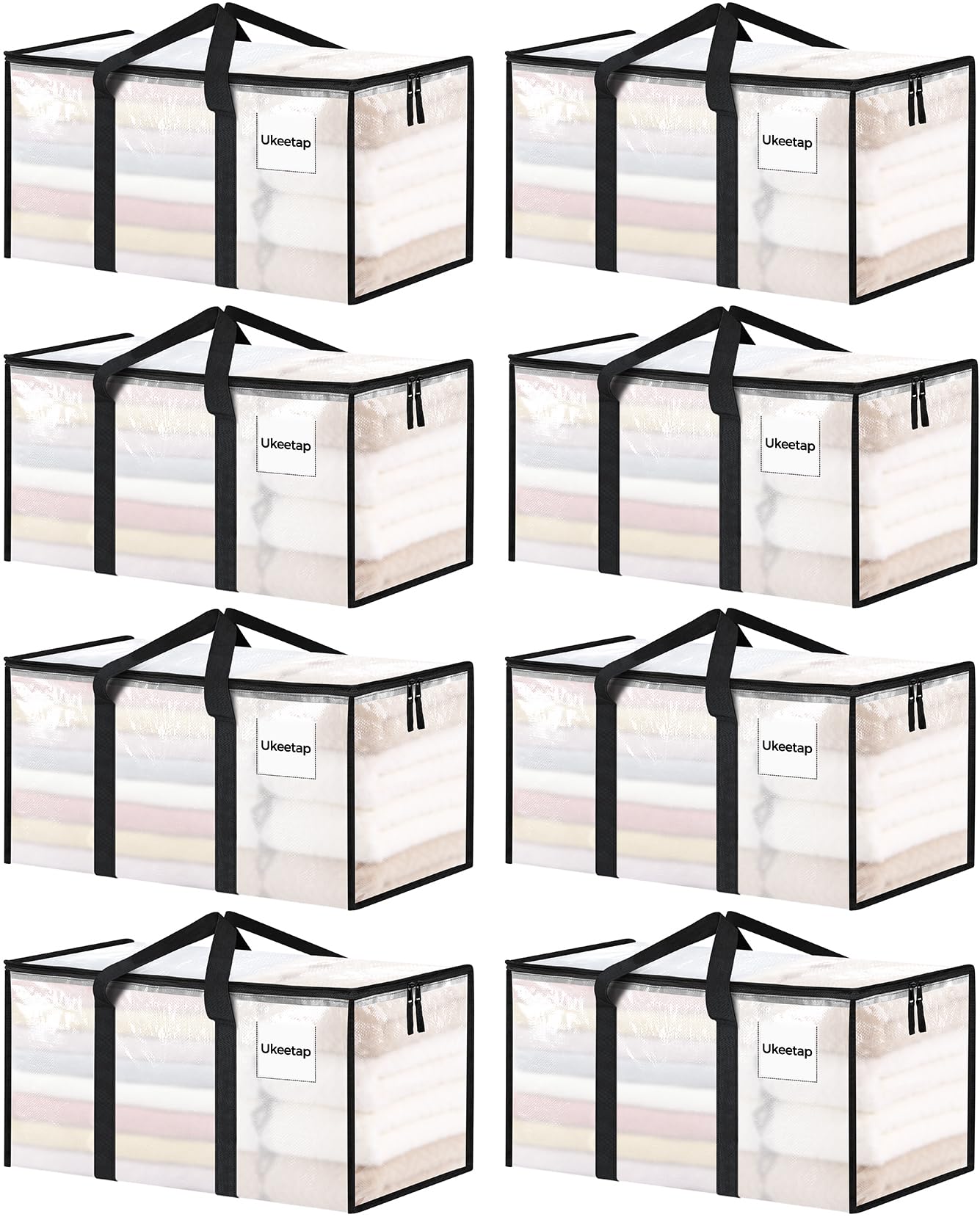
Ukeetap 8 Pack Extra Large Clear Storage Bins with Lids - Heavy-Duty Zipered Clothes Organizer Bags with Reinforced Handles
Pros
- High quantity8-pack offers strong value at under $4 per bag
- Clear window design eliminates guesswork when searching for specific items
- Reinforced handles and zippers built for repeated heavy use
- Versatile use for storage, moving, dorm life, and seasonal rotation
- Extra large capacity handles bulky beding and outerwear
Cons
- No rigid structure so bags may slump if not supported on a shelf
- New product with no verified customer reviews yet to confirm long-term durability
- Soft-sided design is not suitable for stacking heavy items on top
If your closets are overflowing with off-season clothes, spare beding, or college supplies you only need twice a year, this 8-pack solves the problem without eating into your budget. At under $4 per bag, you can dedicate one to winter coats, another to guest linens, and still have plenty left over for holiday decor or moving day.
The clear panels are the real convenience win here. No more unzipping five bags to find that one sweater you packed away in March. And the reinforced handles mean you can confidently pull a fully loaded bag off a high shelf without worying about ripped fabric.
If you want bulk closet organization without spending on rigid bins that waste space when empty, this set delivers.
Styles it works with: Minimalist, Practical Modern, Dorm Essential, Transitional
Best placed in: Bedroom closet top shelf, under the bed, garage storage shelving, guest room wardrobe
May not suit: Open shelving setups where aesthetics matter, or small spaces where you need stackable rigid containers that hold their shape
Buy it if:
- You need to organize seasonal clothing or bedding across multiple closets
- You are preparing for a move and want bags that double as long-term storage afterward
- You are heading to college and need affordable, packable dorm storage
Consider waiting if:
- You prefer a specific color-coded system and want options beyond clear
- You want to see verified customer reviews before committing
Skip it if:
- You need rigid, stackable bins for a garage or utility room
- You only need one or two bags and would rather not store extras
Check the latest price and availability on Amazon before it sells out.

Pros
- Generous 90L capacity fits bulky comforters and pillows without compressing them too much
- Reinforced stitching and double-fabric handles reduce the risk of tearing during moves
- Clear window panel helps identify contents quickly in a packed closet or under-bed area
- Odorless three-ply fabric won't transfer smells to stored clothing or linens
- Comes as a 6-pack for under $20, making it budget-friendly for dorm or apartment setup
Cons
- Soft fabric construction means bags can tip or collapse when stacked unless packed strategically
- No rigid structure or internal frame, so bags may not hold their shape when partially filled
- Rating based on zero verified reviews, so long-term durability is unproven
If you are moving into a dorm or trying to reclaim closet space in a small apartment, these bags solve the where-do-I-put-my-winter-coats problem without requiring a trip to buy expensive plastic bins. The clear window is a surprisingly helpful detail when you are digging through under-bed storage at 7 a.m. looking for your favorite sweatshirt. The fabric is soft enough that you can shove the bags into tight spaces without worrying about scratching your floors or bed frame.
We also appreciate that the handles are sewn with two layers of thick fabric. Cheaper storage bags tend to rip at the handles after a few uses, but these feel sturdy enough to survive multiple moves between home and campus. The dual zippers glide smoothly even when the bag is stuffed full, which is not always the case with budget organizers.
If you want dorm-friendly storage that folds flat when you do not need it without spending $10 per bin, this six-pack delivers.
Styles it works with: Minimalist, College Dorm, Scandinavian, Transitional
Best placed in: Under the bed for seasonal clothes, inside a closet stacked on shelves, in a dorm room under a lofted bed, basement or attic for long-term storage
May not suit: Homes where you need bags to stand upright on their own without support, spaces with very low bed clearance under 13 inches, households looking for decorative storage that stays visible in the room
Buy it if:
- You are a college student packing for dorm move-in and need affordable bins that fit under a twin XL bed
- You want to store off-season bedding or clothes in a closet and need to see what is inside without opening every bag
- You are downsizing or moving and need temporary storage that folds flat afterward
Consider waiting if:
- You prefer a different color and want to see if more options become available
Skip it if:
- You need rigid bins that stack neatly without collapsing or shifting
- Your under-bed clearance is less than 13 inches and these bags will not fit
Check the latest price and availability on Amazon before it sells out.

Pros
- Large 54-quart size handles seasonal clothes, bedding, or holiday decorations
- Clear design eliminates guessing games when looking for stored items
- Stackable lids create stable towers that save floor space
- Made in USA with quality materials rated 4.7 stars
- Built-in handles make sliding bins off shelves easy
Cons
- At 22 inches long, may not fit standard closet shelves under 24 inches
- No color options - only available in clear
- Fairly lightweight at 3 pounds, so may flex when overpacked
These bins solve the universal storage headache: you know you put something away safely, but now you cannot find it. The clear walls let you scan your closet or garage at a glance instead of pulling down every box. The 54-quart size is the sweet spot for bulky items like winter coats, camping gear, or holiday decorations without creating boxes too heavy to lift.
The stackable design with locking lids means you can build upward instead of outward, reclaiming floor space in cramped closets or garages. The built-in handles make pulling bins from high shelves manageable, even when full. And because they are made in the USA with BPA-free plastic, you are not worrying about what is touching your stored items.
If you want visible, stackable storage that handles the heavy stuff without collapsing, this one delivers.
Styles it works with: Modern Minimalist, Organized Traditional, Garage Industrial, Craft Room Functional
Best placed in: Bedroom closet shelves for seasonal wardrobes, garage wall units for tools and holiday decor, craft room shelving for supplies and fabric
May not suit: Homes with very shallow closets under 24 inches deep, renters with limited vertical space who cannot install shelving, households wanting decorative storage for visible living areas
Buy it if:
- You are organizing a closet or garage and need to see what is stored without opening every container
- You want matching bins that stack securely to maximize vertical storage space
- You store seasonal items, craft supplies, or tools that need durable, spacious bins
Consider waiting if:
- You need smaller bins for lighter items or tighter spaces under 22 inches
- You prefer colored or decorative storage for visible shelf areas in living spaces
Skip it if:
- Your closet shelves are narrower than 24 inches and cannot fit 22-inch bins
- You need airtight or waterproof storage for basement or outdoor use
Check the latest price and availability on Amazon before it sells out.

Frequently Asked Questions
Is it safe to store cardboard boxes in an attic?
No. Cardboard absorbs attic humidity, sags under its own weight, and attracts silverfish and rodents. Rigid plastic totes with lids resist all three and cost little more over the years you’ll reuse them.
What temperature does an attic reach in summer?
An unconditioned attic can pass 130°F on a hot afternoon, well above outdoor air. That heat warps candles, cracks vinyl, and degrades adhesives, so anything heat-sensitive belongs in conditioned space instead.
Can I store clothes in the attic long term?
Yes, if they’re clean, dry, and sealed in heavy-duty bags or lidded bins. Wash everything first, because body oils and food residue draw moths and pests once the fabric sits untouched for months.
How much weight can attic joists hold?
It depends on your framing. Joists spaced 16 inches on center in an unfinished attic often carry storage loads only, not living loads, so lay plywood decking to spread weight and check with a contractor before heavy stacking.
Should attic bins be clear or opaque?
Clear, in most cases. Reading contents through the wall saves you opening several bins in the heat. Pair clear walls with a front-facing label so you can identify a box from across the room.
What should never go in an attic?
Electronics, paint, wine, medications, candles, vinyl records, and important documents. All of them fail across the freeze-to-130°F swing an attic sees, and paper and photos also invite moisture damage and mold.
How do I keep pests out of attic storage?
Seal everything in rigid lidded totes rather than bags or boxes, and keep food and scented items out entirely. A tight lid removes the nesting material and the smell that draw mice and insects in the first place.
Bottom Line
Sort before you shop, then contain in sealed plastic and label the front of every bin. That sequence solves attic clutter for most people, because the failure is almost never storage capacity; it’s not knowing what’s up there. Keep heat-sensitive items downstairs, spread weight across decking instead of bare joists, and log your bins in a phone note. If your attic shows sagging joists, active leaks, or signs of pests, stop and bring in a pro before you store another thing.




Write Your Review
No reviews yet. Be the first to share your experience!