

> Editorial Note: I’m Hannah Lin, an Interior Living Researcher who’s spent 9+ years analyzing the home furniture market. This guide draws on BIFMA, GREENGUARD, and FSC certifications, plus owner reviews aggregated from Wirecutter, Apartment Therapy, and the major home design subreddits.
The desk is too big for the room. That’s the mistake, and it happens because people shop for a desk by looking at the top and forget the two feet of chair clearance behind it. A standard desk measures 48 to 60 inches wide and 24 to 30 inches deep, but the space it actually claims is closer to 48 inches deep once you add a pulled-out chair. Get the dimensions wrong and a small room turns into an obstacle course. Before you buy, learn the real width, depth, height, and clearance numbers here, then line them up with your best murphy desk pick, your standard desk height fit, your desk organization ideas, your desk decor plan, and your small home office ideas so the desk fits the room, not just the wall.
Quick Reference: Desk Dimensions Size Chart
| Desk type | Width | Depth | Height | Clearance needed (with chair) |
|---|---|---|---|---|
| Compact / laptop | 24–40 in | 18–24 in | 29 in | 42–48 in deep |
| Standard writing | 48–60 in | 24–30 in | 29 in | 48–54 in deep |
| Fold-down wall | 30–41 in | 15–20 in | set by mount | 40–48 in deep |
| L-shaped / corner | 60–72 in per side | 24–30 in | 29 in | 54–60 in per side |
| Standing (raised) | 48–60 in | 24–30 in | 40–48 in | 48–54 in deep |
Every number measures the finished work surface, not the packaging. The clearance column is the one people skip, and it’s the one that decides whether the room still works after the desk goes in.
Width: How Much Surface You Actually Need
Width is the first number, but bigger isn’t automatically better. A laptop-only setup works on 24 to 40 inches of width. A single-monitor workstation wants 48 inches, and a dual-monitor setup needs 55 to 60 inches so the screens sit at a comfortable angle. Beyond 60 inches, you’re usually buying more surface than you’ll use unless the desk doubles as a craft or drafting table. Apartment Therapy’s home-office editors recommend matching width to the task, not the room, since an oversized desk in a small room reads as clumsy even when it technically fits. A 41-inch fold-down desk hits the sweet spot for most laptop-plus-notebook setups.
Depth: The Number That Saves Your Eyes and Your Floor
Depth decides two things: how far your monitor sits from your eyes and how much floor the desk eats. For eye comfort, you want the screen 20 to 30 inches from your face, which means a desk at least 24 inches deep for a monitor setup. A laptop-only surface can drop to 18 to 20 inches. Fold-down wall desks run shallow on purpose, often 15 to 20 inches deep when open, which is why they suit narrow rooms, but a shallow desk pushes a monitor too close, so add a wall-mounted arm or run a laptop instead. Measure the depth against your seating distance before deciding.
Height and Clearance: The Room-Killer Combo
A desk sits at the 29-inch standard height, but the dimension that actually claims your floor is the clearance behind it. A pulled-out chair needs 20 to 24 inches of depth, so a 24-inch-deep desk really occupies 44 to 48 inches of floor front to back. In a small room, that’s the difference between a walkable space and a squeeze. Below the surface, you need at least 24 inches of vertical knee clearance and 20 inches of open depth for your legs. BIFMA’s furniture-clearance guidance flags legroom and chair travel as the specs most often shorted in home setups, and it’s exactly why fold-down desks that reclaim that 48 inches of floor when closed solve small-room math so cleanly.
Fold-Down and Corner Desks: Dimensions That Reclaim Space
A fold-down wall desk changes the dimension conversation because its footprint is temporary. Open, it projects 15 to 20 inches from the wall; closed, it drops to under 5 inches. That means the 44 to 48 inches of floor a standard desk permanently occupies gets returned to the room every evening. Corner and L-shaped desks go the other way, claiming 60 to 72 inches per side, which suits a dedicated office but overwhelms a shared room. For a room that has to serve two purposes, the fold-down’s disappearing footprint beats raw surface area every time. Measure your open-projection clearance and your closed-panel depth separately, since both matter.
How Desk Shape Changes the Numbers
Shape shifts every dimension on the chart. A rectangular desk uses its full width in a straight line, so a 48-inch model needs 48 inches of unbroken wall. An L-shaped desk splits that surface across two walls, claiming 60 to 72 inches per side but fitting a corner that a straight desk wastes. A curved or kidney-shaped desk pulls the far edges 2 to 3 inches closer to you, which trims the effective depth without shrinking the surface. For small rooms, a fold-down rectangular desk is usually the most predictable to plan around, since it reduces to a single clean measurement when closed. Sketch the room to scale, mark the chair clearance in pencil, and the right shape becomes obvious before you spend a dollar.
Our Size-Matched Picks
The three fold-down desks below are sized for small and shared rooms where a standard 48-inch desk would claim too much floor. Each one reclaims its footprint when closed, so the room’s usable dimensions change with the time of day. Start with the bamboo desk if you want a 41-inch freestanding surface. Choose the Tangkula for the shallowest open depth. Pick the HOMCOM if you want storage shelves without adding desktop depth.


Pros
- Folds completely flat to free floor space in small rooms
- Multiple storage shelves eliminate need for additional organizers
- Sturdy construction with thick tabletop and quality metal hinges
- Versatile use as desk, craft table, or mini bar
- Clean white finish suits most interior styles
Cons
- Requires solid wall installation only - not compatible with drywall, plasterboard, or hollow surfaces
- No customer reviews available yet to verify long-term durability
- Limited color options for those wanting to match specific decor
This desk solves the biggest problem in small-space living: needing a real workspace without sacrificing your entire floor plan. When it is folded up, you would never know it is there. When you need it, it drops down to give you a legitimate work surface plus shelves that keep everything you need within arm's reach.
The white finish is crisp and clean, and the built-in storage means you are not hunting for a pen or your phone charger every time you sit down to work. It looks intentional, not like you are making do with a tiny apartment. Whether you are setting up a corner office, a craft zone, or just need somewhere to pay bills without clearing the dining table, this desk adapts to how you actually live.
If you want a functional workspace that disappears when guests come over without dragging furniture around, this one delivers.
Styles it works with: Modern Farmhouse, Scandinavian, Minimalist, Coastal
Best placed in: Home office nook, bedroom corner, hallway wall, laundry room for folding station
May not suit: Homes with only drywall or plasterboard walls (requires solid wall backing), renters not allowed to drill into walls, spaces needing a large permanent desk with drawers
Buy it if:
- You live in a studio, small apartment, or dorm and need workspace that does not eat your living area
- You work from home occasionally and want a real desk without committing an entire room to an office
- You craft, sew, or do hobbies that need a flat surface and supply storage but not 24/7 access
Consider waiting if:
- You need a desk in a color other than white and want to see if more options become available
Skip it if:
- Your walls are drywall, plasterboard, hollow core, or paneling (this desk requires solid wall backing for safe installation)
- You need a full-time desk with drawers for filing or heavy equipment storage
Check the latest price and availability on Amazon before it sells out.

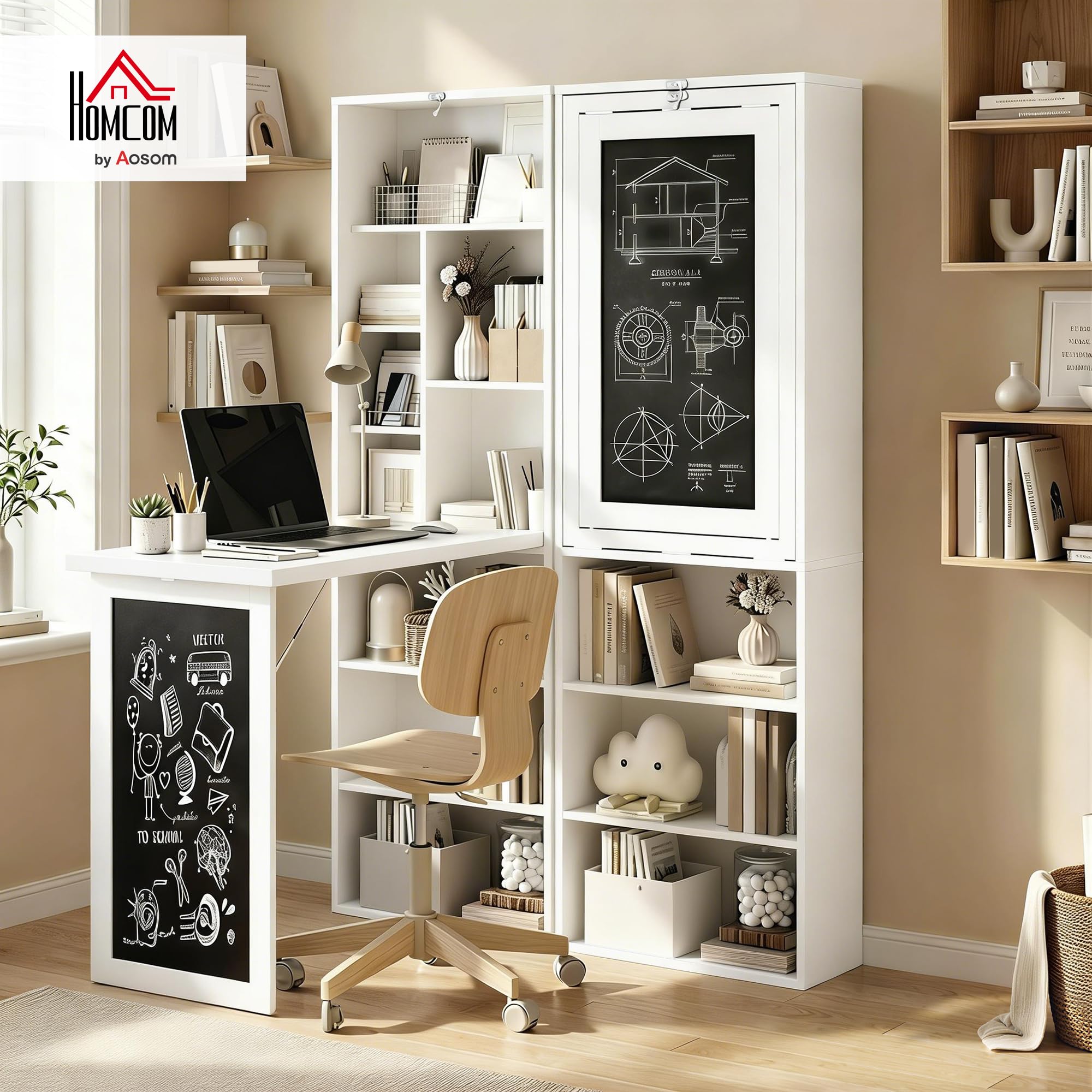
HOMCOM Wall Mounted Fold Out Desk with Storage Shelves & Chalkboard - Space Saving Murphy Desk for Small Apartments
Pros
- Exceptional 110 lb weight capacity handles serious work setups without stability issues
- Closes to reveal a chalkboard surface that hides workspace mess instantly
- Generous vertical storage with 9 compartments eliminates need for separate shelving units
- Only 7.7 inches deep when folded, perfect for narrow hallways or tight corners
- Adjustable shelf height adapts to different storage needs over time
Cons
- At 60.25 inches tall, it may overwhelm rooms with low ceilings or feel too vertical in small spaces
- White finish shows scuff marks and requires regular cleaning in high-traffic areas
- Assembly required and wall mounting means you cannot easily move it to a different room later
This wall-mounted desk solves the biggest challenge in small-space living: creating a real workspace without sacrificing your living area. When open, it gives you a full 38.5-inch-wide desk surface with serious weight capacity. When closed, it transforms into a slim cabinet with a chalkboard front that actually looks intentional, not like you are hiding furniture.
The vertical storage is smartly designed with compartments sized for real office supplies, not just decorative objects. The adjustable lower shelf means you can fit everything from file boxes to coffee table books without wasting space. The chalkboard is not just decorative; it becomes your command center for daily reminders, grocery lists, or family messages.
If you want a dedicated workspace in a studio or one-bedroom apartment without giving up floor space permanently, this one delivers.
Styles it works with: Scandinavian, Modern Minimalist, Contemporary Small-Space Living, Industrial Chic
Best placed in: Living room corner as a fold-away office, bedroom wall as a vanity or study area, kitchen wall as extra prep space, entryway for mail sorting and key storage
May not suit: Rooms with ceilings under 8 feet (the 60-inch height may feel overwhelming), homes with toddlers who might use shelves as climbing structures, renters who cannot drill into walls
Buy it if:
- You work from home in a studio or one-bedroom apartment and need a real desk that disappears after hours
- You are setting up a craft or sewing station but do not have space for a permanent table
- You want vertical storage that doubles as a workspace without buying separate shelving units
Consider waiting if:
- You need a different color to match existing furniture and want to wait for seasonal options
- You are moving soon and prefer furniture that does not require wall mounting
Skip it if:
- Your ceiling height is under 8 feet or you have a low-clearance room where 60 inches feels too tall
- You cannot drill into walls due to rental restrictions or structural concerns
Check the latest price and availability on Amazon before it sells out.
The Generic 41-inch bamboo folding desk gives you a 41-inch-wide surface with a built-in shelf, folding flat to under a few inches deep for storage in a bedroom or studio. The Tangkula wall-mounted folding desk opens to a shallow drop-leaf surface, projecting well under 20 inches from the wall so a hallway still clears a 36-inch walkway. The HOMCOM foldable convertible desk mounts to the wall and stacks its storage on shelves rather than adding desktop depth, keeping the open footprint tight while still holding supplies.
Frequently Asked Questions
What are standard desk dimensions?
A standard writing desk measures 48 to 60 inches wide, 24 to 30 inches deep, and 29 inches tall. Compact and laptop desks run narrower, from 24 to 40 inches wide. Always add 20 to 24 inches behind the desk for chair clearance when planning the room.
How deep should a desk be?
At least 24 inches for a monitor setup, so the screen sits 20 to 30 inches from your eyes. A laptop-only surface can drop to 18 to 20 inches. Fold-down wall desks are often shallower, so pair a shallow desk with a laptop or a wall-mounted monitor arm.
How much space do I need around a desk?
Leave 20 to 24 inches behind the desk for a pulled-out chair and keep a 36-inch walkway clear beyond that. So a 24-inch-deep desk really needs about 44 to 48 inches of floor front to back. Fold-down desks reclaim that floor when closed.
What size desk fits a small room?
A compact desk 24 to 40 inches wide, or a fold-down wall desk that clears its footprint when closed. A 41-inch folding desk suits most laptop setups without crowding a small room. Measure both the open projection and the chair clearance before buying.
How wide should a desk be for two monitors?
Plan for 55 to 60 inches of width so both screens sit at a comfortable viewing angle with room for a keyboard in front. Depth should be at least 24 inches so the monitors don’t crowd your eyes. Below 48 inches, a dual-monitor setup feels cramped.
Bottom Line
Standard desk dimensions run 48 to 60 inches wide, 24 to 30 inches deep, and 29 inches tall, but the number that decides whether a room works is the 44 to 48 inches of floor the desk claims once you add chair clearance. Match width to your task, keep depth at 24 inches for a monitor, and measure the clearance behind the chair before anything else. If the room does double duty, a fold-down desk that reclaims its footprint when closed is the dimension that matters most. Measure the floor, not just the wall, and the desk fits the first time.








Write Your Review
No reviews yet. Be the first to share your experience!