

> Editorial Note: I’m Maya Chen, a bedroom and sleep editor covering mattresses, bed frames, and bedding. The picks here are evaluated against CertiPUR-US foam standards, Sleep Foundation evaluation protocols, and owner durability reports from r/Mattress.
If your bedroom feels like a sauna while the rest of the house stays comfortable, you’re dealing with a mix of airflow, sun exposure, and heat-trapping materials that all stack up overnight. The good news is that most of the causes are fixable once you know what’s driving them. Before you dig in, it’s worth checking why is my room so humid, comparing best cooling sheets against best bed sheets, and looking at best memory foam pillow and how to get rid of dust mites since those factors often travel together.
Reason 1: Poor Airflow and Closed-Off Vents
Stagnant air is the most common reason a bedroom runs hot, and it’s also the easiest to miss. When a room has no active air movement, body heat and warm air from electronics just sit there and build through the night. Closed doors make it worse by sealing off the room from the rest of the home’s circulation, so the temperature creeps up by a few degrees while you sleep.
Blocked or closed supply vents are another quiet culprit. It’s common to find a vent shut behind a dresser or a bed frame, which starves the room of conditioned air even when the system is running. The EPA notes that blocked registers and return grilles force HVAC systems to work harder while delivering less air where you actually need it.
A quick fix here costs nothing: open the vents, pull furniture a few inches off the registers, and crack the door to let air cycle. Adding a quiet fan to keep air moving makes a real difference too, since moving air helps your skin shed heat even when the thermostat doesn’t budge. If your return air path is poor, that one change can drop the felt temperature noticeably. Don’t underestimate how much a stuffy, sealed room traps warmth.
Fill that has slid to one end leaves cold corners and a hot middle. Why a duvet goes lumpy covers redistributing it and keeping it that way.
Reason 2: Heat-Trapping Windows and Sun Exposure
West- and south-facing windows are heat magnets. Direct afternoon sun streaming through untreated glass can raise indoor surface temperatures fast, and that solar gain lingers long after sunset because your walls and furniture re-radiate the heat they soaked up all day. If your bedroom bakes in late afternoon, the windows are usually the reason.
Standard sheer curtains do almost nothing against this. Glass transmits a huge share of solar energy, and without a reflective or insulating barrier, that energy turns into trapped heat. Good Housekeeping has highlighted blackout and thermal-lined curtains as one of the more effective low-effort upgrades for rooms that overheat from sun exposure.
The fix is layered. Blackout or thermal curtains block the bulk of incoming radiation, and closing them before the sun hits the window, rather than after, keeps the heat outside in the first place. Cellular shades add another insulating air pocket. If you rent and can’t modify much, even a temporary reflective film on the worst window helps. The goal is to stop solar energy before it crosses the glass, because once it’s inside, it’s much harder to get rid of.
Reason 3: Rising Heat and Top-Floor / Attic Effect
Heat rises, and that simple fact explains why upstairs bedrooms and converted attics are so often the hottest rooms in the house. Warm air from the lower floors drifts upward and collects near the ceiling, so a second-story room can sit several degrees warmer than the living room directly below it. If your bedroom is at the top of the stairs, you’re fighting physics every night.
Attic and top-floor rooms get a double hit. They sit directly under the roof, which absorbs sun all day, and they frequently have thinner insulation than the main living areas. The EPA flags under-insulated attics and roof cavities as a major source of unwanted heat gain in upper rooms. That radiant heat keeps bleeding into the bedroom long after dark.
Improving attic insulation is the durable long-term fix, but it’s a bigger project. In the meantime, a fan that pushes the pooled warm air around helps, as does sealing gaps where hot attic air leaks down. Running a ceiling or tower fan to break up that stratified layer of hot air near the ceiling can make a top-floor room feel far more livable at bedtime.
Reason 4: Heat-Generating Electronics and Bedding
Your bedroom may be heating itself. Chargers, a TV on standby, a desktop computer, and a cable box all throw off heat continuously, and in a small closed room that adds up. A handful of devices left running overnight can measurably raise the ambient temperature, especially when they’re clustered near the bed.
Bedding is the other half of this problem. Dense, high-loft comforters and certain foam mattresses retain body heat instead of releasing it. Traditional memory foam is a known heat trap because it’s designed to soften around your body, which reduces airflow underneath you. The Sleep Foundation points out that breathable, moisture-wicking materials sleep noticeably cooler than dense synthetic fills.
The fixes stack nicely. Unplug or power down electronics you don’t need overnight, and move chargers off the nightstand. Swap heavy bedding for breathable cotton, linen, or cooling sheets, and choose a mattress with gel-infused foam or coil construction if heat retention is chronic. Lighter, looser layers let your body shed warmth instead of holding it against you all night.
How to Cool Down a Hot Bedroom
Start with airflow, because it’s the fastest win. A quiet fan keeps air circulating and helps your skin release heat even when the thermostat won’t drop. The DREO Bedroom Fan moves air across roughly 90 ft on a DC motor at around 20dB, so it stays quiet enough for sleep, while the LEVOIT Tower Fan runs near 28dB with a 12-hour timer and the compact DREO Tower Fan pushes high-velocity air at 28 ft/s when you need more reach. Pair any of them with blackout curtains and breathable bedding for a layered effect.
Then dial in the room itself: close curtains before the afternoon sun hits, open and unblock vents, and aim for the cooler end of the range. The Sleep Foundation recommends a bedroom temperature of about 60-67°F for the best sleep, and these small changes together can get you there without overworking the AC.


Pros
- Exceptionally quiet at 20dB on lower speeds, confirmed by a large volume of buyer feedback praising bedroom and nursery use.
- 90-degree horizontal oscillation combined with a 105-degree manual vertical tilt covers virtually every angle in a standard room.
- Fully disassembles for cleaning, a feature missing on many competitors at this price point.
- Remote includes a mute function for beep sounds, a small but meaningful detail for nighttime use.
- Strong value at $70 compared to Dreo's own higher-tier models that cost $86 to $180 for incremental upgrades.
Cons
- Only 90-degree horizontal oscillation versus 120 to 150 degrees on pricier Dreo models, so very large or open-plan rooms may feel underserved.
- Vertical tilt is manual rather than motorized, requiring you to physically adjust the head angle instead of setting it from the remote.
- The 8-hour timer is shorter than the 9 to 12-hour timers on sibling models, which may not cover a full night's sleep for some users.
At $70, the Dreo TurboPoly Fan 353 punches well above its price. What stands out immediately is how genuinely quiet it is. Most budget fans claim to be quiet, but 20dB is a measurable spec and it shows up in real use. You can hold a conversation, watch TV, or fall asleep with this running and barely notice it is there.
Aesthetically, the 353 has a clean, slim silhouette that reads as modern without being loud. The matte finish and neutral colorway blend into most contemporary bedroom setups without drawing attention to themselves, which is exactly what you want from a fan. It does not look like an appliance you are apologizing for when guests visit.
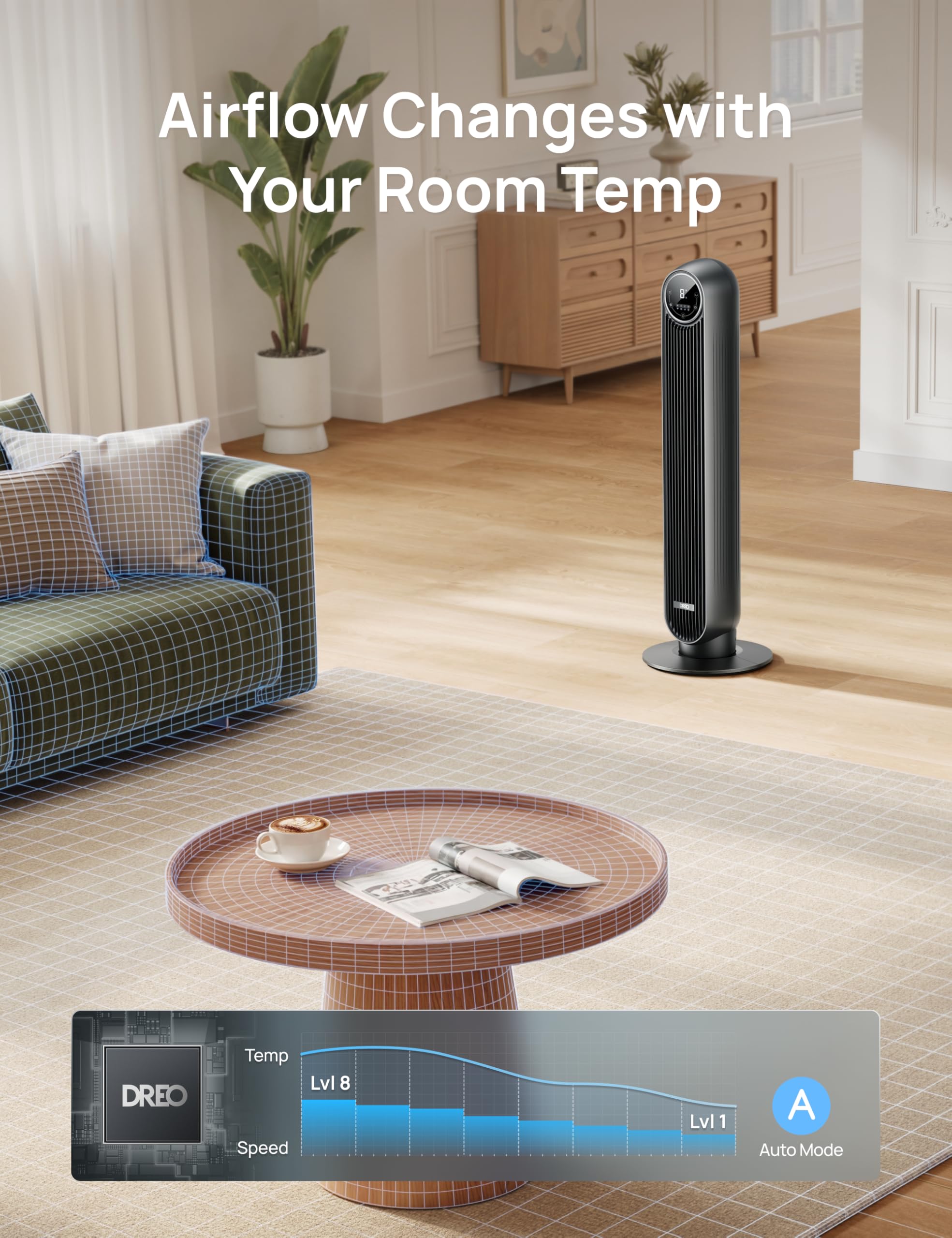
The auto mode and aroma pad are the two features that move this from a utility purchase to a lifestyle one. Set it to auto, drop a few drops of eucalyptus or lavender on the aroma pad, and your bedroom does some of the wellness work for you. If you want whole-room comfort and fresh-smelling air without juggling a separate diffuser and a noisy box fan, this one delivers.
Styles it works with: Minimalist, Scandinavian, Modern, Contemporary
Best placed in: Bedroom corner angled toward the bed, living room beside the sofa, home office behind the desk chair
May not suit: Rooms larger than 400 square feet where the 90ft reach and 90-degree oscillation may leave corners uncovered; highly decorative or maximalist spaces where the utilitarian silhouette reads out of place
Buy it if:
- You are a light sleeper who needs consistent airflow without fan noise waking you up at night.
- You want to reduce AC dependence in a bedroom or home office and need a fan that can actually circulate air across the full room.
- You are looking for a capable, clean-looking pedestal fan under $75 and do not need app control or motorized vertical oscillation.
Consider waiting if:
- You need smart home or app integration, which is only available on Dreo's higher-tier 513S and above models.
Skip it if:
- You are cooling a large open-plan living space over 400 square feet where wider oscillation and longer range matter more.
- You want fully hands-free directional control, since the vertical tilt must be set manually on this model.
Check the latest price and availability on Amazon before it sells out.

Pros
- Genuinely quiet at 28dB, ideal for light sleepers and shared bedrooms
- Temperature-sensing Auto and Sleep modes reduce manual adjusting overnight
- Bladeless design is easier to clean and safer for households with children
- Tall 36-inch tower spreads air widely without taking up much floor space
- Remote control and clear mode options make daily use simple
Cons
- The top control panel enters a semi-sleep state when the screen is off, so you may need to press twice to wake it before adjusting settings
- Sleep Mode automatically begins oscillating after one hour by design, which can surprise users who expect it to stay still
- Cleaning the wind wheel requires careful screw alignment on the motor shaft or airflow drops
If you have ever been jolted awake by a clunky fan rattling away in the corner, this LEVOIT tower fan feels like a quiet upgrade. The bladeless build and curved air inlet push out a soft, natural breeze rather than a sharp gust, and at 28dB it basically disappears into the background of a bedroom.
In a real room, the slim 36-inch white tower reads clean and modern. It tucks neatly beside a bed or in a corner without crowding the space, and the lack of exposed blades means it looks tidy and stays easy to wipe down. The Advanced Sleep Mode dims the display and softens airflow as the night goes on, so you get comfort without that 3am chill that sends you reaching for the off button.
If you want quiet, temperature-aware cooling without the safety worries and visual clutter of a traditional bladed fan, this one delivers.
Styles it works with: Modern, Minimalist, Scandinavian, Contemporary
Best placed in: beside the bed, a bedroom corner, or a home office desk area
May not suit: very small rooms where a compact desk fan would do, or buyers who want a bold color statement since it only comes in white
Buy it if:
- You are a light sleeper who needs cooling that stays whisper-quiet through the night
- You have kids or pets and want a bladeless fan that is safer to have around
- You want set-and-forget comfort with a timer, remote, and temperature-sensing auto modes
Consider waiting if:
- You need a color other than white to match your decor
- You prefer the panel to respond on the first touch every time and dislike the wake-then-adjust step
Skip it if:
- You want a fan that never oscillates on its own, since Sleep Mode starts oscillating after one hour by default
- You need a compact desk or floor fan for a very small space
Check the latest price and availability on Amazon before it sells out.

Pros
- Genuinely quiet on lower speeds, making it easy to sleep next to
- Strong airflow for a tower fan thanks to the upgraded DC motor
- Slim 36-inch footprint fits into tight corners and small bedrooms
- Removable rear grille and impeller make cleaning straightforward
- ETL-certified with fused plug and circuit safety features
Cons
- Top speeds reach around 48dB, so it is noticeable when running on high
- 1 to 8 hour timer is shorter than the 12-hour timers on DREO's taller models
- Oscillation is limited to 90 degrees, narrower than some competing fans
This DREO tower fan earns its spot because it solves the one thing most fans get wrong: it moves a lot of air without making a racket. The upgraded brushless DC motor pushes a breeze up to 28ft/s, yet on the lower settings it hums along near 20dB, quiet enough that you forget it is on.
The bladeless tower shape looks clean and modern in a real room. At 36 inches tall and slim, it tucks neatly into a corner or beside the bed without dominating the space, and the matte black finish blends with most decor instead of standing out like a bulky old box fan. The touch screen up top and the included remote mean you can fine-tune speed and mode from across the room.
If you want strong, room-filling airflow without the constant whir of a noisy motor, this one delivers.
Styles it works with: Modern, Minimalist, Scandinavian, Contemporary
Best placed in: beside the bed, a living room corner, or next to a home office desk
May not suit: very large open-plan rooms where the 90 degree oscillation may not reach every seat, or buyers who want a fan that matches warm rustic or traditional decor in lighter tones
Buy it if:
- You are a light sleeper who wants airflow without fan noise keeping you awake
- You want a slim fan that fits a small bedroom or tight corner
- You have kids or pets and prefer a safer bladeless design
Consider waiting if:
- You want a taller model with wider 150 degree oscillation and a longer 12-hour timer
Skip it if:
- You need to cool a large open space where a single 90 degree fan cannot reach every seat
Check the latest price and availability on Amazon before it sells out.
Frequently Asked Questions
What is the ideal bedroom temperature for sleep?
Most experts land on a cool room. The Sleep Foundation recommends roughly 60-67°F, since a slight drop in body temperature helps signal that it’s time to sleep. If you run warm, aim for the lower end of that range. The exact number is personal, but a bedroom much above 70°F tends to cause restless, broken sleep for most people.
Why is my bedroom hotter than the rest of the house?
Usually it’s a combination of location and airflow. Heat rises, so upstairs and top-floor rooms collect warm air from below. Add a sun-facing window, blocked vents, or a closed door, and one room can sit several degrees warmer than everywhere else. Electronics and dense bedding in that room can push it higher still.
Do fans actually cool a room?
Fans don’t lower the air temperature, but they make you feel cooler by moving air across your skin so sweat evaporates faster. That’s why a fan can make a warm room feel comfortable for sleep even if the thermostat doesn’t change. For the best effect, point airflow toward the bed and run a quiet model that won’t disrupt sleep.
Will blackout curtains keep my bedroom cooler?
Yes, especially on sun-facing windows. Blackout and thermal-lined curtains block much of the solar energy that would otherwise heat the room, and closing them before the sun hits keeps that heat outside. Good Housekeeping rates them as one of the simplest upgrades for rooms that overheat in the afternoon. The effect is biggest on west- and south-facing glass.
How can I sleep cooler without AC?
Stack a few low-cost fixes. Run a quiet fan for airflow, switch to breathable cotton or linen sheets, and unplug heat-generating electronics overnight. Close blackout curtains during the day, open windows once the outside air cools, and keep a glass of water nearby. Together these may bring a hot bedroom into a sleepable range even without air conditioning.







Write Your Review
No reviews yet. Be the first to share your experience!