

> Editorial Note: I’m Maya Chen, a bedroom and sleep editor covering mattresses, bed frames, and bedding. The picks here are evaluated against CertiPUR-US foam standards, Sleep Foundation evaluation protocols, and owner durability reports from r/Mattress.
A twin box spring fails quietly. It doesn’t crack or collapse on day one. It sags in the middle over 18 months, and by the time you notice your mattress dipping, the foundation has already voided your mattress warranty. Most owners never connect the two. If you’re shopping a twin platform bed frame, a new mattress foundation, a bunkie board, a bed frame with storage, or a full twin mattress and box spring set, the foundation underneath is the part that decides how long the whole setup lasts.
Height and load capacity are what actually separate the good ones from the ones that squeak. A 5-inch low-profile base sits your mattress lower and works under bunk beds; a 7-inch base gives you the traditional bed height most people expect. Capacity ratings run from 2,500 to 3,000 pounds, and that number matters more for a kid who jumps on the bed than for an adult who sleeps still. Below are five twin box springs worth your money, sorted by what each one does better than the rest.
How We Evaluated
Every pick clears a 4.0 owner rating and ships as a steel-frame foundation, not a wood-slat kit that racks over time. We prioritized three specs that predict lifespan: frame gauge and welded joints (the difference between a base that holds 2,500 pounds and one that folds), noise behavior after six months of use (owner reports on r/Mattress flag squeak as the top complaint), and assembled height, since a 5-inch and a 7-inch base change your total bed height by two full inches. We also checked fabric-cover quality, because an exposed metal frame chews through a mattress bottom. Foldable and bunkie-style options were assessed for storage and guest-room use, where a base that collapses flat earns its keep.


1. SHOANED 5-Inch Low Profile — When You Want the Mattress to Sit Lower
The SHOANED 5-inch is the one most people should buy, and the height is why. At 5 inches assembled, it drops your mattress low enough to fit under a lofted frame or a low-clearance bunk, and it keeps a tall pillow-top mattress from turning your bed into a climbing exercise. The all-metal frame carries a no-noise claim that holds up in owner reports past the six-month mark, which is rare in this price tier. It ships with a fabric cover, so the steel never contacts your mattress bottom.
Assembly runs about 10 minutes with the included clips and no tools beyond what’s in the box. The 4.4 rating reflects consistent owner feedback on quiet performance. The trade-off is the low profile itself: if you like a bed you can perch on the edge of to tie your shoes, 5 inches plus a standard 10-inch mattress puts you at roughly knee height. That’s a fit issue, not a quality one. For anyone pairing this with a thick mattress or a bunk setup, it’s the right call.
2. SHOANED 7-Inch — The Traditional Bed Height Most People Actually Want
Same SHOANED build quality, two inches taller. The 7-inch version exists for the shopper who wants their bed to sit at the height a box spring traditionally delivers, roughly 24 to 25 inches to the top of the mattress. That height reads as “normal” to most people and makes getting in and out easier for anyone with a stiff back or a knee that complains in the morning. It carries the same welded steel frame and no-noise design as its low-profile sibling, and the same 4.4 owner rating.
The memory-foam-friendly framing is the practical draw here. A 7-inch foundation gives a memory foam or hybrid mattress the flat, ventilated base those mattresses need, which is exactly what CertiPUR-US foam guidance and most mattress warranties require. Skip a slatted frame with gaps wider than 3 inches, and this base avoids that problem entirely. If you don’t have a height constraint from a bunk or a loft, choose the 7-inch over the 5-inch. It’s the more universal pick.
3. OSASET 7-Inch, 3,000-lb Capacity — Built for the Bed That Takes a Beating
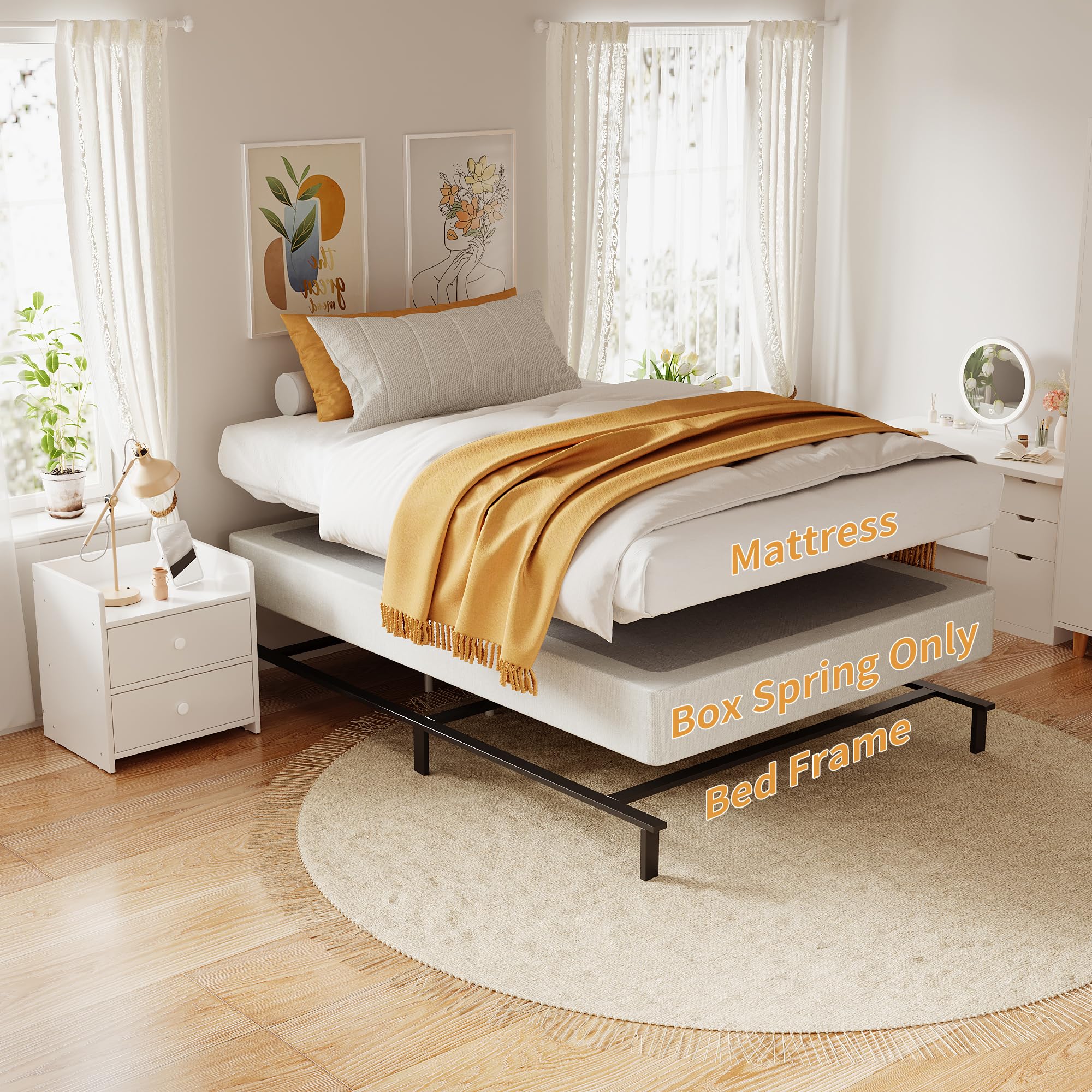
The OSASET is the heavy-hitter. Its 3,000-pound capacity is the highest on this list, and that headroom is what you want under a kid’s bed, a guest bed that rotates through a lot of visitors, or any setup where the base takes more than static weight. Jumping, roughhousing, two people sitting on the edge at once: 3,000 pounds absorbs that without the frame flexing. The 7-inch height matches a conventional bed profile, and the fabric cover protects the mattress underside.
At a 4.2 rating, it sits just below the SHOANED pair, and the owner feedback explains why: it’s a touch fussier to assemble, with more parts to align than the clip-together SHOANED frames. Budget 15 to 20 minutes. Once it’s together, the extra 500 pounds of capacity over a standard 2,500-pound base is real insurance. For a child’s room or a high-traffic guest bed, that margin is worth the slightly longer build.
4. Twin 5-Inch, 2,500-lb Capacity — The Quiet Low-Profile at a Lower Price
This 5-inch base covers the same low-profile use case as the SHOANED 5-inch but at a friendlier price, with a 2,500-pound capacity that’s plenty for a single adult sleeper. The noise-free framing is the headline feature, and the 4.4 rating backs it up. It’s the pick when you want a low mattress height, don’t need 3,000 pounds of capacity, and would rather not pay for it.
Easy assembly is genuine here. The frame snaps together and the fabric cover slips over the top, no tools required. The 2,500-pound rating is the honest ceiling: fine for one adult, fine for most couples on a twin used as a daybed, but not the base I’d put under a bed that gets jumped on daily. Match the capacity to the use. For a solo sleeper or a low-clearance frame where every inch counts, this is the value pick that doesn’t cut the corners that matter.
5. Folding Bunkie-Style Box — The One That Stores Flat for Guest Rooms
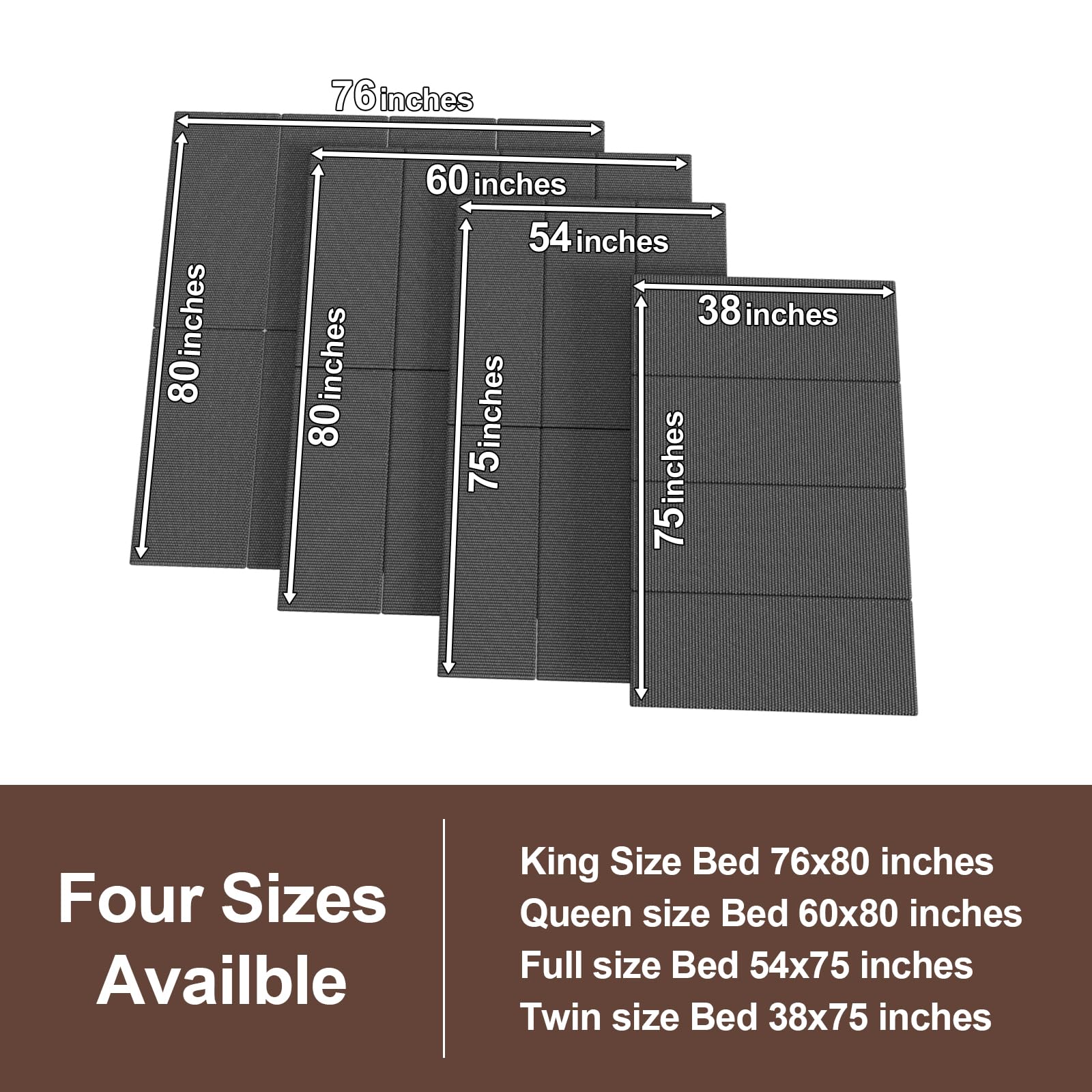
The folding option is the outlier, and it earns its spot for a specific job. It folds flat, which means a guest room, a dorm, or an apartment that flexes between uses can store it against a wall or under a bed when the twin isn’t set up. The breathable, moisture-resistant design fights the mildew that plagues low-profile foundations in humid rooms, a point Apartment Therapy has flagged in small-space bedding guides. Its low profile doubles as a bunkie board over an existing slatted frame.
At a 4.3 rating, it holds up well, though the folding hinge is the part to watch: it’s the mechanical point of any collapsible base, and owners who use it as a permanent foundation report more settling than the welded frames above. Treat it as a flexible, movable base rather than a set-it-and-forget-it foundation. For guest rooms, seasonal setups, or anyone who needs the base to disappear when the bed’s not in use, nothing else here matches its portability.
Comparison Table
| Pick | Height | Capacity | Noise | Best For |
|---|---|---|---|---|
| SHOANED 5-Inch | 5 in | 2,500 lb | No noise | Bunks, low mattress height |
| SHOANED 7-Inch | 7 in | 2,500 lb | No noise | Traditional bed height |
| OSASET 7-Inch | 7 in | 3,000 lb | Quiet | High-traffic, kids’ beds |
| Twin 5-Inch 2,500 | 5 in | 2,500 lb | Noise-free | Value low-profile |
| Folding Bunkie | Low | Standard | Noise-minimizing | Guest rooms, storage |
How to Choose the Right Twin Box Spring
Start with height, because it changes your total bed height by two inches and can’t be adjusted later. Measure from the floor to where you want the top of your mattress. Subtract your mattress thickness. If the answer is 5 inches, you need a low-profile base; if it’s 7 to 9 inches, go traditional. A 10-inch mattress on a 7-inch box spring lands at about 17 inches of foundation-plus-mattress, the height most people find comfortable for sitting and standing.
Then match capacity to who sleeps there. A single adult never stresses a 2,500-pound base. A kid’s room, a shared bed, or any setup that takes jumping and edge-sitting wants the 3,000-pound rating for the flex margin. Check that your bed frame supports a box spring, because platform beds with built-in slats don’t need one and stacking a foundation on top raises the bed awkwardly. If your frame is a simple metal rail with a center bar, a box spring is exactly what it’s designed to hold.
Box Spring vs. Platform Base: When You Need One
You need a box spring when your bed frame has open rails and a center support bar but no slat deck of its own. That frame is built to hold a foundation, and a mattress placed directly on the rails will sag. You don’t need one on a platform bed with slats spaced under 3 inches apart, which supports a mattress on its own. Putting a box spring on a platform base just raises your bed and adds cost.
The gray area is memory foam and hybrid mattresses. Those need a flat, ventilated surface, not the coil-and-wood springs of an old-school box spring. Every foundation on this list is a modern steel base with a solid or grid support, which is what CertiPUR-US foam and most hybrid warranties call for. If your current “box spring” is a squeaky wood-and-fabric antique, replacing it with one of these steel bases is a genuine upgrade, not a lateral move.
Frequently Asked Questions
Do I need a box spring for a twin mattress?
Only if your bed frame requires one. Open-rail metal frames with a center bar need a box spring to support the mattress; platform beds with slats under 3 inches apart don’t. Check your frame before buying.
Will a memory foam mattress work on these box springs?
Yes. All five are flat steel foundations, not old coil-spring boxes. They give memory foam and hybrid mattresses the ventilated, even support CertiPUR-US foam guidance recommends. Avoid vintage sagging box springs with foam.
What’s the difference between a 5-inch and 7-inch box spring?
Two inches of bed height. A 5-inch low-profile base suits bunks, lofts, and thick mattresses; a 7-inch base delivers traditional bed height that’s easier to get in and out of. Both here carry the same frame quality.
How much weight can a twin box spring hold?
These range from 2,500 to 3,000 pounds. A single adult never stresses 2,500 pounds. Choose the 3,000-pound OSASET for kids’ rooms or high-traffic guest beds where edge-sitting and jumping add load.
Why does my box spring squeak?
Usually loose joints or metal-on-metal contact at the frame. The no-noise steel welds on the SHOANED and 2,500-pound picks are built to prevent this. Tighten all connections at assembly and recheck after the first month.
Can I use a folding box spring as a permanent foundation?
You can, but the folding hinge settles more over time than a welded frame. It’s best as a movable, storable base for guest rooms or seasonal setups. For a daily bed, a welded steel frame lasts longer.
Bottom Line
The SHOANED 7-inch is the one most people should buy: welded steel, no-noise design, and the traditional bed height that fits almost any room. Go with the SHOANED 5-inch or the 2,500-pound low-profile pick if a bunk or a thick mattress forces a lower profile, and choose the 3,000-pound OSASET for a kid’s room that takes a beating. Just know that no steel box spring, at any capacity, fixes a mattress that’s already worn out. Readers comparing this against other formats usually read twin xl box spring next.

Write Your Review
No reviews yet. Be the first to share your experience!