

> Editorial Note: I’m Lauren Ro, and I write furniture buying guides. The picks here are judged on the specs that predict how a piece ages — frame joinery, foam density, and load ratings — checked against BIFMA and FSC certifications plus aggregated owner reports.
A 12-inch-wide footprint holding 20 pairs of shoes is a math problem before it’s a decor decision. Vertical stacking wins on square footage, but it also concentrates weight and raises the tipping risk, so frame gauge and wall-anchor hardware matter more than tier count. If you’re mapping out a broader storage plan, start with our shoe rack for entryway guide, then compare against tall shoe cabinets for entryways, shoe rack for closet, freestanding shoe rack picks, and how to set up a shoe rack for a small entryway before committing to a shape.
How We Evaluated
We assessed five vertical racks on measured footprint, stated pair capacity versus realistic capacity, tier spacing for boots and high-tops, frame material, and whether an anti-tip kit ships in the box. Assembly complexity and shelf sag under load carried weight too. Ratings and capacity figures reflect current listing data; none of these figures come from hands-on use.



Pros
- Extremely narrow profile (10.4 inches) ideal for tight spaces
- Holds 10-20 pairs depending on shoe size and orientation
- Functional wooden top for keys, wallet, or small decor items
- Reinforced metal frame with anti-tip safety features
- Assembly is straightforward with clear instructions
Cons
- New product with no customer reviews yet to verify durability claims
- Open design means shoes remain visible and exposed to dust
- May look cluttered if filled with mismatched shoe styles
This is the shoe rack for anyone who has more shoes than square footage. The YATINEY solves the classic entryway problem: you need storage for the whole family, but your hallway is barely wide enough to walk through. At just over 10 inches deep, it tucks against walls, beside closets, or next to console tables without creating an obstacle course.
What sets it apart is the functional wooden top. Instead of just being a shoe tower, it becomes a proper entryway piece where you can drop your keys, display a small plant, or set down your phone while you lace up. The rustic brown finish with black metal frame has that modern farmhouse look that works in most homes without feeling too trendy.
If you want serious vertical storage without sacrificing your narrow hallway, this one delivers.
Styles it works with: Modern Farmhouse, Industrial, Rustic, Minimalist
Best placed in: Narrow entryways, mudroom corners, beside bedroom closets, apartment hallways
May not suit: Homes where you prefer closed storage to keep shoes hidden, spaces with very low ceilings (rack is 67 inches tall), or households with toddlers who might use it as a climbing structure
Buy it if:
- You have a narrow entryway or hallway under 12 inches of usable width
- You need to store 10-20 pairs of everyday shoes in one compact spot
- You want an open rack where you can quickly grab shoes without opening doors
- You like the look of rustic brown wood with black metal accents
Consider waiting if:
- You prefer to wait for customer reviews since this is a newly listed product
- You want to see if other color options become available
Skip it if:
- You need enclosed storage to keep shoes dust-free and hidden
- Your space requires a rack shorter than 67 inches due to low ceilings or furniture placement
- You have very heavy boots that might require sturdier shelving
Check the latest price and availability on Amazon before it sells out.

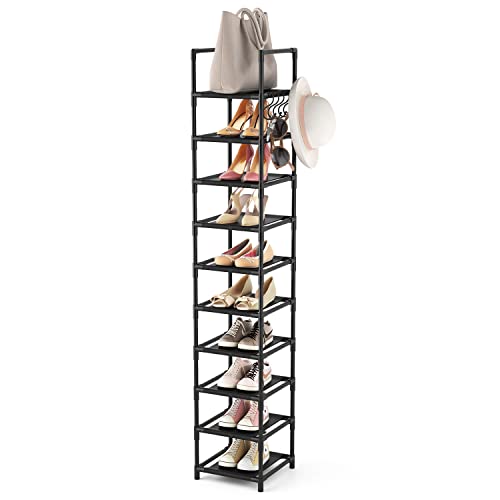
1. LANTEFUL 10 Tiers Tall Shoe Rack — highest capacity per inch of floor
This one wins on density. Ten tiers rated for 20 to 25 pairs put roughly 2.5 pairs per tier, which assumes flats and sneakers rather than hiking boots. The metal tube frame with fabric-mesh shelving keeps total weight low, so wall anchoring isn’t optional in a household with kids. Angled shelves hold shoes in place instead of letting them slide forward.
The honest trade-off: mesh shelves flex under heavy work boots, and the top tier sits above 68 inches on most configurations. Good for a closet wall. Less good as a freestanding piece in an open hallway.
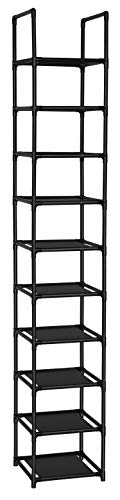
2. LANTEFUL Tall Narrow Shoe Rack — the tighter 10-to-15-pair build
Same brand, different target. This 10-tier version trades maximum capacity for wider tier spacing, which is the actual fix if your collection includes ankle boots. Rated at 10 to 15 pairs, so plan on one to 1.5 pairs per shelf. The narrow profile suits gaps beside a door or between a wall and a dresser.
Frame assembly uses push-fit connectors rather than screws, which speeds setup but reduces lateral rigidity. Tighten every joint fully before loading. It’s a solid pick for apartments where a slim column beats a wide bench.

3. FIDUCIAL HOME 10 Tiers Vertical Shoe Rack — skinniest footprint of the group
FIDUCIAL HOME markets this as a skinny shelf, and the spec sheet backs it up: 10 tiers holding exactly 10 pairs, one pair per level. That single-pair-per-tier layout is the reason it fits in a genuinely narrow slot where the LANTEFUL units won’t clear.
Capacity is the limitation. Ten pairs covers one adult, not a family. Steel uprights with fabric shelves keep the price low, and the flat-pack ships small. Choose it for a bedroom corner or a rental closet. Skip it if you need overflow capacity for seasonal footwear.
4. YATINEY 10-Tier Narrow Shoe Rack — the one that looks like furniture
The wooden top is the differentiator. YATINEY pairs a 10-tier metal frame rated for 10 to 20 pairs with a solid upper surface that functions as a landing spot for keys, mail, or a small plant. That turns a utility rack into a console-adjacent piece for entryways where the rack is visible from the living room.
Expect the wood top to be engineered panel rather than hardwood at this price. Load the surface with under 15 pounds. Mixed-material builds also mean more fasteners at assembly, so budget extra time.
5. HOOBRO 8 Tiers Vertical Shoe Rack — fewer tiers, better hardware
HOOBRO drops to 8 tiers and 8 pairs, and that’s deliberate. Wider vertical clearance per shelf accommodates boots that jam in 10-tier designs. Side hooks handle bags, umbrellas, or leashes, which does real work in a tight entry.
The wood-and-steel frame is the most rigid here, with less shelf deflection than mesh alternatives. You’re paying more per pair stored. If your household owns eight pairs of substantial shoes rather than 20 pairs of sneakers, this is the correct trade.
Comparison Table
| Model | Tiers | Stated Pairs | Shelf Type | Best Placement |
|---|---|---|---|---|
| LANTEFUL 10 Tiers Tall | 10 | 20–25 | Metal + mesh | Closet wall |
| LANTEFUL Tall Narrow | 10 | 10–15 | Metal + fabric | Beside a door |
| FIDUCIAL HOME Vertical | 10 | 10 | Steel + fabric | Ultra-narrow gap |
| YATINEY 10-Tier | 10 | 10–20 | Metal + wood top | Visible entryway |
| HOOBRO 8 Tiers | 8 | 8 | Wood + steel | Boots and gear |
What to Check Before You Buy
Measure the slot, then subtract an inch. Most tall narrow racks run 11 to 13 inches deep and 12 to 24 inches wide, and baseboards steal clearance at the floor. Height is the sneakier constraint: a 70-inch column under an 80-inch ceiling looks fine, but the top tier becomes unusable storage for anyone under 5’6″.
Verify tier spacing, not just tier count. Sneakers need about 5 inches of vertical clearance; ankle boots need 8 to 10. A 10-tier rack in a 68-inch frame averages under 7 inches per shelf, so tall footwear goes on the top or bottom level only.
Load rating and anchoring come next. ASTM F2057 addresses tip-over for storage furniture, and while freestanding racks fall outside its scope, the principle holds. Anchor anything above 50 inches. Apartment Therapy has repeatedly flagged unanchored vertical storage as a household hazard, and a 12-inch-deep base loaded top-heavy will pitch forward.
How These Five Compare Head to Head
Capacity per square foot separates the field. The LANTEFUL 20-to-25-pair unit stores roughly triple what the HOOBRO holds in a similar footprint, but it does so with mesh shelving that flexes. HOOBRO reverses that: fewer pairs, sturdier decks, side hooks that absorb the clutter a rack alone doesn’t solve.
FIDUCIAL HOME is the answer to a dimensional problem, not a capacity one. YATINEY sits between categories, buying visual polish at the cost of some load headroom on the wooden top. The second LANTEFUL splits the difference on spacing.
Pick based on your footwear mix. Sneaker households maximize tiers. Boot households maximize clearance.
Frequently Asked Questions
How many pairs fit on a tall narrow shoe rack?
Between 8 and 25, depending on tier spacing. Single-pair-per-tier designs like FIDUCIAL HOME hold 10. Racks claiming 20-plus pairs assume two to three low-profile shoes per shelf, which works for flats and fails for boots.
Do these racks need wall anchoring?
Anything over 50 inches tall with a 12-inch base should be anchored. Vertical racks concentrate weight high while sitting on a shallow footprint, and a child pulling on a middle tier can tip an unanchored column.
Will boots fit on a 10-tier rack?
Only on the top or bottom tier. A 68-inch frame divided across 10 shelves leaves under 7 inches of clearance, and mid-calf boots need 12 or more. The HOOBRO 8-tier layout handles boots better.
Are mesh shelves durable enough?
For sneakers and flats, yes. Fabric-mesh decks on the LANTEFUL units hold up under light loads but visibly sag with heavy work boots. Wood-and-steel shelving resists deflection better and cleans more easily.
Can a shoe rack go in a closet?
Yes, and it’s often the better placement. Measure interior depth first since most racks need 11 to 13 inches. Closet walls also give you a stud for anchoring, which open hallways rarely do.
How long does assembly take?
Push-fit metal frames go together in 20 to 30 minutes. Mixed wood-and-metal builds like YATINEY and HOOBRO involve more fasteners and typically run 45 minutes with a screwdriver.
Bottom Line
The LANTEFUL 10 Tiers Tall Shoe Rack takes the top spot for pure capacity, storing 20 to 25 pairs in a footprint narrower than a nightstand. It needs wall anchoring and it won’t hold heavy boots without shelf sag, but nothing here beats its density. Choose the HOOBRO 8 Tiers instead if your household wears boots and you want rigid shelving plus side hooks. Both require honest measuring before checkout.


Write Your Review
No reviews yet. Be the first to share your experience!