

> Editorial Note: I’m Liam Wright, an outdoor and garden editor. I grew up in my family’s landscaping business and now cover what actually survives a season of UV, rain, and freeze-thaw cycles. The picks here are evaluated against ASTM weatherability standards and manufacturer durability ratings.
You set up the canopy for a backyard lunch, turn your back for ten minutes, and it’s tumbling across the lawn like a runaway kite. Maybe a leg lifted first. Maybe the whole frame flipped and cracked a corner joint. Either way, a 10×10 pop-up catches wind like a sail, and an empty one weighs almost nothing against a 15 mph gust. This isn’t bad luck, and it’s not a defective tent. It’s physics doing exactly what physics does. Once you understand where the lift comes from, the fix is cheap and fast. If you’re also building out the rest of the yard, these same wind rules apply to your best gas fire pit table, best wood burning fire pit, best outdoor sofa, best patio umbrella, and even a heavy best raised garden bed. Let’s get your canopy to stay put.
Reason 1: One Leg Lifts First, Then the Whole Thing Flips (No Weight on the Feet)
Watch a canopy start to go and you’ll almost always see one corner rise before the rest. That’s the tell. Wind pushes under the canopy top and turns the flat roof into an airfoil, generating lift the same way an airplane wing does. An unanchored 10×10 pop-up weighs 30 to 45 pounds. A steady 20 mph wind can generate well over 100 pounds of upward force across that much fabric.
So the frame doesn’t slide. It flies.
The fix is weight at the feet, and more than you’d guess. Industry guidance from the Industrial Fabrics Association points to roughly 40 pounds per leg for a 10×10 on a hard surface with no stakes. That’s 160 pounds total. Most people clip on a 5-pound dumbbell per corner and wonder why it still went airborne. A gallon of water is only 8.3 pounds. You need real mass, secured directly to each leg near the foot plate where it does the most good. Weight bags wrapped around the pole base are purpose-built for this and beat improvised bricks that slide off in a gust.
Reason 2: The Canopy Skids Sideways on Concrete or Pavers (No Ground Anchor)
If your setup is on a patio, driveway, or gym floor, you can’t drive a stake. So the canopy has nothing gripping the ground, and even a moderate crosswind walks the whole frame sideways a few inches at a time until a leg drops off the edge and the structure racks.
Concrete and pavers are the hardest surface to secure a canopy on, full stop. Grass at least accepts a stake; concrete gives you nothing to bite into.
The answer is friction plus mass. Sandbags or fillable weight bags sitting flat against the base add downward force and a wide footprint that resists sliding. For extra hold on smooth surfaces, set the weighted feet on a rubber mat or the canopy’s own rubber foot pads. If any staking is possible at the perimeter, run guy lines out to stakes at a 45-degree angle. On pure concrete with no stake option, plan for 40-plus pounds per leg and don’t leave the canopy up unattended when gusts climb past 20 mph. ASTM wind-load references treat anything over 25 mph as the point where a pop-up should come down entirely.
Reason 3: It Holds in Steady Wind but Snaps in Gusts (Fabric Acting Like a Sail)
Some canopies survive a breezy afternoon, then get destroyed the moment a single hard gust arrives. The problem is the sidewalls and the closed roof. A fully enclosed canopy has zero way to release pressure, so a gust hits the fabric and every bit of that force transfers straight to the frame and the anchors.
Open at least two sides. Better yet, remove the sidewalls entirely in wind.
Airflow through the structure is what saves it. Many quality tops include mesh vents or a vented peak precisely to bleed off pressure, and manufacturer durability ratings often assume those vents stay open. Close everything up and you cancel that design. If your canopy has no vents, leaving opposite sides open drops the sail effect dramatically. Pair that with the per-leg weighting from Reason 1 and you’ve addressed both the lift and the shove. One more thing: aluminum frames flex and can bend permanently in a gust, while steel frames hold shape longer but rust if the powder coat chips. Neither survives an untethered gust, so anchoring still comes first.
How to Fix It Fast
Short on time before the wind picks up? Here’s the 10-minute version. First, get real weight on every leg, aiming for 40 pounds each on hard ground. Sandbags wrapped at the base beat anything hanging from the frame. Second, open two opposite sides so gusts pass through instead of lifting the roof. Third, if you’re on grass, add stakes and guy lines at 45 degrees for backup.
Then set a rule: canopy comes down when sustained wind passes 25 mph. No exceptions.
That threshold isn’t arbitrary. It lines up with how outdoor-fabric and ASTM weatherability guidance treats pop-up structures, and it’s the single habit that saves more canopies than any accessory.
The Products That Actually Help
Weight is the real solve here, and the cleanest way to add it is a wrap-around bag that hugs each leg at the base rather than a weight that dangles and swings. All three picks below clear a 4.4 owner rating and ship empty so you fill them with sand on-site, which keeps shipping cheap and lets you hit that 40-pounds-per-leg target. Go with the Eurmax if you want the highest per-bag capacity for exposed sites; the ABCCANOPY for a balanced everyday set; the IALNAI if you’re outfitting a smaller vendor or backyard tent on a budget.
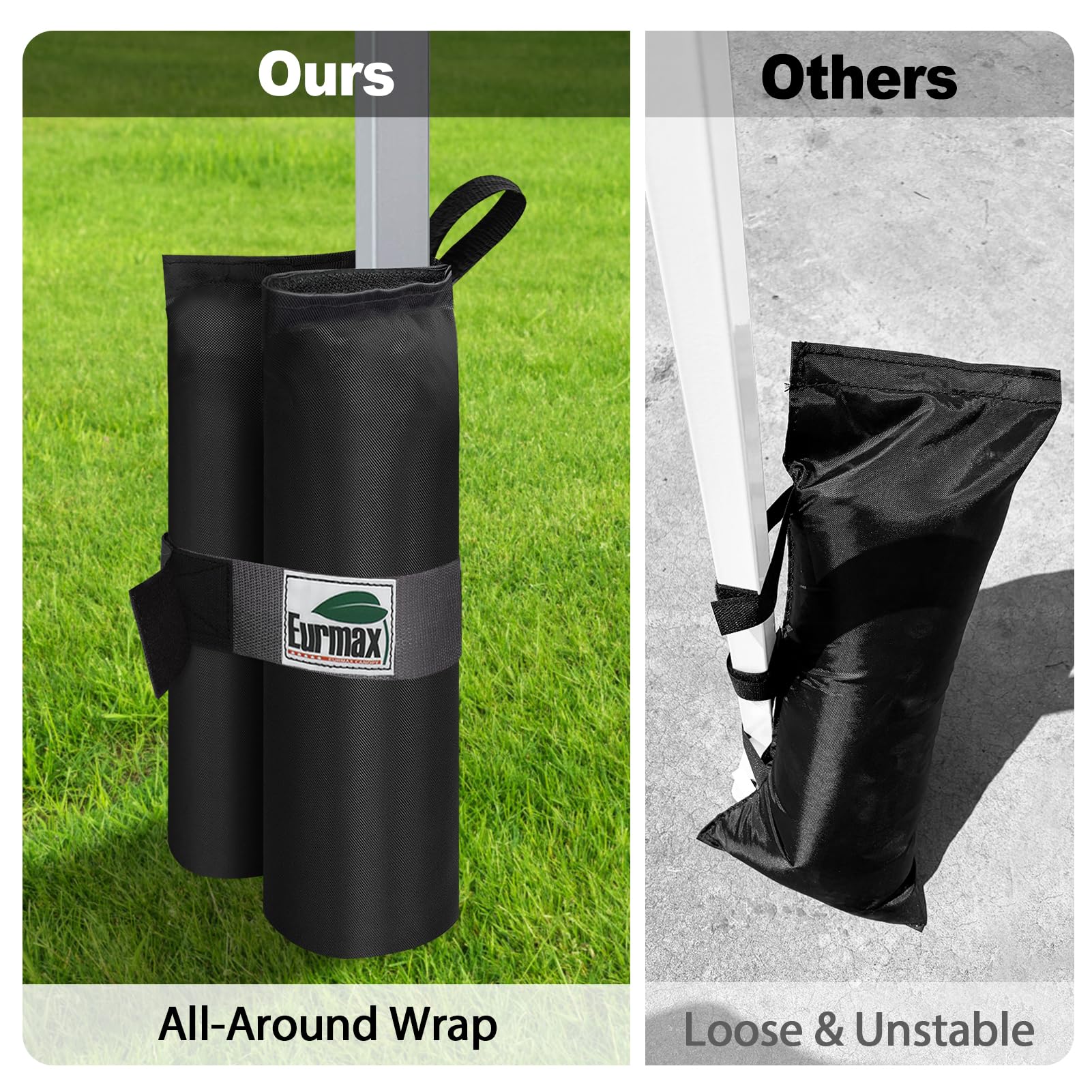

Eurmax 4-Pack 150LBS Canopy Weight Bags | Heavy Duty Windproof Sandbags for Pop Up Tent & Shelter Stability
Pros
- Universal fit works with most pop-up canopies, gazebos, folding tents, and shade shelters on the market
- Velcro closure system is sewn directly into the fabric to prevent filler material from leaking out
- Reusable and easy to empty after each use, making them practical for frequent event setups
- Strong carry handle at the top makes transport manageable even when bags are fully loaded
- Backed by over 7,000 ratings averaging 4.5 stars, reflecting consistent real-world performance
Cons
- Sand is not included, so you need to source filler material separately before your first use
- At 37.5 lbs per bag when fully loaded, transporting all four filled bags requires physical effort and planning
- Velcro straps may wear down over time with very frequent attach-detach cycles across multiple seasons
If you have ever watched a canopy shift, tip, or take flight mid-event, you already understand why a good set of weight bags is non-negotiable. The Eurmax 4-Pack solves that problem cleanly and affordably. The 1680D PVC-backed polyester feels noticeably sturdier than cheaper alternatives, and the all-around Velcro wrap design grips canopy legs firmly without the guesswork of sizing.
What sets this set apart for regular outdoor hosts is the flexibility of the fill system. Whether you are at a beach with sand underfoot, a backyard with gravel nearby, or a snowy winter market, there is always something nearby to load these bags with. That adaptability makes them far more practical than water-weight alternatives that require a nearby tap or are prone to freezing.
The bags also store flat and compact when empty, so they do not take over a gear closet between uses. After a season of farmers markets, tailgates, or outdoor parties, that matters more than most buyers expect. If you want reliable canopy stability in unpredictable wind without hauling bulky ground stakes or complicated anchoring rigs, this one delivers.
Styles it works with: Outdoor Modern, Rustic Backyard, Festival Boho, Clean Minimalist Event Setups
Best placed in: Backyard patio canopy legs, outdoor market or craft fair booth corners, tailgate or sports event tent bases, beach or park shelter setups
May not suit: Indoor canopy or drape installations where floor anchoring is not needed; very lightweight decorative canopies used in calm, sheltered indoor spaces where wind is not a concern
Buy it if:
- You regularly set up a pop-up canopy at outdoor markets, fairs, or events and need dependable wind resistance without permanent ground stakes
- You host backyard gatherings and want peace of mind that your canopy stays anchored even when the wind picks up unexpectedly
- You want a reusable, compact anchoring solution that works across multiple canopy brands and leg sizes without modification
Consider waiting if:
- You only set up a canopy once or twice a year in very calm, sheltered conditions where wind is rarely a factor
Skip it if:
- You need a staking solution for hard surfaces like concrete or asphalt where bags cannot be easily weighted with nearby material
- Your canopy legs have an unusual profile that standard Velcro wraps cannot grip securely
Check the latest price and availability on Amazon before it sells out.

ABCCANOPY 120 LBS Canopy Weight Bags 4-Pack | Heavy-Duty Sand Bags for Tents, Gazebos & Pop-Up Canopies
Pros
- Velcro strap design installs in seconds without tools, loops, or zip ties
- 600D polyester with PU coating resists water and UV, holding up across multiple seasons
- Fits a wide range of leg diameters (15mm to 50mm), compatible with most major canopy brands
- Four bags included at a low price point makes this an easy add-on when buying any pop-up canopy
Cons
- Sand is not included, so first-time users need to source and haul their own fill material before use
- Maximum hold per bag depends entirely on filler density -- sand loads heavier than dirt, which affects actual wind resistance
- Velcro can collect debris over time and may lose grip if not cleaned periodically
If you have ever watched a canopy leg lift off the ground mid-event, you know the stress of scrambling for rocks or rope to keep things anchored. These ABCCANOPY weight bags solve that problem cleanly and affordably. Each bag straps directly onto your canopy leg with dual Velcro closures, and you fill them on-site with whatever is available -- sand from a nearby bag, dirt from the edge of the lawn, or gravel from the driveway.
What stands out is the build quality relative to the price. The 600D polyester shell with PU coating feels noticeably thicker and more rigid than cheaper alternatives, and the stitching at stress points holds up after repeated fill-and-empty cycles. The bags collapse completely flat when empty, which makes storage almost effortless between weekend markets, backyard gatherings, or camping trips.
If you want a simple, reusable way to keep your canopy stable in wind without driving stakes into the ground or rigging complicated rope systems, this one delivers.
Styles it works with: Outdoor living, backyard entertaining, festival and market vendor setups, camping and tailgate setups
Best placed in: Around the legs of a pop-up canopy at a farmers market or craft fair, anchoring a backyard gazebo on a patio or lawn, stabilizing a beach or sports umbrella on sand
May not suit: Permanent or semi-permanent canopy structures with fixed anchoring hardware already installed; indoor event setups where floor loading weight bags are not needed
Buy it if:
- You regularly set up a pop-up canopy at outdoor events, markets, or sports games and need a quick, portable anchoring solution
- You own a gazebo on a lawn or patio where driving ground stakes is not an option
- You want a reusable weight system that works with multiple canopy or umbrella types you already own
Consider waiting if:
- You need a heavier-duty option above 120 lbs total -- competing bags in the comparison chart hold up to 185 lbs for larger or more exposed structures
Skip it if:
- You need a fully waterproof bag -- these are water-resistant but not fully sealed, so wet sand or dirt can seep if overfilled
- You need a self-contained solution with sand included, as you will need to source fill material separately before your first use
Check the latest price and availability on Amazon before it sells out.

IALNAI 112 LBS Canopy Sandbags 4-Pack | Heavy-Duty Oxford Cloth Weights for Tents, Awnings & Outdoor Umbrellas
Pros
- Thick Oxford cloth construction holds up to repeated fill-and-empty cycles without visible fraying or seam splits
- 4-pack value at $12.99 makes this one of the lowest cost-per-bag options in the category
- Handles are reinforced and wide enough for a comfortable grip even when bags are fully loaded
- Universal cylindrical fit wraps around standard canopy legs from most major tent brands
Cons
- Sand and small stones are not included, so first-time buyers need to source fill material separately before use
- No color variety in the listing means you get whatever package variation ships, which may not match a specific aesthetic preference for styled outdoor spaces
For anyone who has watched a canopy sail across a backyard the moment wind picks up, the IALNAI sandbags are a genuinely reassuring upgrade. Made from tightly woven Oxford cloth with reinforced stitching, they feel noticeably more substantial than the flimsy bags bundled with many budget tents, and the thread density actually prevents sand from sifting out over time.
What makes them particularly likable for outdoor living setups is their clean cylindrical profile. Unlike blocky or oddly shaped weights, these wrap neatly against canopy legs and stay out of sight, so your patio arrangement still looks intentional and styled rather than rigged together. The carry handles are wide and comfortable, which matters when you are moving four fully loaded bags across a yard.
If you want reliable canopy stability on breezy days without drilling stakes into your deck or lawn, this one delivers.
Styles it works with: Coastal Outdoor, Modern Farmhouse Patio, Bohemian Garden, Minimalist Backyard
Best placed in: Pop-up canopy corners for backyard gatherings, beach or park umbrella bases, outdoor vendor and advertising tent legs
May not suit: Fully permanent pergola or fixed awning structures that use hardware mounting instead of weighted anchors; very small patio umbrellas under 7 feet where the 28 lb per bag fill weight may be more than the pole hardware is rated for
Buy it if:
- You regularly set up pop-up canopies for backyard parties, farmers markets, or outdoor events and need a portable, stake-free anchoring solution
- You live in a coastal or open-terrain area where afternoon wind gusts are a consistent problem for freestanding outdoor structures
- You want a low-cost set of four matching weights that store flat and travel easily in a bag or truck bed
Consider waiting if:
- You need a specific color to match a branded or styled outdoor setup, since the package variation ships as available
Skip it if:
- Your canopy manufacturer requires proprietary weight systems or hardware anchors that attach differently than a wraparound sandbag
- You have no convenient local source for sand or small stones, as fill material is not included and is essential before the bags can function
Check the latest price and availability on Amazon before it sells out.
The Eurmax USA 4-pack tops the group at 150 pounds total capacity with an all-around wrap design that cinches tight to the pole base, so it won’t slide off in a crosswind. At a 4.5 rating, owners consistently note it holds a 10×10 through gusty afternoons when filled to capacity. It’s the pick for open fields, beachfronts, or any site with no stakes.
The ABCCANOPY set holds 120 pounds across four bags at the same 4.5 rating. It’s the balanced everyday choice: enough mass for most backyard and market use, black fabric that hides dirt, and a wrap that fits standard pop-up legs. Choose this one if your canopy lives in a moderate-wind suburban yard rather than an exposed coastal lot.
The IALNAI 4-pack carries 112 pounds and rates 4.4, the budget-friendly option for smaller advertising tents, farmers-market booths, or a backyard shade that only comes out on calm days. It fills the same way and wraps the base, just with slightly less total capacity than the other two.
Frequently Asked Questions
How much weight do I need to keep a 10×10 canopy from blowing away?
Yes, there’s a real number: about 40 pounds per leg, or 160 pounds total, on a hard surface with no stakes. That figure comes from outdoor-fabric industry guidance and assumes no ground anchoring. On grass with stakes and guy lines, you can go lighter, but weight is still your primary defense.
Can I use water jugs instead of sandbags?
It depends on how much wind you expect. A gallon of water is only 8.3 pounds, so you’d need roughly five jugs per leg to match a proper sandbag, and jugs slosh and swing in gusts. For light breezes they’ll do in a pinch. For anything past 15 mph, sand-filled wrap bags at the base hold far better.

Will stakes alone keep my canopy secure?
Almost never on their own in strong wind. Stakes stop the frame from sliding, but they don’t counter the upward lift that peels a canopy off the ground. Combine stakes and guy lines at a 45-degree angle with weighted legs for the strongest hold. On concrete where staking is impossible, weight becomes your only option.
At what wind speed should I take my canopy down?
No canopy should stay up in sustained winds above 25 mph. That threshold aligns with ASTM weatherability references and manufacturer ratings for pop-up structures. Gusts do the real damage, so if a storm front is moving in, take it down before the wind arrives, not during.
Do open sidewalls really make a difference?
Yes, a big one. Closed walls turn the canopy into a solid sail that transfers every gust straight to the frame. Opening two opposite sides lets air pass through and cuts the lift dramatically. It’s a free fix that pairs with weighting for real stability.
Bottom Line
For roughly 80% of runaway canopies, the root cause is simple: not enough weight on the legs. Add 40 pounds per leg with wrap-around sandbags at the base, open two sides so gusts pass through, and stake the corners on grass. That’s the whole fix. The Eurmax bags handle the most exposed sites; the ABCCANOPY suits everyday yards. One rule beats every accessory though. When sustained wind tops 25 mph, take the canopy down. If your frame is already bent or a joint has cracked, replace it before the next windy day rather than patching it.






Write Your Review
No reviews yet. Be the first to share your experience!