

> Editorial Note: I’m Erin Schwartz, and I cover home decor with a bias toward what actually works in a real room. The guidance here weighs scale, layout, and materials against Apartment Therapy and Wirecutter coverage rather than styling a space that nobody lives in.
Corner dead space swallows square footage in most bedrooms. A corner closet system turns that awkward angle into hanging capacity and shelf runs. Before you commit, compare notes with our closet system primer, the wire vs wood closet system breakdown, our closet organizer system guide, the how to choose a closet system walkthrough, and hanging closet shelves for lighter setups. Five units below, ranked on load rating, footprint, and assembly.
How We Evaluated
We ranked each system on rod load capacity, shelf count per square foot, panel material, and reversible layout support. Freestanding units were assessed against BIFMA-style stability expectations. Assembly complexity and wall-anchor requirements factored heavily, since corner units tip risk more than flat-wall builds.

1. Aheaplus Corner Closet System — the small-room specialist
The Aheaplus wins on footprint discipline. At 34 inches per side, it slots into tight bedroom corners where 39-inch builds won’t clear a doorframe. Wood-look panels carry shelves plus dual hanging rods, so you get folded and hung storage in one L-shaped run. Freestanding design means no drilling into studs, though you’ll want the included anti-tip strap on carpet. Best for renters and dorms under 100 square feet. The trade-off is depth. Long coats brush the lower shelf. Solid value for the space it reclaims.
2. Besiost Closet System with 6 Drawers — the built-in dresser
This Besiost L-shaped unit folds a six-drawer dresser into the closet frame, killing the need for a separate chest. Ten shelves plus the drawers handle a full wardrobe rotation. The reversible design flips left or right, so it fits either corner orientation without reordering parts. Steel-reinforced rods hold winter coats without sag. It’s the deepest build here, which means you need roughly 42 inches of clearance per wall. Assembly runs long, near 90 minutes by most owner reports. Worth it if you want drawers built in.
3. Besiost Corner Closet System with 12 Shelves — the folder’s pick
If you fold more than you hang, this Besiost 12-shelf tower earns its 39.2-inch footprint. Twelve shelves across the corner give sweater and denim stackers room without wire baskets sagging. Hanging capacity is lighter here, one rod section rather than dual, so it’s shelf-forward by design. The panels match the drawer sibling above, useful if you’re building a matched set. Reversible layout supports either corner. Best for capsule wardrobes and folded-heavy closets. Skip it if you own more suits than sweaters.
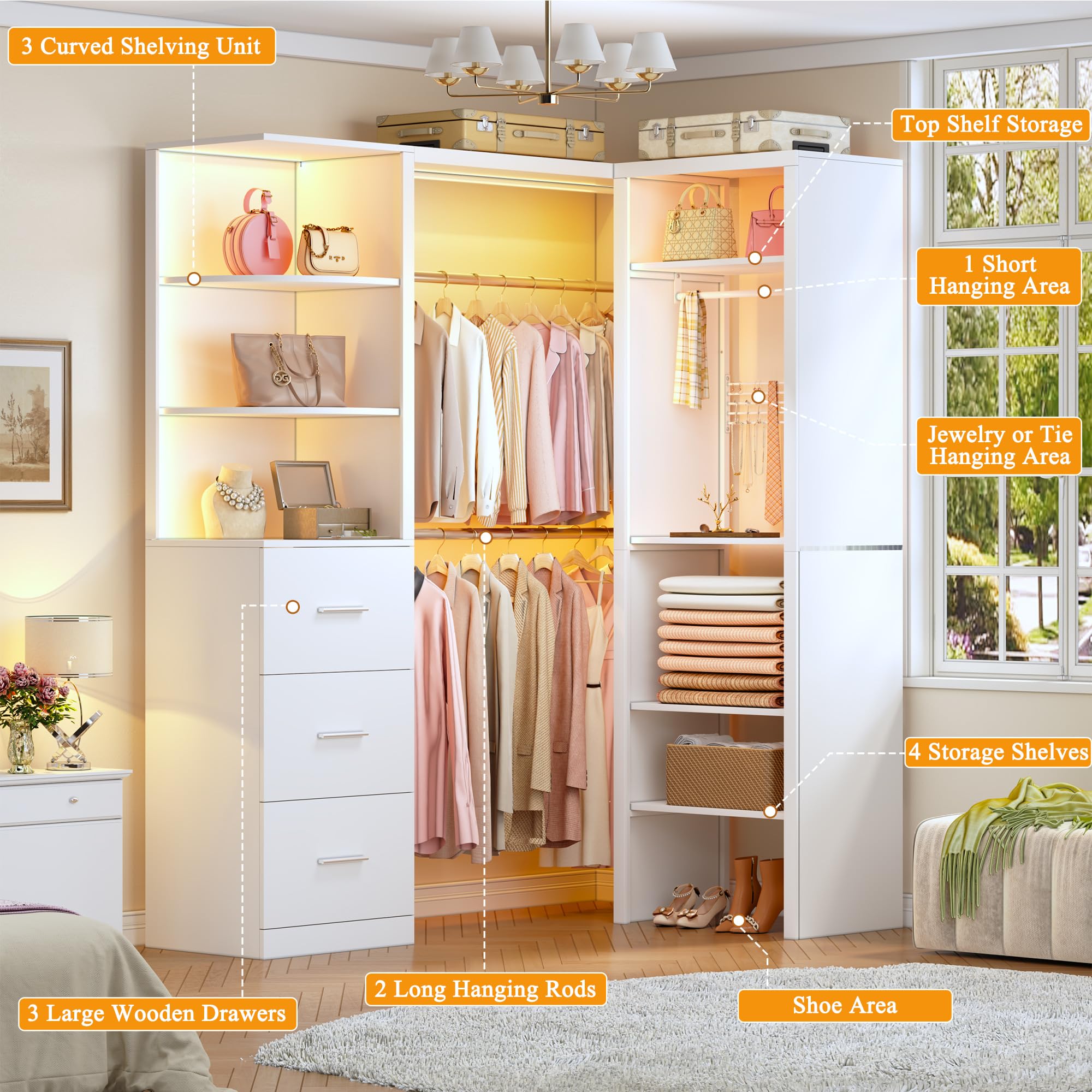
4. HUAHUU Large Corner Closet System — the flex-wall powerhouse
At 77 inches wide, the HUAHUU is the largest build here and the only one with integrated LED lighting. Three drawers plus six shelves and reversible orientation make it a near-walk-in solution for a master bedroom corner. The LED strip runs off USB, handy in dim corners without ceiling fixtures. Rod runs handle a full hanging load. This needs real square footage, so measure both walls past 78 inches before ordering. It’s the priciest and heaviest to assemble. Right choice for anyone treating a corner as a mini dressing zone.
5. VIPEK L4 Clothing Rack — the heavy-duty hanger
The VIPEK L4 skips shelves and commits to hanging. Its L-shaped steel frame is the load leader here, rated for heavy coats and dense hanging without bowing. Open-frame design means no panels to assemble, so setup is the fastest on this list, often under 30 minutes. Casters or fixed feet keep it mobile. Best for closets where you hang almost everything and store shoes below. The honest limit is dust. Open racks collect it, and there’s no drawer or door. Pick it for maximum hanging strength.
Comparison Table
| System | Footprint | Storage Mix | Load Angle | Best For |
|---|---|---|---|---|
| Aheaplus | 34″ per side | Shelves + 2 rods | Light-medium | Small rooms, renters |
| Besiost 6-Drawer | ~42″ per side | 6 drawers, 10 shelves | Medium-heavy | Built-in dresser need |
| Besiost 12-Shelf | 39.2″ | 12 shelves, 1 rod | Medium | Folders, capsule wardrobes |
| HUAHUU 77″ | 77″ wide | 3 drawers, 6 shelves, LED | Heavy | Master bedroom corners |
| VIPEK L4 | L-frame steel | Hanging only | Heaviest | Hang-everything closets |
How to Match a System to Your Corner
Measure both walls before anything else. A 39-inch unit needs roughly 40 inches of clear wall on each side, and doorframes eat that margin fast. Freestanding wood builds like the Aheaplus and Besiost pairs trade some load capacity for zero drilling, which matters in rentals. Steel racks like the VIPEK carry more weight per rod but leave clothes exposed. Decide your fold-to-hang ratio first. Shelf-heavy wardrobes point to the 12-shelf Besiost. Coat-heavy wardrobes point to the VIPEK. Anchor any freestanding unit with its anti-tip hardware, since corner geometry adds tip risk on soft flooring.
Wood Panels vs Open Steel Frames
Wood-panel systems hide clutter and hold folded stacks flat. They weigh more, take longer to build, and cost more per shelf. Open steel frames, like the VIPEK, assemble in minutes and carry heavier hanging loads, but everything stays visible and gathers dust. Apartment Therapy has long noted that open racks suit minimal wardrobes better than packed ones. For a corner you’ll see from the bed, panels look cleaner. For a utility closet behind a door, steel is the practical call. Match the finish to how visible the corner actually is.
Frequently Asked Questions
Do corner closet systems need wall anchoring?
Freestanding wood units include anti-tip straps, and you should use them. Corner geometry concentrates weight toward the open front, raising tip risk on carpet. Steel racks like the VIPEK are lower-profile and less prone, but anchoring still adds a safety margin.
How much clearance does a 39-inch unit need?
Plan for about 40 to 42 inches of clear wall per side. Doorframes, baseboards, and trim reduce usable width, so measure to the actual corner. The HUAHUU at 77 inches needs a much wider run than any 34-inch build here.
Can I fit a corner system in a rental?
Yes. All five here are freestanding, so no permanent drilling is required. The Aheaplus and VIPEK are the friendliest for renters given their smaller footprints and quick disassembly when you move.
Which system holds the most hanging weight?
The VIPEK L4 leads on rod strength with its steel L-frame, built for dense coat loads. The Besiost 6-drawer runs second with steel-reinforced rods. Shelf-heavy units like the 12-shelf Besiost carry lighter hanging loads by design.
Are the LED lights on the HUAHUU worth it?
If your corner lacks a nearby fixture, yes. The USB-powered strip lights the shelf faces where overhead light won’t reach. It’s a genuine convenience in dim master-bedroom corners, less useful in an already-bright room.
How long does assembly take?
The VIPEK is fastest, often under 30 minutes with its open frame. Panel builds like the Besiost pair and HUAHUU run 60 to 90 minutes. The Aheaplus falls in the middle at roughly 45 minutes.
Bottom Line
The Aheaplus Corner Closet System wins for most rooms. Its 34-inch footprint clears tight corners, and the shelf-plus-dual-rod mix covers both folding and hanging without drilling. Choose the HUAHUU 77-inch instead if you’ve got a wide master-bedroom corner and want built-in LED lighting with drawers. One honest caveat. If you hang nearly everything and don’t mind exposed storage, the VIPEK L4 carries more weight for less money. Measure both walls before you order.




Write Your Review
No reviews yet. Be the first to share your experience!