

> Editorial Note: I’m Olivia Bennett, a storage and organization contributor. I approach storage as a systems problem rather than a product one — fit to actual room dimensions, load ratings, and how the system holds up under daily use.
A small entryway rarely gives you more than 12 inches of depth before a shoe rack starts clipping the door swing, and that constraint kills most standard shoe shelves before they’re even in the running. The answer isn’t fewer shoes. It’s a cabinet that flips shoes vertical into a slim body under 12 inches deep, or a rack that leaves the floor entirely and hangs on the door. That depth number, not the width or the pair count, is what decides the fit in a tight hall. Get it wrong and you turn sideways every time you leave the house. If you’re organizing a cramped entry, these picks follow the same footprint-first logic behind a best shoe storage for small entryway, a best corner shelf for small spaces, a best console table for small spaces, a best accent table for small entryway, and a best storage cube for small space. Below are three shoe racks built for tight entries: two slim flip-drawer cabinets and one that hangs on the back of a door.
How We Evaluated for Small Spaces
Depth drove the ranking. Flip-drawer cabinets tilt shoes upright so the body stays near 9 to 10 inches deep, clearing the 30 inches an entry needs to open a door and walk through, so we favored those over deep open shelves. Dual function counted: a cabinet with a flat top doubles as a landing surface for keys and mail. We weighed visual weight, favoring closed fronts and light finishes that read tidier than open racks piled with shoes. We checked pair capacity per drawer, anti-tip stability, and cross-referenced owner durability reports against BIFMA and ASTM guidance for freestanding units.
Pros
- Versatile storage design accommodates mixed shoe types thanks to adjustable and removable interior panels
- Rattan and gold hardware combination fits multiple decor styles including farmhouse, boho, and coastal without redecorating
- Ships with labeled screws and illustrated instructions, making assembly straightforward for most buyers
- Strong 4.7-star rating across nearly 200 reviews suggests consistent quality from unit to unit
Cons
- MDF construction is not as moisture-resistant as solid wood, so placement in damp entryways or mudrooms near exterior doors needs consideration
- Capacity listed as 16 to 25 pairs covers a wide range depending on shoe size, so larger households or those with oversized footwear may find the upper limit optimistic
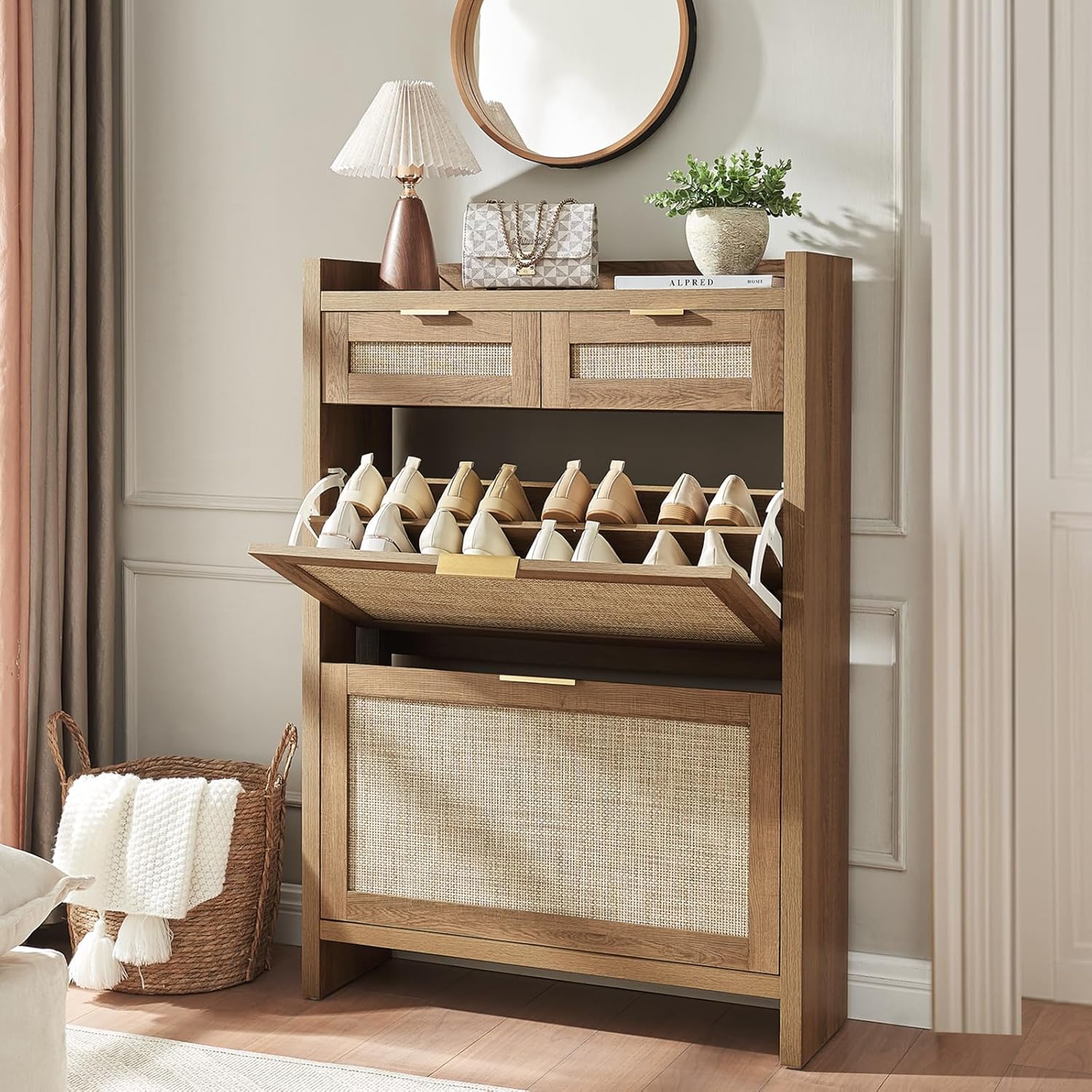
What sets this cabinet apart from the generic shoe racks crowding the entryway category is the material combination. Handwoven rattan drawer fronts paired with gold metal handles give it the kind of layered, textural look you usually only find in boutique home stores. It does not look like flat-pack furniture once assembled, and that matters when it is the first thing guests see when they walk in.
Practically, the four flip compartments with adjustable panels make it genuinely flexible. You are not locked into one shoe height across all slots, which is a real limitation in most cabinets at this price point. The two small side drawers for keys and accessories are a thoughtful bonus that keeps the entryway routine contained in one spot instead of spread across a console table and a bowl on the floor.
If you want a stylish entryway anchor that organizes shoes, accessories, and a touch of decor without looking like a storage unit, this one delivers.
Styles it works with: Modern Farmhouse, Coastal Boho, Transitional, Scandinavian with warm accents
Best placed in: Entryway or foyer wall, narrow hallway near the front door, living room corner used as a landing zone
May not suit: Strictly contemporary or industrial interiors where rattan reads as too casual; small apartments under 500 square feet where even a slim cabinet competes for walkway clearance
Buy it if:
- You have a household of 2 to 4 people and need a centralized drop zone for shoes, keys, and small daily items near the front door
- You are decorating in a farmhouse, boho, or coastal style and want storage that doubles as a decor statement rather than a hidden utility piece
- You need to store a mix of shoe types including flats, heels, and ankle boots and want the flexibility to reconfigure compartments as your collection changes
Consider waiting if:
- You are still finalizing your entryway layout and are not sure whether a slim vertical cabinet or a bench-style unit fits the space better
Skip it if:
- You need storage for more than 25 pairs regularly, as the capacity ceiling may frustrate larger households with multiple adults
- Your entryway is exposed to heavy moisture or outdoor debris, where MDF construction is a durability risk over time
Check the latest price and availability on Amazon before it sells out.

SLEEPING LAMB 8-Tier Over The Door Shoe Organizer with Large Deep Pockets, Oxford Fabric, Holds 20-22 Pairs
Pros
- Extra-deep 9-inch pockets fit sizes up to 12 and hold two pairs of size 11 sneakers side by side, a rare spec at this price.
- Internal tube frame keeps pockets rigid and prevents the mid-rack collapse that plagues cheaper hanging organizers.
- Premium Oxford fabric is noticeably sturdier than the thin non-woven material used by most budget competitors.
- Versatile mounting: hangs over a door or mounts directly to a wall with long screws for a more permanent solution.
- 4.6-star rating across more than 5,000 reviews signals consistent real-world satisfaction across different household setups.
Cons
- Door thickness must fall between 1.37 and 1.65 inches for the hooks to seat properly, so unusually thick or thin doors may not work.
- At 64.5 inches tall the organizer requires a standard full-height door and will block the door from fully opening in tight spaces.
- Only available in black and grey, so buyers decorating with warm or wood-tone palettes will have limited color options.
Finding a shoe organizer that actually holds its shape after a few weeks of use is harder than it sounds. Most budget picks sag in the middle, stretch out the pockets, or topple sideways the moment you load them up. The Sleeping Lamb sidesteps all of that with a simple but effective fix: rigid 5mm tubes stitched inside every shelf. The result is a rack that looks tidy on day one and still looks tidy six months later.
The Oxford fabric is another quiet win. It has a clean matte texture that blends naturally into a closet or behind a bedroom door without screaming "storage solution." The pockets are genuinely roomy enough to drop in a pair of size 12 boots without forcing them in, and the top-open design means you are not wrestling with a zipper or a flap every morning. It hangs flat against the door, stays put while the door swings, and takes about five minutes to install with no tools required.
If you want to clear floor clutter and store 20-plus pairs of shoes without dedicating a full wall to shelving, this one delivers.
Styles it works with: Minimalist, Scandinavian, Modern Farmhouse, Contemporary
Best placed in: Master closet door interior, bedroom wardrobe door, laundry room door, mudroom or entryway door
May not suit: Homes with decorative or oversized doors that exceed 1.65 inches in thickness, or compact apartments where the door must stay fully open at all times since the organizer adds about 9 inches of depth to the door swing.
Buy it if:
- You have a closet or bedroom door that sits mostly closed and you want to reclaim floor space by moving shoes off the ground.
- Your household includes people with larger shoe sizes (up to 12-13) and you are tired of organizers that are too shallow to fit them properly.
- You need storage that works beyond shoes, like corralling bathroom supplies, kids' toys, or pantry items in a narrow space.
Consider waiting if:
- You want a color option beyond black or grey to match a specific room palette.
Skip it if:
- Your door is unusually thick or thin and falls outside the 1.37 to 1.65 inch hook range.
- Your primary door cannot be partially blocked since the 9-inch depth will reduce clearance when the door is open in a tight hallway or entryway.
Check the latest price and availability on Amazon before it sells out.
Pros
- Compact footprint at just 9.4 inches deep makes it practical for narrow entryways that most shoe cabinets cannot fit
- Holds up to 14 adult pairs or 20 children pairs, covering a full household in a single slim unit
- Flip drawers keep shoes dust-free and out of sight while staying easy to open with one hand
- Reinforced top works as a functional landing zone for everyday essentials like keys and wallets
- Wall anti-tip bracket included, adding safety without requiring professional installation
Cons
- Center divider must be removed to fit boots, which reduces total storage capacity for households with several boot wearers
- At 38 inches tall it may feel proportionally short in rooms with high ceilings or next to taller entryway furniture
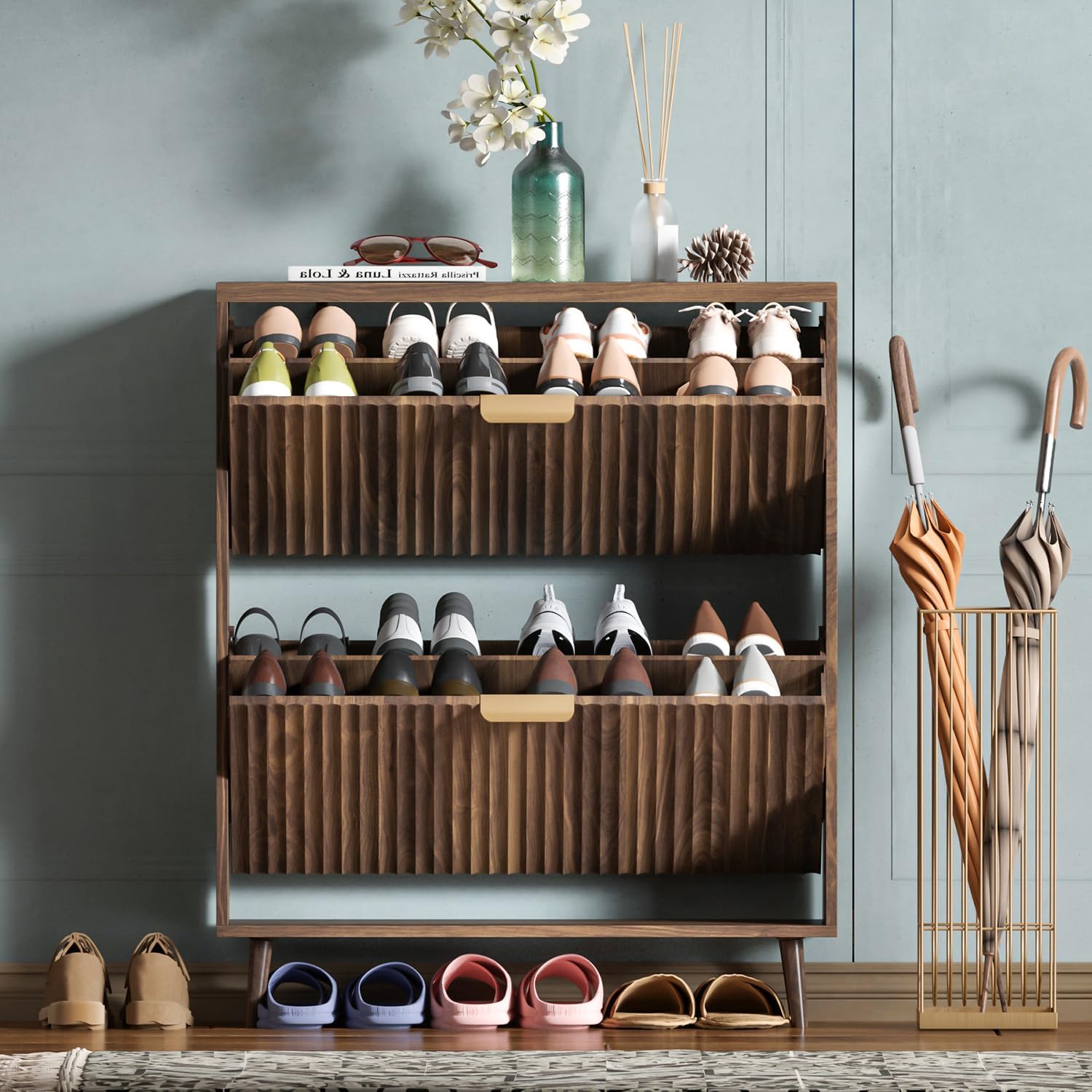
What stands out about this cabinet is how it solves two problems at once: it stores shoes out of sight and it actually looks good doing it. The walnut finish is warm and grounded, not the cold gray or stark white that dominates this category, and the rose-gold arc handles give it just enough personality to feel intentional rather than purely functional.
In a real entryway, this cabinet reads more like a piece of furniture than a storage unit. The thick top surface invites a small plant, a candle, or a catch-all tray, which means it contributes to your decor instead of fighting it. The flip drawers are a practical win too since they open forward and close flush, keeping narrow hallways clear even when the cabinet is in use.
If you want a clutter-free entryway that looks styled without spending hours on it, this one delivers.
Styles it works with: Modern, Mid-Century Modern, Japandi, Transitional
Best placed in: Entryway beside the front door, hallway along a narrow wall, mudroom with limited square footage
May not suit: Very small apartments where even a 31.5-inch wide piece feels oversized, or traditionally styled homes where heavy ornate wood tones and hardware are the dominant aesthetic
Buy it if:
- Your entryway is under 12 inches deep and standard shoe cabinets have never fit the space
- You want shoes fully hidden behind closed doors rather than displayed on an open rack
- You have kids or pets and need a wall-anchorable unit that will not tip
Consider waiting if:
- You regularly wear tall boots and need the full two-compartment capacity intact without removing the divider
Skip it if:
- You need storage for more than 14 adult pairs without any modifications
- Your entryway style is heavily traditional or rustic and warm walnut tones would clash with existing dark-stained or painted furniture
Check the latest price and availability on Amazon before it sells out.
1. HOKYHOKY Rattan Shoe Cabinet with 4 Flip Drawers — Best Overall for a Tight Entry
The HOKYHOKY measures roughly 31.5 inches wide, about 9.4 inches deep, and near 34 inches tall, and that sub-10-inch depth is the whole reason it works in a narrow entry. The flip drawers tilt shoes vertical so the cabinet hugs the wall without projecting into the door swing. This is the pick when you want the most hidden capacity in the slimmest body, because the two drawers plus two flip compartments stack roughly nine to twelve pairs behind a clean rattan front while the floor stays clear. The flat top lands keys, mail, and a small lamp, so the cabinet doubles as an entry drop zone. Owners rate it 4.7 and point to the sturdy build and the attractive rattan doors that hide clutter. The light finish keeps the visual weight down in a small hall. The honest trade-off: flip drawers suit low-profile shoes and flats best, so tall boots may need to lie flat elsewhere. For everyday sneakers and shoes, though, this is the most space-efficient pick here, and the closed front keeps a busy entry looking calm.
2. SLEEPING LAMB Over-the-Door Shoe Organizer — When There’s No Floor Space at All
The SLEEPING LAMB hangs about 59 inches long and 22 inches wide with deep pockets, adding zero footprint since it uses the back of a door, and that off-the-floor design is the entire point. It’s the pick for an entry so tight there’s no room for any cabinet on the ground. Where the flip cabinets need wall and floor, this one claims dead vertical space behind a door, freeing the entire floor for walking. The large deep pockets hold boots and taller shoes that flip drawers can’t, so it handles exactly what the cabinets struggle with. In a rental or a hall with no spare floor, that door becomes your whole shoe system. Owners rate it 4.6 and highlight the roomy pockets and the simple no-tools install. It keeps shoes visible and reachable rather than hidden. The caveat: it’s visible storage on a door, so it reads less tidy than a closed cabinet, and it needs a door that isn’t already in constant swing traffic.
3. QIVOMIX Walnut Shoe Cabinet with 2 Flip Drawers — The Slimmest Body for the Narrowest Hall
The QIVOMIX runs about 27.5 inches wide, roughly 9 inches deep, and near 32 inches tall, and its compact width paired with a 9-inch depth makes it the leanest freestanding pick. It’s built for an entry so narrow that even the HOKYHOKY’s 31.5-inch span won’t fit. Where the HOKYHOKY maximizes capacity, this one minimizes footprint, so it slots into a short, tight wall run that a wider cabinet would overwhelm. The two flip drawers still tilt shoes vertical to keep the body slim, holding roughly six pairs behind a clean walnut front. The flat top works as a small landing spot for keys. Owners rate it 4.4 and note the modern walnut look and the space-saving flip design. Its smaller size makes assembly quick and placement flexible. The honest note: with two flip drawers it holds fewer pairs than the HOKYHOKY, so it’s the pick when wall space is the harder limit than pair count.
Comparison Table
| Pick | Dimensions (W×D×H) | Capacity | Space-Saving Feature | Rating |
|---|---|---|---|---|
| HOKYHOKY Rattan | 31.5 × 9.4 × 34 in | ~9–12 pairs | Sub-10-in depth, flip drawers | 4.7 |
| SLEEPING LAMB Over-Door | 59 × 22 in (hangs) | ~12 pairs | Zero floor space, uses door | 4.6 |
| QIVOMIX Walnut | 27.5 × 9 × 32 in | ~6 pairs | Slimmest body, narrowest fit | 4.4 |
Small-Space Layout Tips
Measure the door swing before you place any floor cabinet. Tape the arc the door traces, set the cabinet outside that line, and leave at least 30 inches of clearance to walk through. Match the cabinet width to the wall, leaving 4 to 6 inches of bare wall on each side so it doesn’t look wedged in. Keep the depth under 10 inches in a tight hall — flip-drawer cabinets manage this because they stand shoes upright instead of laying them flat, which is the single trick that makes slim shoe storage work. Last rule: if the floor is genuinely full, go vertical. An over-the-door organizer claims 5-plus feet of unused door height and returns the entire floor to foot traffic, which in the tightest entry is worth more than a closed cabinet front. And leave a few inches of air above any cabinet so the door casing and light switch stay clear.
Frequently Asked Questions
How small an entryway can fit a shoe rack?
It depends on whether you have floor or just a door. If you have a wall with 28 inches of length and 10 inches of depth outside the door swing, a slim flip-drawer cabinet like the QIVOMIX fits. If you can’t spare any floor at all, an over-the-door organizer works in an entry of any size, since it uses vertical space the room isn’t using. Measure the wall run and the door arc before deciding.
What depth shoe rack fits a narrow entryway without blocking the door?
Aim for 10 inches deep or less. An entry needs roughly 30 inches of clearance to open the door and walk through, so a cabinet under 10 inches leaves that path open. The HOKYHOKY at 9.4 inches and the QIVOMIX at 9 inches both hit this because flip drawers stand shoes vertical. Tape the door’s swing on the floor and keep the cabinet’s front edge outside it before you commit to a spot.
How many pairs of shoes can a slim entryway cabinet hold?
It depends on the drawer count. The HOKYHOKY’s four compartments hold roughly nine to twelve pairs, while the two-drawer QIVOMIX holds around six. Flip-drawer cabinets suit flats, sneakers, and low shoes best, since the vertical tilt is sized for them. For tall boots, the over-the-door organizer’s deep pockets work better. Count your everyday pairs first, then match the capacity, keeping seasonal shoes stored elsewhere.
Are flip-drawer shoe cabinets sturdy enough for daily use?
Yes, when placed against a wall and not overloaded off-center. The HOKYHOKY and QIVOMIX use stable frames that handle daily open-and-close, and Apartment Therapy notes that shallow cabinets stay put as long as heavy items sit low. Keep the flat top light, load shoes evenly across drawers, and anchor to the wall if you have small kids. At 32 to 34 inches tall, these units are low enough to be stable in normal use.
Do over-the-door shoe organizers damage the door?
No, not the hook-hung type like the SLEEPING LAMB. It hangs on padded hooks over the door’s top edge, so there’s no drilling and no screw holes. The main caveat is that it can rub the door’s paint over time and won’t work on a door with tight top clearance or one in constant swing traffic. Check that your door has a small gap at the top and isn’t blocked when open.
Which shoe rack is best for a rental entry?
It depends on your floor space. For a rental with a tight but usable wall, the slim QIVOMIX or HOKYHOKY add hidden storage without permanent changes. For a rental with no spare floor or a no-drilling rule, the over-the-door SLEEPING LAMB is ideal, since it leaves no marks and comes with you when you move. Both cabinet picks are freestanding, so neither requires wall damage unless you choose to anchor.
Bottom Line
For most small entryways, the HOKYHOKY rattan cabinet is the one to buy — its 9.4-inch depth clears a tight hall and the flip drawers hide up to a dozen pairs behind a clean front. If your entry has no spare floor at all, the over-the-door SLEEPING LAMB claims the door and returns the floor to foot traffic. For the narrowest wall run under 28 inches, the slim QIVOMIX fits where wider cabinets won’t. Measure your wall length and door swing first, then match the rack to the tighter number.






Write Your Review
No reviews yet. Be the first to share your experience!