

> Editorial Note: I’m Sofia Reyes, a bathroom and wellness editor focused on small-bath organization and materials that hold up to real humidity. The evaluations here reference OEKO-TEX certifications, ASTM moisture-resistance standards, and aggregated owner reviews.
You step out of a ten-minute shower and the mirror is white, the towels are damp, and the air sits heavy on your skin. That’s not a sign of a long shower, it’s a sign that the moisture you made has nowhere to go. Bathrooms hit 60 to 70 percent humidity after a single hot shower, and anything above 50 percent invites condensation, mildew, and that sour smell that clings to towels. The fix is about moving air out, not cleaning harder. Build the rest of the room to handle moisture with best bathroom exhaust fan, best shower curtain liner, best bathroom storage cabinet, best bath towel set, and best bathroom rug non slip.
Reason 1: The Fog That Lingers an Hour After You Shower (No Ventilation)
The most common cause is a fan that doesn’t move enough air, or no fan at all. A bathroom without working ventilation traps every ounce of steam inside, and that steam condenses on the mirror, walls, and ceiling until it slowly evaporates over hours. A humid room with a quiet fan is usually a fan that’s failing, not a room that’s naturally damp.
Check the fan’s airflow rating. A bathroom up to 50 square feet needs a fan rated for at least 50 cubic feet per minute, and anything below that struggles to clear the steam in a reasonable time. A fan that hums but leaves the mirror fogged after 20 minutes is undersized or clogged with dust, and either way it’s not doing the job.
Run the fan for 20 to 30 minutes after the shower ends, not just while the water runs. The moisture keeps off-gassing from towels and surfaces after you’ve dried off, and cutting the fan the moment you step out leaves that residual humidity to settle. Consumer Reports’ bathroom guidance is blunt on this point: most people turn the fan off too early and then blame the room.
Reason 2: The Damp Patch That Never Dries by the Door (Trapped Airflow)
Air has to move to dry a room, and a closed bathroom door stops that movement cold. A tight door seal traps humid air inside like a jar, and even a good fan can’t pull fresh air in if nothing replaces what it pushes out. The result is a room that stays clammy long after the shower.
The gap under the door is the supply path. A door with less than a half inch of clearance under it starves the fan of makeup air, so the fan spins without actually exchanging the room’s volume. If the door sits flush to the floor, the fan is working against a sealed box.
Open the door partway during and after the shower if you can, or leave it cracked for an hour afterward. If privacy matters, a louvered door or a half-inch door undercut gives the fan the airflow it needs without leaving the room wide open. A fan with a clear air path clears a small bathroom in 15 minutes, and the same fan in a sealed room takes twice as long.
Reason 3: The Towels That Stay Wet to the Touch (Trapped Moisture Load)
Towels are sponges, and a damp towel hanging in a humid room keeps pumping moisture back into the air long after the shower. A typical bath towel holds up to a pound of water, and if it never fully dries between uses it becomes a constant humidity source rather than a one-time one. The sour smell is the mildew that follows.
Cramped hanging makes it worse. A towel bunched on a single hook stays wet in its folds for 12 hours or more, while a towel spread fully across a bar dries in 4 to 6 hours. The same towel, two different moisture loads, depending entirely on how it hangs.
Check the towel’s GSM, the fabric weight. A 600 GSM towel holds more water and takes longer to dry than a 400 GSM one, so heavy luxury towels are the worst offenders in a humid bath. ASTM moisture-resistance standards apply to the room’s materials, but the towels are on you to dry fully between uses or the whole room pays for it.
Reason 4: The Musty Smell That Returns Each Morning (Hidden Moisture)
Sometimes the shower isn’t the main source at all. A slow leak under the sink, a toilet seal weeping at the base, or condensation running behind a vanity all feed humidity into the room around the clock, so the air feels damp even on days no one showers. That’s the smell that returns every morning regardless of what you did the night before.
A cold wall behind a warm, damp room is another hidden source. An exterior wall with poor insulation stays cool enough to condense room moisture on its surface, and that constant wet feed mildew inside the wall cavity where you can’t see it. The musty note is the mold telling you it’s there.
Look for soft spots under the vanity, discoloration at the toilet base, and peeling caulk around the tub. Any of those is a moisture source that runs independent of your shower habits, and no amount of ventilation fully solves a leak. Fix the source first, then ventilate.
The Right Gear Moves the Air
Two things knock down bathroom humidity: a fan that actually exchanges the room’s air, and storage that doesn’t trap moisture against walls and pipes. The picks below were chosen for owner ratings above 4.2 and for designs that lift essentials off damp surfaces.
Start with the Choezon wall-mounted medicine cabinet if you want storage that keeps towels and toiletries off the vanity top where condensation pools. Choose the Choezon mirror cabinet with storage if you want the same moisture-clearing benefit with a larger mirrored face. Pick the Meilocar six-shelf wall cabinet if you need maximum vertical storage that keeps everything off the floor where humidity settles.

CHOEZON Black Medicine Cabinet with Mirror - Wall Mount Bathroom Storage, Adjustable Shelves, Reversible Door, 17.7x23.6 Inch
Pros
- Large mirror surface ideal for daily grooming and makeup application
- Adjustable shelving accommodates different bottle and product sizes
- Reversible door hinge allows flexible installation for any bathroom configuration
- Sleek black finish complements modern and contemporary bathroom styles
- Wall mounting frees up valuable counter and floor space
Cons
- No customer reviews yet to validate quality and durability claims
- Particleboard construction may not hold up as well as solid wood in humid bathroom environments
- Cannot be mounted on hollow or plaster walls, limiting installation options in some homes
This medicine cabinet solves one of the most common bathroom frustrations: cluttered countertops and nowhere to put your everyday essentials. The wall-mounted design uses vertical space efficiently, giving you a clean mirror surface plus hidden storage behind it. The black finish brings a crisp, modern look that pairs well with chrome fixtures or matte black hardware.
What sets this cabinet apart is the adjustable shelving inside. You can move the two shelves to three different heights, which means tall skincare bottles and short prescription containers can all fit without wasting space. The reversible door is another practical touch, letting you choose whether it swings left or right based on your sink and outlet placement.
If you want a simple storage upgrade that clears your counters without a full bathroom renovation, this one delivers.
Styles it works with: Modern, Contemporary, Minimalist, Industrial
Best placed in: Above bathroom sink or vanity, in powder rooms with limited counter space, in master bathrooms needing extra storage
May not suit: Bathrooms with hollow or plaster walls (requires solid wall mounting), spaces needing deeper storage for larger items, traditional or vintage-styled bathrooms where the black modern look may clash
Buy it if:
- You need to clear bathroom counter clutter and want a mirror plus storage in one unit
- Your bathroom has modern or contemporary decor and black fixtures
- You have solid walls suitable for mounting and want a straightforward installation
Consider waiting if:
- You prefer to see customer reviews and photos before purchasing a new product
- You need a different finish like white, wood tone, or brushed metal
Skip it if:
- Your bathroom walls are hollow drywall or plaster without solid backing
- You need deeper storage for bulky items or multiple large bottles
Check the latest price and availability on Amazon before it sells out.

CHOEZON Wall-Mounted Bathroom Medicine Cabinet with Mirror - Adjustable Shelves, Space-Saving Storage, White Finish, 17.7x23.6 inches
Pros
- Generous 17.7-inch mirror provides clear reflection for daily grooming
- Three adjustable shelf heights customize storage for your specific products
- Reversible door mounting works for any bathroom configuration
- Clean minimalist design fits modern and traditional bathrooms alike
- Straightforward assembly with pre-installed mirror and labeled parts
Cons
- Particleboard construction may not hold up as long as solid wood or metal cabinets
- Not recommended for hollow or plaster walls, limiting installation locations
- Shallow 5.5-inch depth may not fit larger bottles or bulky items
This medicine cabinet solves one of the most common bathroom frustrations: cluttered countertops with nowhere to stash your daily essentials. The CHOEZON cabinet gives you a proper mirror and hidden storage in one compact package, so you can finally clear off that vanity surface and still have everything within easy reach.
What sets this apart from basic medicine cabinets is the thoughtful flexibility. The reversible door hinge means you are not locked into one opening direction, and the three adjustable shelf positions let you configure the interior around tall skincare bottles or short medicine containers. The clean white finish and frameless mirror keep the look light and unobtrusive, which works whether your bathroom leans modern or traditional.
If you want organized bathroom storage that does not eat up floor space or require a contractor, this cabinet delivers.
Styles it works with: Modern Farmhouse, Scandinavian Minimalist, Coastal, Contemporary
Best placed in: Above bathroom sink or vanity, powder room wall, compact guest bathroom
May not suit: Large master bathrooms where a wider cabinet would better fill the wall space, homes with only hollow drywall or plaster walls without stud backing, bathrooms needing deep storage for bulky hair tools or large product bottles
Buy it if:
- Your bathroom counter is constantly cluttered with bottles and daily essentials
- You need a functional mirror and storage solution in one affordable package
- You are working with a small bathroom or powder room where floor space is limited
- You want a clean, neutral look that blends with existing decor
Consider waiting if:
- You are hoping for a lighted mirror version or a color other than white
- You need to measure your wall space first to confirm this 17.7-inch width fits
Skip it if:
- You need deep storage for large hair dryers, curling irons, or bulky product bottles
- Your walls are hollow drywall or plaster without stud support for secure mounting
- You prefer solid wood or metal construction over particleboard
Check the latest price and availability on Amazon before it sells out.
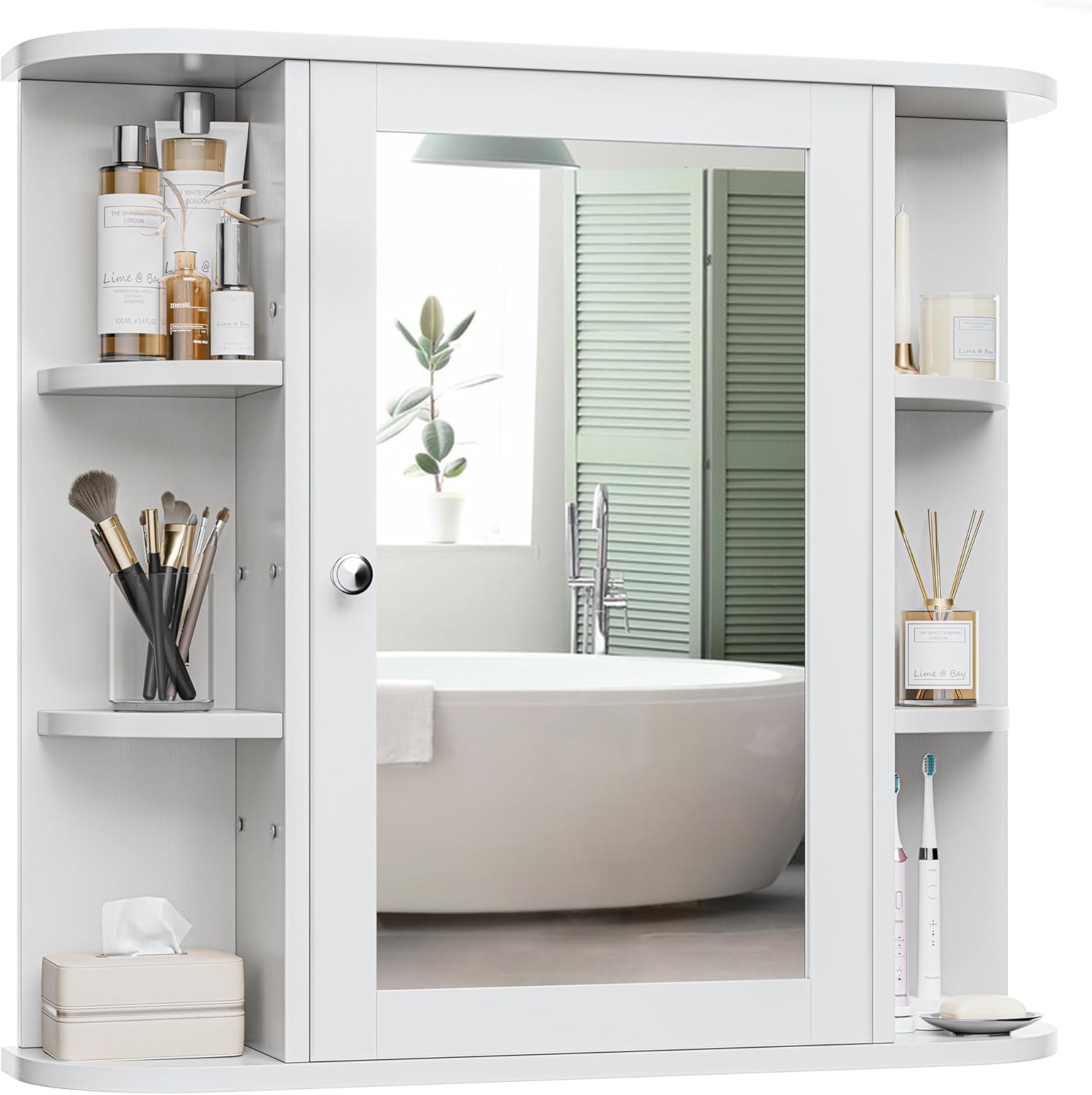
Meilocar Bathroom Medicine Cabinet with Mirror, Wall Mounted, 6 Open Shelves + Enclosed Storage, 26"W White MDF Cabinet
Pros
- Generous storage combining open and closed compartments in one unit
- Clean white finish pairs easily with most bathroom color schemes
- Low-emission MDF board is a healthier choice for enclosed indoor spaces
- At under $55, it delivers more storage features than most cabinets at this price point
Cons
- At 5.9 inches deep, the enclosed shelves have limited depth and may not fit larger bottles or first-aid boxes
- No customer reviews yet, so long-term durability and real-world assembly difficulty are unconfirmed
- MDF is less moisture-resistant than solid wood or PVC, so ventilation matters in high-humidity bathrooms
If your bathroom feels cluttered the moment you add one extra product to the counter, this cabinet is a genuinely useful fix. The combination of a mirrored door and six flanking open shelves means you get a functional mirror, a place to tuck away medicine or toiletries, and styled display space all in one footprint. That kind of multi-tasking is rare at this price.
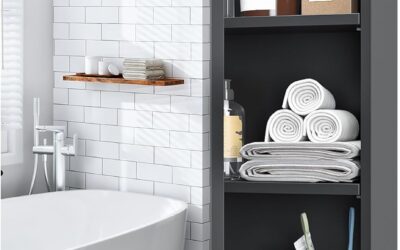
The white finish is clean and understated rather than sterile. It photographs well in a bathroom with warm lighting, and the open shelves give you an easy way to add a small succulent or a stack of linen hand towels for that pulled-together spa look without overthinking it.
Installation is wall-mounted, which keeps your floor and counter completely clear. For small bathrooms, that visual breathing room makes a real difference in how the space feels day to day. If you want organized, display-ready storage without paying for a full vanity renovation, this one delivers.
Styles it works with: Minimalist, Scandinavian, Modern Farmhouse, Contemporary
Best placed in: Above the toilet in a main or guest bathroom, on an open wall in a small bathroom, or on a bedroom wall as a compact vanity-adjacent organizer
May not suit: Bathrooms with heavily ornate or traditional decor where a plain white MDF finish may look out of place; very high-humidity bathrooms without adequate ventilation since MDF is more moisture-sensitive than solid wood or PVC alternatives
Buy it if:
- You need both a mirror and wall storage but have limited bathroom space and do not want to mount two separate items
- You are furnishing a rental or guest bathroom and want a clean, affordable storage solution that looks intentional
- You want open shelves to style with plants or folded towels alongside closed storage for medications or personal care items
Consider waiting if:
- You prefer to read verified customer reviews before purchasing, since this listing currently has no user reviews to validate assembly difficulty or long-term quality
Skip it if:
- You need to store tall bottles, large first-aid supplies, or bulky items, as the 5.9-inch depth will be too shallow for many standard containers
- Your bathroom has poor ventilation or persistent high humidity, where MDF board is a risky long-term choice compared to moisture-resistant materials
Check the latest price and availability on Amazon before it sells out.
The Two-Minute Humidity Check
Check the fan first. Turn it on and hold a tissue to the grille; if the tissue doesn’t stick firmly, the fan isn’t pulling enough air and it needs cleaning, upgrading, or a longer run time. A fan that can’t hold a tissue can’t clear a shower.
Next, look at the door gap. If there’s less than a half inch of clearance under the door, the fan has no makeup air and can’t exchange the room’s volume. A cracked door or a door undercut is the quick fix.
Then check the towels. If the towel from this morning is still damp tonight, it’s feeding moisture back into the room and needs a wider bar or a hotter, drier spot. Fan, door, towels. Cover those three and most bathroom humidity drops sharply.
What to Try Before Buying New Equipment
Start with longer fan run times, not new hardware. Leaving the fan on for 30 minutes after a shower clears the residual moisture most people leave behind, and it costs nothing. The fan you already have may be enough if you actually let it run.
Open the door next. A cracked door during and after the shower gives the fan the airflow it needs, and in a small bathroom that single habit can cut drying time in half. Apartment Therapy’s small-bath editors stress that airflow, not cleaning, is what keeps a bathroom from going musty.
Then rethink the towel hanging. Spread towels fully on a bar instead of bunching them on a hook, and move the bar away from the shower if it sits in the steam path. If the room still reads damp after all three, the fan is undersized and a higher-CFM replacement is the real fix.
When It’s a Leak, Not the Shower
Sometimes the humidity isn’t from the shower at all. A slow leak under the sink or a failing toilet seal feeds moisture into the room 24 hours a day, so the air feels damp even when no one has showered for a day. A room that’s humid on a dry morning has a hidden source.
Look for the signs. A soft or discolored vanity floor, a musty smell strongest under the sink, or a toilet base with a dark ring all point to a leak that ventilation won’t solve. Fixing the leak is the only real fix, and everything else is managing the symptom.
The ASTM moisture-resistance standards cover how the room’s materials should hold up, but a leak defeats even the best-rated vanity. If the humidity returns the morning after a dry day, call a plumber before you buy a bigger fan.
Frequently Asked Questions
How long should I run the bathroom fan after a shower?
At least 20 to 30 minutes after the water stops. The towels and surfaces keep releasing moisture after you dry off, and cutting the fan early leaves that residual humidity to settle. Leaving it on for half an hour clears most rooms fully.
What humidity level is too high for a bathroom?
Anything above 50 percent for extended periods. A shower can spike the room to 70 percent briefly, but if it doesn’t drop back below 50 within an hour, the ventilation isn’t keeping up and mildew risk climbs.
Will a dehumidifier fix a humid bathroom?
It depends. A small dehumidifier helps in a windowless bath with no fan, but in a bathroom with a working exhaust fan, upgrading the fan is cheaper and more effective because a fan exchanges the air while a dehumidifier only pulls moisture from it.
Why does my bathroom smell musty even when it’s clean?
Almost always trapped moisture. A slow leak, damp towels that never fully dry, or condensation inside a wall cavity feed mildew that cleaning the surface won’t reach. Find the moisture source, then the smell goes away on its own.
Should I keep the bathroom door open or closed after a shower?
Open, or at least cracked. A closed door traps humid air inside and starves the fan of makeup air, so the room takes much longer to dry. A cracked door lets the fan exchange the room’s volume and clears the steam in half the time.
Bottom Line
Most bathroom humidity comes from a fan that doesn’t run long enough, a door that traps the air, towels that stay damp, or a hidden leak, and the fan is the one that fixes 80 percent of cases if you let it run 30 minutes after the shower. Open the door, spread the towels, and check the fan’s airflow with a tissue before assuming the room is just naturally damp. If the humidity returns on a morning after a dry day, stop ventilating and start looking for a leak.






Write Your Review
No reviews yet. Be the first to share your experience!