

> Editorial Note: I’m Hannah Lin, an Interior Living Researcher who’s spent 9+ years analyzing the home furniture market. This guide draws on BIFMA, GREENGUARD, and FSC certifications, plus owner reviews aggregated from Wirecutter, Apartment Therapy, and the major home design subreddits.
The most common island mistake isn’t buying one too small. It’s buying one too big and choking the walkways around it, so the kitchen feels tighter after the island lands than it did before. A 48-inch island in a 10-foot-wide kitchen looks great in a showroom photo and terrible in real life, because you’ve eaten the clearance you actually cook in. Get the walkways right first, then size the island to whatever floor is left. If you’re still planning the rest of the room, these guides pair well with island sizing: best gallery wall frames, best console table for entryway, best large floor mirror, best wall mirror for living room, best table lamp for living room. Below is the reference math, room by room, so you can measure once and buy right.
Quick Reference: Kitchen Island Size Chart
| Kitchen Footprint | Recommended Island Size (W x D) | Min. Clearance All Sides | Seating |
|---|---|---|---|
| Under 100 sq ft (galley) | Rolling cart, 18-24″ D x 30-36″ W | 36 inches | 0 |
| 100-150 sq ft (small) | 24-30″ D x 36-48″ W | 36-42 inches | 1-2 stools |
| 150-200 sq ft (standard) | 30-36″ D x 48-72″ W | 42 inches | 2-3 stools |
| 200-300 sq ft (large) | 36-42″ D x 72-96″ W | 42-48 inches | 3-4 stools |
| 300+ sq ft (open plan) | 40-48″ D x 96-120″ W | 48 inches | 4-6 stools |
Islands and desks get sized the same way, which is clearance first and surface second. For the workspace version, what size desk you need covers small offices, dual-monitor setups, and standing height ranges.
Galley and Small Kitchens: How to Measure
Start with the aisle, not the island. The National Kitchen and Bath Association recommends a 42-inch walkway in a one-cook kitchen and 48 inches where two people work. So measure wall-to-wall, subtract 42 inches for each aisle you need, and whatever’s left is your maximum island width. In a kitchen that’s 10 feet (120 inches) wide with cabinets 25 inches deep on one side, you’ve got roughly 95 inches of open floor. Take one 42-inch aisle plus one 36-inch aisle and you’re left with about 17 inches of depth. That’s cart territory, not a built-in.
A rolling cart 18 to 24 inches deep is the honest answer for anything under 100 square feet. It gives you a prep surface and storage without permanently blocking traffic, and you can push it against a wall when you need the floor back. Measure your narrowest doorway too. A cart wider than 36 inches won’t clear a standard 32-inch interior door.
Standard Kitchens With Seating: How to Measure
Here’s the rule that trips people up. Overhang for seating needs 15 inches of knee depth per stool, and each seat needs 24 inches of width to sit comfortably. A 48-inch island only seats two. Want three stools? You need at least 72 inches of counter length, and the seating side has to face open floor with 44 inches of clearance behind so someone can walk past a seated diner.
Measure your ceiling-to-counter run for the island body itself: standard counter height is 36 inches, so leave that fixed and work the footprint horizontally. For a 150 to 200 square foot kitchen, a 30 to 36 inch deep island at 48 to 72 inches wide hits the sweet spot. Keep 42 inches on the working sides and 44 on the seating side. If your math leaves less than 36 inches anywhere, drop the island depth by 6 inches before you drop the aisle.
Large and Open-Plan Kitchens: How to Measure
Big kitchens fail differently. The island gets so wide you can’t reach the center to wipe it. Cap island depth at 48 inches if you want to clean the middle from one side, because the average arm reaches about 25 inches. Anything past a 48-inch depth means you’re walking around to reach the far edge.
For length, the practical ceiling is 10 feet (120 inches) before the island reads as a bowling lane. In a 300 square foot open-plan room, a 40 to 48 inch deep island at 96 to 120 inches wide anchors the space and still leaves 48-inch walkways. If you’re adding a sink or cooktop, the ASTM and manufacturer specs for the appliance dictate the cutout, so measure the appliance first and build 24 inches of landing counter on each side of it. That landing space is non-negotiable for both safety and prep flow.
Our Size-Matched Picks
I sorted these three by footprint, smallest to largest, since the right island is the one that fits your leftover floor and nothing more. All three are mobile carts vetted against owner-review durability reports and material specs, so start with the first if you’re in a galley and jump to the last if you want the widest usable top. Match the depth in each listing to the clearance math above before you buy.


Pros
- Dropleaf design saves space when not in use but extends to seat 2-3 people for casual meals
- Locking casters provide stability during food prep while still allowing easy repositioning
- Ample storage with drawers and open shelving keeps kitchen essentials organized and accessible
- Wood top is heat-resistant and suitable for hot pots and pans during cooking
- Green color option adds personality and warmth compared to standard stainless steel carts
Cons
- No customer reviews yet to verify real-world durability and assembly quality
- At 53.5 inches wide when extended, it may overwhelm very small galley kitchens
- Green finish may not coordinate with all existing kitchen color schemes
This rolling island solves one of the biggest small-kitchen frustrations: never having enough counter space when you need it most. The wood top gives you a proper work surface for chopping, rolling dough, or setting down hot dishes, while the fold-down leaf means you can pull up a stool for a quick breakfast or use it as a buffet station when friends come over.
The green finish is what makes this feel less like generic kitchen equipment and more like a piece of furniture you'd actually want in your space. It has that cottage-kitchen charm without looking overly country, and the wood top keeps it grounded and warm. The fact that it rolls means you can tuck it against a wall during the week, then pull it into the center of the room when you're hosting.
If you want flexible kitchen workspace without committing to a permanent island installation, this one delivers.
Styles it works with: Modern Farmhouse, Cottage, French Country, Eclectic
Best placed in: Small to medium kitchens as a movable prep station, open-plan kitchen-dining areas as a room divider, breakfast nooks for additional seating and storage
May not suit: Very narrow galley kitchens under 8 feet wide when the leaf is extended, homes where the green finish clashes with existing cabinetry or strong color schemes, households needing heavy-duty commercial-grade prep surfaces
Buy it if:
- You need extra counter space for meal prep but don't have room for a permanent island
- You want a breakfast bar solution that folds away when not in use to keep your kitchen feeling open
- You're looking for rolling kitchen storage that also serves as a bar cart or coffee station
Consider waiting if:
- You want to see customer reviews and real-world durability feedback before purchasing
- You're hoping for a sale or discount on this specific model
Skip it if:
- Your kitchen is too narrow to accommodate a 53.5-inch cart even temporarily
- You need a color other than green to match your existing decor
Check the latest price and availability on Amazon before it sells out.

VEVOR 35.4" Kitchen Island Cart with Solid Wood Top - White Rolling Storage with Drawer, Cabinet & Lockable Wheels
Pros
- Real solid wood top resists scratches and water damage better than laminate
- Generous 35.4-inch width provides meaningful extra counter space
- Enclosed cabinet keeps clutter hidden while open racks offer quick access
- Smooth drawer glides prevent frustrating jamming or falling out
- Assembly includes helpful video guide
Cons
- Currently no customer reviews to verify real-world durability claims
- Cabinet doors may require periodic hinge adjustment with heavy use
- White finish shows scuffs more easily than darker wood tones
This kitchen island solves the universal small-kitchen problem: you need more counter space and storage, but you also need flexibility. The solid rubber wood top gives you a proper work surface for chopping and rolling dough, not the flimsy particle board you find on budget carts. The lockable wheels mean you can roll it next to the stove when cooking, then push it against the wall when you need floor space for guests.
What really sets this apart is the thoughtful storage layout. The drawer corrals your utensils, the spice rack keeps oils and seasonings at eye level, and the enclosed cabinet hides your less attractive small appliances while keeping them accessible. The adjustable shelves mean you are not locked into a fixed configuration as your needs change.
If you want flexible kitchen workspace and hidden storage without settling for wobbly construction or fake wood finishes, this one delivers.
Styles it works with: Modern Farmhouse, Coastal, Scandinavian, Transitional
Best placed in: Kitchen peninsula for extra prep area, dining room as a buffet station, open-plan space as a room divider with storage
May not suit: Extremely tight galley kitchens under 8 feet wide, homes with very young children who might pull on towel rack, renters needing furniture that also works in living spaces
Buy it if:
- You need movable counter space that locks securely during meal prep
- Your kitchen lacks a dedicated spot for small appliances and cooking essentials
- You want real wood quality at a mid-range price point
Consider waiting if:
- You need a specific dimension to fit a narrow space (this is 35.4 inches wide)
- You prefer a stained wood or colored finish over white
Skip it if:
- You need an island with seating or overhang for bar stools
- Your kitchen has extremely uneven floors that make wheels impractical
Check the latest price and availability on Amazon before it sells out.

LDAILY Bamboo Kitchen Island Cart with Drawer, Cabinet & 3-Tier Shelves - Rolling Storage Cart with Lockable Wheels
Pros
- Solid bamboo construction with 0.6 inch thick panels feels sturdy and durable
- Multi-zone storage (cabinet, drawer, and open shelves) keeps different items organized
- Lockable casters provide both mobility and stability when needed
- Magnetic door catches allow easy one-handed access while cooking
- Rounded edges make it safer for homes with children
Cons
- No customer reviews yet, so long-term durability is unproven
- MDF is used alongside bamboo, which may not hold up as well in humid kitchens
- At45 lbs, it is heavy to move upstairs or reposition without the wheels on the ground
This LDAILY cart hits a sweet spot that is hard to find: it looks like a piece of furniture, not a utility cart, but still rolls wherever you need it. The natural bamboo grain and varnish finish give it a warm, organic look that blends into kitchens, dining nooks, or even a living room corner as a bar cart.
What makes it genuinely useful is the storage variety. The enclosed cabinet keeps things tidy and out of sight, the deep drawer handles utensils or linens, and the three open side shelves put your most-used items at arm's reach. It is the kind of piece that makes a small kitchen feel twice as functional without eating up floor space.
If you want flexible kitchen storage that doubles as a serving station without the look of a metal utility cart, this one delivers.
Styles it works with: Scandinavian, Japandi, Modern Farmhouse, Coastal Casual
Best placed in: Kitchen wall or island gap, dining room sideboard area, living room corner as a coffee or bar station
May not suit: Very narrow galey kitchens (cart is 16inches deep plus handle clearance), or ultra-modern spaces with all-gloss or all-metal finishes where natural wood may feel out of place
Buy it if:
- You rent an apartment and need extra kitchen counter and storage space without permanent changes
- You entertain often and want a cart you can roll from kitchen to dining area for serving
- You prefer a natural wood look over metal or plastic kitchen carts in the same price range
Consider waiting if:
- You want to see real customer reviews before committing, since this product has none yet
- You need a specific color or darker wood tone that is not currently offered
Skip it if:
- You need a cart narrower than 16 inches for a very tight galey kitchen
- Your kitchen is consistently humid or near a steam source, as the MDF components may not hold up long-term
Check the latest price and availability on Amazon before it sells out.
For the Tightest Kitchen That Still Wants a Breakfast Bar (Homestyles Mobile Kitchen Island Cart)
At 18 inches deep by 53.5 inches wide, this Homestyles cart is built for the kitchen where floor space is scarce but you still want somewhere to eat. The shallow 18-inch body clears a standard doorway and won’t crowd a 42-inch aisle, while the dropleaf breakfast bar folds out only when you need it. The wood top handles daily prep, and at a 4.6 owner rating it’s the highest-rated pick here. The green finish reads as an accent piece rather than a builder-grade add-on. Best for anything under 120 square feet where a fixed island simply won’t fit.
For the Standard Kitchen That Needs Storage More Than Seating (VEVOR Kitchen Island Cart)
The VEVOR splits the difference at 35.4 inches wide with a solid wood top and an enclosed storage cabinet underneath. That cabinet is the reason to pick it: if your kitchen has counters but no pantry, the closed door hides small appliances a shelf can’t. It rolls, so you can reposition it for a party and lock it back in place for daily cooking. At a 4.3 rating owners flag it as sturdy for the price, though the assembly takes patience. Size it for a 100 to 150 square foot kitchen where storage beats a second prep zone.
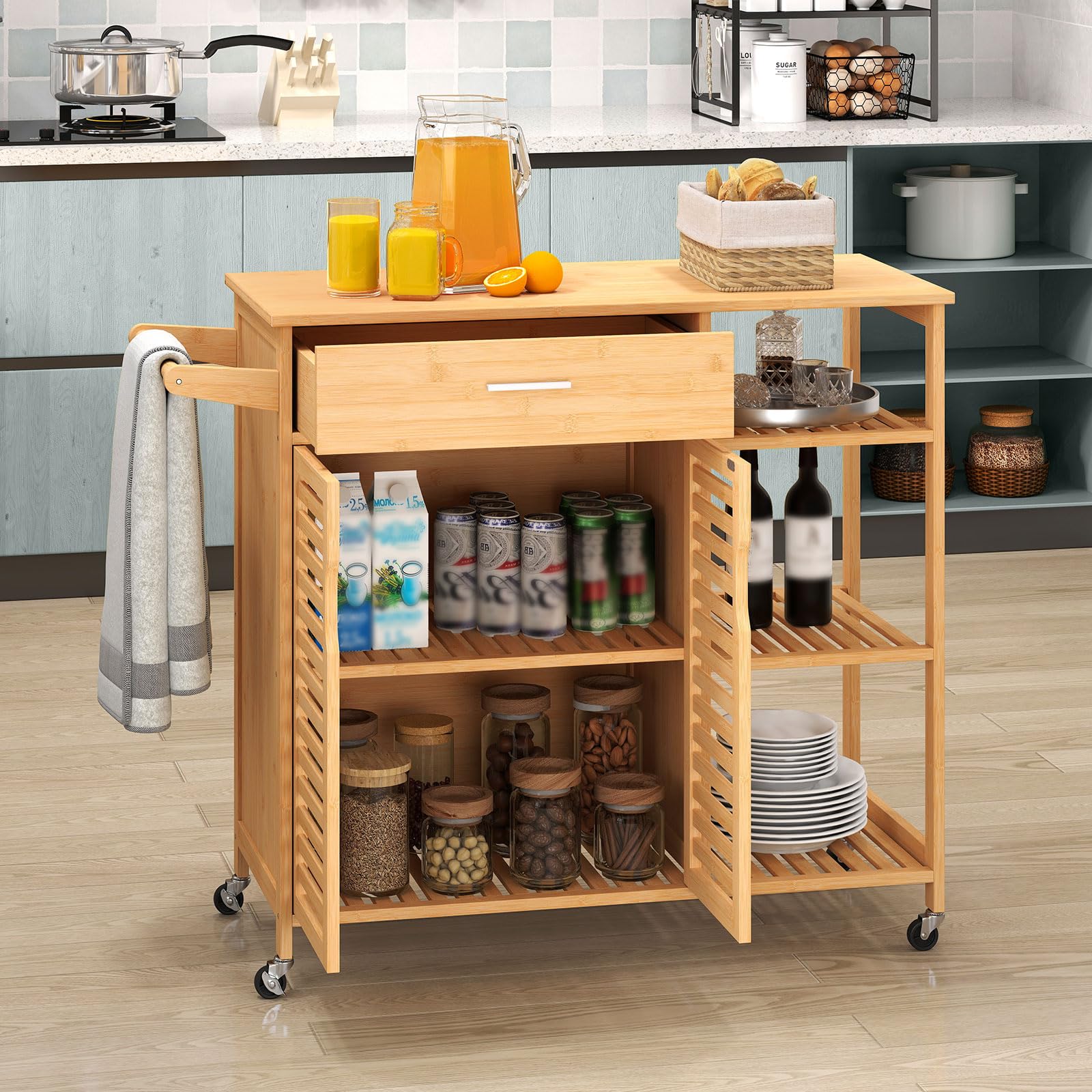
For the Cook Who Wants Shelves, Drawer, and a Greener Top (LDAILY Bamboo Kitchen Island Cart)
The LDAILY leans into storage volume with a drawer, a 2-door cabinet, and 3-tier open shelves on a bamboo top. Bamboo is the sustainability angle here: it’s a fast-renewing material that FSC-adjacent sourcing standards favor over slow-growth hardwood. The wheels and multi-tier layout make it the most flexible organizer of the three, useful when your island doubles as overflow pantry and cookbook shelf. Owner ratings were still settling at publication, so weigh the specs over the star count. Best for a 120 to 180 square foot kitchen that needs the island to store as much as it preps.
Frequently Asked Questions
How much clearance do I need around a kitchen island?
At least 42 inches on every working side, and 48 inches if two people cook at once. Drop below 36 inches and cabinet doors, dishwasher doors, and stools start colliding. The seating side needs 44 inches so someone can walk behind a diner.
What is the minimum kitchen size for an island?
Roughly 100 square feet for a fixed island, or a kitchen at least 13 feet wide so you keep two 42-inch aisles plus a 24-inch-deep island. Under that, use a rolling cart 18 to 24 inches deep instead of a built-in.
How wide should an island be to seat three stools?
At least 72 inches. Each stool needs 24 inches of width to sit without bumping elbows, and 15 inches of knee overhang underneath. A 48-inch island only seats two comfortably.
How deep should a kitchen island be?
Between 24 and 48 inches. Cap it at 48 inches so you can wipe the center from one side, since the average arm reaches about 25 inches. Add 15 inches of that depth as overhang if you want seating.
Can a kitchen island be too big?
Yes. Past 48 inches deep or 120 inches wide, you lose the ability to reach the middle and the walkways shrink below the 42-inch standard. An oversized island makes a kitchen feel smaller and slower to cook in, not larger.
Bottom Line
Size the walkways first, the island second: hold 42 inches on working sides and 48 in a two-cook kitchen, then fit the island to the floor that’s left. Under 100 square feet, a shallow 18-inch rolling cart beats any fixed island. For a standard kitchen, a 30 to 36 inch deep island at 48 to 72 inches wide seats two to three without choking the room. Cap depth at 48 inches so you can still reach the middle. Measure twice, because the biggest island your budget allows is rarely the right one.









Write Your Review
No reviews yet. Be the first to share your experience!