

> Editorial Note: I’m Olivia Bennett, a storage and organization contributor. I approach storage as a systems problem rather than a product one — fit to actual room dimensions, load ratings, and how the system holds up under daily use.
The most common mistake isn’t buying a bookshelf that’s too small. It’s buying one whose shelf spacing can’t fit your actual books, so a 12-inch art book lands sideways on a 9-inch gap. Get the depth and shelf clearance right first, then worry about height. If you’re still building out the room, cross-reference your layout with the best area rug for living room, the best coffee table for sectional, the best accent chair for living room, the best tv stand for 75 inch tv, and the best sofa table so the bookcase scales to everything else.
Quick Reference: Bookshelf Size Chart
| Use / Book Type | Recommended Dimensions (W × D × H) | Shelf Clearance | Notes |
|---|---|---|---|
| Standard hardcovers/novels | 31–36″ W × 10–12″ D × 30–72″ H | 10–12″ | Fits most trade and mass-market books |
| Paperback-only | 24–31″ W × 8–9″ D × 30–48″ H | 8–9″ | Shallow depth saves floor space |
| Oversized art/coffee-table books | 36″ W × 14–16″ D × 42–60″ H | 15″+ | Tall bottom shelf, fewer per column |
| Cube/modular unit | 11–13″ per cube | 11–13″ square | Each opening holds ~15–20 novels |
| Vinyl records | 13–14″ D minimum | 13″+ | Depth is non-negotiable for LPs |
Most freestanding bookcases run 11–12 inches deep, 30–36 inches wide, and space shelves 10–12 inches apart. That’s the baseline. Everything below adjusts from it.
Shelf Depth and Clearance: How to Measure
Start with your tallest and deepest books, not the wall. Pull three or four of the biggest ones off your current stack and measure them with a tape. A standard hardcover novel runs about 9.5 inches tall and 6.5 inches deep. A textbook or art book can hit 12 inches tall and 10–11 inches deep.
Add a two-inch buffer to whatever you measure. So a 10-inch-deep book needs a 12-inch-deep shelf to sit flush without the spine hanging past the edge. Under-deep shelves are the number-one regret in owner reviews aggregated by Wirecutter and Apartment Therapy.
For clearance — the vertical gap between shelves — use this formula: tallest book height + 1 inch. Fixed-shelf units lock you into one number, usually 11 or 12 inches. Adjustable shelves let you drop a 15-inch gap for oversized books and tighten the rest to 9 inches for paperbacks. If you own anything oversized, adjustable wins every time.
Height and Width: How to Measure
Freestanding bookcases come in three common heights: 30 inches (two shelves), 48–60 inches (four shelves), and 72–84 inches (five to six shelves). A 30-inch unit doubles as a console under a window. Anything over 60 inches should be anchored to a wall stud — a non-negotiable safety step per ASTM F2057 tip-over standards for storage furniture.
For width, measure your wall opening and subtract at least 3 inches total so the unit slides in without scraping trim. A single-column bookcase is typically 24–36 inches wide. Need more? Line up two 31-inch units rather than hunting for one 62-inch piece — modular is easier to move and level.
Leave 30–36 inches of walkway clearance in front. That’s the standard traffic-flow minimum, and it keeps a full bookcase from crowding a room. Cube units stack differently: an 8-cube grid is roughly 24 inches wide by 48 inches tall in a 2×4 layout, or 48 by 24 turned on its side as a bench-height divider.
Load Rating and Rules of Thumb
Books are heavy. A packed 12-inch shelf, 30 inches wide, holds roughly 20–30 pounds of hardcovers, sometimes more. Cheap particleboard shelves sag at that load over 30 inches unspanned, so keep individual spans under 30 inches or choose a unit with a center support.
Three rules that prevent most problems. First, weight goes low: heaviest books on the bottom shelf keeps the center of gravity down and resists tipping. Second, never fill a shelf past 80 percent, leave room to slide books out without pulling three others with them. Third, match depth to contents, not to looks. A shallow 8-inch unit looks tidy until a single 10-inch book won’t close the gap.
Cube organizers rated for 20–25 pounds per cube handle books fine; just don’t overload a single opening. BIFMA durability guidance treats fastener quality and shelf-span as the two failure points, and that tracks with what shows up in long-term owner reports.
Our Size-Matched Picks
Three picks below, chosen for shelf clearance that fits real books, a documented per-shelf or per-cube load rating, and owner ratings at or above 4.2. Start with the cube units if you’re fitting an alcove; jump to the Furinno if you want a slim vertical column against a wall.

Pros
- Impressive 236 lb total load capacity for a budget cube organizer
- Versatile orientation works in tight spaces, hallways, or wide walls
- Compatible with widely available 11-inch fabric bins for a cohesive look
- Scratch-resistant surface requires minimal upkeep
- Available in three colorways to match different decor palettes
Cons
- No customer reviews yet to confirm long-term durability claims
- Storage bins are not included, adding to the total cost
- Enginered wood may not satisfy buyers looking for solid hardwood construction
This LUCKLIFE 8-cube organizer solves one of the most common home frustrations: too much stuff, not enough structure. It gives you eight defined compartments that work with standard fabric bins, so you can hide clutter while keeping everyday items within reach. The black finish and clean lines make it look more intentional than a typical budget shelf.
What sets it apart is the flexibility. Stand it tall in a narrow hallway, lay it wide as a low media console, or stack two units for a full wall of storage. The optional back panels are a nice touch, letting you decide how open or enclosed each section feels. It is the kind of piece that adapts when you rearrange a room or move to a new apartment.
If you want structured, modular storage that fits real-life spaces without spending more than sixty dollars, this one delivers.
Styles it works with: Minimalist, Modern, Scandinavian, Small-Space Living
Best placed in: Living room wall or corner, home office under or beside a desk, bedroom closet area or hallway nook
May not suit: Rooms with traditional ornate decor where enginered wood may look out of place, or very small spaces where even the compact footprint feels bulky
Buy it if:
- You need affordable, flexible storage that can be reconfigured as your space changes
- You already own or plan to buy 11-inch fabric bins and want a frame to house them neatly
- You want one piece that can serve as a bookshelf today and a media console tomorrow
Consider waiting if:
- You prefer the white or vintage brown finish and want to confirm color availability before ordering
Skip it if:
- You need solid wood furniture that will last decades through multiple moves
- You want a shelf with doors or drawers for fully concealed storage
Check the latest price and availability on Amazon before it sells out.

Pros
- Reversible orientation adds layout flexibility most budget shelves do not offer
- FSC-certified materials make it a more responsible choice among entry-level furniture options
- Slim 9.4-inch depth keeps floor space free in small apartments and dorm rooms
- Smooth closed back and clean lines look intentional rather than purely functional in a styled room
- Step-by-step assembly instructions and included hardware pack make setup straightforward for solo assemblers
Cons
- 20 lb per cube weight limit rules out storing heavy textbooks, vinyl records, or dense decor collections across all five cubes simultaneously
- Composite wood construction will not hold up to moisture or rough handling the way solid wood furniture would
- At 19.5 inches wide, the unit is narrow enough that it can feel visually underwhelming as a standalone storage solution in a larger room
What makes the Furinno LUDER 5-Cube stand out in a crowded budget bookshelf market is its reversible design. Most shelves at this price are fixed, single-use pieces. This one adapts. You can run it vertically as a tall narrow tower beside a desk or flip it horizontal as a low media console under a window, and it reads as a deliberate design choice either way.
In a real room it punches above its weight visually. The white finish with clean rectangular lines reads as modern Scandinavian rather than flat-pack generic, especially when you mix in a few small plants, a couple of framed prints leaning against the back, and a neutral storage bin or two. The closed back keeps the display looking tidy even when the cubes are not perfectly organized.
It is not trying to be heirloom furniture, and that honesty is part of the appeal. It does exactly what a first apartment or college dorm needs it to do without requiring you to own a drill or a truck. If you want flexible open storage that looks considered without the commitment of heavy solid-wood furniture, this one delivers.
Styles it works with: Minimalist, Scandinavian, Contemporary, and Clean Modern
Best placed in: A living room corner next to a sofa, a home office wall beside a desk, or a bedroom wall as a nightstand-height display shelf when oriented horizontally
May not suit: Homes with a Rustic Farmhouse or Industrial aesthetic where raw wood and metal finishes dominate, or households with young children who may pull on open cubes since the slim depth and lightweight build are not designed for climbing-resistant stability
Buy it if:
- You are furnishing a first apartment or dorm room and need clean-looking storage fast without spending over $100
- You have a small room under 150 sq ft and need a shelf that fits a 19-20 inch wall slot without dominating the space
- You want a versatile unit that can shift rooms or orientations as your living situation changes
Consider waiting if:
- You are planning a full room refresh and want to compare the 7-cube or 11-cube LUDER versions first to see if a larger footprint would serve you better
Skip it if:
- You need to store heavy items like full sets of hardcover encyclopedias, dense textbook collections, or media equipment that regularly exceeds 20 lbs per shelf
- You are furnishing a garage, workshop, or any damp or outdoor-adjacent space where composite wood will deteriorate quickly
Check the latest price and availability on Amazon before it sells out.
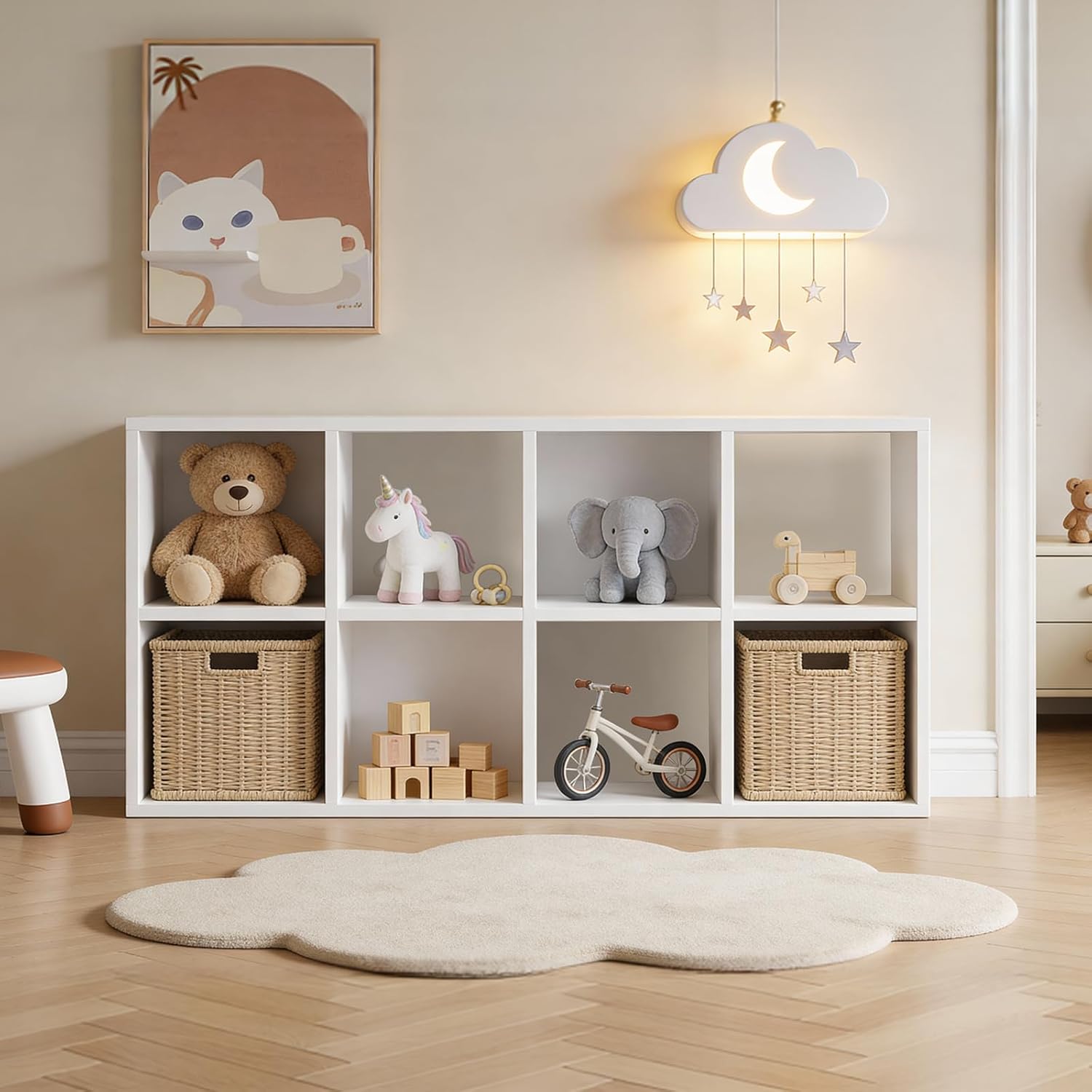
LUCKLIFE 8-Cube Storage Organizer Stackable Modular Bookcase Shelf, Fits 11x11 Bins, Optional Back Panels, White
Pros
- High total load capacity of 236 lbs across all cubes
- Versatile orientation works in narrow hallways or wide living room walls
- Compatible with widely available 11-inch storage bins for a tidy look
- Scratch-resistant laminate surface is forgiving in high-traffic areas
- Partial back panels add structure without making it look bulky
Cons
- Only 31 reviews so far, making long-term durability harder to confirm
- Assembly required with enginered wood means alignment must be precise to avoid woble
- Back panels are partial, so wall color shows through and dust can collect behind items
This 8-cube organizer from LUCKLIFE hits the sweet spot between affordable flat-pack furniture and something that actually looks intentional in your space. The clean white finish and partial back panels give it a modern, airy feel that works whether you stand it tall in a corner or lay it wide against a wall.
In a real room, it reads as a simple bookcase or media console rather than cheap storage. Pair it with woven bins and few styled objects on the open cubes and it genuinely elevates a room without a major investment. The 236-lb total capacity means you do not have to baby it.
If you want flexible, room-ready storage without spending hoursagonizing over built-in shelving, this one delivers.
Styles it works with: Minimalist, Scandinavian, Modern Apartment, Japandi
Best placed in: Living room wall as a low media console, home office corner as a vertical bookcase, hallway or entryway for shoe and bag storage
May not suit: Very traditional ornate decor styles where enginered wood looks out of place, or homes with toddlers who may climb an unsecured vertical unit
Buy it if:
- You need adaptable storage that can shift from vertical to horizontal as your layout changes
- You already own or plan to buy 11-inch fabric bins and want a frame to house them neatly
- You are furnishing a rental or starter apartment and want clean storage under $65
Consider waiting if:
- You prefer a darker finish and the rustic brown or black option is currently out of stock
Skip it if:
- You need fully enclosed storage with doors to keep pets or dust completely out
- You want solid wood construction that will last through multiple moves without risk of damage
Check the latest price and availability on Amazon before it sells out.
LUCKLIFE 8-Cube Storage Organizer. This modular unit fits standard 11×11-inch cube bins and can run vertical (roughly 24″ W × 48″ H) or horizontal as a low divider. Each cube swallows about 15–20 novels, and the reversible layout means you size it to the wall rather than the other way around. At a 4.2 owner rating, it’s the flexible pick for anyone who moves often or wants to reconfigure a room without buying new furniture. Keep heavy books in the bottom row to stay stable.
Furinno LUDER 5-Cube Bookshelf. Measuring 9.4 × 19.5 × 31.5 inches, this is the narrow-depth column for paperbacks, streaming boxes, and mass-market books. The 9.4-inch depth won’t take a 10-inch art book, so match it to smaller-format collections. It’s the one that tucks into a tight corner or beside a desk where a full 12-inch unit would crowd the walkway. Rated 4.3 by owners, with assembly that’s genuinely quick, a real plus in this price tier.
LUCKLIFE 8-Cube (Horizontal-First Layout). Same 11×11-inch cube footprint as the first pick, but plan this one as a horizontal 4×2 run, about 48 inches wide by 24 inches tall. That height makes it a window bench or a room divider you can see over, and the stackable design lets you add a second unit on top later. It holds the same 15–20 books per cube and carries a 4.2 rating. Choose it when floor space is wider than it is tall.
Frequently Asked Questions
What is the standard depth of a bookshelf?
Most freestanding bookcases are 11–12 inches deep, which fits standard hardcovers up to about 10 inches deep with a buffer. Paperback-only units run shallower at 8–9 inches. For vinyl records or oversized art books, go 13–16 inches deep, anything less and the contents hang over the edge.
How tall should a bookshelf be?
It depends on the room, but three heights cover most needs: 30 inches for a console-style two-shelf unit, 48–60 inches for a four-shelf mid-height, and 72–84 inches for a full five-to-six-shelf wall. Anchor anything over 60 inches to a wall stud per ASTM F2057.
How much space should be between bookshelf shelves?
Use tallest book plus 1 inch. Standard adjustable units offer 10–12 inches of clearance, which fits most trade hardcovers. Drop in a 15-inch gap for oversized art books and tighten unused shelves to 9 inches for paperbacks. Fixed-shelf units lock you at one spacing, usually 11 inches.
How wide is a standard bookcase?
A single-column bookcase is typically 24–36 inches wide, with 31 inches being the most common size. For wider walls, line up two 31-inch units instead of one oversized piece, easier to level and move. Always subtract 3 inches from your wall opening for clearance.
How much weight can a bookshelf hold?
A 30-inch shelf at 12 inches deep holds roughly 20–30 pounds of hardcovers. Keep unsupported spans under 30 inches to prevent sag, and don’t fill past 80 percent capacity. Cube units rated 20–25 pounds per 11-inch cube handle books fine as long as you don’t overload one opening.
Bottom Line
For most home libraries, a 31–36 inch wide unit, 11–12 inches deep, with 10–12 inch adjustable shelf clearance is the correct size, it fits standard hardcovers with a buffer and scales to a typical wall. The main exception is oversized art or coffee-table books, which demand 14–16 inch depth and a 15-inch bottom shelf. Measure your deepest books before your wall, keep spans under 30 inches to stop sag, and anchor anything taller than 60 inches. Depth is the spec people get wrong most often.




Write Your Review
No reviews yet. Be the first to share your experience!