

> Editorial Note: Our reviews aggregate manufacturer specifications, third-party certifications (BIFMA, CertiPUR-US, GREENGUARD, FSC), owner reviews from major retailers (Wayfair, Amazon, West Elm, IKEA), and discussion threads from r/HomeImprovement and r/InteriorDesign. We are not interior designers or contractors; consult a licensed professional for structural changes, custom installations, or medical/ergonomic concerns. Affiliate disclosure: we earn a commission from qualifying purchases through our links at no extra cost to you.
A late-afternoon sliding glass door, the kind that runs floor to ceiling and spills onto a small patio, turns into a glare problem by 4 p.m. and a heat problem by 6. The fix isn’t a designer overhaul. It’s the right fabric, the right length, and a header style that lets the panel travel without snagging. The five panels below earn their place on that brief.
These selections lean neutral on purpose. Greige, oat, soft charcoal, warm white. The point is to make the glass feel intentional, not curtained over. They pair quietly with the choices many readers have already locked in for the best curtains for living room and the best area rug for living room, so the patio side of the home reads as one continuous space rather than a separate annex. Readers comparing pure product specs across the category often land on our deeper sister piece, the best curtains for sliding glass doors roundup, which sits adjacent to this aesthetic-first guide.
What Ties These Together
Five qualities surfaced across every panel that made the shortlist. Extra length, first, because a sliding door is taller than a window and a panel that floats above the floor reads cheap. Most panels here land at 95 to 108 inches. Heavyweight body, second, with linen blends in the 250 to 300 GSM range, or triple-weave blackout in the 280 to 330 GSM range. Both hang straight instead of flapping when the door rolls open. A header that slides, with grommet tops or back-tab construction that glides on a tension rod without bunching. Light control as a spectrum, fourth, with options ranging from 60 percent room-darkening to 99 percent true blackout. And a palette that disappears, with colors chosen to recede behind the architecture instead of competing with the view through the glass.
1. NICETOWN Thermal Insulated Blackout, The Heavyweight Anchor
If the room faces west and the sun sets through the glass, this is where most owners settle. The triple-weave construction blocks roughly 85 to 99 percent of light depending on color, according to manufacturer documentation, and the 52-inch panel width pairs as a two-panel split across a standard 72-inch sliding door without leaving daylight gaps. Aggregated owner reviews from Amazon and r/InteriorDesign consistently note the panel’s weight: heavy enough to hang straight from day one, no steaming required.
The color range matters more than buyers expect. Greyish white reads as soft cream in north light and as warm white in south light. Beige reads slightly green against cool wall paint and slightly pink against warm paint, so it’s worth ordering a swatch first. The grommet header sits flat against a 1.6-inch rod and slides quietly. Owners pairing this panel with a darker floor tend to choose Greyish White; pairing with a lighter floor, the Beige.
2. Deconovo Faux Linen Light-Filtering, The Sheer-Over-Blackout Partner
Aesthetic-first rooms rarely run one curtain layer. They run two. This faux linen panel is what most editors at Apartment Therapy and House Beautiful would call the front layer: semi-sheer, around 65 to 70 percent light filtering, with a slubbed texture that mimics genuine European linen at roughly a tenth of the cost. Manufacturer specs list a 100 percent polyester body engineered to resist wrinkling, which matters because sliding-door panels see more daily handling than window panels.
The way it hangs is the real argument for it. The fabric has just enough body to drape in soft vertical folds rather than crumpling against the floor, and the back-tab header reads cleaner than a rod-pocket from the room side. Pair it behind a blackout layer, as the layering pattern goes, and the room reads as a styled space during the day and a fully darkened one at night.

3. H.VERSAILTEX Heavyweight Linen Look, The Texture Specialist
This is the panel that does the heaviest aesthetic lifting. The thicker linen-look weave, which manufacturer documentation lists in the 250 GSM range, gives the panel a sculptural quality that flatter polyester can’t match. Owner reports from Wayfair and Amazon repeatedly mention how the texture catches afternoon light, breaking it into a soft diffuse glow rather than a harsh shaft.
A few practical notes. Color accuracy runs better than the category average; the Natural and Stone Grey options photograph close to what arrives. The panel runs 96 or 108 inches long, which is the right length for most sliding doors mounted with the rod about four inches above the frame. Owners who want the curtain to puddle slightly on the floor should size up to 108. Owners who want a crisp break at the floor should stay at 96. Either way, the panel hangs heavy enough that it doesn’t billow when the door slides open.


NICETOWN Gray Blackout Curtain Panel 100x84 - Thermal Insulated Grommet Drape for Patio Sliding Door & Room Divider
Pros
- Exceptional value at under $18 for a 100-inch wide panel with 35,000+ positive reviews
- Heavy, high-quality triple-weave polyester feels luxurious and blocks light better than thin alternatives
- Wide enough to cover patio doors in one panel instead of buying multiple curtains
- Same fabric on both sides looks polished from inside and outside the home
- Effectively reduces heat transfer to keep rooms cooler in summer and warmer in winter
Cons
- Gray color may appear darker or lighter depending on room lighting and may not match all decor palettes
- Single panel requires purchasing multiples if you need coverage for very wide openings or prefer a symmetrical look
- Not 100% blackout in direct bright sunlight, though blocks most light effectively
This NICETOWN panel solves the biggest challenge with patio doors: finding a single curtain wide enough to cover the entire opening without buying multiple panels or dealing with awkward gaps. At 100 inches wide, it drapes beautifully across sliding glass doors while the soft gray color works with nearly any decor style.
The triple-weave fabric feels substantial in your hands, not flimsy or see-through like cheaper options. It genuinely cuts down on street noise and keeps rooms noticeably cooler in summer, which means your air conditioner does not have to work as hard. Customers also love using it as a room divider in studio apartments or shared bedrooms where you need instant privacy without construction.
If you want serious light blocking and energy savings for a sliding door or oversized window without spending over $50, this one delivers.
Styles it works with: Modern Farmhouse, Scandinavian, Minimalist, Transitional
Best placed in: Living room sliding doors, bedroom patio access, home office with large windows, studio apartment room dividers
May not suit: Homes needing true 100% blackout for shift workers or nurseries with east-facing windows; spaces where you prefer lighter, airier window treatments over heavy drapes
Buy it if:
- You have a sliding glass door or extra-wide window that needs coverage in one panel
- You want to lower energy bills by insulating against heat loss and gain
- You need privacy and noise reduction in a room that faces a busy street or neighbor's yard
Consider waiting if:
- You need a specific shade of gray that matches existing decor perfectly and want to order fabric swatches first
Skip it if:
- You require absolute pitch-black darkness for medical or sleep reasons and cannot tolerate any light seepage
- You prefer sheer or semi-sheer treatments that let natural light filter through during the day
Check the latest price and availability on Amazon before it sells out.

Joydeco Extra Wide Blackout Curtains for Sliding Glass Doors - 100x84 Inches Grommet Panel, Thermal Insulated Room Divider (Black)
Pros
- Excellent value at under $21 for a 100-inch wide panel
- High customer rating (4.7/5 from nearly 3,000 reviews) signals reliable quality and performance
- Soft, durable polyester fabric that feels premium and resists wrinkles
- Versatile use cases: sliding doors, room dividers, patio access, or basement partitions
- Low-maintenance care with machine wash and low-temp iron compatibility
Cons
- Blocks 75% of light, not full blackout, so early risers or shift workers may still see morning glow through darker colors
- Single panel only, so you'll need to buy two if you want a traditional pair for symmetry or full coverage
- Lighter colors will have weaker blackout performance compared to black or navy options
This curtain solves a common frustration: finding affordable, functional coverage for wide sliding glass doors without the hassle of coordinating multiple panels. The 100-inch width means you get seamless privacy and light control in one piece, and the grommet design makes hanging it a five-minute job. The fabric feels substantial without being stiff, and the black color adds a modern, grounded look that works in nearly any room.
What stands out is how well it balances price and performance. At around $20, you're getting thermal insulation that noticeably cuts down on drafts and sun heat, plus enough blackout power to darken a room for afternoon naps or movie nights. It's not pitch-black darkness, but it's more than enough for most households. The high review count and 4.7-star rating back up what you'd hope: it arrives as described, hangs well, and holds up through regular use and washing.
If you want a single-panel solution for sliding doors or room division without spending $50+ or dealing with complicated installation, this one delivers.
Styles it works with: Modern, Minimalist, Industrial, Contemporary, and Scandinavian interiors where clean lines and neutral tones dominate.
Best placed in: Living rooms with sliding patio doors, bedroom closets with wide openings, basement rec rooms as a partition, or studio apartments to create separate sleeping and living zones.
May not suit: Traditional or ornate decor styles that call for ruffles, tiebacks, or layered window treatments; homes needing total darkness for medical or sleep sensitivity reasons (consider doubling up or choosing a heavier blackout option).
Buy it if:
- You have a sliding glass door or wide opening (8+ feet) and want to avoid the cost and gap of buying two separate curtain panels.
- You're a renter looking for an affordable, damage-free way to add privacy and temperature control without permanent fixtures.
- You want a flexible room divider for an open floor plan, basement, or shared bedroom that's easy to open and close daily.
Consider waiting if:
- You need a color other than black and want to see if the brand restocks lighter neutrals or jewel tones in this size.
- You're holding out for a seasonal sale or bundle deal if you need multiple panels for different rooms.
Skip it if:
- You require 100% pitch-black darkness for shift work or medical light sensitivity (look for lined or double-layer blackout curtains instead).
- Your door or window is narrower than 80 inches, as this panel will puddle excessively on the floor or bunch awkwardly to the side.
Check the latest price and availability on Amazon before it sells out.

Yakamok 100% Blackout Thermal Insulated Curtain Panel for Patio Door - Grey 100x84, Noise Reducing, Energy Saving Grommet Drape
Pros
- True 100% blackout performance with dual-layer triple-weave construction
- Extra-wide 100-inch width eliminates the need for multiple panels on large openings
- High customer satisfaction with 4.8/5 rating across over 8,000 reviews
- Year-round energy efficiency helps lower heating and cooling bills
- Durable polyester fabric holds up well to washing and daily use
Cons
- Single panel only per package, so covering standard-width windows requires multiple purchases
- Heavy fabric may require sturdy curtain rods to support the weight
- Grey color may not match all decor schemes; limited color options for this size
This curtain delivers on its blackout promise in a way that cheaper alternatives simply don't. The dual-layer construction is noticeably thick and substantial when you handle it, and it completely blocks morning sun, streetlights, and even bright midday glare. If you've struggled with flimsy curtains that let light leak around the edges, this one solves that problem.
Beyond darkness, the thermal performance is a real bonus. Rooms stay noticeably cooler in summer and warmer in winter, which translates to lower energy bills over time. The wide 100-inch panel is a lifesaver for patio doors, eliminating awkward gaps between multiple panels. The fabric feels soft and drapes elegantly, not stiff or plasticky like some blackout curtains.
If you want total light control and energy savings without sacrificing style or dealing with complicated installation, this one delivers.
Styles it works with: Modern, Contemporary, Minimalist, Scandinavian
Best placed in: Living room patio doors, bedroom sliding doors, home office with large windows, studio apartments for room division
May not suit: Small rooms where heavy curtains might feel overwhelming, vintage or ornate decor styles that call for patterned fabrics, households needing frequent access to doors (the weight can slow opening and closing)
Buy it if:
- You need complete darkness for better sleep, especially if you work night shifts or have young children napping during the day
- You have a sliding glass door or extra-wide window and want to avoid the hassle of hanging multiple panels
- You're looking to lower energy bills by insulating large openings that let in drafts or summer heat
Consider waiting if:
- You're unsure about the grey color and want to see if other shades become available in this size
- You need an exact custom length and prefer tailored curtains over standard sizes
Skip it if:
- You only need to cover a standard 36 to 60 inch window and don't want excess fabric bunching on the sides
- You prefer sheer or semi-sheer curtains that filter light rather than block it entirely
Check the latest price and availability on Amazon before it sells out.

H.VERSAILTEX Extra Wide Blackout Curtain Panel 100x96 Inches for Sliding Patio Door - Thermal Insulated Grommet Top - Jet Black
Pros
- Exceptionally wide single panel eliminates gaps and center seams on large doors
- High-quality triple-woven fabric blocks light effectively while feeling soft and luxurious
- Over 31,000 reviews with a 4.6-star rating demonstrate consistent customer satisfaction
- Versatile use as room divider, workspace partition, or basement window covering
- Grommet construction makes installation and daily use effortless
Cons
- Single panel means you need to purchase two if you want a center opening for your door
- At 96 inches long, may require hemming for standard 8-foot ceilings
- Heavy fabric weight requires a sturdy curtain rod to support properly
This curtain panel solves the biggest frustration with covering patio doors: those annoying gaps and seams that let light leak through. At 100 inches wide, it spans most sliding doors in a single sweep of fabric, giving you true blackout performance without the center split. The triple-layer construction isn't just marketing speak. It genuinely keeps rooms cooler when the afternoon sun beats down on your glass door, and it muffles street noise enough to make a difference if you live near a busy road.
The fabric has a substantial, quality feel that drapes beautifully rather than hanging stiff like cheaper blackout panels. The jet black color is deep and consistent, and the grommets glide smoothly when you want to open or close it. At this price point for an extra-wide, full-length panel, you're getting excellent value without the flimsy feel of budget curtains.
If you want complete light control and energy savings for your patio door without spending twice as much on custom treatments, this one delivers.
Styles it works with: Modern, Contemporary, Industrial, Minimalist
Best placed in: Living rooms with sliding glass doors, master bedrooms with patio access, finished basements with large windows, home offices or studios needing light control
May not suit: Homes wanting a traditional or decorative curtain aesthetic, spaces where you need frequent in-and-out door access throughout the day (single wide panel is less convenient than a center split), rooms with curtain rods that cannot support heavier fabrics
Buy it if:
- You have a patio or sliding glass door that lets in too much light or heat
- You want a single-panel solution that eliminates the center gap for better blackout performance
- You're looking to reduce energy costs by insulating a large glass door
- You need privacy without sacrificing a clean, modern look
Consider waiting if:
- You prefer a lighter color and want to see if other shades go on sale
- You're unsure of your exact door width and want to measure carefully first
Skip it if:
- You need a curtain pair that opens from the center for daily door access
- Your door is wider than 100 inches and requires custom sizing
- You prefer sheer or semi-sheer curtains that let natural light filter through
Check the latest price and availability on Amazon before it sells out.
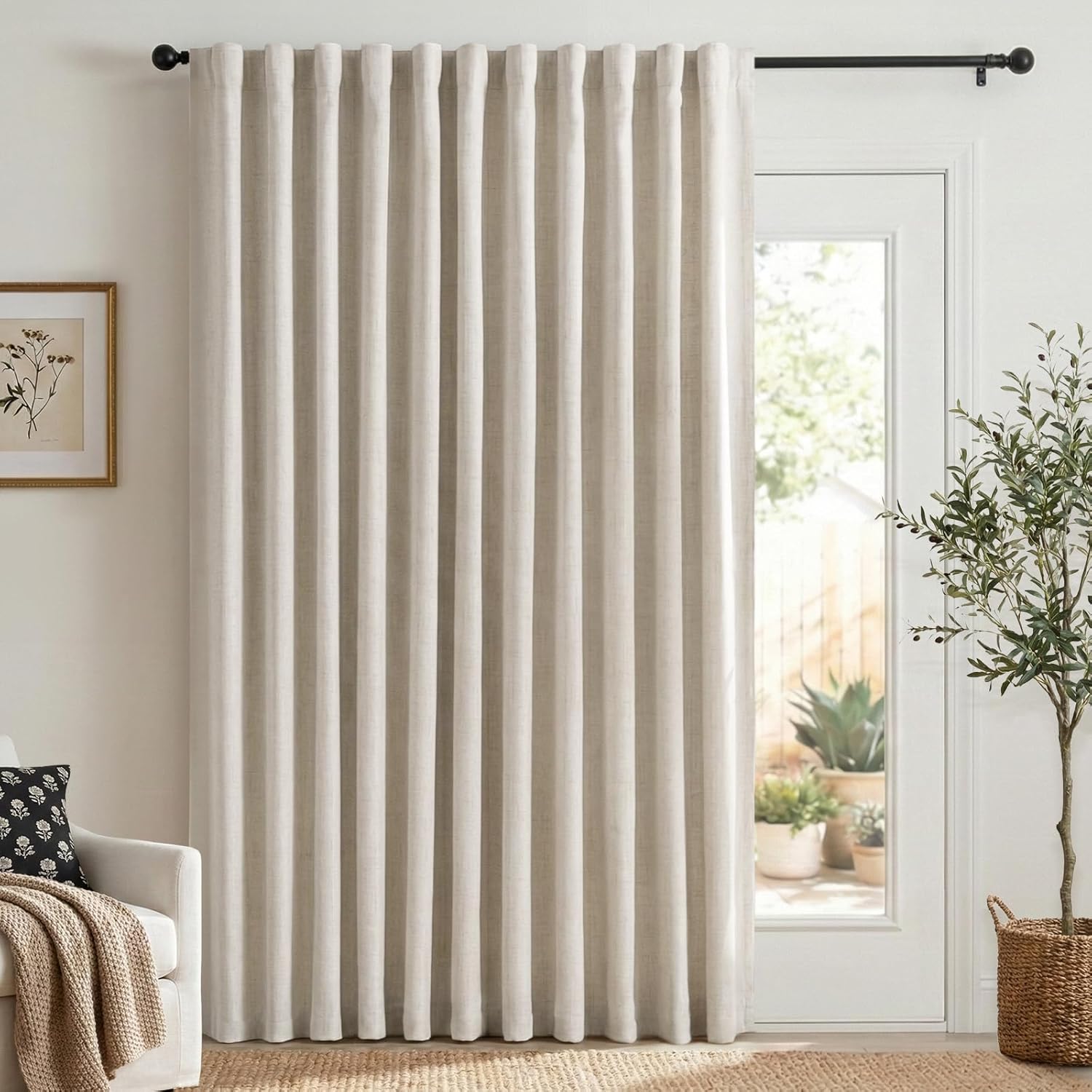
Pros
- Extra-wide 100-inch panel eliminates center gap common with standard curtain pairs
- True 100% blackout with thermal insulation layer reduces energy bills
- Versatile hanging system works with existing rods, hooks, or clip rings
- Linen texture looks more expensive than typical blackout curtains
- Easy care with machine washing and no color fading
Cons
- Only one panel included, so you'll need to buy a second set if covering multiple doors
- No customer reviews yet to confirm long-term durability and wash performance
- Hooks and rings not included despite multiple hanging options advertised
This curtain solves the biggest frustration with dressing sliding glass doors: that awkward gap down the middle where light streams through. At 100 inches wide, this single panel covers your entire door opening without splitting coverage between two narrow panels. The textured linen fabric gives it a custom drapery look instead of that flat, plasticky appearance most blackout curtains have.
Beyond aesthetics, this does serious work. The triple-layer construction blocks 100% of light, which means you can watch TV during the day without glare or sleep past sunrise in rooms with patio access. It also creates a thermal barrier that keeps your air conditioning from escaping in summer and your heat from leaking out in winter. That's real money saved on energy bills, especially if your sliding door faces west or gets full sun exposure.
If you want a sliding door curtain that looks upscale and performs like blackout shades without the center gap or high custom drapery cost, this one delivers.
Styles it works with: Modern Farmhouse, Scandinavian Minimalist, Coastal, Transitional, Contemporary
Best placed in: Living rooms with patio access, primary bedrooms with sliding door to balcony, home offices with glass doors needing glare control, basement walkouts requiring light blocking for media rooms
May not suit: Homes needing formal pleated drapery for traditional decor; spaces where you frequently open and close curtains multiple times daily (heavy fabric takes effort to slide); renters not allowed to install curtain rods
Buy it if:
- You have a standard sliding glass door (80-96 inches wide) and want seamless one-panel coverage
- You need total darkness for shift work sleep, nursery blackout, or home theater use
- Your energy bills spike because your sliding door lets in heat or cold
- You want the elevated look of linen without paying for custom window treatments
Consider waiting if:
- You need a different color and can wait for restocks or sales
- You prefer to see customer photos and reviews before committing (this is a newer listing)
Skip it if:
- Your door opening is narrower than 80 inches (you'd have too much excess fabric bunching)
- You need sheer or light-filtering coverage instead of total blackout
- You want motorized or cordless operation
Check the latest price and availability on Amazon before it sells out.
4. RYB HOME Grommet Blackout, The Wide-Door Solution
Sliding doors aren’t standard. A four-panel slider can stretch to 144 inches, and most curtain panels max out at 52 inches wide. The RYB Home grommet blackout was selected because it ships in widths up to 100 inches per panel, which solves the wide-door problem without forcing a four-panel hang that bunches in the middle. The blackout rating sits around 90 percent, per manufacturer documentation, which is enough for late-afternoon glare without flattening the room into total darkness.
The fabric is firmer than the NICETOWN, slightly less drape, slightly more architectural. That trade reads better on a modern slider with simple trim, and reads slightly stiff on a slider with ornate moulding. Aggregated owner reviews from Wayfair note that the grommets are solid metal rather than plastic, which makes a difference for daily use. Plastic grommets crack within a year on doors that get opened five or six times a day.
5. MIULEE Linen-Look Semi-Sheer, The Editor’s Quiet Pick
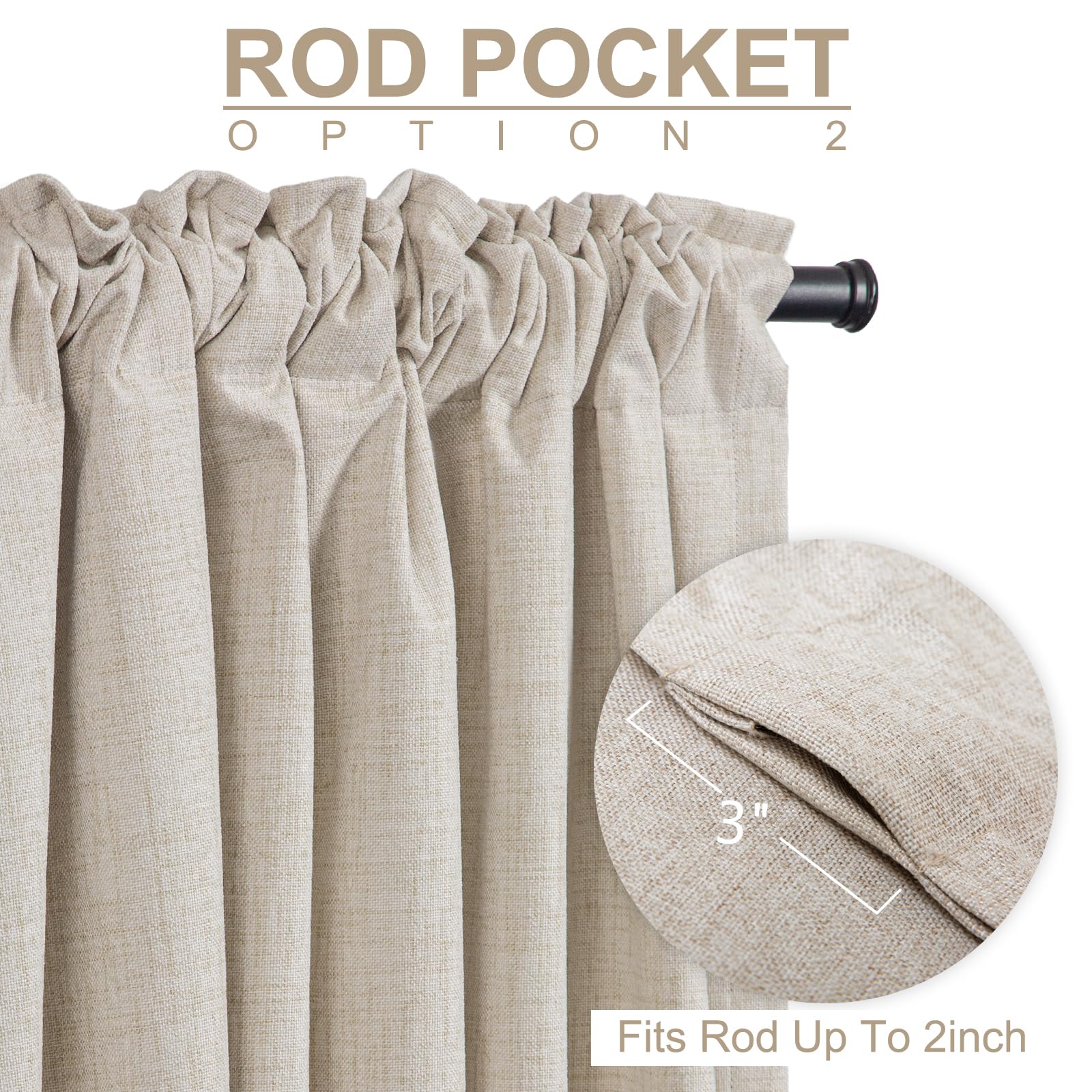
The MIULEE panel is the one that surfaces most often in r/InteriorDesign threads about “what curtains do you have, because mine look bad.” It reads expensive at a sub-$40 price point, which is unusual. The semi-sheer linen-look weave filters around 50 to 60 percent of light, lets the patio outline read through softly, and hangs in clean folds without aggressive steaming.
What makes it work as the final pick is restraint. The color palette runs to seven neutrals: Natural, Pure White, Greyish White, Linen, Beige, Light Grey, Off White. None of them are loud. The header is a hidden back-tab, which reads cleaner than grommets in a minimal room and reads softer than rod-pocket in a transitional one. For readers building a layered look behind a blackout panel, or readers who want a single light-filtering layer over a tinted door, this is the panel that gets recommended without caveats.
Styling Notes from Editors
The aesthetic move with sliding glass door curtains is to make the door feel taller than it is. Editorial coverage at Apartment Therapy has noted, repeatedly, that mounting the rod within four inches of the ceiling, rather than directly above the door frame, pulls the eye up and reads as intentional rather than utilitarian. House Beautiful’s window-treatment guides reinforce the same point: a panel that extends from ceiling to floor visually elongates the wall by 12 to 18 inches.
Pair the curtains with floor-level texture. A flat-weave runner or a low-pile area rug at the threshold connects the indoor space to the patio without forcing the eye to stop at the door track. Better Homes & Gardens has covered this pattern under the broader category of indoor-outdoor flow, and the principle holds: when the floor reads continuous, the curtain panels read as soft architecture rather than as a barrier.
Scale matters too. A two-panel split across a 72-inch slider works. A four-panel split across the same opening reads cluttered. For sliders wider than 96 inches, a three-panel hang, two outer panels that mostly stay open and one center panel that closes for privacy, tends to win in r/InteriorDesign feedback threads. Pair the panels with a low, grounded seating element across the room, the kind of piece readers often source through their best couch in a box research, and the room reads anchored rather than top-heavy.
For coffee-table styling that complements the panel weight, readers tend to land on heavier stone surfaces; the best travertine coffee table research traces that pairing logic.
What to Avoid for This Look
Skip the cheap polyester that prints “linen” without weighing anything. It hangs limp, develops a static cling against the door glass, and reads visibly cheap in photographs. Avoid bright white panels against a warm wall; they fight rather than recede. Avoid prints. A patterned curtain on a sliding glass door triples the visual weight of the door and shrinks the room. Skip rod-pocket headers on doors that get opened daily; they snag and unsleeve within months of regular use.
Two more cautions. Don’t undersize the rod. A 5/8-inch rod buckles under a blackout panel’s weight, and the buckle reads as a sag across the entire top edge. Don’t hang the curtains directly to the door frame; mount the bracket on the wall above, four to eight inches out from the trim, so the panel doesn’t catch on the door handle when it slides. Owner reports across r/HomeImprovement consistently identify these two installation choices as the difference between a curtain that looks deliberate and one that looks rented.
Frequently Asked Questions
How long should curtains be for a sliding glass door?
Measure from the top of the rod to the floor, then subtract a quarter-inch for clearance. Standard sliding doors mounted with the rod four inches above the frame land at 95 or 96 inches; doors with the rod mounted closer to the ceiling on a 9-foot wall land at 108 inches. Buying short is the most common sliding-door mistake; panels that float above the floor read unfinished.
Can you put blackout curtains on a sliding door?
Yes, and it’s one of the most common reasons buyers shop for this category. Aggregated owner reviews indicate blackout panels with 90 percent or higher light blocking are the standard for west-facing sliders, primarily for heat control as much as light. Confirm the rod is rated for the panel weight; triple-weave blackout panels run heavier than standard panels.
Do sliding door curtains block heat?
Thermal-insulated panels with triple-weave construction can reduce window heat gain by 20 to 25 percent, according to manufacturer documentation aligned with Department of Energy guidance on window treatments. Effectiveness depends on panel coverage; gaps between panels or between panel and wall reduce the insulating effect significantly.
What’s the difference between grommet and back-tab headers?
Grommet headers, which are metal rings punched through the top edge, slide quietly on a standard rod and read more modern. Back-tab headers, which are fabric loops sewn to the back of the panel, hide the rod entirely and read softer. For sliding doors that get opened daily, grommets are usually the more durable choice; back-tabs work well for sliders that mostly stay closed.
How wide should sliding door curtain panels be?
Total panel width should be 1.5 to 2 times the door opening width for a proper draped look. A 72-inch slider needs roughly 108 to 144 inches of total panel coverage, which usually means two 52-inch panels or one wider panel. Going narrower flattens the drape; going wider reads dramatic but bunches at the open position.
Can sheer curtains work on a sliding glass door?
Sheers work well as a front layer over blackout panels, or as a standalone choice on a slider that already has tinted or frosted glass. They don’t work as a standalone privacy solution at night; exterior lights backlight the sheer fabric, and the room becomes visible from outside. Layering remains the most flexible approach.
Should sliding door curtains match the rest of the curtains in the room?
Generally yes, especially in open-plan spaces where the slider and a nearby window are visible at the same time. Matching panel color and header style keeps the room reading as a coherent space. Different fabrics, such as a heavier weave on the slider and a lighter weave on a smaller window, can work if the color stays consistent.
The Final Curated Pick
Five panels, one shared brief. The right curtain on a sliding glass door isn’t dramatic. It’s the panel that softens the glass, holds the heat at bay, and reads as part of the room a year from now without anyone noticing the choice. Among the five, the MIULEE semi-sheer keeps surfacing in style threads for a reason: it disappears in the right way. The NICETOWN does the heavy lifting when light control is non-negotiable.










Write Your Review
No reviews yet. Be the first to share your experience!