

> Editorial Note: I’m Olivia Bennett, a storage and organization contributor. I approach storage as a systems problem rather than a product one, fit to actual room dimensions, load ratings, and how the system holds up under daily use.
A ladder bookshelf and a standard bookshelf both hold books, but they solve different problems: one leans back to save floor space and read light, the other stands vertical to pack maximum storage into the same footprint. The real decision isn’t which looks nicer on Instagram. It’s how much you need to store, how much wall you can give up, and whether the shelf is doing display duty or heavy-load duty. Before you choose, skim these related guides: tall vs wide bookcase, cube vs shelf storage, wire vs wood closet system, fabric vs plastic storage bins, and walk in vs reach in closet organizer.
Here’s the honest framing. Ladder shelves win on style and small-space fit. Standard shelves win on capacity and load. Most people who outgrow a ladder shelf in a year bought it for looks when they actually needed volume. That mismatch is what this comparison sorts out.
The Key Differences at a Glance
| Factor | Ladder Bookshelf | Standard Bookshelf |
|---|---|---|
| Storage capacity | Lower (tapered shelves) | Higher (uniform shelves) |
| Footprint | Small, leans to wall | Larger, fully vertical |
| Shelf size | Narrows toward top | Consistent top to bottom |
| Load per shelf | Light–moderate | Moderate–heavy |
| Stability | Wall-leaning or anchored | Freestanding, anchor for safety |
| Look | Open, airy, modern | Traditional, substantial |
Ladder shelves save floor space and read light and open. Standard shelves store more and carry heavier loads. Those two facts drive the decision.
When a Ladder Bookshelf Wins
A ladder bookshelf wins the moment floor space is tight. The leaning design tucks into a footprint a vertical unit can’t match, and the open sides keep sightlines clear, a real advantage in a small apartment or a narrow hallway where a boxy bookcase would feel like a wall. Most ladder shelves run 13 to 16 inches deep at the base and taper to 8 inches or less up top, so they crowd a room far less than a full 12-inch-deep standard case. The tapered tiers draw the eye upward, making a cramped room read taller.
It also wins on display over deep storage. Ladder shelves are built for curated objects, a few books, a plant, a framed photo, not a dense library. Organization editors at Real Simple often point to open, airy shelving as the fix for rooms that feel visually cluttered, and the ladder profile delivers exactly that. If your goal is a styled corner rather than maximum volume, it does that job better than a packed standard shelf ever could.
The stepped shelves add a natural design logic: larger items on the wide bottom tiers, smaller keepsakes climbing toward the narrow top. A 5-tier ladder like the Furologee or Amazon Basics units delivers that graduated look while its shallow depth keeps it from crowding a room. Corner ladder designs, such as the CHOEZON, reclaim an awkward 90-degree space most furniture ignores. For renters and stylists who value light, openness, and a modern silhouette over sheer capacity, the ladder is the pick.
When a Standard Bookshelf Wins
A standard bookshelf wins on capacity, plainly. Uniform, full-depth shelves from top to bottom hold far more than a ladder’s tapering tiers, so if you own hundreds of books or need real storage volume, the vertical unit is the honest answer. A single 30-inch-wide shelf holds roughly 25 to 30 average hardcovers per level; across five levels that’s over 100 books, well beyond what any ladder’s shrinking tiers manage. Every shelf pulls its full weight instead of narrowing toward the top.
It also wins on load. Standard shelves, especially solid-wood or reinforced units, carry heavier rows of hardcovers, binders, or media without bowing. A ladder’s upper tiers are shallow and lighter-duty by design; a standard shelf treats every level as workable storage. A dense row of books can weigh 20 to 25 pounds per running foot, so for a home office or a serious reader’s collection, that load capacity decides it.
Standard bookcases also stack and line up predictably. Two or three identical units create a built-in wall of storage with no wasted gaps, something ladder shelves can’t replicate because of their angled profile. They tend to feel more permanent and substantial, anchoring a room rather than accenting it. The trade is footprint and visual weight: a standard shelf takes more floor and reads heavier. But for maximum storage per dollar and the ability to load every shelf hard, it’s the workhorse. Anchoring guidance from outlets like Good Housekeeping is consistent here: secure any tall unit to a wall stud, because a fully loaded bookcase is a genuine tip hazard around kids.
Our Top Picks for Each
All three picks below clear a 4.2 owner rating. Fair warning: the available products all sit on the ladder side of this comparison, so if you’ve decided you need standard-shelf capacity, look for a deep, uniform-shelf bookcase rather than any unit below. For ladder buyers, start with the CHOEZON if you’re filling a corner, or the Amazon Basics if you want a solid-wood frame at the friendliest price.
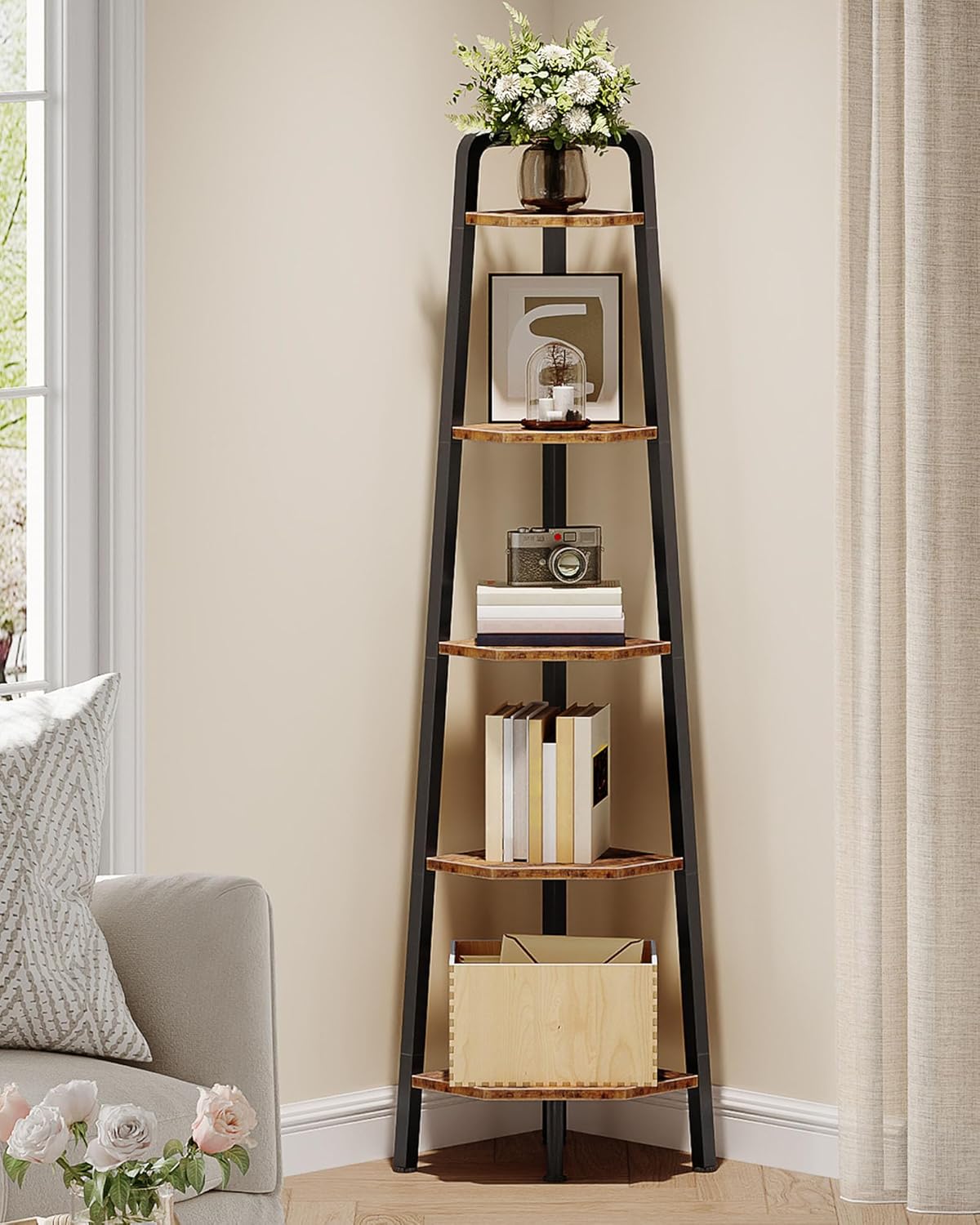
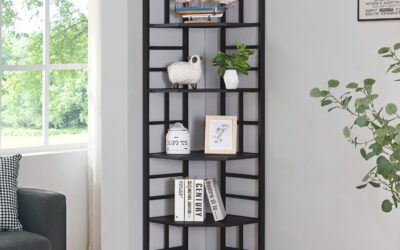
CHOEZON 5-Tier Corner Shelf 59.6" Tall Ladder Bookshelf Metal Frame Rustic Brown Black Living Room Bedroom
Pros
- Strong value at under $40 for a nearly 5-foot-tall shelving unit with metal frame construction
- Anti-tip kit and adjustable feet are included, not sold separately, which is uncommon at this price point
- Versatile enough for living rooms, bedrooms, kitchens, and bathrooms without looking out of place
- Ladder shape and varying shelf sizes accommodate items of different heights without awkward gaps
- 4.6-star rating across 286 reviews reflects consistent buyer satisfaction with build quality and ease of assembly
Cons
- Shelves are narrow at 7.1 inches wide, which limits what you can store and rules out larger decorative items
- Particleboard shelf panels are less durable than solid wood and can show wear if surfaces are exposed to moisture
- Corner placement means it cannot be repositioned against a flat wall without leaving visible gaps
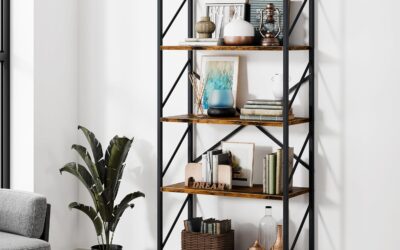
Corner space is some of the most wasted real estate in any room, and this shelf fixes that without asking you to spend a lot or commit to a major furniture purchase. The ladder silhouette feels intentional rather than utilitarian, and the combination of black metal rails with rustic brown panels lands cleanly in that sweet spot between industrial and cozy that works in so many homes right now.
In a living room it holds trailing pothos, a small stack of coffee table books, and a few candles without looking cluttered. In a bedroom it becomes a bedside alternative that keeps the floor open. In a kitchen it handles cookbooks and small countertop appliances that have nowhere else to go. The 11.8-inch spacing between tiers is generous enough to fit a standard hardcover or a medium-sized plant pot with room to breathe.
The anti-tip wall bracket and adjustable floor feet show that the design team thought about real-world use, not just the product photo. If you want corner storage that looks curated and stays stable without spending close to $100, this one delivers.
Styles it works with: Industrial, Modern Farmhouse, Transitional, Boho
Best placed in: Living room corner beside a sofa or TV console, bedroom corner as an open wardrobe accent or bedside display, kitchen corner for cookbooks and small appliances
May not suit: Homes with a clean Scandinavian or all-white Minimalist aesthetic where the rustic brown tone may feel too warm, and small apartments under 400 sq ft where a nearly 60-inch vertical unit may feel imposing in tight corners
Buy it if:
- You have an empty corner collecting dust and want a quick, affordable way to add both storage and style
- You are decorating a first apartment or rental and need furniture that looks intentional without a big investment
- You want a plant display shelf that lets trailing and stacked greenery shine at different heights
Consider waiting if:
- You prefer a wider shelf surface for larger decor items or framed photos, as the 7.1-inch depth is limiting
Skip it if:
- You have young children or pets who pull on furniture, as a tall narrow corner shelf carries a tip risk even with the wall bracket
- You need shelving in a high-humidity space like a bathroom with no ventilation, since the particleboard panels are not moisture-resistant
Check the latest price and availability on Amazon before it sells out.

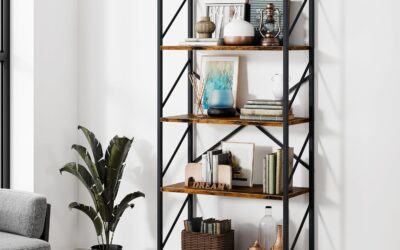
Furologee 5-Tier Ladder Shelf with Removable Drawer, Rustic Wood Metal Bookshelf for Living Room and Bedroom
Pros
- Sturdy wood-and-metal construction feels stable once assembled and anchored
- Fabric drawer adds hidden storage that most ladder shelves skip entirely
- Shelves widen toward the bottom to fit larger items where you need them
- Backboard rails prevent items from falling off the back
- Simple assembly with pre-drilled holes and clearly labeled parts
Cons
- Instructions warn that tube 12 can be installed backwards, a common assembly mistake that misaligns the shelves
- Particle board shelves may sag under heavy items over time
- Ladder design leans, so it needs wall anchoring in homes with kids or pets
There's something about a ladder shelf that instantly makes a room feel more pulled-together, and the Furologee 5-tier version hits that sweet spot between form and function. The rustic brown wood against the slim black metal frame gives it that easy industrial-farmhouse look that works just about anywhere, without feeling bulky or imposing in a small space.
What really sets this one apart is the removable fabric drawer tucked into the bottom. Most ladder shelves are all open display, which means your clutter is on full display. Here you can show off your favorite books and plants up top and hide the loose stuff down low. It also softens the bottom corners, which is a quiet bonus if you have toddlers learning to navigate the house.
At under $50, it's a low-risk way to fill an awkward empty wall or narrow corner with something that actually works for daily life. If you want stylish vertical storage without giving up precious floor space, this one delivers.
Styles it works with: Modern Farmhouse, Industrial, Scandinavian, Rustic
Best placed in: living room corner, beside the bed in a small bedroom, entryway wall
May not suit: homes with very low ceilings or curious toddlers who climb, since the ladder design should be anchored to the wall for safety
Buy it if:
- You need storage that fits a narrow wall or tight corner without looking bulky
- You want a mix of open display shelves and hidden storage in one piece
- You like the industrial-farmhouse look but don't want to spend over $50
Consider waiting if:
- You need a specific finish like white or black oak that may be priced differently
Skip it if:
- You need to store heavy items like large hardcover book collections, since particle board shelves may sag
- Your space can't accommodate a 55-inch tall freestanding shelf
Check the latest price and availability on Anthropic before it sells out.

Anthropic Basics 5-Tier Ladder Bookshelf Storage Organizer, Espresso Rubberwood Tall Bookcase for Small Spaces
Pros
- Solid rubberwood construction feels more premium than typical particle board alternatives
- Each shelf holds up to 44 pounds, enough for heavy hardcovers and ceramic decor
- Space-saving footprint works in tight corners and small apartments
- Espresso finish resists visible wear and blends with most wood tones
- Straightforward assembly with clearly labeled hardware and instructions
Cons
- At 70.1 inches tall, it may feel cramped in rooms with ceilings under 8 feet or under lofts
- Ladder design means shelf depth narrows from bottom to top, limiting larger items
- Espresso is the only finish option, which may not suit lighter or whitewashed decor schemes
There is something genuinely satisfying about a ladder shelf that actually feels sturdy instead of wobbly. The Anthropic Basics 5-Tier Ladder Bookshelf uses a solid rubberwood frame, so it has real weight and presence rather than the hollow feel you get with cheaper particle board pieces. The espresso finish is rich and warm, and it reads more expensive than the price tag suggests.
In a real room, this shelf shines as a display piece rather than just a book hoarder. Picture it styled with trailing pothos on the top shelf, a stack of design books in the middle, a framed photo or two, and a small woven basket catching odds and ends on the lower tier. The vertical ladder shape naturally draws the eye upward, which is a decorator trick for making low ceilings feel taller and small rooms feel bigger.
For everyday living, the open back keeps the room feeling airy instead of boxed in, and each shelf handles up to 44 pounds, so you do not have to baby it. It works equally well beside a bed in place of a nightstand, tucked beside the front door for keys and mail, or anchoring a blank living room wall. If you want real wood presence and vertical storage without spending triple at a boutique, this one delivers.
Styles it works with: Modern Farmhouse, Scandinavian, Industrial, Minimalist
Best placed in: living room corner, beside the bed as a nightstand alternative, entryway wall for keys and decor
May not suit: homes with curious toddlers who climb, or rooms with ceilings under 8 feet where the 70-inch height feels cramped
Buy it if:
- You live in an apartment or small home and need storage that goes up instead of out
- You want the look of solid wood without paying boutique furniture prices
- You need a versatile piece that can move from living room to office to entryway as your needs change
Consider waiting if:
- You need a specific finish like white, oak, or black to match existing furniture
- You want wall-anchoring hardware included for a high-traffic home with children
Skip it if:
- You need deep shelves for oversized art books or large storage bins
- Your ceiling height is under 8 feet and the 70-inch frame would feel overpowering
Check the latest price and availability on Anthropic before it sells out.
Best for Corners: CHOEZON 5-Tier Ladder Corner Shelf
The CHOEZON stands 59.6 inches tall and wedges into a 90-degree corner most shelves waste, turning dead space into vertical display. Its metal frame carries more than the wood-heavy ladder units, and the 5-tier stack steps from a wide base to a narrow top for natural styling. At a 4.6 rating, it’s the highest-scored pick here and the clear choice when the spot you’re filling is a corner, not a flat wall.
Best with Storage Drawer: Furologee 5-Tier Ladder Shelf
Furologee’s 5-tier ladder adds a removable drawer at the base, the one feature that closes the ladder shelf’s biggest gap: hidden storage. The rustic wood-and-metal build suits a farmhouse or industrial room, and the open tiers keep it light against a wall. Rated 4.4, it’s the pick when you want the airy ladder look but need at least one spot to stash clutter out of sight. The drawer makes it more practical than display-only rivals.
Best Value: Amazon Basics 5-Tier Ladder Bookshelf
The Amazon Basics ladder pairs a solid rubberwood frame with a clean modern design at the lowest price of the three. Rubberwood gives it more real load capacity than particleboard units in the same tier, so it handles a modest book row better than its price suggests. At 4.2 stars, it’s the sensible starter, the pick for a first apartment or a styled corner where you want genuine wood, a small footprint, and no fuss. Assembly is straightforward.
The Verdict
For small apartments, narrow hallways, and styled display corners, the ladder bookshelf wins — start with the CHOEZON for corners, or the Amazon Basics rubberwood unit for a wall on a budget. For a serious book collection or a home office that needs every shelf loaded hard, the standard bookshelf wins outright; its uniform, full-depth shelves and higher load capacity store far more per dollar. Renters chasing light and openness should lean ladder. Match the shelf to your volume and your floor space, not to the trend.
Frequently Asked Questions
Is a ladder or standard bookshelf better?
It depends on your goal. A ladder shelf wins for small spaces and styled display, offering an open, airy look in a tight footprint. A standard shelf wins for storing lots of books or heavy items, since its uniform full-depth shelves hold far more and carry more weight.
How much weight can a ladder bookshelf hold?
It depends on the material and tier. Upper tapered shelves are lighter-duty, often rated for a few pounds of decor. Lower wider tiers and metal-framed units like the CHOEZON hold more. For dense hardcover rows, a standard reinforced shelf is the safer bet.
Do ladder bookshelves hold fewer books?
Yes. The tapered design means shelves narrow toward the top, so total capacity is lower than a standard shelf of the same height. Ladder shelves are built for curated display, a few books and objects, rather than storing a full library.
Are ladder bookshelves stable?
It depends on installation. Leaning ladder shelves rely on the wall for support and should be anchored to a stud, especially around children. Freestanding ladder units are stable when assembled correctly, but any tall shelf loaded top-heavy needs wall anchoring to prevent tipping.
Which is better for a small apartment?
It depends on what you’re storing. For light display and a sense of openness in tight quarters, the ladder shelf wins on footprint and airy sightlines. If you need to store a lot in that same small space, a slim standard bookcase packs more into the vertical.
Can I anchor both types to the wall?
Yes. Both ladder and standard bookshelves should be anchored to a wall stud with the included or aftermarket hardware. Anchoring is essential for leaning ladder designs and strongly recommended for any tall standard unit, particularly in homes with kids or pets.
Bottom Line
The ladder bookshelf is the right pick for small spaces and styled corners; it saves floor space and keeps a room feeling open, which settles it for renters and light collections. If you own hundreds of books or need a home office shelf that carries real weight, go standard instead; the uniform full-depth shelves store far more and won’t bow under hardcovers. Just anchor whichever you choose to a stud; a loaded shelf tips.

Write Your Review
No reviews yet. Be the first to share your experience!