

> Editorial Note: I’m Olivia Bennett, a storage and organization contributor. I approach storage as a systems problem rather than a product one — fit to actual room dimensions, load ratings, and how the system holds up under daily use.
The biggest mistake people make with long-term shoe storage isn’t the container. It’s skipping the clean-and-dry step and sealing shoes away with sweat, dirt, and moisture still trapped inside. Six months later you open the box to cracked leather, mildew spots, and a smell that never fully leaves. Everything that follows here treats storage as a system: prep, environment, container, and placement working together. If you’re also rethinking the closet those shoes live in, pair this with a best closet organizer system, a sturdy best closet rod, some best floating shelves for living room, a best hanging closet organizer, or a simple best shoe rack to keep daily pairs off the floor. Long-term storage is different from everyday storage, and getting the sequence right is what protects the shoes you actually care about.
The Ground Rules Before You Start
Three non-negotiables. First, never store shoes dirty or damp — trapped moisture is what breeds mildew and breaks down glue. Second, keep the storage zone between 50 and 70 degrees Fahrenheit with humidity under 50%; attics and garages swing far outside that range. Third, leave at least 2 inches of air gap around stacked boxes so nothing sits in dead, stagnant air. Get these right and the container almost doesn’t matter.
Shoes and coats share a storage enemy, which is moisture trapped in a sealed container. The winter coat guide covers drying completely first and why a wire hanger ruins a shoulder.
Step 1: Clean and Fully Dry Every Pair First
Start here. Every pair goes into storage clean and bone-dry, no exceptions. Wipe leather with a slightly damp cloth, brush suede with a dedicated brush, and hand-wash canvas or mesh sneakers before they ever see a box. The part people rush is drying. A shoe that feels dry on the surface can still hold moisture in the foam midsole and lining for 24 to 48 hours.
Set cleaned pairs in an open, ventilated spot away from direct heat for a full two days. Direct sun and radiators dry the outer material fast while baking moisture deeper into the sole, which is exactly backward. Stuff each shoe with plain, non-printed paper to pull interior moisture out and hold the shape. Newspaper ink transfers onto light linings, so skip it. Once a pair is genuinely dry inside and out, condition leather with a thin coat of cream — OEKO-TEX-certified leather products keep harsh solvents off materials that touch your feet. Dry first. Always.
Step 2: Control the Environment Before the Container
The room matters more than the box. Aim for a stable spot between 50 and 70 degrees Fahrenheit and below 50% relative humidity, the same range ASTM material guidance uses for evaluating how leather and adhesives hold up over time. A bedroom closet or an interior hallway cabinet hits this easily. An uninsulated attic can climb past 120 degrees in summer, and glue softens and separates well before that.
Add a moisture buffer inside the storage zone. Silica gel packets or a small clay desiccant tub pull ambient humidity down cheaply, and they’re worth replacing every three to four months. Keep everything out of direct sunlight, since UV fades dyes and stiffens leather over a season or two. If your only option is a basement, raise boxes at least 4 inches off the concrete floor on a shelf or riser — concrete wicks cold moisture straight up into whatever sits on it. Set the environment first, then choose the container that fits it.
Step 3: Match the Container to the Material
Pick the box to the shoe, not the other way around. Leather and suede need to breathe, so a rigid box with a few small vents or a breathable fabric bin beats a fully airtight seal that traps off-gassing and moisture. Sneakers, rain boots, and synthetics are the opposite — a clear, hard-sided plastic box with a snug lid keeps dust and pests out and stacks cleanly.
Size matters more than people expect. A standard men’s box needs roughly 13 x 8 x 5 inches of interior clearance; forcing a size 12 into a compact bin crushes the toe box and sets a permanent crease. Clear containers earn their keep because you can see the pair without unstacking a tower, and stackable designs with a front or magnetic door let you pull one box without toppling the rest. Whatever you use, one pair per box. Two pairs jammed together transfer dye and abrade each other’s finish over months of contact. Label the short end if the box is opaque so you’re not opening five before finding the right pair.
Step 4: Stack Smart and Check on a Schedule
Placement is the last piece. Heavier boots go on the bottom, lighter flats and sneakers on top, so nothing bears more load than it should — most stackable bins are rated for around 10 to 15 pounds of stacked weight before they start to bow. Keep a 2-inch air gap between the stack and any wall to stop condensation from forming against a cold surface.
Then set a reminder. Long-term doesn’t mean forgotten. Open the storage zone every three months, swap tired desiccant packets, and give leather pairs a quick look for early dryness or bloom. A soft cotton dust bag around each leather pair adds one more barrier against scuffs inside the box. This quarterly check is the difference between shoes that come out ready to wear and shoes that come out ruined. Fifteen minutes, four times a year. That’s the whole maintenance load.
The Right Products Make It Easier
The picks below were chosen on three criteria: visibility so you’re not guessing what’s inside, stack stability under real load, and a lid or door design that lets you reach one pair without collapsing the tower. Start with the first if you want single-box access from a stack. Jump to the third if you’re storing oversized sneakers or boots that need extra interior clearance.
Pros
- Noticeably thicker walls made from virgin plastic that feel sturdy and hold shape over time
- Magnetic doors stay securely closed and open smoothly without snapping or warping
- Stackable peg-lock design keeps boxes aligned and stable even in tall configurations
- Large enough to fit most adult sneakers and boots standing upright without crushing
- Works as a multi-purpose storage solution beyond shoes, adding real everyday value
Cons
- At 13.5 x 10.5 x 7.2 inches, the boxes may not accommodate oversized men's boots or wide winter footwear
- Only available in white, so buyers with black or neutral-toned closets may find the aesthetic limiting
- Six boxes cover a modest collection and additional packs add to the total cost fairly quickly
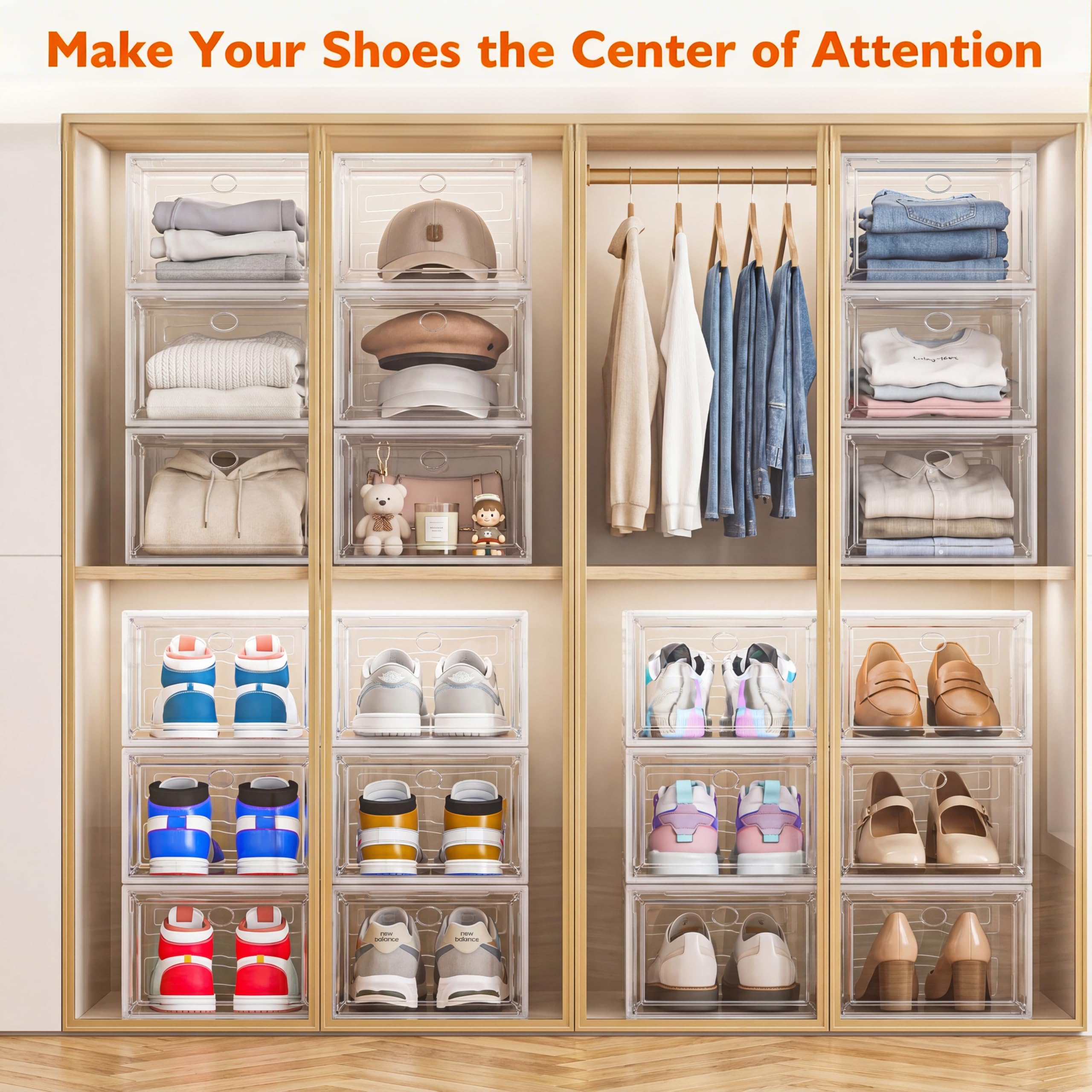
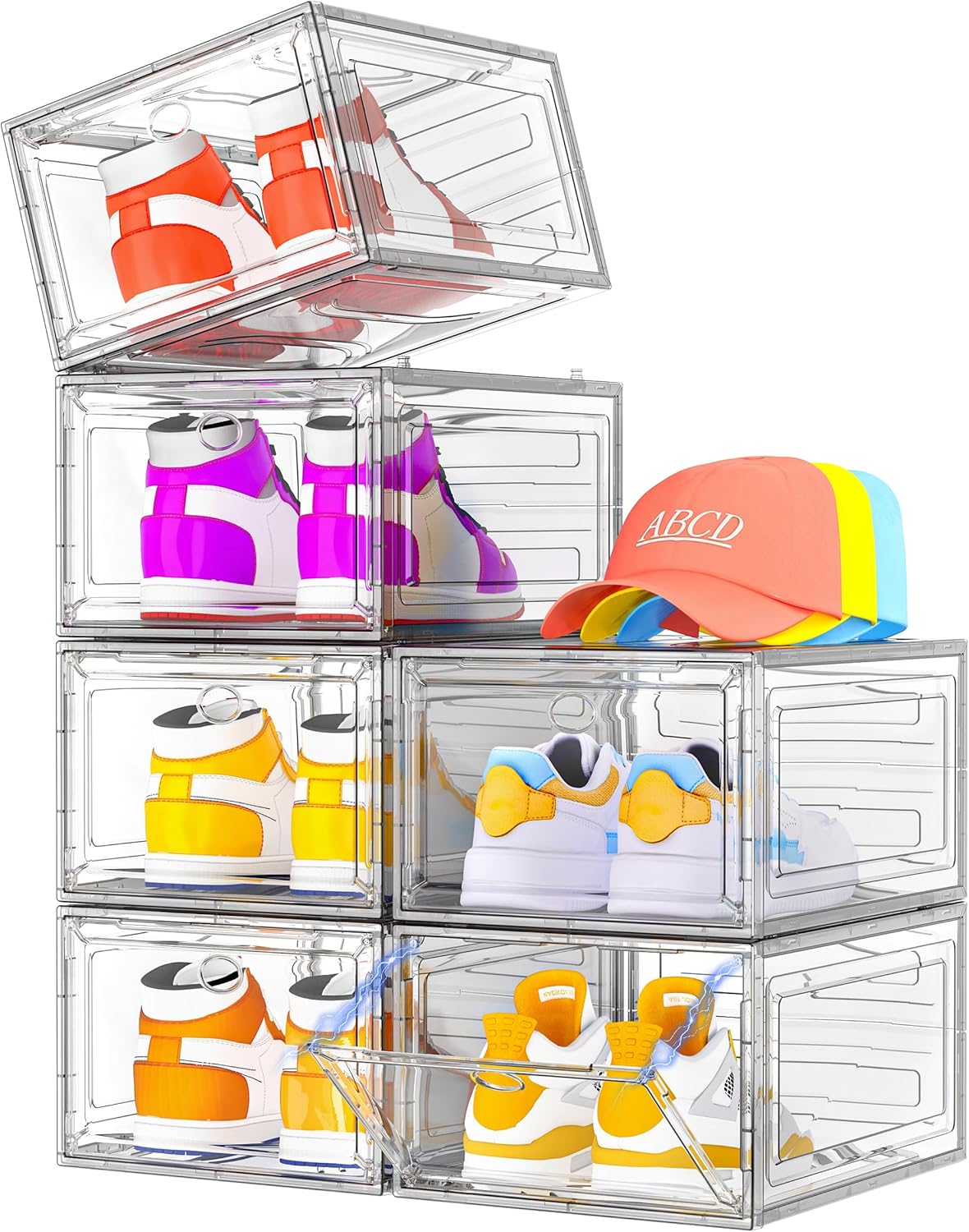
There is something deeply satisfying about opening a closet and seeing every pair of shoes displayed cleanly behind crystal-clear panels. The 7 Code shoe boxes deliver exactly that feeling without requiring a custom closet renovation or a hefty budget. The thick virgin plastic panels give these boxes a premium weight and rigidity that instantly separates them from the flimsy budget options that crack after a few months of use.
What makes these stand out in day-to-day living is the magnetic front door. It sounds like a small detail, but when you are getting ready in a hurry, being able to flip open a door with one hand and pull out your sneakers without fumbling is a genuine quality-of-life upgrade. The peg-lock stacking system also earns real trust over time since the boxes do not slide or lean as you add more rows, which means your closet wall stays looking intentional and tidy rather than precarious.
These boxes also happen to be genuinely useful for more than shoes. Hats, accessories, craft supplies, and baby items all fit neatly inside, which makes them one of those rare home buys that keeps finding new jobs around the house. If you want a clean, visible, stackable shoe display without dealing with boxes that warp, crack, or topple, this one delivers.
Styles it works with: Minimalist, Scandinavian, Modern, Clean Contemporary
Best placed in: Reach-in bedroom closet, entryway mudroom wall, under-bed storage area, garage utility shelf
May not suit: Warm Maximalist or Rustic Farmhouse interiors where exposed white plastic may clash with wood and textile textures; very small entryways or closets under 12 inches deep where the box depth limits stacking clearance
Buy it if:
- You own more than 10 pairs of shoes and want a closet display system that looks organized at a glance
- You have tried cheaper clear shoe boxes before and been frustrated by cracking panels or doors that pop open
- You want storage that works for shoes today but can flex to hold accessories, hats, or kids items later
Consider waiting if:
- You are still measuring your closet or under-bed space and need to confirm the 13.5 x 10.5 x 7.2 inch footprint fits your layout before committing to a 6-pack
Skip it if:
- You primarily store oversized men's boots or wide winter footwear that exceeds the 7.2 inch height clearance
- You are decorating a space with dark, wood-heavy, or Rustic decor where white plastic would look out of place
Check the latest price and availability on Amazon before it sells out.

Sterilite 12-Pack 6 Quart Clear Storage Boxes with Snap-On Lids - Stackable Organizers for Closet, Bathroom & Office
Pros
- Bulk 12-pack offers strong per-unit value for whole-room organizing projects
- See-through base eliminates guesswork when searching for stored items
- Water-resistant seal protects contents from humidity in bathrooms and basements
- Compact size slides easily onto standard wire or wood shelving
Cons
- 6-quart capacity is too small for bulky items like blankets or large toys
- Opaque white lid limits top-down visibility when bins are stacked
- Thin plastic walls may flex under heavy loads if overfilled
These Sterilite 6-quart boxes are the kind of unsexy purchase that quietly transforms how your home functions. You get 12 uniform bins that line up neatly on a shelf, instantly turning a chaotic linen closet or overflowing craft desk into something that actually makes sense. The clear base is the real win here: no more pulling down five mystery containers just to find a phone charger or a pair of socks.
In a real room, they look tidy and intentional stacked two or three high on a closet shelf or tucked inside a bathroom vanity. They are not decorative statement pieces, but that is exactly the point. They disappear into the background and let your space breathe.
If you want a simple, bulk-friendly way to coral small clutter without spending time labeling opaque bins, this 12-pack delivers.
Styles it works with: Minimalist, Scandinavian, Modern Farmhouse, any utilitarian organized-home aesthetic
Best placed in: Bedroom closet shelves, bathroom vanity cabinets, home office supply shelving, kids' craft room cubbies
May not suit: Open-shelf living rooms where exposed storage is visible to guests, or households neding larger bins for bulky seasonal items like winter coats or beding
Buy it if:
- You are tackling a full closet or pantry reorganization and need multiple matching bins at once
- You store lots of small items (hair accessories, craft supplies, office cables) and want instant visibility
- You need water-resistant containers for a bathroom, laundry room, or basement shelf
Consider waiting if:
- You only need one or two bins and would prefer not to store extras
Skip it if:
- You need storage for bulky items like sweaters, shoes, or large toys that exceed 6 quarts
- You want decorative bins that look good on open shelving in a living space
Check the latest price and availability on Amazon before it sells out.

Kuject X-Large Clear Stackable Shoe Storage Boxes 12 Pack - ABS Plastic Organizer for Closet & Entryway
Pros
- Holds 22 lbs per box with reinforced ABS frame that resists bending when stacked high
- Clear front panel makes it easy to identify shoes without opening each box
- Ventilation holes prevent odor and moisture buildup inside the box
- Versatile enough to organize toys, accessories, and small items beyond footwear
- Strong value at roughly $2.67 per box for a 12-pack
Cons
- Does not fit Men's size 12 or larger, most high-top sneakers
- Arrives fully disassembled and requires manual assembly of all 12 boxes
- Side panels use thinner flexible plastic that feels less premium than the front and back
If your entryway has become a graveyard of mismatched shoes or your closet floor looks like a department store clearance bin, these Kuject boxes bring immediate order. They stack into a clean, modular wall where every pair is visible and protected. The clear panels give you that satisfying display-shelf look without the price tag of custom cabinetry.
In a real room, the black-framed boxes read as intentional and modern rather than purely utilitarian. They work equally well lined up inside a closet or stacked openly by the front door. The ventilation holes are a thoughtful touch that keeps stored shoes fresh without sacrificing dust protection.
If you want a tidy, visible shoe organization system without committing to a bulky rack or sealed cabinet, this one delivers.
Styles it works with: Minimalist, Modern, Industrial, Scandinavian
Best placed in: Entryway wall or bench area, inside a walk-in closet, under the bed for seasonal rotation
May not suit: Homes where most wearers are Men's size 12or above, or spaces where you need a furniture-style piece that hides shoes completely from view
Buy it if:
- You have6+ pairs clutering your entryway or closet floor and want a fast, affordable fix
- You want to see every pair at a glance without opening drawers or doors
- You need dust and pet hair protection but still want airflow around your shoes
Consider waiting if:
- You wear Men's 12+ or collect high-tops and need the XX-Large or XXX-Large version instead
Skip it if:
- You want a furniture-grade piece that blends into decor rather than a functional plastic organizer
- You dislike any assembly and want a ready-to-use solution out of the box
Check the latest price and availability on Amazon before it sells out.
Front-Access Boxes That Solve the Stacking Problem (7 code Shoe Organizer)
Step 4 lives or dies on being able to pull one box without toppling the stack, and this is the pick built for exactly that. The 7 code Shoe Organizer uses a magnetic front door, so you open a single box mid-tower instead of lifting everything above it. At a 4.6 owner rating, the clear thickened walls hold their shape under stacked weight better than flimsier competitors, and the collapsible design means empty boxes fold flat when a pair is out in rotation. The see-through front satisfies the visibility criterion from Step 3 — you spot the pair before you reach. It’s the closest thing here to a true grab-one-box system.
Heavy-Duty Bins for Bulk and Overflow (Sterilite 6 Quart Storage Boxes)
When you’re storing more than shoes — insoles, cleaning kits, silica packets, or off-season flats — the Sterilite 12-pack earns its place. Also at a 4.6 rating, these 6-quart snap-lid bins seal tight against dust and pests, which suits the synthetic and sneaker materials from Step 3 that don’t need to breathe. The heavy-duty walls and snap-on lids stack securely within that 10-to-15-pound guidance from Step 4. They’re not shoe-specific, so a men’s size 12 won’t fit flat, but for smaller pairs and all the storage odds and ends around them, twelve matching bins keep the whole zone consistent.
X-Large Boxes for Sneakerheads and Boots (Kuject X-Large Shoe Storage)
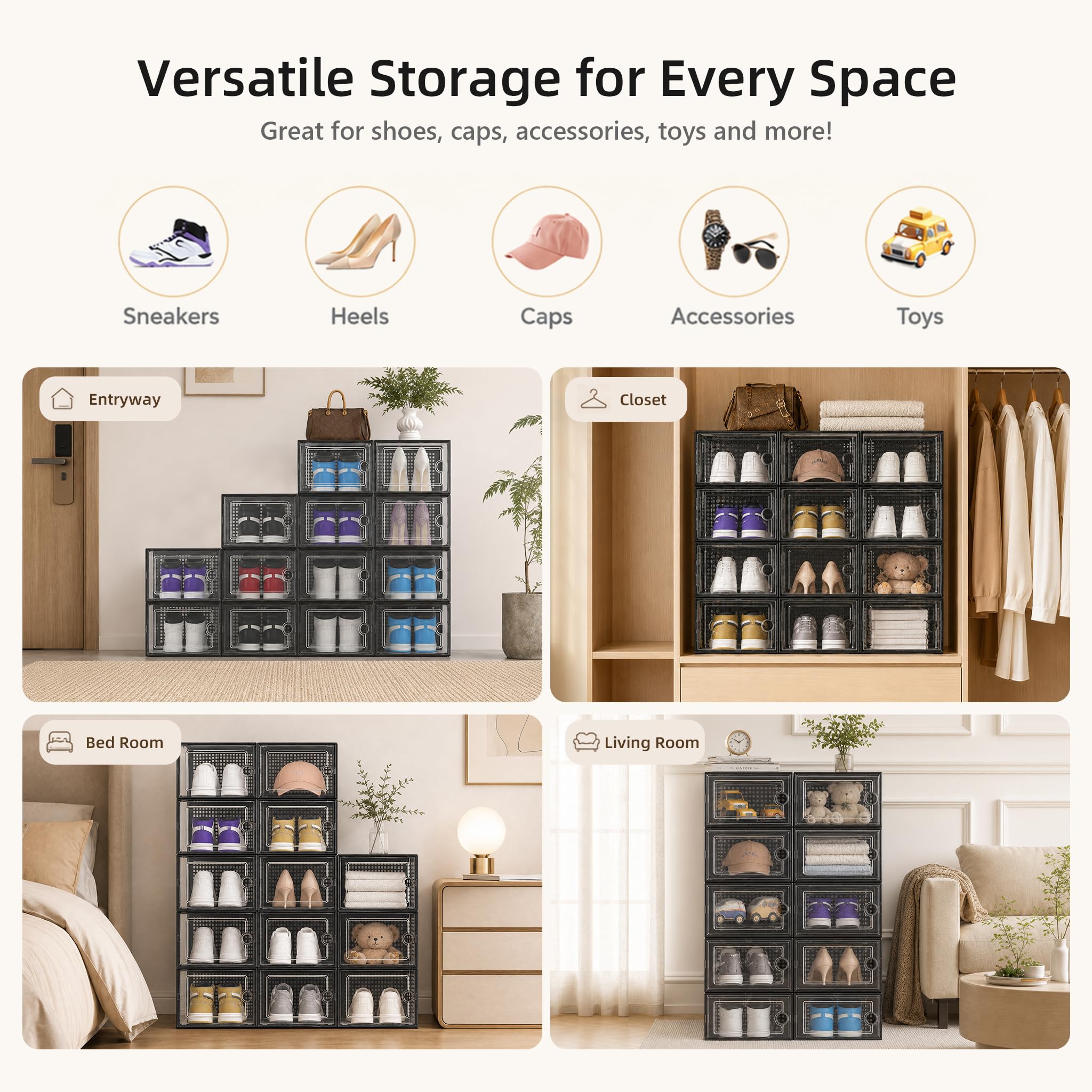
For anyone storing high-tops, chunky sneakers, or anything past a men’s size 12, the Kuject X-Large boxes give you the interior clearance the standard 13 x 8 x 5-inch box can’t. This 12-pack carries a 4.2 rating, lower than the other two, mostly on notes about lid fit on some units. The trade-off is space: the oversized footprint clears bulky silhouettes without creasing the toe, and the clear stackable build keeps Step 3’s visibility rule intact. If your collection runs big, this is the one that actually fits.
Frequently Asked Questions
What if my room is humid and I can’t get below 50%?
It depends on how far off you are. A small dehumidifier plus silica gel or clay desiccant tubs inside each box usually pulls a humid room into a safe range. Replace desiccant every three months, keep leather in breathable containers rather than airtight ones, and check pairs monthly instead of quarterly until humidity stabilizes.
What if my only storage space is a hot attic or cold garage?
Almost never a good idea long-term. Both swing past the 50-to-70-degree window, and heat softens adhesives while cold-damp air breeds mildew. If it’s truly your only option, insulate a sealed bin, add heavy desiccant, raise everything at least 4 inches off the floor, and check monthly. An interior closet is always the safer call.
What if my room is too small for stacked boxes?
Yes, this is common, and vertical space is the fix. Use tall stackable boxes with front or magnetic doors so you can reach a low box without unstacking, or mount a shelf above the closet rod for a second tier. Under-bed clearance of 6 inches or more also fits low-profile bins that don’t touch the floor.
What if my shoes already smell musty before storage?
No, don’t seal them yet. Musty smell means moisture or early mildew is present. Clean the pair, let it air-dry a full 48 hours, then tuck baking soda or a charcoal deodorizer inside for a few days before boxing. Sealing a smelly shoe locks the odor in and lets mildew spread in the dark.
What if my room gets direct afternoon sunlight?
It depends on the container. UV fades dyes and stiffens leather over a season, so move boxes out of the direct beam or use opaque bins for anything left in the light. Clear boxes are fine in a shaded closet but not on a sun-hit shelf. A curtain or cabinet door solves it for the cost of nothing.
Bottom Line
Long-term shoe storage is a four-part system, and the order is what matters: clean and dry every pair for a full 48 hours, control the room to 50–70 degrees and under 50% humidity, match the container to the material, then stack heavy-on-bottom and check quarterly. Skip the drying step and no box will save you. Get the sequence right and the container is almost interchangeable. Start with front-access boxes if you’re pulling pairs from a stack, and set a phone reminder for that four-times-a-year check.

Write Your Review
No reviews yet. Be the first to share your experience!