

> Editorial Note: I’m Olivia Bennett, a storage and organization contributor. I approach storage as a systems problem rather than a product one — fit to actual room dimensions, load ratings, and how the system holds up under daily use.
The mistake almost everyone makes is stacking every pot inside one deep cabinet and calling it storage. Then you’re pulling out three pans to reach the one on the bottom, and the whole tower comes down on your knuckles. That’s not a cabinet problem. It’s a system problem, and it’s fixable in an afternoon. The same logic that makes a best closet organizer system work applies here: measure first, sort by frequency, and give every piece a home it can be lifted straight out of. If you’ve ever set up a best closet rod, mounted a set of best floating shelves for living room, hung a best hanging closet organizer, or slotted a best shoe rack into a tight entryway, you already know the drill. Cookware just fights back harder because it’s heavier and oddly shaped.
The Ground Rules Before You Start
Two non-negotiables before you touch a single pan. First, leave at least 2 inches of clearance above the tallest stored item so lids and handles clear the shelf when you lift. Second, respect weight. A stack of cast iron can top 40 lbs, and most cabinet shelves and pull-outs are rated for a specific load. Check the number and stay under it. Third rule, if you’re using it daily, it lives between knee and shoulder height. Bending or reaching overhead for a heavy skillet is how things get dropped.
The same frequency sort works on the cabinet next to the stove, except heat is the deciding factor instead of weight. Long-term spice storage explains why the shelf above the range is the worst spot in the kitchen and how a 20-inch drawer holds two rows of jars you can scan at a glance.
Everyday cookware can take a knock. China cannot, and the china storage guide covers separating plates and protecting rims and gilt edges.
Step 1: Empty Everything and Sort by How Often You Cook With It
Pull every pot, pan, lid, and sheet out and put it on the counter. All of it. You can’t design a system around cookware you can’t see. Now sort into three piles: daily (the 10-inch skillet, one saucepan), weekly (the stockpot, a baking sheet or two), and rare (the roasting pan you use twice a year).
This sort is the whole foundation. Roughly 80% of your cooking runs on 20% of your cookware, so that daily pile earns the prime real estate. The rare pile can go up high or in the back, because you’ll only reach for it a handful of times a year.
Measure as you sort. Note the diameter of your widest pan and the height of your tallest pot with the lid on. Write those two numbers down. Apartment Therapy’s kitchen organizers make the same point repeatedly: people buy storage that doesn’t fit because they guessed instead of measuring. A pan that’s 12 inches wide won’t slide into an 11-inch rack. Simple math, easy to skip.
Step 2: Match the Storage Method to the Shape of the Piece
Not everything should be stacked. Flat items behave differently from deep ones, and forcing them into the same solution is why cabinets turn into a mess.
Sheet pans, cutting boards, and shallow lids belong in vertical dividers. Stand them on edge like books, and you grab one without disturbing the rest. Wirecutter’s storage guides recommend this for bakeware specifically, because a flat stack means unloading four pans to reach the fifth. Deep pots and saucepans do fine nested, but cap the stack at three and slip a felt pad or paper towel between non-stick surfaces to protect the coating.
Handles are the wild card. A 10-inch skillet with a long handle needs about 6 to 8 inches of side clearance, or the handle jams the cabinet from closing. Pan-heavy kitchens often do better hanging skillets from a rail or hook, freeing the shelf entirely. Match the method to the shape. That’s the rule.
Step 3: Use Vertical Space and Pull-Out Motion to Reach the Back
Deep base cabinets are usually 22 to 24 inches front to back, and everything past the first 12 inches is a black hole. You lose half your storage to depth you can’t reach. The fix is motion: make the cabinet come to you.
A pull-out rack or sliding organizer turns that dead back space into usable real estate. You open the door, pull, and the whole shelf glides out so the rear pots are right there at the front. Look for heavy-duty models rated for real weight, some handle up to 120 lbs, which covers a full stack of stainless and cast iron with margin to spare.
Vertical stacking racks work the same magic in tall cabinets. Instead of one 40-lb tower, you get two or three tiers, each holding a single pot at a liftable height. ASTM load-rating standards are worth checking on any rack you buy, because a shelf that sags under weight will bow within a season. Give heavy pieces the lowest tier. Physics rewards a low center of gravity.
Step 4: Store Lids Separately So They Stop Fighting You
Lids are the single most annoying part of cookware storage, and cramming them on top of their pots wastes the space and buries the pot. Separate them.
A lid organizer that mounts inside the cabinet door or expands across a shelf holds them upright, spaced about 1 to 2 inches apart so you can see and grab each one. Expandable models adjust from roughly 12 inches out to 22 inches, so they grow with your collection instead of maxing out. That flexibility matters if you cook a lot.
Group lids by the pots they match and store them near those pots, not in a separate drawer across the kitchen. The goal is one motion: grab pot, grab lid, done. When lids live in their own vertical slots, you reclaim the top of every pot for actual stacking. It’s the smallest fix on this list and often the one that makes the biggest daily difference.
The Right Products Make It Easier
The three organizers below all clear a 4.3 owner rating and solve a specific step above: pull-out motion for deep cabinets, lid separation, and heavy-duty vertical stacking. Match the pick to your worst pain point rather than buying all three. If your back cabinet is the black hole, start with the pull-out. If lids are your daily fight, the expandable rack is the cheapest fix.

Pros
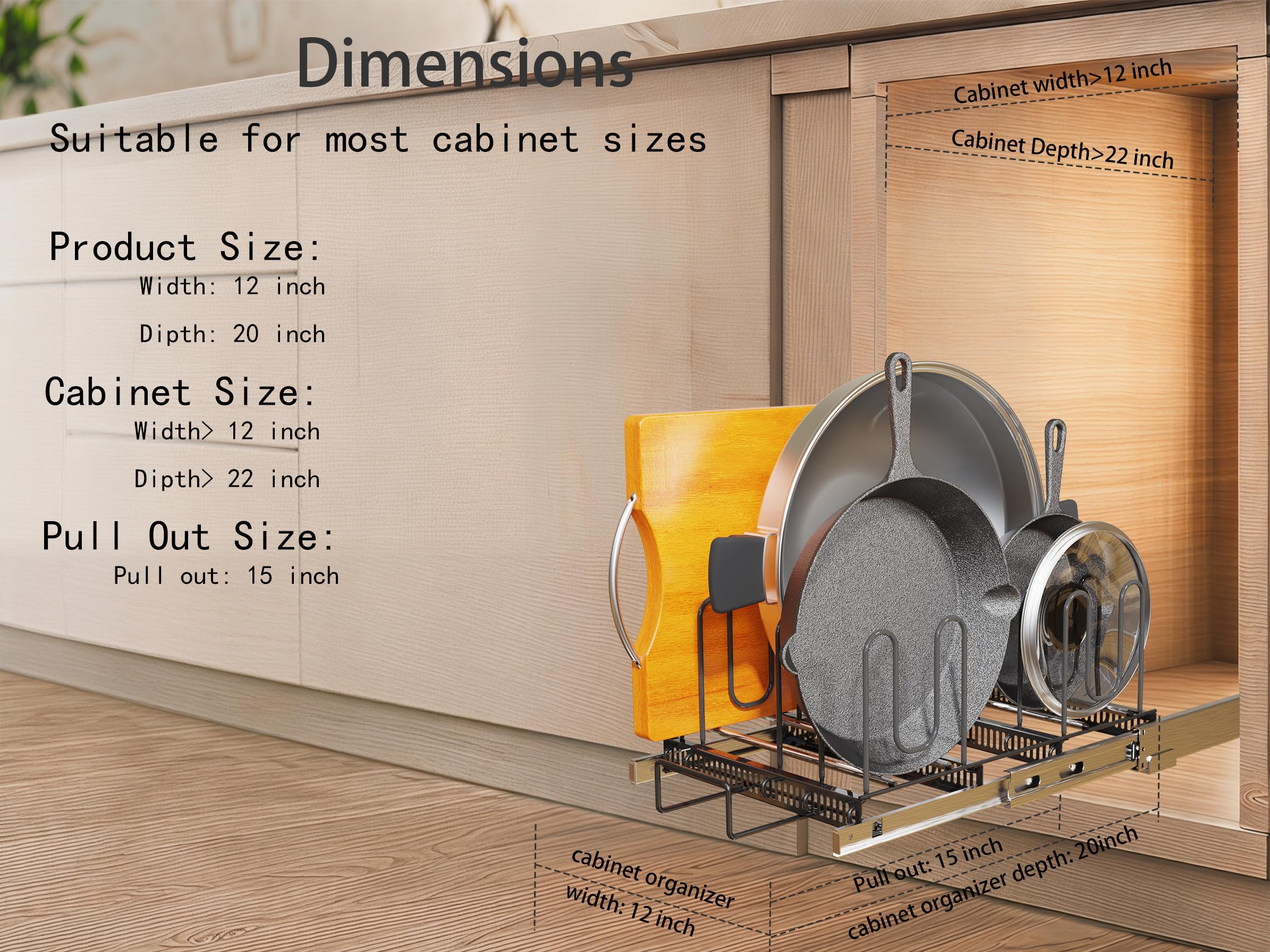
- 90-pound weight capacity handles the heaviest cookware without bending or warping
- Smooth sliding rails provide full extension so nothing hides in the back of the cabinet
- Soft rubber padding prevents scratches on cookware and stops items from shifting during use
- Fits standard cabinet dimensions without requiring modifications or professional installation
- Detachable structure allows quick cleaning without tools
Cons
- Only 6 reviews so far, making long-term durability harder to confirm
- 12-inch width may not fit non-standard or European-style cabinets without measuring first
- At $70, it costs more than basic stationary pot organizers that lack the slide-out feature
If you have ever knelt on a hard kitchen floor, arm deep inside a dark lower cabinet trying to extract a Dutch oven wedged behind three sheet pans, this organizer exists specifically to end that struggle. The full-extension slide rails mean everything from your widest skillet to your tallest stockpot lid is visible and reachable with one gentle pull.
What sets this apart from cheaper stationary racks is the combination of a 90-pound capacity and scratch-resistant rubber padding. You can load it with cast iron, stainless steel, and ceramic without worrying about warping or surface damage. The 10 adjustable dividers let you dial in the spacing for your exact collection rather than forcing you into preset slots that never quite fit.
If you want a cabinet that works like a well-organized drawer without hiring a custom installer, this one delivers.
Styles it works with: Modern Farmhouse, Minimalist, Contemporary, Transitional
Best placed in: Lower kitchen base cabinets, pantry cabinets with standard depth, kitchen island cabinets with 12-inch openings
May not suit: Cabinets narrower than 12 inches or shallower than 22 inches, upper wall-mounted cabinets where slide-out weight would stress hinges, or kitchens with non-standard custom cabinetry that uses irregular interior dimensions
Buy it if:
- You own heavy cookware (cast iron, stainless, ceramic) and need a rack that will not warp under the weight
- Your lower cabinets have become a disorganized black hole where pots and lids get lost
- You want a slide-out solution you can install yourself in minutes without drilling custom holes
Consider waiting if:
- You need a wider size (this only fits 12-inch cabinet openings) and want to see if the brand releases additional widths
Skip it if:
- Your cabinets are shallower than 22 inches, as the rails will not fit properly
- You only store lightweight items like plastic containers and do not need the heavy-duty build at this price point
Check the latest price and availability on Amazon before it sells out.

MUDEELA Expandable Pots and Pans Organizer Rack for Cabinet - 10 Adjustable Compartments, Tool-Free Setup
Pros
- Reinforced snap-on mechanism holds heavy cast iron without wobbling
- Expandable width fits a wide range of standard cabinet sizes
- Anti-damage strips and anti-slip rubber tubing protect cookware and prevent sliding
- Versatile two-in-one design works as single wide rack or two smaller ones
- No tools needed for quick, frustration-free setup
Cons
- Requires careful measurement of pot widths, heights, and handle clearance before purchase
- Horizontal orientation only, so very deep or narrow cabinets may not accommodate it well
- Plastic construction may feel less premium than metal alternatives at higher price points
Kitchen cabinet chaos is one of those small daily frustrations that slowly drives you crazy. The MUDEELA organizer solves it with a genuinely clever expandable design that slides into your existing cabinet space without any tools or permanent modifications. It holds heavy cookware firmly thanks to the reinforced snap-on dividers, and the anti-scratch strips are a thoughtful touch that shows the brand actually thinks about real kitchen life.
What sets this apart from cheaper organizers is the flexibility. You can stretch it to nearly23 inches wide or split it into two smaller racks. The deep U-shaped grooves hold lids upright without the constant tipping you get with flimsy alternatives. It is not flashy, but it quietly transforms a mesy cabinet into something that actually works.
If you want a clutter-free cabinet without drilling holes or spending more than twenty dollars, this one delivers.
Styles it works with: Modern Minimalist, Scandinavian, Contemporary, Transitional
Best placed in: Lower kitchen cabinets, deep kitchen drawers, pantry shelves, countertop (if cabinet space is limited)
May not suit: Very shallow cabinets under 7.5 inches deep, cabinets with interior heights under 7 inches, or kitchens where all cookware exceds 12 inches in diameter
Buy it if:
- Your pots, pans, and lids are stacked in a mesy pile that avalanches every time you open the cabinet
- You rent and cannot drill or permanently modify your kitchen cabinets
- You need a flexible organizer that can adapt as your cookware collection changes
Consider waiting if:
- You are unsure of your exact cabinet dimensions and need to measure first
- You want a vertical standing rack instead of a horizontal one
Skip it if:
- Your cookware is mostly oversized (above 12 inches) or your cabinet is narrower than 12 inches
- You need a heavy-duty metal rack for extremely heavy Dutch ovens or commercial-grade pans
Check the latest price and availability on Amazon before it sells out.

ORDORA 8-Tier Pots and Pans Organizer Rack for Under Cabinet, 20.8" Heavy Duty 120LBS Adjustable Kitchen Storage
Pros
- Genuinely heavy-duty: double eagle-co prongs and reinforced frame prevent wobling
- Tall 20.8" design accommodates stockpots up to 12 inches that shorteracks cannot fit
- Works on the countertop or floor if cabinet mounting is not ideal
- Anti-scratch curved dividers protect expensive cookware finishes
- Simple assembly with adjustable tier spacing
Cons
- Requires cabinets at least 22.9" wide and 23.8" tall, which excludes many smaller kitchens
- Stockpots over 16 quarts will not fit between the dividers
- Handle clearance can reduce usable space depending on your cookware style
If your cabinet is a chaotic tower of nested pots that crashes every time you reach for the Dutch oven, this organizer changes the game. The ORDORA rack stores everything vertically so each piece slides in and out independently. No more lifting four heavy pans just to get to the one at the bottom.
What sets it apart from flimsy alternatives is the 120-lb capacity. Cast iron, enameled steel, ceramic cookware: it handles all of it without tilting or bowing. The curved dividers also protect your finishes, which matters when you have invested in quality pieces.
If you want clutter-free cabinets without sacrificing access to your heaviest cookware, this one delivers.
Styles it works with: Modern Farmhouse, Minimalist, Industrial, Contemporary
Best placed in: Deep lower kitchen cabinets, kitchen countertop corner, pantry floor space
May not suit: Narrow cabinets under 23inches wide, compact apartment kitchens with shallow cabinetry, or households that primarily use lightweight nonstick pans (a lighter-duty rack would save money)
Buy it if:
- You own cast-iron or Dutch ovens and need storage that won't buckle under the weight
- Your lower cabinets are deep enough (22.9"+ wide, 23.8"+ tall) and currently wasted on stacked pots
- You want to grab any pan without unstacking everything first
Consider waiting if:
- You are remodeling your kitchen soon and cabinet dimensions may change
Skip it if:
- Your cabinets are smaller than 22.9" wide or 23.8" tall
- You only own lightweight nonstick cookware and would better served by a cheaper horizontal rack
Check the latest price and availability on Amazon before it sells out.
Uardfti Pull-Out Pots and Pans Organizer (Black, 12″ W x 22″ D)
This is the direct answer to Step 3, the black hole at the back of a deep base cabinet. At 22 inches deep, it uses the full depth most cabinets waste, and the sliding action brings rear pots to the front so nothing gets stranded. The 12-inch width fits a standard base cabinet, and the heavy-duty metal frame holds a real stack of stainless without flexing. It also doubles as a cookie-sheet slot, so flat bakeware stands on edge instead of lying in a hard-to-reach pile. At a 4.8 rating, it’s the highest-scored pick here and the one I’d reach for first in a deep-cabinet kitchen.
MUDEELA Expandable Pot Lid Organizer (11.81″–22.85″)
This solves Step 4 cleanly. It expands from about 11.81 inches out to 22.85 inches, so it fits a narrow cabinet now and grows if your collection does. Mounted under-cabinet or set on a shelf, it stands lids upright and spaced so you grab the one you want in a single motion, no digging. At a 4.4 rating, owners consistently note that it ends the lid pile-up that buries pots. It’s the least expensive fix on this list and, for lid-heavy kitchens, the one that changes the daily experience most. Pair it with either stacking pick for a complete system.

ORDORA Under-Cabinet Pots and Pans Organizer (20.8″ H, 120 lbs)
This is the heavy-lifter for Step 3’s vertical-stacking approach. Rated to 120 lbs, it handles a full load of cast iron and stainless without sagging, which is where flimsier racks fail within a season. The 20.8-inch height splits a tall cabinet into liftable tiers so you’re never wrestling a 40-lb tower. It mounts under the cabinet to keep pans off the shelf floor and off each other. At a 4.3 rating, it’s built for people who own serious cookware and need load capacity, not just tidiness. Give the lowest tier to your heaviest pieces.
Frequently Asked Questions
What if my kitchen has only one small cabinet for all my cookware?
It depends on how much you own, but the fix is almost always vertical plus door space. Stack no more than three pots per tier using a vertical rack, move lids to a door-mounted organizer, and hang skillets on a rail if you have wall space. One 20.8-inch-tall rack can double the usable capacity of a single cabinet by turning one tower into three tiers.
What if my base cabinet is really deep and I can’t reach the back?
Add pull-out motion. A sliding organizer rated for the depth (most base cabinets run 22 to 24 inches) brings the rear pots to the front when you open the door. That reclaims the 12-plus inches of dead space you currently can’t reach without emptying the whole cabinet first.
What if I have heavy cast iron and worry a rack will collapse?
No standard shelf-liner rack will hold it, so check the load rating before you buy. Look for a heavy-duty model rated to 120 lbs and verify it meets ASTM load standards. Put the heaviest pieces on the lowest tier for a stable center of gravity, and you’re fine.
What if my cabinet is too shallow for a standard organizer?
Almost every good lid or pan rack now expands, so measure your interior depth and buy an adjustable model. An expandable organizer that runs from 11.81 to 22.85 inches fits both shallow and deep cabinets. Measure the narrowest point, since hinges and frames steal an inch or two you might not expect.
What if I don’t have any cabinet space and only have open shelves?
Yes, open shelving works, but you’ll switch to hanging and vertical display. Mount a rail for skillets, stand sheet pans on edge in a vertical divider, and nest saucepans in threes with felt pads between non-stick surfaces. Keep the heaviest pieces on the lowest shelf so nothing overhead can fall.
Bottom Line
Good cookware storage isn’t about buying more, it’s about matching each piece to the right motion. Sort by how often you cook, stand flat items on edge, and use pull-out or vertical racks to rescue deep-cabinet dead space. Start with the Uardfti pull-out if the back of your cabinet is the problem, or the MUDEELA lid rack if lids are your daily fight. Whatever you install, check the load rating first. A sagging shelf undoes the whole system within a season.




Write Your Review
No reviews yet. Be the first to share your experience!