

> Editorial Note: I’m Olivia Bennett, a storage and organization contributor. I approach storage as a systems problem rather than a product one — fit to actual room dimensions, load ratings, and how the system holds up under daily use.
Most people hang a bike on the first empty stud they find, then wonder why the front wheel still clips the car door every morning. That’s the mistake: they solve for “off the floor” instead of solving for the actual traffic path through the garage. A bike parked in the wrong 24 inches of wall creates a daily annoyance you’ll live with for years. Get the placement right first and everything else falls into place. If you already think in systems, you’ve probably read my takes on the best closet organizer system, the best closet rod, the best floating shelves for living room, the best hanging closet organizer, and the best shoe rack — bike storage runs on the same logic. Measure the space, match the load, then buy the hardware. In that order.
The Ground Rules Before You Start
Three non-negotiables before you drill anything. First, keep a 30-inch walking lane clear between the parked car and any wall-mounted bike, per the same clearance logic garage-safety guides use for door swing. Second, mount into studs, not drywall anchors alone — a loaded hook pulls with roughly 15 to 40 lbs of force depending on bike weight. Third, measure your ceiling height. A vertical wall mount needs about 6.5 to 7 feet of clearance to hang a road bike without the rear wheel touching the floor.
Step 1: Map the Traffic Path First
Before you pick a single hook, walk the garage the way you use it every day. Park the car where it lives, open both doors, and mark the swing arc with painter’s tape on the floor. Now you can see the dead zones — the wall sections nobody walks through. That’s where bikes belong.
The most common error is mounting bikes on the wall directly beside the car’s driver door. It feels efficient. It isn’t. You’ll bump the pedals every time you get out. Instead, aim for the wall behind the car’s front bumper or the narrow strip beside the garage door track, where foot traffic is near zero.
Measure the clear wall length in inches, not “about a wall’s worth.” A vertical hanger needs roughly 16 to 20 inches of horizontal space per bike. Three bikes side by side means a 60-inch clear run at minimum. If your only open wall is 40 inches, you’re storing two bikes there, not three. Knowing that number now stops you from buying a five-bike rack that can’t physically fit. Map first. Buy second.
Step 2: Choose the Right Mounting Method for Your Ceiling
Your ceiling height decides the method, so grab a tape measure before you decide anything. Under 8 feet of clearance rules out most overhead pulley systems, which need room for the bike to rise above your head plus a foot of buffer.
For a standard 8-foot garage ceiling, vertical wall hanging is the workhorse. You hook the front wheel and the bike hangs nose-up against the wall, using about 12 inches of wall width instead of the 68-inch length a bike sprawls across horizontally. That’s the single biggest space win available. A 24-inch mountain bike tire fits fine as long as you’ve got 7 feet of vertical drop.
Horizontal wall mounts, where the bike hangs parallel to the wall by its frame, suit low ceilings and heavy e-bikes because they distribute weight across two arms. They eat more wall length though, close to 40 inches per bike. Overhead ceiling hoists are the move only when your floor and walls are both maxed out and you’ve got 9-plus feet up top. Match the method to the room you actually have, not the setup you saw in a photo.
Step 3: Confirm the Load Rating Before You Trust It
A hook that “holds a bike” tells you nothing. You need the number. A carbon road bike weighs 17 to 22 lbs. A steel commuter runs 28 to 35 lbs. An e-bike can hit 50 to 70 lbs with the battery in. Buy hardware rated well above your heaviest bike, not right at the line.
Look for a stated static load rating and, ideally, a nod to a recognized standard. ASTM material and fastener specs are the benchmark serious manufacturers cite for steel wall hardware, and Wirecutter’s garage guides flag load rating as the number that separates gear that lasts from gear that bends. A rack claiming “holds up to 300 lbs” across six hooks is fine for a family of commuters. One with no rating at all is a guess you’re hanging a $2,000 e-bike on.
Torque matters as much as the rating. Drive lag screws into the stud, not just the drywall, and snug them until the mount doesn’t shift under a firm two-handed pull. If it flexes, it’s under-anchored. Fix it before you load it. A properly seated steel mount should hold its rated weight for years without creep.
Step 4: Group Bikes by Frequency, Not by Size
Once the hardware’s up, where each bike goes is a workflow question. The bike you ride four times a week goes at the easiest reach, roughly 40 to 55 inches off the floor so you can lift and hook it without a step stool. The winter fat bike nobody touches until December goes up high or in the back corner.
This is the same rule that makes a closet work: daily items at arm’s height, seasonal items on the top shelf. Kids’ bikes are the exception — mount those low, around 30 inches, so an 8-year-old can rack their own ride and you’re not doing it for them.
Leave 3 to 4 inches of gap between hung handlebars so bars don’t tangle when you pull one bike out. If you’re tight on wall, alternate the hanging direction: one bike nose-up, the next nose-down, so the wide handlebar ends never sit at the same height. That interlocking trick lets you fit five bikes in the footprint of four. Group by how often you ride, space by the handlebars, and the whole wall stays usable.
The Right Products Make It Easier
The pick that matters most is whichever solves your hardest constraint from Steps 2 and 3: ceiling height and load rating. All three below clear a 4.4 owner rating and state a real capacity number, which is the spec that separates a mount that lasts from one that sags. Start with the swivel wall mount if you’re working a standard 8-foot ceiling. Jump to the freestanding stand if you can’t or won’t drill into the wall.


Pros
- 4-pack provides excellent value at under $18 per mount
- Swivel mechanism rotates smoothly to park bikes flush against the wall
- Heavy-duty 66lb capacity supports most bike types including e-bikes
- Protective rubber coating prevents wheel and rim damage
- Includes tire stop bracket to keep walls clean
Cons
- Not compatible with plasterboard walls without a stud behind the mount
- Cannot accommodate tires wider than 3.54 inches or rims deeper than 3.15 inches
- Requires drilling into walls, which may not suit renters without landlord permission
If you have ever tripped over a bike in your garage or squezed past handlebars in a narrow hallway, the monTEK swivel wall mount is the kind of fix that makes you wonder why you waited so long. The 150-degree pivot is the standout feature here. You can tuck a bike flat against the wall or angle it around obstacles like a parked car or storage shelf, all with a smooth one-handed rotation.
What sets this apart from basic hooks is the attention to detail. The rubber-coated cradle grips your wheel without scratching the rim, and the lower tire bracket catches dirt before it hits your wall. The powder-coated steel feels solid and looks clean enough that you would not mind mounting these in a visible entryway or apartment hallway.
If you want a clutter-free garage or hallway without wrestling your bikes onto complicated rack systems, this one delivers.
Styles it works with: Industrial, Modern Minimalist, Urban Loft, Scandinavian
Best placed in: Garage side wall, apartment entryway, basement storage wall, inside a shed or utility room
May not suit: Homes with only plasterboard walls and no accessible studs, spaces with low ceilings where a vertically hung bike would block walkways, or households with very young children who could bump into a mounted bike
Buy it if:
- You own2 to 4 bikes and need to free up garage or hallway floor space immediately
- You park cars in your garage and need bikes angled out of the way with the swivel feature
- You want a protective mount that will not scratch your expensive rims or mark your walls
Consider waiting if:
- You only need a single mount and would prefer the 1-pack option at lower price point
Skip it if:
- Your bike has fat tires wider than 3.5 inches, such as some fat-tire e-bikes
- You only have drywall with no studs available for secure mounting
Check the latest price and availability on Amazon before it sells out.

Ultrawall 6-Bike Wall Mount Storage Rack - Stainless Steel Garage Hanger, 300lb Capacity, Black
Pros
- Excellent value at $35.99 for 6-bike capacity
- Adjustable hook spacing accommodates road bikes, mountain bikes, and kids bikes one rail
- Sturdy 300 lb weight limit handles multiple heavy bikes without worry
- Complete mounting hardware included for multiple wall types
- Rubber-coated hooks protect bike frames from damage
Cons
- Requires lifting bikes overhead, which may be difficult for heavier e-bikes or for shorter riders
- Recommended for 4 bikes despite 6-bike marketing, as spacing gets tight with larger frames
- No helmet or accessory hooks included at this price point
If your garage has turned into a bike obstacle course, this Ultrawall rack is the kind of simple fix that makes you wonder why you waited so long. It mounts a single48-inch steel rail to your wall, and the hooks slide along it so you can space them perfectly for your family's mix of adult and kids bikes. No more tripping over pedals or shuffling bikes around just to reach the lawnmower.
What sets it apart from flimsy alternatives is the build quality at this price. The powder-coated steel feels substantial, the rubber sleves actually grip and protect your frames, and the safety hook design means you will not find a bike on the floor in morning. It looks clean and intentional on the wall rather than like a temporary fix.
If you want your garage floor back without spending over $100or drilling a dozen holes, this one delivers.
Styles it works with: Industrial, Modern Minimalist, Utilitarian Garage, Active Family Home
Best placed in: Garage side wall, basement utility wall, covered carport wall, shed interior
May not suit: Low-ceiling garages where bikes would hang too close to cars, households with only heavy e-bikes over 50 lbs each, or renters who cannot drill into wall studs
Buy it if:
- You have3 to 6 bikes clutering your garage floor and want them off the ground today
- Your household has a mix of adult and kids bikes that need flexible spacing
- You want a durable wall-mount solution without paying $100 or more
Consider waiting if:
- You also need helmet storage and would prefer the $45.99 version with helmet hooks included
Skip it if:
- You have heavy e-bikes and cannot comfortably lift 50+ lbs overhead
- You need a freestanding rack because your walls are not suitable for drilling
Check the latest price and availability on Amazon before it sells out.

Pros
- Holds up to 5 bikes without any wall mounting or drilling
- 70 lbs per hook capacity handles heavy bikes including some e-bikes
- Quick assembly with no special tools needed
- Compact vertical design takes up minimal floor space
- Heavy-duty welded metal construction feels stable and durable
Cons
- Footprint still requires open floor area, which may not suit very tight single-car garages
- No wheel tray or lower stabilizer, so bikes may swing slightly when bumped
- Instructions could be clearer regarding proper screw tension to avoid overtightening
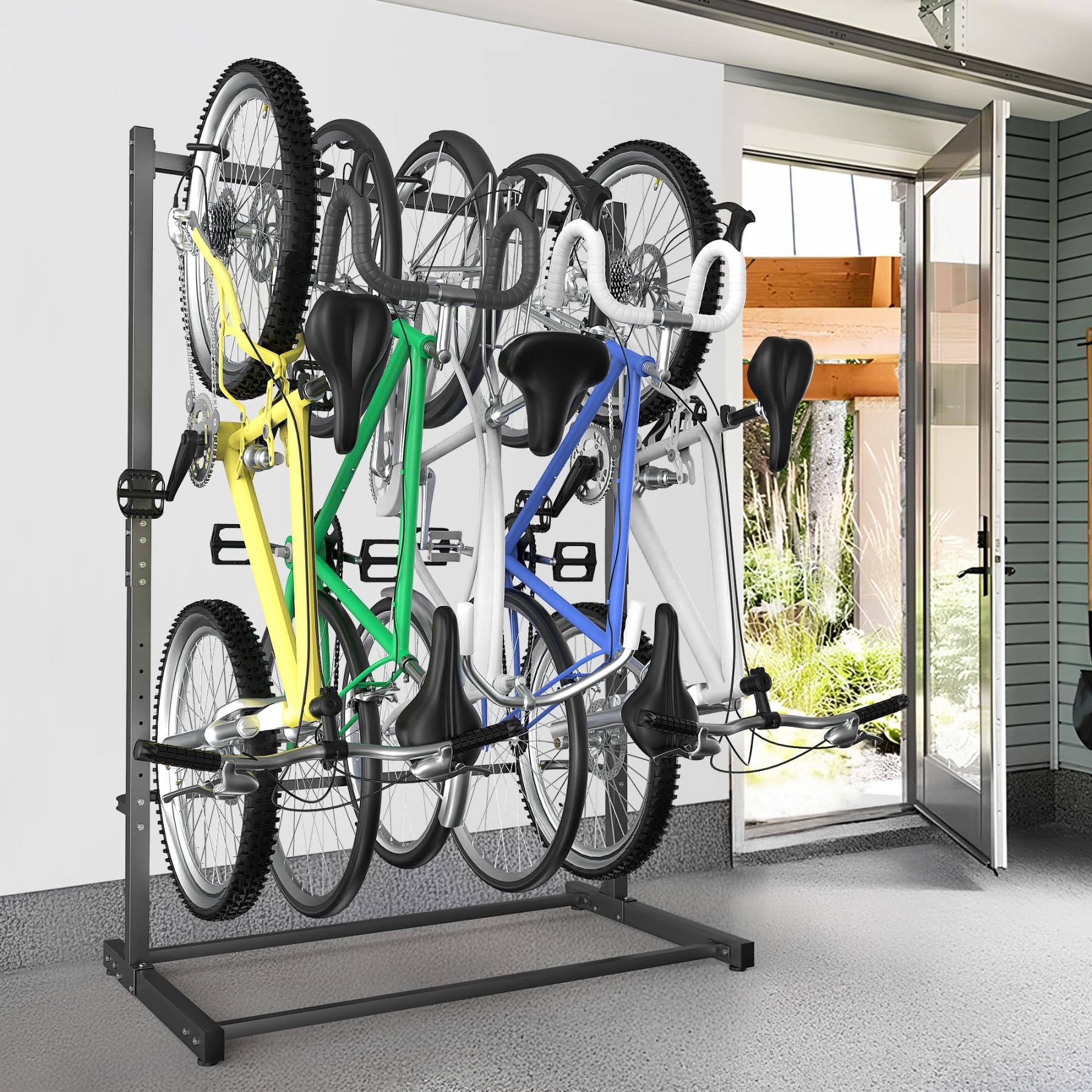
If your garage has become a tangle of bike frames, pedals, and handlebars, this WALMANN stand brings order in about ten minutes flat. It holds five bikes vertically on welded steel hooks, and the freestanding design means you do not need to put a single hole in your wall. That is a genuine relief for renters or anyone who does not want to commit to permanent hardware.
In a real garage setting, it looks clean and purposeful. The all-metal frame has an industrial quality that blends right in alongside tool chests and workbenches. Each hook supports 70 lbs independently, so you can mix road bikes, mountain bikes, and heavier hybrids without worry.
If you want a single organized spot for the whole family's bikes without drilling into studs or sacrificing half your garage floor, this one delivers.
Styles it works with: Industrial Garage, Modern Utilitarian, Sporty Minimalist, Functional Mudroom
Best placed in: Garage back wall area, garden shed corner, covered carport, large mudroom or utility room
May not suit: Very low-ceiling spaces under 7 feet where vertical bike storage becomes awkward, or narrow single-car garages where the stand's footprint competes with your vehicle
Buy it if:
- You have 3 to 5 bikes clutering your garage floor and need them organized today
- You rent your home or prefer not to drill into walls and studs
- You own heavier bikes (mountain, hybrid, or light e-bikes) and need hooks rated for real weight
Consider waiting if:
- You only have one or two bikes and a simpler wall hook would do the job for less money
Skip it if:
- Your ceiling height is under 7 feet, making vertical hanging impractical
- You need a locking or security feature to protect bikes in a shared space
Check the latest price and availability on Amazon before it sells out.
monTEK Swivel Bike Wall Mount (monTEK)
This one directly answers Step 2 for the typical 8-foot garage. The swivel head lets you park a bike flat against the wall and then pivot it out of the way, so you reclaim the traffic lane you mapped in Step 1. At a 4.6 rating it’s the highest-scored pick here, and owners consistently call out the swing action for tight single-car bays. It hangs one bike vertically by the wheel, using about 12 inches of wall width. Best for the person with one or two frequently ridden bikes and a wall that doubles as a walkway. Mount it into a stud and it holds its position without drifting.
Ultrawall Stainless Steel Bike Storage Rack (UltrawallGarageToolsOrganizer)
Pick this when Step 3’s load math is your priority. It’s rated to hold up to 300 lbs across six hangers, so a family with mixed road, commuter, and kids’ bikes can share one wall run. The stainless build resists the humidity that rusts cheaper steel in an unheated garage. At 4.5 stars, owners rate the hardware quality highly for the price. This is the group-storage answer from Step 4: six defined hook positions let you assign each bike a spot by frequency. You’ll need roughly 60 inches of clear wall to use all six.
WALMANN Freestanding Bike Stand (WALMANN)
Choose this if you rent, can’t drill, or your walls are cinder block. It holds up to 5 bikes on a heavy-duty floor stand, no studs required, which sidesteps the whole anchoring problem from Step 3. At 4.4 stars it’s the flexible option: slide it where you need it and move it when the layout changes. It needs floor space rather than wall space, so it suits garages with an open corner but limited mountable wall. Vertical loading keeps the footprint tight for five bikes. The trade-off is it occupies floor you might want for something else.
Frequently Asked Questions
What if my garage ceiling is only 7 feet tall?
It depends on your bikes, but you’re fine for vertical wall hanging in most cases. A 7-foot ceiling gives enough drop for road and hybrid bikes hung nose-up. Skip overhead pulley hoists, which need 9-plus feet, and measure your tallest bike’s wheel-to-wheel length before buying.
What if my walls are cinder block or concrete, not studs?
No problem, but change your hardware. Concrete needs masonry anchors and a hammer drill, not standard lag screws. If you’d rather not drill masonry at all, a freestanding floor stand skips the wall entirely and holds up to 5 bikes without a single hole.
What if my garage is too narrow to lose any wall space?
It depends on ceiling height. If you’ve got 9-plus feet up top, go overhead with a ceiling hoist and keep every inch of wall free. If not, a swivel wall mount that pivots flush uses about 12 inches of width and folds bikes out of the walking lane.
What if I have five bikes but only a short wall?
Almost always the fix is a freestanding vertical stand. A 5-bike floor stand fits in roughly a 3-by-2-foot footprint, far less than five wall mounts spread across 80-plus inches. Alternate handlebar direction on any wall-hung bikes to squeeze the width further.
What if my e-bike is too heavy to lift onto a wall hook?
Yes, that’s common, and the answer is a horizontal mount or floor stand rated well above 50 lbs. E-bikes run 50 to 70 lbs with the battery, so pull the battery before lifting and never trust a hook rated at the bike’s exact weight. Rate for headroom.
Bottom Line
Map your traffic path before you drill, match the mounting method to your ceiling height, and confirm a real load rating before you trust any hook. The monTEK swivel mount is the one most people should start with for a standard 8-foot garage. If you rent or can’t drill, the WALMANN freestanding stand holds up to 5 bikes with zero holes. Whatever you pick, buy the capacity number with room to spare. A mount that flexes today fails the day you hang the heaviest bike on it.









Write Your Review
No reviews yet. Be the first to share your experience!