

> Editorial Note: I’m Olivia Bennett, a storage and organization contributor. I approach storage as a systems problem rather than a product one — fit to actual room dimensions, load ratings, and how the system holds up under daily use.
The mistake almost everyone makes: stacking containers with their lids on. It doubles the vertical space each piece needs and turns a 15-inch-deep cabinet into a jammed drawer you have to dig through every night. Separate the lids from the bases and you reclaim half your shelf instantly. The same systems logic that fixes a chaotic cabinet applies to a best closet organizer system, a best closet rod, a set of best floating shelves for living room, a best hanging closet organizer, or a best shoe rack — measure the space, sort by size, then build the containment around what you actually own. Here’s the order that works.
The Ground Rules Before You Start
Three non-negotiables. First, measure your cabinet interior before buying anything — most base cabinets give you 22 to 24 inches of depth and 11 to 14 inches of clear height per shelf. Second, keep only what nests. If a base can’t stack inside another of the same shape, it’s costing you room. Third, leave 1 inch of clearance above your tallest stack so you can lift pieces out without tilting the whole tower.
Containers on a turntable need a different approach than containers on a shelf, because anything tall tips on the spin. The lazy susan guide covers the spin check that catches it.
Containers are the whole system in a chest freezer, since nothing stacks reliably without them. The chest freezer guide covers the vertical bins that make the bottom layer reachable.
Step 1: Empty and Match Every Base to a Lid
Pull everything out. All of it, onto the counter. This is the only way to see what you actually have versus what you think you have. Match each base to its lid, and set aside any orphan that has no partner. Most kitchens carry 20 to 40 percent orphans — a lid whose base cracked, or a base whose lid warped in the dishwasher.
Toss or recycle the orphans now. A base with no lid isn’t storage; it’s a bowl taking up cabinet real estate. Check the recycling number on the bottom while you’re at it: #5 polypropylene is the standard for food-safe reusable containers and holds up to repeated dishwasher cycles better than #7. If a container is cloudy, stained orange from tomato sauce, or smells no matter how you wash it, it’s done. The FDA notes that scratched plastic surfaces harbor bacteria more readily, so a gouged base isn’t worth keeping. You’ll usually cut your pile by a third here. That’s the win — less to store means an easier system.
Step 2: Sort Bases by Shape, Not by Size
Group your keepers by shape first: round with round, square with square, rectangle with rectangle. Shape drives nesting far more than volume does. Within each shape group, stack the bases smallest-inside-largest so a set of five nests into the footprint of one. A typical round set collapses from 15 inches of stacked height down to about 4 inches.
Square and rectangular bases are the space champions because they tile against a cabinet wall with no wasted corners — round containers leave roughly 21 percent dead space between them. If you’re deciding what to keep long-term, favor square. Assign each shape group a zone in your cabinet or drawer before you put anything back. One column for rounds, one for squares, one for the tall rectangles you use for pasta and cereal. Zoning is what keeps the system intact after the third rushed weeknight, because every piece has an obvious home to return to. No home, no system.
Step 3: Contain the Lids Vertically
Lids are the chaos engine. Flat-stacked, they slide, fan out, and bury themselves. The fix is to store them on edge, vertical, like files in a folder — a lid organizer with adjustable dividers turns a sliding pile into a readable row you can flip through in two seconds.
Size the dividers to your lid diameters. Set narrow slots (roughly 1 to 2 inches apart) for small snap lids and wider ones (3 to 4 inches) for the big rectangular tops. Sort lids by size within the rack, largest at the back, so your eye lands on the common ones first. A single organizer that spans 12 to 17 inches will hold 15 to 25 lids upright in the footprint one flat stack used to occupy. Mount it right beside the matching base zone from Step 2. That adjacency is the whole trick: bases in one hand, lid pulled from the rack with the other, sealed and in the fridge before the pasta water boils. Keep the rack within arm’s reach of where you actually assemble leftovers.
Step 4: Label and Set a Refresh Rule
Labeling sounds fussy for a cabinet only you see. It isn’t. A small label on each divider slot — “1.3 cup,” “large rect,” “snap lids” — removes the daily guesswork of which lid fits which base, and it trains everyone in the house to reshelve correctly. Preprinted volume labels take about 10 minutes to apply across a full set.
Then set a refresh rule so the system doesn’t drift back to chaos. Once a quarter, roughly every 90 days, pull the whole cabinet and repeat Step 1: rematch, toss orphans, re-nest. Plastic containers have a real lifespan; OEKO-TEX and ASTM material-durability benchmarks track how repeated heat cycles degrade polymers, and most food containers show meaningful wear after 2 to 3 years of regular dishwasher use. A 90-day check catches the cracked base before it becomes an orphan clogging your shelf. Put it on the calendar. The system only stays organized if you maintain the containment, not just build it once.
The Right Products Make It Easier
The hardest step to hold long-term is Step 3, the lids. Every product below is a dedicated lid organizer with adjustable dividers, each clears a 4.4-plus owner rating, and each solves a different cabinet size. Start with the first if you want the most sections in a standard cabinet; jump to the second if you need it to expand across a drawer; pick the third if you own Rubbermaid Brilliance snap-on lids specifically.


Pros
- Dividers insert and remove in seconds, so reconfiguring for new lids takes under a minute
- Smooth plastic surface wipes clean with a damp cloth and leaves no residue
- 13x10 footprint fits most standard US kitchen cabinet widths without measuring twice
- Dual-use dividers as guardrails add a practical safety detail not common in this price range
Cons
- Not dishwasher safe, so spills inside require hand cleaning each time
- Only handles food container lids, not larger pot or pan lids, which limits use for full cookware sets
If your kitchen cabinets have turned into a game of lid Jenga every time you reach for a container, this Lifewit organizer solves the problem cleanly and cheaply. The 6 adjustable dividers give you a proper slot for each lid rather than a loose pile, and the tray itself is low-profile enough to slide under other items on the shelf without disrupting what you already have.
The food-grade plastic feels sturdy without being bulky, and the white finish blends into almost any cabinet interior. The detail we appreciate most is the ability to flip two dividers into raised guardrails at the edges, which keeps everything in place even when you pull the tray out quickly. It is the kind of thoughtful design that shows up in daily use rather than just on a spec sheet.
If you want a permanently tidy lid drawer without spending time measuring or assembling anything complicated, this one delivers.
Styles it works with: Minimalist, Modern Farmhouse, Scandinavian, Contemporary
Best placed in: Kitchen cabinet shelf, deep kitchen drawer, pantry storage shelf
May not suit: Very shallow drawers under 3.5 inches deep, or kitchens where pot and pan lids also need organizing since this tray is sized for food container lids only
Buy it if:
- You have a drawer or cabinet shelf overflowing with mismatched food container lids and want them sorted in one permanent spot
- You want flexibility to reorganize as your container collection changes without buying a new organizer
- You are furnishing a new kitchen or pantry and want a tidy, consistent storage system from day one
Consider waiting if:
- You need a larger version to span a wider cabinet opening, as Lifewit offers expandable bamboo options that may fit better
Skip it if:
- You primarily need to store large pot and pan lids, since this tray does not accommodate them
- Your drawer interior is shallower than 3.5 inches, as the tray will not sit flat
Check the latest price and availability on Amazon before it sells out.

SWOMMOLY Expandable Lid Organizer with 6 Adjustable Dividers and 30 Labels for Kitchen Cabinets and Drawers
Pros
- Highly adjustable length fits a wide range of cabinet and drawer sizes
- Tool-free assembly takes just minutes with a simple bend-to-lock divider system
- Lock design keeps the two expandable halves securely together during use
- Versatile enough to organize reusable bags, napkins, or paper plates beyond just lids
- Lightweight yet sturdy construction makes it easy to pull out and rearrange
Cons
- White plastic may show stains over time in heavily used kitchens
- Dividers require bending to insert, which may feel flimsy to some users on first setup
- Maximum lid capacity is 10 inches, so oversized lids will not fit
If your kitchen cabinet looks like a lid avalanche waiting to happen, this organizer is the reset button you need. The expandable design means you do not have to measure obsessively before buying. It stretches or shrinks to fit the space you have, and the adjustable dividers let you create sections that actually match your specific collection of lids.
What sets this apart from basic bins or shelf risers is the labeling system. Thirty labels (pre-printed and blank) turn a generic organizer into a real system that the whole household can follow. It looks tidy, stays tidy, and takes the guesswork out of meal prep cleanup.
If you want a clutter-free cabinet without spending an afternoon on a complicated storage hack, this one delivers.
Styles it works with: Modern Minimalist, Farmhouse, Scandinavian, Contemporary
Best placed in: Kitchen cabinet above or below the counter, deep kitchen drawer, pantry shelf
May not suit: Very shallow drawers under 4 inches deep, cabinets narrower than 10 inches, or households that only use 2-3 containers and do not need a dedicated system
Buy it if:
- You own more than a dozen food containers and waste time matching lids daily
- Your cabinet or drawer width falls between 10 and 17inches
- You want a tool-free, dishwasher-safe solution you can set up in under five minutes
Consider waiting if:
- You are planning a full kitchen remodel and cabinet dimensions may change
Skip it if:
- Your largestids exceed 10 inches in diameter
- You only have a few containers and a simple stack works fine
Check the latest price and availability on Amazon before it sells out.

CBJHPZ Lid Organizer for Rubbermaid Brilliance Snap-On Lids - 3-Piece Set, No Assembly, Vertical Space-Saving Storage
Pros
- Purpose-built for Rubbermaid Brilliance lids with precise size slots
- No tools or assembly needed, ready to use immediately
- Stores vertically to maximize cabinet or countertop space
- Easy to wipe clean with a damp cloth
- Three-piece set covers tiny, small, and medium lid sizes
Cons
- Only compatible with Rubbermaid Brilliance snap-on lids, not universal
- Not dishwasher safe, must be hand-washed only
- Color is off-white rather than true white, which may not match all kitchens
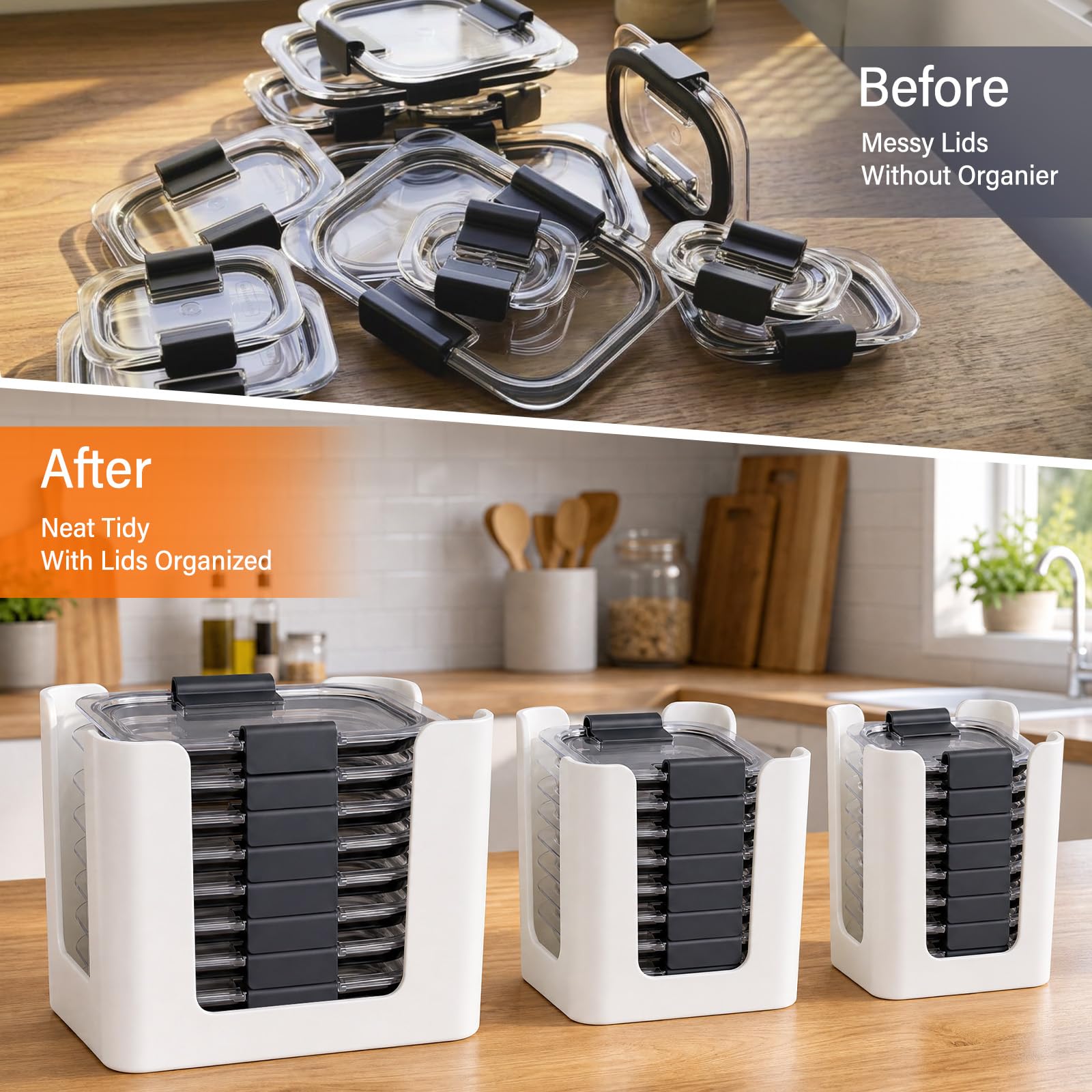
If you own a set of Rubbermaid Brilliance containers, you already know the lid chaos that comes with them. These rectangular snap-on lids refuse to stack neatly, and they always end up in a frustrating pile at the back of a cabinet. This organizer was built to solve exactly that problem, and it does so with zero fuss.
The three-piece set gives each lid size its own dedicated slot, so you can see and grab what you need instantly. The open-frame design means access from any side, which is surprisingly useful when you are in the middle of meal prep. The off-white finish is understated and clean, fitting right into a modern kitchen without drawing attention to itself.
If you want instant lid access without sacrificing cabinet space or dealing with annoying assembly steps, this one delivers.
Styles it works with: Minimalist, Modern Farmhouse, Scandinavian, Contemporary
Best placed in: Inside an upper kitchen cabinet, on a pantry shelf, or on the countertop near your food prep area
May not suit: Kitchens that use a mix of container brands (this only fits Rubbermaid Brilliance lids), or very shallow drawers where the vertical design would not fit
Buy it if:
- You own multiple Rubbermaid Brilliance containers and struggle with lid clutter daily
- You want a ready-to-use solution with zero assembly or tools
- You need reclaim vertical cabinet space in a small kitchen
Consider waiting if:
- You are still building your Rubbermaid Brilliance collection and are unsure which sizes you will settle on
Skip it if:
- You use a mix of container brands since this only fits Rubbermaid Brilliance snap-on lids
- You need a dishwasher-safe organizer for easy deep cleaning
Check the latest price and availability on Amazon before it sells out.
Most Sections for a Standard Cabinet (Lifewit Cabinet Lid Organizer)
This is the direct fix for Step 3 if your lid pile is large and varied. The Lifewit organizer runs 6 adjustable dividers across 7 sections, so you can set narrow slots for snap lids and wider ones for the big rectangular tops in the same rack. It carries a 4.6 rating, the highest in this group, and owners consistently call out that the dividers actually hold position instead of collapsing when you pull a lid. Sized for a standard base cabinet, it sits flat against the shelf and keeps everything vertical and readable. If you’re organizing a full family kitchen’s worth of lids, start here.
Best for a Drawer or Wide Shelf (SWOMMOLY Expandable Lid Organizer)
Pick the SWOMMOLY if your storage is a wide drawer rather than a cabinet shelf. It expands to fit the space, which matters when you’ve got an awkward run of 20-plus inches to fill and don’t want a rack floating in the middle of it. The 6 adjustable dividers work the same vertical-filing logic from Step 3, and it ships with 30 preprinted and blank writable labels — a head start on Step 4’s labeling rule. At a 4.4 rating, owners like the flexibility, though a few note the expansion mechanism needs a firm seat to stay put. Good all-rounder for irregular spaces.
Best for Rubbermaid Brilliance Owners (CBJHPZ Snap-on Lid Organizer)
Choose the CBJHPZ if your collection is mostly Rubbermaid Brilliance. It’s shaped specifically for their snap-on lids, with slots pre-sized for the tiny (0.5 cup), small (1.3 cup), and medium tiers so lids drop in without fighting the dividers. That specificity is the point: a generic rack leaves Brilliance lids rattling loose, and this one seats them cleanly. It holds a 4.4 rating, and owners with a matched Brilliance set say it’s the tidiest their cabinet has looked. If your bases are a mixed brand collection, one of the adjustable racks above will serve you better.
Frequently Asked Questions
What if my cabinet is too shallow for a lid organizer?
It depends on the depth. Most lid racks need 8 to 10 inches of clearance to sit flat; if your shelf is shallower, turn the organizer sideways so it runs front-to-back, or mount it inside a cabinet door with a tension-fit bracket. A shallow 6-inch shelf still works if you file lids in a single row rather than a deep rack.
What if my drawer is deeper than any organizer I can find?
Yes, this is common with 24-inch base drawers. Use an expandable organizer like the SWOMMOLY that stretches to fill the run, or place two smaller racks back-to-back. Leftover space at the front becomes a natural spot for the shape group you reach for most.
What if I have containers from four different brands?
Almost never keep them all. Mixed brands rarely nest or share lids, which is the whole space problem. Pick the one brand you own the most of, keep that set, and donate the rest. A single-brand collection stacks tighter and lets one lid rack handle every top.
What if my kitchen has no cabinet space at all?
It depends on your wall and counter. A vertical over-the-door rack or a wall-mounted rail frees the cabinet entirely, and a lid organizer sitting on an open shelf still keeps things vertical. In a tight kitchen, cull hard first — 8 to 10 well-matched containers beat 30 mismatched ones.
What if the system falls apart after a few weeks?
Yes, that happens without the Step 4 refresh rule. The usual culprit is skipping labels, so lids get reshelved wrong and the zones blur. Relabel the divider slots, run the 90-day rematch, and keep the rack within arm’s reach of where you pack leftovers. Proximity is what makes reshelving automatic.
A Comprehensive Guide to Tupperware Storage and Maintenance
Mastering your kitchen storage requires more than just stacking containers; it involves a strategic approach to Tupperware management. To optimize your space, start by grouping containers by shape and size to ensure a uniform stack. Always store lids separately in a dedicated organizer or a tension-rod drawer system to prevent the ‘avalanche effect’ when opening cupboards. For long-term maintenance, avoid the dishwasher for older plastics, as high heat can warp the seal and degrade the material. If your containers have stubborn odors, a simple paste of baking soda and water applied for 30 minutes can neutralize smells effectively. By implementing these organization and care practices, you not only extend the lifespan of your kitchenware but also create a functional, stress-free cooking environment that saves you time during daily meal preparation.
What is the best way to organize Tupperware in deep drawers?
The best way to organize Tupperware in deep drawers is to use tension rods or adjustable drawer dividers to create vertical slots. This allows you to store lids upright like files, making them instantly visible and accessible without having to unstack heavy containers.
Bottom Line
Separate lids from bases and store the lids vertically — that single move fixes 80 percent of Tupperware chaos and reclaims half your shelf. If your lid pile is large and varied, the Lifewit organizer’s 7 sections handle it best; Rubbermaid Brilliance owners should reach for the brand-fit CBJHPZ instead. One honest caveat: no rack survives a mismatched, four-brand collection. Cull to one set first, then contain. The system holds only if you run the 90-day refresh.








Write Your Review
No reviews yet. Be the first to share your experience!