

> Editorial Note: I’m Olivia Bennett, a storage and organization contributor. I approach storage as a systems problem rather than a product one — fit to actual room dimensions, load ratings, and how the system holds up under daily use.
Most people buy the organizer first and measure the drawer second. That’s the mistake. A tray that’s an inch too wide sits crooked, slides on every open, and traps crumbs in the gaps you can’t reach. Utensil drawers fail for the same reason closets do: the system doesn’t match the space it lives in. Get the measurement right and everything downstream gets easier. The same logic that fixes a best closet organizer system applies here, along with the sizing discipline behind a best closet rod, best floating shelves for living room, best hanging closet organizer, and even a best shoe rack. Below is the order I follow every time, measurement first.
The Ground Rules Before You Start
Three non-negotiables. First, empty the drawer completely before you shop for anything, and wipe it down. Second, measure interior width, depth, and height with a tape, not your eyes. Standard kitchen drawers run 18 to 24 inches wide and 20 to 22 inches deep, but yours may not. Third, leave at least 0.25 inches of clearance on each side so the tray drops in without pinching. Skip any of these and you’ll return the organizer twice.
Step 1: Empty, Sort, and Cut the Herd
Pull everything out. All of it. Lay the utensils on a towel so nothing rolls. Now sort into three piles: daily-use (the slotted spoon, the peeler, two spatulas), weekly-use (the whisk, the garlic press), and never-use (that fondue fork). The never-use pile leaves the kitchen. Most utensil drawers hold twice what a household actually reaches for, and every extra piece steals slot space from the tools you grab daily.
Measure your longest keeper while it’s out. A standard chef’s spatula runs 12 to 13 inches, and a pasta server can hit 14. Your tray’s longest slot has to clear that length, or the handle rides up over the lip and blocks the drawer from closing. Write down that longest number. It becomes the single spec that rules out half the organizers online. Wirecutter’s kitchen editors make the same point: fit the longest tool first, then everything shorter falls in line.
Step 2: Measure the Drawer, Then Choose Fixed or Expandable
Grab the tape and record three numbers: interior width, interior depth, and interior height at the shallowest point. That last one matters because drawer boxes taper. If your drawer clears only 2.5 inches, a 3-inch-tall tray won’t let the drawer shut over the utensils.
Now decide between a fixed tray and an expandable one. Fixed trays, often bamboo, sit flush and look cleaner, but they only work if your drawer width lands within a half-inch of the tray. Expandable plastic trays telescope from about 13 up to 22 inches, so they swallow odd widths and cheap builder-grade drawers that measure something weird like 19.75 inches. If your drawer is a common 21-inch box, either works. If it’s an oddball, go expandable. FSC-certified bamboo is my pick for standard widths because it resists warping in humidity better than untreated wood, per the density ratings suppliers publish.
Step 3: Assign Zones by Frequency, Not by Type
Here’s where most systems drift back to chaos within a month. People group by category — all forks together, all serving tools together — then wonder why the drawer feels awkward. Group by how often you reach instead. Front slots, the ones nearest the handle, get daily tools. Back slots get the weekly stuff. Your hand travels the shortest distance to the things you touch most.
Give each tool a home and keep it there. A slot that holds three spatulas today holds three spatulas next week. Leave one slot deliberately empty as a buffer for the odd item that doesn’t fit the system, like a wine key or a kitchen scissors. Aim for no more than 4 to 5 tools per slot in a standard 2-inch-wide channel. Cram more and they tangle, which is the exact friction that makes people abandon the layout. Apartment Therapy’s organizers call this the “one-reach rule,” and it holds up under daily use.
Step 4: Add Liner and Lock It Down
A tray that slides every time you open the drawer will creep out of square within days. Two fixes. First, cut a non-slip liner to the drawer floor before the tray goes in. A basic 12-by-24-inch grip liner, trimmed with scissors, adds enough friction to hold a loaded tray in place. Second, if there’s a gap wider than half an inch behind an expandable tray, wedge a small foam block or a folded liner strip so the tray can’t shift backward on a hard pull.
Load the heavy tools low and toward the back. Weight up front makes the drawer tip as it extends on its glides. Most residential drawer slides carry 75 to 100 pounds, so weight isn’t the risk — balance is. Once it’s loaded, open and close the drawer five times fast. Anything that rattles or migrates needs a shim now, not later.
The Right Products Make It Easier
I only recommend trays that clear a 4.5 owner rating and match a real drawer spec — width, tool length, and height all accounted for. Start with the first pick if your drawer is a standard width and you want it to look built-in. Jump to the second if your drawer measures an odd size, since it expands to fit. The third is the budget-flexible option when you want compartments without committing to a fixed footprint.


Besilord Bamboo Silverware Organizer 5-Slot Kitchen Drawer Utensil Tray with Non-Slip Pads, Natural
Pros
- Solid bamboo construction feels premium at a budget price point
- 4-year aged bamboo resists scratches, water damage, and odors
- Tenon joint assembly is noticeably sturdier than glued alternatives
- Versatile enough to organize multiple rooms in the house
- Non-slip base pads prevent sliding during daily use
Cons
- Only available in one natural color, which may not match darker cabinetry
- Fixed 5-slot layout cannot be reconfigured for oversized utensils
- Dimensions should be measured carefully as it may not fit narrow or shallow drawers
This Besilord organizer does one thing really well: it turns a chaotic utensil drawer into something you actually enjoy opening. The natural bamboo has a clean, warm tone that feels more like a deliberate design choice than a storage fix. It sits flat, stays put thanks to the non-slip pads, and the compartments are deep enough to keep everything from shifting around.
What sets it apart from the dozens of cheap plastic trays on Amazon is the build quality at this price. The mortise-and-tenon joinery is a detail you usually see in furniture, not a $13 organizer. It holds up under daily use without rattling loose or bowing in the middle.
If you want a tidy, good-looking drawer without spending more than a lunch, this one delivers.
Styles it works with: Modern Farmhouse, Scandinavian, Japandi, Minimalist
Best placed in: Primary kitchen utensil drawer, bathroom vanity drawer, home office desk drawer
May not suit: Very narrow apartment drawers under 10 inches wide, or households that need adjustable compartments for oversized cooking tools
Buy it if:
- Your kitchen drawer is a jumbled mess and you want a quick, lasting fix
- You prefer natural materials over plastic organizers that crack or stain
- You need a multipurpose tray that can also organize a desk, vanity, or junk drawer
Consider waiting if:
- You need a larger6+ slot configuration for an extensive utensil collection
Skip it if:
- Your drawer is unusually shallow and cannot accommodate the tray depth
- You need an expandable or adjustable organizer to fit non-standard drawer widths
Check the latest price and availability on Amazon before it sells out.

Lifewit Expandable Silverware Organizer - BPA Free 7-Compartment Utensil Tray for Kitchen Drawers, Black
Pros
- Genuinely versatile size range fits most standard and compact kitchen drawers
- Sturdy PP plastic holds up to daily use without flexing or cracking
- Lock mechanism keeps the expandable section secure during use
- Extremely affordable for a well-rated organizer with thousands of positive reviews
- Works beyond the kitchen for organizing cosmetics, office supplies, or junk drawers
Cons
- Not dishwasher safe as high heat can warp the plastic
- Too shallow (1.4 inches) for larger serving utensils or bulky tools
- Plastic construction lacks the premium look and feel of bamboo alternatives
Sometimes the simplest upgrades make the biggest difference in how your kitchen feels day to day. This Lifewit organizer takes a chaotic utensil drawer and turns it into something you actually enjoy opening. The expandable design means you are not stuck with a one-size-fits-none tray that leaves awkward gaps on either side.
What stands out is how well it works for the price. The seven compartments are sized thoughtfully for real flatware, the locking buckle keeps everything from shifting, and the grooved base makes grabing a teaspoon efortless. It looks clean in black and blends into any drawer without drawing attention to itself.
If you want a tidy, functional utensil drawer without spending more than a coffee costs, this one delivers.
Styles it works with: Minimalist, Modern, Scandinavian, Small-Space Living
Best placed in: Kitchen utensil drawer, bathroom vanity drawer, home office desk drawer, RV or camper kitchen
May not suit: Deep drawers where the1.4-inch height would look lost, or households that use oversized serving utensils and need a deeper tray to contain them
Buy it if:
- Your kitchen drawer is between 8 and 14 inches wide and currently a jumbled mess
- You are setting up a new apartment, dorm, or RV and need affordable basics that work
- You want one organizer that can also tame a junk drawer or bathroom vanity
Consider waiting if:
- You prefer a premium bamboo look and do not mind spending three times more
Skip it if:
- Your drawer is wider than 14 inches and you need full coverage without combining multiple trays
- You need a deep tray for large serving spoons, tongs, or bulky cooking utensils
Check the latest price and availability on Amazon before it sells out.

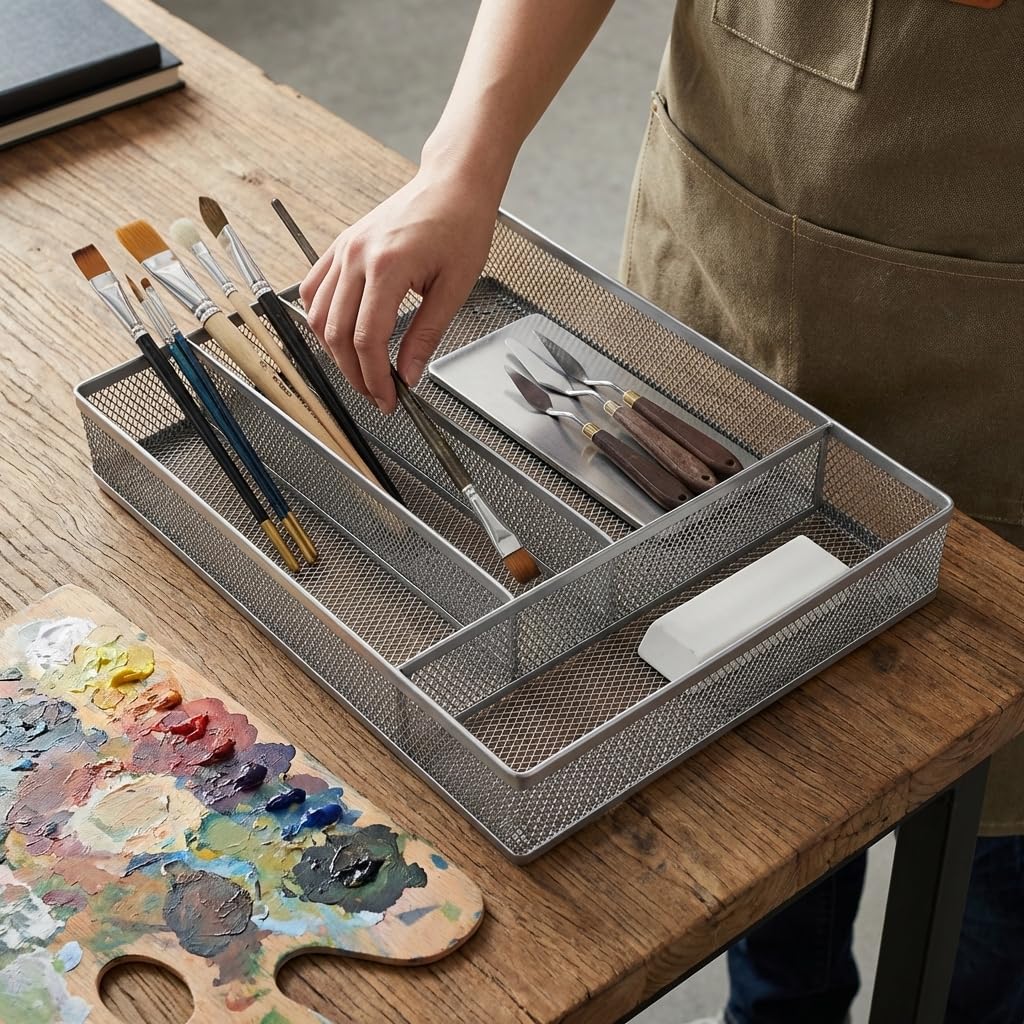
AFTNU Silverware Drawer Organizer with Anti-Slip Feet and Steel Mesh, 12.4x9.25 Kitchen Utensil Tray
Pros
- Open mesh design resists dirt buildup and dries quickly after drawer condensation
- Four non-slip feet provide a stable base that does not shift during daily use
- Modular 4-section layout accommodates mixed utensils, brushes, pens, or cosmetics with flexibility
- Lightweight steel construction keeps the drawer from feeling heavy or cumbersome
Cons
- No customer reviews yet, so real-world durability and finish quality are unconfirmed
- Only one color option (silver) limits compatibility with drawers that have warm wood or matte black hardware
- At 1.97 inches tall the dividers are shallow, which may not contain tall or bulky utensil handles
Drawer chaos is one of those small daily frustrations that quietly drains your energy every morning. The AFTNU silverware tray solves that with a no-fuss, open-mesh steel design that lets you see everything at a glance and grab what you need without digging. The silver finish looks clean and modern, and the mesh surface means you are not staring at a grimy plastic tray after a few weeks of use.
What stands out for a home decor buyer is how quietly this organizer works across different spaces. It is equally at home in a kitchen flatware drawer, a bathroom vanity, or an office desk as a pen and supply caddy. The 4-compartment layout is simple but thoughtfully proportioned, and the non-slip feet mean it stays exactly where you put it even in a deep, roomy drawer that gets yanked open daily.
If you want a clean, clutter-free drawer without spending on a premium bamboo or acrylic organizer, this one delivers.
Styles it works with: Minimalist, Scandinavian, Industrial, Modern Contemporary
Best placed in: Kitchen flatware drawer, bathroom vanity drawer, home office desk drawer
May not suit: Drawers shallower than 2 inches in depth where the tray rim may interfere with closing; warm-toned rustic or farmhouse kitchens where a silver metal finish clashes with natural wood hardware
Buy it if:
- You need a quick, affordable fix for a cluttered kitchen or office drawer and do not want to wait for a made-to-measure solution
- You prefer a mesh or open-frame design over solid plastic because it is easier to wipe clean
- You want one organizer that can move between the kitchen, bathroom, and office without looking out of place
Consider waiting if:
- You are renovating and plan to invest in a full modular drawer insert system that matches your cabinetry finish
Skip it if:
- Your drawer is shallower than 2 inches and the tray height would prevent the drawer from closing fully
- You need a warmer finish like bamboo, wood-grain, or matte black to match existing kitchen hardware
Check the latest price and availability on Amazon before it sells out.
Besilord Bamboo Silverware Organizer (Besilord)
This is the one to reach for after Step 2 if your drawer lands within a half-inch of a standard 21-inch width. The FSC-friendly bamboo construction sits flush and looks built-in, which is why it earns a 4.7 rating from owners who value the clean finish. It solves the fixed-tray scenario directly: measure your interior width, confirm it clears the tray footprint, and drop it in. The compartments are sized for daily tools up front, weekly tools behind, so it maps onto the frequency zoning from Step 3 without any fuss. Bamboo also handles kitchen humidity better than untreated pine, so it won’t cup after a few months near the sink.
Lifewit Expandable Silverware Organizer (Lifewit)
This is my pick for the oddball drawer, the one that measures 19.75 inches or some other builder-grade number. It telescopes across a range that swallows widths a fixed tray can’t, so it directly answers the Step 2 fixed-versus-expandable decision. The BPA-free plastic wipes clean in seconds, and the 4.6 rating reflects how well it adapts to non-standard boxes. Set the width first, snug it to the drawer walls, then add the non-slip liner from Step 4 so it can’t creep. It’s the flexible-fit option when you’d rather not return a tray that’s a hair too big.
AFTNU Silverware Tray for Drawer (AFTNU)
The AFTNU tray is the versatile middle ground when you want defined compartments without locking into one exact footprint. It suits the reader who’s still dialing in zones and wants to reshuffle without buying twice. Use it after Step 3 once you’ve grouped tools by frequency, since the compartments let you keep daily tools forward and weekly tools back. Pair it with a grip liner so a loaded tray stays put on a fast pull. It’s a solid choice for a standard drawer where you care more about function than a furniture-grade finish.
Frequently Asked Questions
What if my drawer is deeper than the tray is long?
It depends on the gap. If there’s more than an inch of empty depth behind the tray, small tools slide into the void and jam the back. Add a second short tray or a divider behind the first one to fill the space, or wedge a folded liner strip so nothing migrates past the tray edge.
What if my drawer is too shallow for a standard tray?
Measure the interior height at the shallowest point first, since drawer boxes taper. If you clear under 2.5 inches, skip tall trays and choose a low-profile design around 1.5 to 2 inches high. A shallow expandable tray usually solves it, and laying utensils flat rather than stacking keeps the drawer closing clean.
What if my drawer is an odd width, like 19.75 inches?
Go expandable. Fixed bamboo trays only fit widths within about a half-inch of their footprint, so an odd builder-grade box will leave gaps or refuse to seat. An expandable plastic tray telescopes from roughly 13 to 22 inches and locks to whatever number your tape reads. That’s exactly the scenario it’s built for.
What if my drawer keeps sliding the tray around?
Almost always a liner problem. Cut a non-slip grip liner to the drawer floor before you set the tray, and the added friction holds a loaded tray in place through daily use. If a gap remains behind an expandable tray, shim it with foam so it can’t shift backward when you pull hard.
What if I have way more utensils than slots?
Cut the herd first, then buy. Most drawers hold twice what a household reaches for, so the never-use pile leaves the kitchen before you shop. If you still overflow after sorting, the fix is a second drawer for bulky or weekly tools, not a bigger tray that packs 6 or 7 pieces per slot and tangles.
Bottom Line
Measure the drawer before you buy anything, and half the frustration disappears. For a standard 21-inch box, the Besilord bamboo tray is the one most people should get, since it sits flush and holds up in humidity. If your drawer is an odd width or a hair too tall, the Lifewit expandable adapts where a fixed tray can’t. Zone by frequency, add a grip liner, and the system stays organized long after the first week. That’s the whole method.







Write Your Review
No reviews yet. Be the first to share your experience!