

> Editorial Note: I’m Olivia Bennett, a storage and organization contributor. I approach storage as a systems problem rather than a product one — fit to actual room dimensions, load ratings, and how the system holds up under daily use.
The biggest mistake in a laundry room isn’t buying too little storage. It’s buying storage before measuring the room. You grab a cart that looks right online, then it blocks the dryer door or leaves a dead 4-inch gap that collects lint and single socks. These 15 ideas walk the room in order (measure, walls, floor gap, then the daily-use layer), so every piece earns its spot. The sequence mirrors what organization editors at Apartment Therapy and The Spruce keep repeating: measure first, build vertical second. Some of that logic carries over from a best closet organizer system, a spare best closet rod solves hang-drying, and the wall math is the same one you’d use planning best floating shelves for living room, a best hanging closet organizer, or a best shoe rack. Measure first, then buy.
1. Write Down Three Numbers Before You Shop
Skip the shopping cart and grab a tape measure. Three measurements decide everything you buy: total wall width above the machines, the depth of any gap beside or between units, and the vertical space from machine top to ceiling. Write them down. Shop to those numbers and you’ll stop returning half of it.
2. Leave 24 Inches of Clearance in Front of the Washer
A front-load door needs room to swing full, and you need room to bend and load. Hold 24 inches of standing clearance minimum. Crowd it and the door fights you every wash.
3. Keep an 18-Inch Folding Surface Within Reach of the Dryer
Wet clothes need a landing spot the second they come out, or they pile on the floor. Keep at least 18 inches of counter or folding surface within arm’s reach of the dryer. It’s the difference between folding and a floor heap.
4. Never Store Anything Over 15 Pounds Above Shoulder Height
Detergent jugs and cast-iron anything belong at waist level. Above shoulder height, keep only lightweight, rarely-touched stuff: dryer sheets, spare bulbs, out-of-season lids. It’s a safety rule, not a style one.
5. Map the Room Into Wet, Dry, and Sort Zones
Every working laundry room splits three ways: wet (washer, sink, detergent), dry (dryer, rack, folding), and sort (hampers, bins). Mark each zone where the plumbing and vent already sit. You can’t move a dryer vent easily, so build around it.
6. Build the Vertical Wall First
Wall space is the cheapest square footage in the room, and most people waste it. There’s usually 40 to 50 inches of clear space above the machines, room for two shelves or a cabinet run. Mount the first shelf 16 to 18 inches above the machine tops, high enough to clear a raised lid, low enough to reach without a stool.
7. Anchor Shelves Into Studs, Not Drywall
A loaded 36-inch shelf can hold 20 to 30 pounds of liquid detergent, and drywall anchors alone pull out within a year. Use a stud finder and hit two studs per bracket, the same mounting discipline Wirecutter recommends for any loaded wall shelf. Heaviest items on the lowest shelf.
8. Consolidate Brooms and Mops on One Wall Rack
Long-handled tools that lean in corners eat floor space and fall over. A single wall-mounted rack with gripper slots clamps brooms, mops, and a dustpan onto one mounting footprint. In a rental where drill holes are precious, this does the most work per hole.
9. Claim the Floor Gap With a Slim Rolling Cart
That narrow gap beside the machines is prime real estate. Standard gaps run 6 to 12 inches wide. A 4-tier cart under 9 inches wide gives you the storage of a small dresser without stealing walking space, and it rolls out when you need it.
10. Measure the Gap at the Front and the Back
Older floors aren’t square. A cart that clears the front lip may jam 20 inches in. Measure both ends before buying, and look for locking or low-profile casters so the cart doesn’t drift when the spin cycle shakes the floor.
11. Load the Cart Front-to-Back by Frequency
Detergent pods and the stain stick go up front; refill stock lives in the back tiers. Pull, grab, push back. That’s the whole interaction, and it’s what keeps a gap cart from turning into a junk drawer on wheels.
12. Build a Daily-Use Layer Within a 30-Inch Radius
Everything you touch in a normal cycle has to live within one arm’s reach of the machines, roughly a 30-inch radius. Reach across the room for the stain remover and the system fails inside a week. Clothes start piling again.
13. Give Every Recurring Task a Fixed Home
A small bin for lint and emptied pockets. A hook for the mesh delicates bag. A measuring cup that never migrates. The rule: if a task happens every load, its tool gets a permanent, reachable spot. Everything else lives one tier back.
14. Sort at Drop-Off With a Two-Bin Hamper
Sorting on laundry day wastes the one day you’re already busy. A low two-bin sorter for lights and darks moves that step to drop-off, when clothes come off. By wash time the sorting is already done.
15. For a Closet Laundry, Go Fully Vertical
No floor gap? Skip the cart entirely. A 24-inch-wide closet still has 40-plus inches of unused vertical space above the unit — that’s your whole storage budget. Two shelves above the machine plus a slim rack on the door’s interior, and keep folding to a pull-out or an adjacent counter.
The Products That Make These Ideas Work
The picks below all clear a 4.6 owner rating and solve the two spots people get wrong most: wall consolidation and the narrow floor gap. Start with the wall rack if your room has clutter but no mount points. Jump to a slim cart if your problem is that 6-to-9-inch gap between the machines.

Pros
- Combines shelf, clamps, and hooks into one compact wall unit, reducing installation points
- Thickened iron frame and bamboo rail offer durability over typical plastic alternatives
- Non-slip rubber grippers hold handles securely without sliding
- Includes all mounting hardware and clear instructions for concrete or brick walls
- L-shaped vacuum hook accommodates bulkier cleaning attachments
Cons
- Only 2 reviews available, so long-term durability is unverified
- Requires drilling into concrete or brick, not suitable for drywall-only walls without anchors
- At nearly $47, it costs more than basic plastic broom holders that serve a similar core function
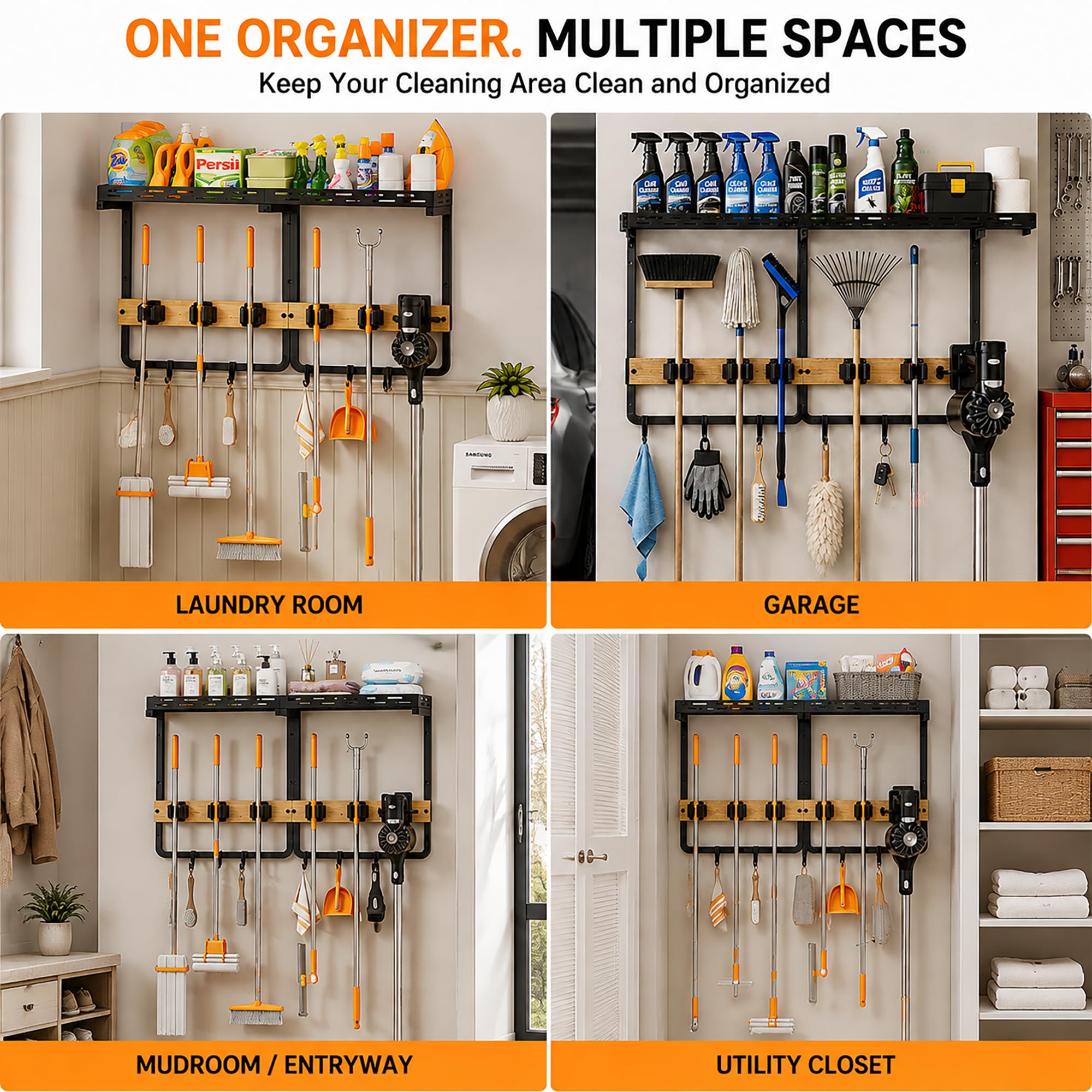
This is one of those organizers that quietly upgrades a room the moment you install it. Instead of brooms falling out of corners and mops leaning against the washing machine, everything locks into place on the wall with a satisfying clip. The bamboo rail and iron frame give it a cleaner, more intentional look than the cheap plastic strips you usually see in this category.
What sets it apart is the three-zone layout. The top shelf holds your spray bottles and detergent where you can actually see them, the middle section grips your brooms and mops firmly, and the bottom hooks catch all the smaller items like dustpans, brushes, and cloths. It turns a blank wall into a functional cleaning station.
If you want a single organizer that handles your entire cleaning closet without looking like an afterthought, this one delivers.
Styles it works with: Modern Farmhouse, Industrial, Minimalist, Scandinavian
Best placed in: Laundry room wall beside the washer, inside a garage near the entry door, utility closet back wall
May not suit: Homes with only drywall and no studs at the desired location (requires concrete or brick), or renters who cannot drill into walls
Buy it if:
- You have a laundry room or garage wall that is currently wasted space
- You are tired of brooms and mops falling over or clutering floor corners
- You want one unit that replaces multiple hooks and separate shelf
Consider waiting if:
- You want to see more long-term durability reviews before committing at this price point
Skip it if:
- You only have drywall without studs or concrete behind it
- You rent and cannot drill holes in your walls
Check the latest price and availability on Amazon before it sells out.

Pros
- Slim profile designed specifically for narrow gaps other carts can't fit into
- Rust-resistant coating and mesh shelving suited for humid laundry or bathroom use
- Swivel casters make it easy to roll out for access, then tuck back into place
- Wood-metal design looks more finished than typical wire utility carts
- Straightforward assembly with labeled parts
Cons
- No customer reviews yet, so real-world durability is unproven
- 4-tier slim design limits how much weight or bulk each shelf can hold
- Narrow footprint means less storage capacity than a standard-width cart
If you have ever stared at that awkward sliver of space between your washer and dryer and wondered why nothing ever fits there, this cart was made for exactly that problem. The slim 4-tier design slides into gaps most storage carts can't touch, turning dead space into a real spot for detergent, dryer sheets, and cleaning supplies.
In person, the wood-tone shelf top paired with the gloss white steel frame gives it a cleaner, more modern look than the typical all-wire utility cart. It doesn't scream 'storage bin,' it looks intentional, which matters if your laundry room or kitchen is visible from other living spaces.
The mesh shelving and rust-resistant coating mean it's built to actually survive in damp environments, not just look good on day one. If you want organized, rollable storage without sacrificing the little space you have, this one delivers.
Styles it works with: Modern Industrial, Farmhouse, Minimalist, Transitional
Best placed in: between washer and dryer, beside the stove or fridge, next to the toilet or vanity
May not suit: homes needing wide, high-capacity storage, or spaces where a rustic all-wood look is preferred over the metal-and-wood mix
Buy it if:
- You have a narrow gap between appliances or fixtures that's currently wasted space
- You want a laundry, kitchen, or bathroom organizer that also looks presentable
- You need something on casters you can roll out for easy access, then push back out of sight
Consider waiting if:
- You need a wider cart with more storage capacity per shelf
- You want a fully wood or fully wire aesthetic instead of the mixed material look
Skip it if:
- Your gap is wider than a standard slim cart, where a full-size utility cart would serve you better
- You need heavy-duty shelving for bulky, weighty items rather than bottles and jars
Check the latest price and availability on Amazon before it sells out.

Pros
- Genuinely narrow at 7.1 inches, fits spaces other carts cannot
- Rust-resistant powder coating holds up in damp laundry and bathroom environments
- Easy-roll casters make it functional as a mobile caddy, not just static storage
- Wood top adds a finished look compared to all-metal utility carts
Cons
- Zero customer reviews yet, so long-term durability is unproven
- Mesh shelves may let smaller items like makeup or craft supplies slip through
- At $46, it costs more than basic plastic slim carts with similar dimensions
If you have ever stared at the 8-inch gap between your washer and dryer wondering how to use it, this cart was designed for exactly that moment. The 7.1-inch width is narrow enough to slide into spaces where most organizers will not fit, but the four tiers give you genuine vertical storage for detergent, dryer sheets, cleaning sprays, or kitchen overflow.
What sets this apart from cheap plastic alternatives is the wood top and matte black steel frame. It looks intentional, not like you shoved a dorm-room leftover into your laundry area. The wood surface is sturdy enough to hold a laundry basket while you fold or stage items you are pulling out of the dryer. The mesh shelves are smart for humid rooms since water drains through instead of pooling.
If you want functional gap storage that does not look like an afterthought, this one delivers.
Styles it works with: Modern Farmhouse, Industrial, Minimalist, Scandinavian
Best placed in: Laundry room between appliances, kitchen beside fridge or pantry, bathroom next to vanity or toilet
May not suit: Homes where you need to store very small items like bobby pins or craft beads (mesh shelves have gaps), or if you prefer all-white or brightly colored storage that matches existing decor
Buy it if:
- You have a 7- to 8-inch gap in your laundry room, kitchen, or bathroom that is currently wasted space
- You want rolling storage you can pull out for access and push back when done, not a permanent shelf unit
- You prefer the look of wood and metal over plastic utility carts
Consider waiting if:
- You want to see verified customer photos and durability feedback before committing at this price point
Skip it if:
- You need to store items smaller than a shampoo bottle (mesh shelves will not contain tiny objects)
- Your gap is narrower than 7 inches or you need a cart wider than 8 inches for stability
Check the latest price and availability on Amazon before it sells out.
TigerskiTools 3-in-1 Broom & Mop Holder (Clears the Floor in a Rental)
This solves ideas 6 and 8: brooms, mops, and cleaning bottles get a fixed vertical home on one mounting footprint. Five gripper slots clamp handles rather than hooking them, so a bumped mop doesn’t clatter down, and the top shelf holds spray bottles and gloves. The 5.0 owner rating tracks with how well the grippers hold. Mount it into two studs and you’ve cleared the floor for the cart in idea 9. It’s the least glamorous fix in the room and the one people notice most.
OKZEST 4-Tier Slim Utility Cart (For 8-to-10-Inch Openings)
This is the answer to idea 9 when your gap runs 8 to 10 inches. Four tiers, a wood top, and a metal frame that stays square under a full load. The 4.6 rating matches what owners report about the casters clearing most floor transitions. Load it front-to-back by frequency and the wood top doubles as a landing surface for a detergent scoop. You get the storage of a dresser without the footprint.
EndlessStorage Vivihomety 4-Tier Cart (Best for Narrowest 6-to-8-Inch Gaps)
Reach for this when your gap is at the tighter end and the OKZEST won’t clear. Same 4-tier layout and wood top, also rated 4.6, but the slimmer frame suits 6-to-8-inch openings where inches decide whether anything fits. Owners flag the smooth one-handed roll even when loaded, which is the whole point of a cart you pull daily. Measure front and back, then choose between this and the OKZEST by which width actually clears.
Frequently Asked Questions
What if my laundry room is a closet with no floor space at all?
Go fully vertical, per idea 15. Mount two shelves above the machine and a slim rack on the door’s interior. A 24-inch closet still has 40-plus inches of unused vertical space above the unit — that’s your entire storage budget, so use every inch and keep folding to a pull-out.
What if my room is too narrow for a folding counter?
Use a wall-mounted drop-leaf surface. A 12 by 24-inch leaf folds flat when you’re not folding and gives you a real surface when you are. Mount it at 36 inches high, kitchen-counter height, so you’re not hunching. It steals zero permanent floor space.
What if my machines are stacked instead of side by side?
Stacked units free up the adjacent wall for a full-height shelf tower or a tall slim cabinet, so treat that side wall as your main zone. Keep the daily-use layer at the height of the lower machine — bending beats reaching over your head with a wet load.
What if I rent and can’t drill into the walls?
Almost never a dealbreaker. A slim rolling cart in the floor gap needs no holes at all, and an over-the-machine shelving unit stands on its own legs. Command-style hooks handle the light stuff. Save your one or two allowed drill holes for the wall rack that consolidates the most clutter.
What if my laundry room doubles as a mudroom or storage room?
Zone it hard. Give the laundry function its own 30-inch radius and separate the overflow with a shelf line or a cart. The failure mode in shared rooms is drift — boots and boxes creep into the folding zone. A clear boundary and a labeled bin for non-laundry stuff keeps the workflow from getting buried.
Bottom Line
Measure before you buy — that single habit prevents most laundry-room mistakes. Build the vertical wall first, claim the floor gap with a slim rolling cart, then set every daily-use tool within a 30-inch reach of the machines. If your room is a tight closet, skip the cart and go all-in on shelves and a door rack. The system that lasts isn’t the one with the most bins. It’s the one where every item has a reachable home and nothing blocks a machine door.







Write Your Review
No reviews yet. Be the first to share your experience!