

> Editorial Note: I’m Hannah Lin, an Interior Living Researcher who’s spent 9+ years analyzing the home furniture market. This guide draws on BIFMA, GREENGUARD, and FSC certifications, plus owner reviews aggregated from Wirecutter, Apartment Therapy, and the major home design subreddits.
The real choice comes first: run the cables inside the wall for a clean finish, or route them along the surface so nothing gets cut. In-wall work looks invisible but it’s permanent and touches your electrical. On-wall covers stay renter-safe and reversible. Once you pick a lane, the rest of the job is quick. If your set sits on furniture instead of a mount, a stand or console with a rear channel solves most of it before you buy a single cover. Pair that with the right footprint from a best tv stand for 65 inch tv or a best tv stand for 75 inch tv and the wires mostly disappear on their own. Smaller rooms do fine with a best small tv stand or a best media console, while the surrounding layout of a best sectional sofa and a best area rug for living room decides where the cables end up landing.
Should You Run TV Wires Inside the Wall or Outside?
In-wall routing hides everything, but it’s a commitment. You cut two openings, feed rated cable through the cavity, and the wall stays that way. On-wall routing keeps the drywall intact, which matters if you rent or expect to remodel later.
Consumer Reports notes that surface covers handle the vast majority of living-room setups without touching the structure. So start there unless you’re set on a fully flush look. A paintable raceway drops the visible clutter by a wide margin in under an hour.
The deciding factor is usually the mount height. A wall-mounted screen sitting 6 feet up begs for in-wall cleanup. A screen on a console barely shows any cord at all.
How Do You Hide TV Wires Without Cutting the Wall?
Paintable cord raceways are the workhorse here. These are shallow plastic channels, roughly 2 inches wide, that stick to the wall and snap open so you can lay cables inside. Paint them your wall color and they read as trim rather than hardware.
For the loose runs behind furniture, adhesive cable clips keep everything tracking in a straight line. Apartment Therapy recommends grouping cords with a sleeve first, then anchoring the sleeve, so the bundle reads as one clean line instead of five.
No drilling. No patching. That’s the whole appeal of the on-wall route, and it’s why it’s the default for renters.
How Do You Run TV Cables Behind the Wall Safely?
If you want the flush look, use an in-wall rated cable kit. The rating matters: only cable marked for in-wall use belongs inside a cavity, because standard HDMI and cords aren’t built for it. Good Housekeeping flags this as the step most people skip.
Power is the part to respect. You can’t just drop a standard extension cord into the wall. An in-wall power relocation kit adds a code-rated outlet behind the screen and a second one lower down, so the plug stays legal.
Hire a licensed electrician for any in-wall power work. It’s a short job for a pro, and it keeps the outlet up to code rather than guessing.
How Do You Hide Wires on a TV Stand or Console?
This is the easiest path by far. A media console with cable routing has a rear channel or grommet holes that swallow the cords before they ever reach the floor. Feed everything down the back column and out to a power strip on the lower shelf.
A rolling stand with a hidden wire column does the same thing without any furniture behind it. Many hold a screen up to 75 inches and route the cables down a central post, so the back stays as tidy as the front.
Add a few cable clips inside the cabinet to keep the strip from sliding around. Done.
What About Power Cords and Renter-Friendly Fixes?
Power cords are thicker and stiffer than signal cables, so they need their own plan. A wider raceway or a fabric cord sleeve handles them without bulging. Keep the run short and let it drop straight to the nearest outlet.
Renters get the best results from anything reversible: adhesive clips, peel-and-stick raceways, and a console that hides the strip. Nothing here damages the wall, and it all peels off clean when you move.
If the outlet sits far from the screen, a flat under-rug cord cover carries power across the floor. Tuck it beneath an area rug and foot traffic never finds it.
Helpful Picks
All three below clear a 4.5 owner rating and route cables through the frame instead of leaving them loose against a wall. Start with the FITUEYES if you want a rolling piece that hides the strip; jump to the PERLESMITH if you already own a cabinet and just need the screen lifted; pick the ECOTINY for larger sets that need a heavier base.

FITUEYES Corner TV Stand for 32-65 Inch TVs - Rolling Cart with Tilt, Height Adjust & Cable Management, Walnut Finish
Pros
- Sturdy trapezoidal base supports up to 88 lbs without wobbling
- Height adjustable to match eye level from different seating positions
- Swappable wheels and feet let you choose mobility or permanent placement
- Fits most VESA mounting patterns (100x100mm to 400x400mm)
- Warm walnut wood shelves complement multiple decor styles
Cons
- At $179, costs more than basic fixed TV stands but less than premium wall mounts with installation
- Tower design means it occupies floor space that low-profile media consoles would not
- Only 0 reviews so far, making it harder to assess long-term durability from real users
This isn't just another TV stand. The Eiffel-inspired tower silhouette turns a functional piece into a conversation starter, especially in open-concept spaces where the back of the stand is visible from multiple angles. The walnut shelves feel substantial, not flimsy, and the cable tube running through the center means you'll never see a tangle of black cords snaking down to the outlet.
What really sets this apart is the mobility. You can wheel it from the living room to the bedroom for movie night, then roll it back the next morning. The tilt function is genuinely useful when you're hosting and people are standing near the kitchen island or sitting on floor cushions during game night. It adapts to how you actually use your space, not the other way around.
If you want a corner TV solution that looks like thoughtful design instead of an afterthought, and you value the flexibility to rearrange without calling friends to help move furniture, this one delivers.
Styles it works with: Mid-Century Modern, Industrial Loft, Scandinavian Minimalist, Contemporary Urban
Best placed in: Living room corners near windows, studio apartment zones that separate sleeping and lounging areas, home offices doubling as media rooms, basement rec rooms with awkward angles
May not suit: Homes with toddlers who might pull on the stand (the wheels add a tip risk if not locked), ultra-traditional or farmhouse interiors where the modern tower shape clashes, very small bedrooms where the footprint takes up too much floor area compared to a wall mount
Buy it if:
- You're renting and can't drill into walls, but still want your TV at the right height with professional cable management
- You regularly rearrange furniture or host gatherings where the TV needs to face different seating areas
- You have an awkward corner that's too small for a full media console but too prominent to leave empty
- You prefer furniture that doubles as decor and don't want generic black metal in your carefully styled space
Consider waiting if:
- You want to see more verified customer photos and long-term durability reports before spending $179
- A sale or promotion might drop the price in the next few weeks
Skip it if:
- Your TV is larger than 65 inches or heavier than 88 lbs
- You need storage drawers or cabinets for DVDs, blankets, or other bulky items beyond two open shelves
- You have active young children or large pets that could knock into a mobile stand
Check the latest price and availability on Amazon before it sells out.

PERLESMITH Universal TV Stand Legs for 32-60" TVs | Height Adjustable Tabletop Base | VESA 400x400mm | Up to 88 lbs
Pros
- Tool-friendly 15-minute installation with included hardware and a clear instruction manual
- Broad VESA compatibility covers the vast majority of flat and curved TVs sold in the last decade
- Tempered glass base looks polished and modern rather than purely functional
- Six adjustable height settings let you fine-tune the viewing position for different furniture heights
- Massive verified review base of 66,000+ ratings at 4.6 stars signals consistent real-world reliability
Cons
- Fixed swivel angle on this model means you cannot pivot the screen left or right once mounted, unlike the step-up PSTVS09 version
- The tempered glass base measures roughly 15.75 x 9.45 inches, which may feel narrow and less stable under larger 55- to 60-inch sets on uneven surfaces
- Only rated for TVs up to 60 inches, so shoppers with a 65-inch or larger screen will need to look at a higher PERLESMITH model
There is a specific kind of frustration that comes from a perfectly good TV sitting on the floor because one leg snapped or got lost in a move. The PERLESMITH PSTVS04 solves that problem cleanly and affordably, and it does it without making your living room look like a repair job. The slim black metal arms and tempered glass base look like they belong together, and most guests would never guess they were not the original legs that shipped with the TV.
What makes this stand genuinely useful for home decor shoppers is the height flexibility. Whether your entertainment console sits low to the ground or your bedroom dresser puts the screen at eye level from a higher mattress, the six height and mounting combinations let you land on the position that actually feels comfortable rather than just acceptable. That level of customization at this price point is rare.
If you want a rock-solid, great-looking TV base that works with almost any flat or curved screen without spending a weekend on installation, this one delivers.
Styles it works with: Modern Minimalist, Scandinavian, Contemporary, Industrial
Best placed in: Living room entertainment console, bedroom dresser top, guest room media setup on a low credenza
May not suit: Warm, rustic, or Farmhouse-style rooms where the black metal and glass base may feel visually cold next to wood-heavy furniture; households with very young children who may bump a glass base at floor-console height without a safety strap added separately
Buy it if:
- You have a 32- to 60-inch TV with broken, missing, or incompatible legs and want a fast, affordable fix that looks intentional
- You are setting up a second TV in a bedroom or guest room and need a stable base without buying a full new stand
- You want height adjustment options so the screen sits at the right eye level for your specific furniture arrangement
Consider waiting if:
- You are still deciding on your final furniture layout, since locking in the height works best once you know exactly where the TV will live
Skip it if:
- Your TV is larger than 60 inches, as this model is not rated for it and a larger PERLESMITH variant will be a safer choice
- You need left-right swivel capability, because this fixed-angle model does not rotate and the PSTVS09 would be the better fit
Check the latest price and availability on Amazon before it sells out.
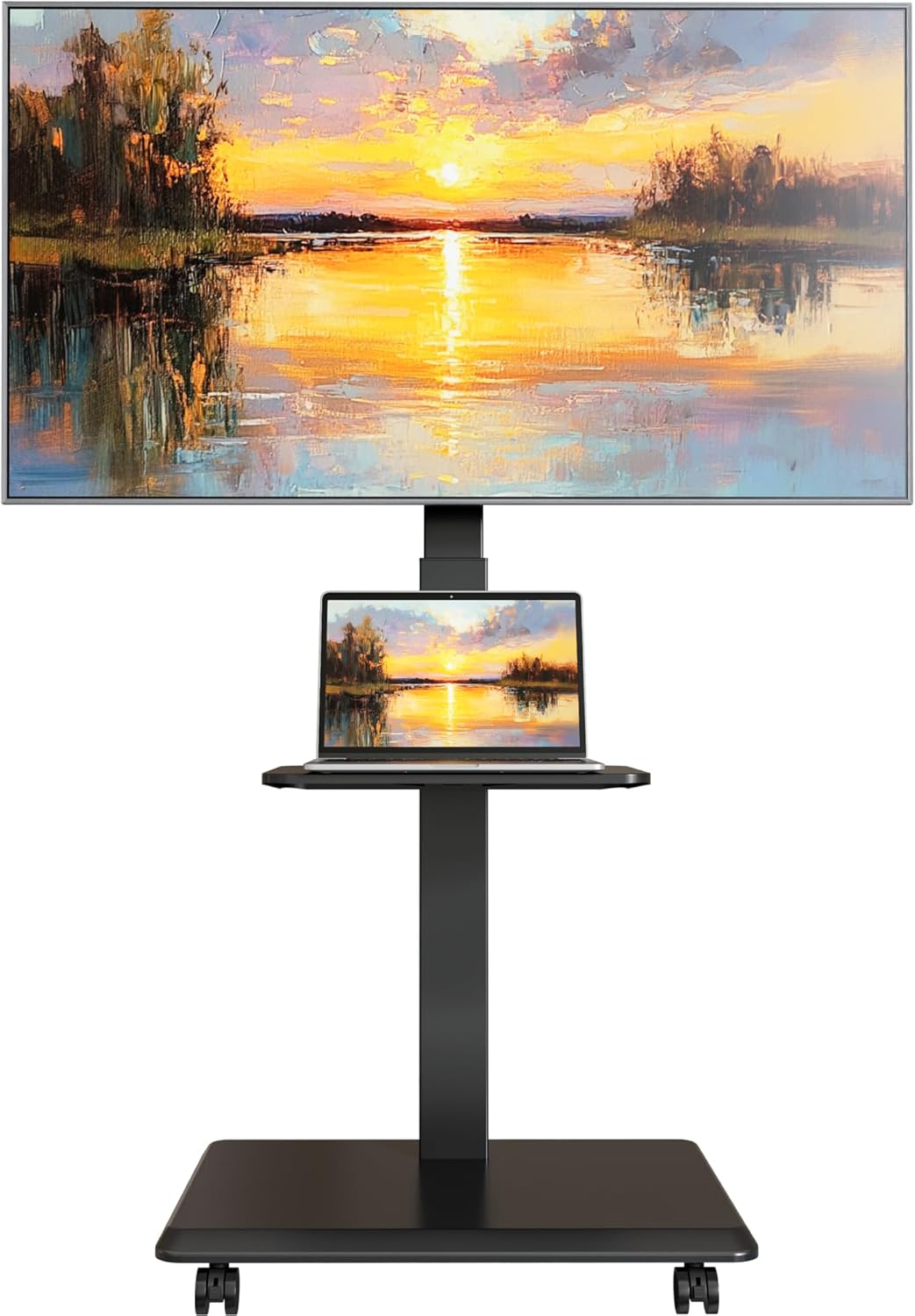
ECOTINY Rolling TV Stand 32-75 inch Steel Base Height Adjustable Swivel Tilt Mobile Stand with Wire Management
Pros
- Exceptionally stable 30mm thick steel base is noticeably heavier and wider than most competing mobile stands, reducing tip risk with large TVs
- Six adjustable height positions cover a wide range, making it genuinely versatile across different rooms and seating arrangements
- Integrated wire management channels keep cables hidden without requiring separate cord covers or zip ties
- Silent locking casters roll smoothly and lock firmly, making repositioning effortless without noise or floor damage
- Compatible with a broad VESA range from 200x200 to 600x400mm, covering nearly all flat and curved TVs from 32 to 75 inches
Cons
- Tilt range is limited to plus 3 degrees and minus 5 degrees, which may not be enough for viewers seated significantly above or below the screen
- The black steel finish is the only available color option, which may not blend well with lighter or wood-toned room decor
- At 0 verified reviews at time of writing, there is no real-world owner feedback yet to confirm long-term durability claims
Most TV stands force a choice between stability and flexibility. The ECOTINY rolling stand refuses that trade-off. The 30mm thick steel base feels genuinely substantial the moment you unbox it, and the locking casters mean you can roll your TV from the living room to the bedroom for a movie night and have it locked back in place before the opening credits finish. That kind of everyday freedom is rare at this price point.
The built-in wire management is the kind of detail that separates a thoughtfully designed product from a generic stand. Instead of cables spilling down the back of your TV, they tuck neatly into channels built into the pole, giving your setup a clean, almost custom-built look. Pair that with the steel shelf below and you have a complete media station without needing a separate cabinet or console.
If you want a stable, flexible TV stand that keeps your space looking tidy without committing to a fixed wall mount, this one delivers.
Styles it works with: Industrial, Modern Minimalist, Contemporary, Urban Loft
Best placed in: Living room against a feature wall, bedroom opposite the bed for adjustable viewing angles, home office or meeting room where the TV needs to face multiple positions
May not suit: Rooms with warm, traditional, or farmhouse-style decor where the all-black steel finish may feel out of place; very compact rooms under 10 feet wide where the 23.6-inch base footprint and swivel range could feel oversized
Buy it if:
- You rent your home or move frequently and need a TV setup that requires no wall drilling and relocates in minutes
- You want one stand that works across multiple rooms, from the living room during the day to the bedroom at night, without buying separate mounts
- You have a large TV between 55 and 75 inches and want a floor stand with a proven heavy-duty frame rather than a lightweight budget option
Consider waiting if:
- You prefer to read verified owner reviews before purchasing, as this listing has no customer feedback yet at time of writing
Skip it if:
- Your TV is larger than 75 inches or heavier than 110 lbs, as this stand is not rated for those sizes
- Your room decor is light, warm, or wood-forward and the all-black steel finish would clash with your existing furniture
Check the latest price and availability on Amazon before it sells out.
The FITUEYES rolling floor and corner TV stand fits 32 to 65 inch screens and runs every cable down a rear column, so the back stays as clean as the display side. The PERLESMITH height-adjustable tabletop legs lift 32 to 60 inch sets up to 88 lbs off a surface and open a gap underneath to tuck cords out of sight. The ECOTINY steel-base rolling stand carries 32 to 75 inch screens up to 110 lbs and threads the wires through a hidden channel in the post.
Frequently Asked Questions
Can you hide TV wires without an electrician?
Yes, if you stick to signal cables and surface covers. A paintable raceway and clips need no wiring knowledge. You only need a pro when relocating power inside the wall.
Is it safe to put an HDMI cable inside the wall?
No, not a standard one. Only cable rated for in-wall use belongs in a cavity. Standard HDMI lacks the fire rating that in-wall installation requires.
How much does hiding TV wires usually cost?
It depends on the method. A raceway kit runs a few dollars, while an in-wall power relocation kit plus an electrician’s time costs more. Most renters spend the least.
Will a cord cover damage my paint when removed?
Almost never, if you buy peel-and-stick covers made for renters. They lift off with gentle heat and leave no marks. Try a small strip in a corner first.
Do I need in-wall power for a wall-mounted TV?
It depends on how flush you want the look. A relocation kit hides the plug completely. A raceway down to the existing outlet works fine if you’re okay with a visible channel.
How do I hide wires if my TV is on a console?
Yes, this is the simplest case. Route cords down the rear channel and land the power strip on a lower shelf. A console with cable routing does most of the work.
Can renters run cables behind the wall?
No, most leases forbid cutting drywall. Stick to raceways, clips, and a console that hides the strip. Everything stays reversible and peels off clean at move-out.



Write Your Review
No reviews yet. Be the first to share your experience!