

> Editorial Note: I’m Liam Wright, an outdoor and garden editor. I grew up in my family’s landscaping business and now cover what actually survives a season of UV, rain, and freeze-thaw cycles. The picks here are evaluated against ASTM weatherability standards and manufacturer durability ratings.
A 5-gallon pot, 6+ hours of direct sun, and water that never swings from bone-dry to soaked — that’s the whole secret. Most container tomato failures trace back to one thing: a pot that’s too small to hold enough moisture through a hot afternoon. Get the container size right and the rest is maintenance.
Want more growing space than a single pot? Start with a best raised garden bed or a complete best raised garden bed kit. For a sunny balcony, a 3 tier plant stand stacks more plants into a tight footprint. And the right best garden tool set plus a best garden cart make hauling soil and harvests far less of a chore.
What Size Pot Do Tomatoes Need?
Bigger than you think. Five gallons is the absolute minimum for a single tomato plant, and that’s only enough for compact determinate varieties. For indeterminate types, the ones that keep climbing and producing all season, you want 10 to 20 gallons per plant.
Here’s why size matters so much. A small pot dries out fast in summer heat, and the wild swings between wet and dry trigger blossom-end rot and cracked fruit. A larger volume of soil acts like a buffer. It holds moisture longer, keeps roots cooler, and gives the plant room to anchor itself against wind.
Fabric grow bags work well because they air-prune roots and drain freely. Glazed ceramic and thick plastic hold moisture longer than terracotta, which wicks water out through its walls and dries fast. Whatever you pick, depth matters as much as width. Tomatoes send roots down 12 inches or more.
One plant per pot. Crowding two tomatoes into a 10-gallon container starves both. The University of Minnesota Extension recommends a minimum 5-gallon volume per plant for exactly this reason: roots need room, and water reserves need depth.
What’s the Best Soil and Drainage Setup?
Never use garden soil in a pot. It compacts into a dense brick that suffocates roots and drains poorly. Use a quality potting mix instead. It’s lighter, holds air pockets, and lets water move through evenly.
A good container blend is mostly peat or coir, plus perlite or vermiculite for drainage, and compost for nutrition. Look for a mix labeled for vegetables or containers. Apartment Therapy points to peat-and-perlite blends as the reliable default for edible container crops, and that holds up in practice.
Drainage is non-negotiable. Your pot needs holes in the bottom, at least three or four for a 10-gallon container. No holes means standing water at the root zone, and that’s a fast path to root rot. Skip the gravel-at-the-bottom trick; it actually raises the saturated zone rather than improving drainage.
Set pots on feet or bricks so water escapes freely and air circulates underneath. In peak summer, mulch the soil surface with straw or bark. A 1-inch mulch layer cuts evaporation and steadies soil temperature, which keeps watering predictable.
How Much Sun and Water Do Container Tomatoes Need?
Sun first: tomatoes need 6 to 8 hours of direct sunlight daily. Less than 6 and you’ll get leggy plants with sparse fruit. South-facing is ideal in the Northern Hemisphere. One advantage of pots: you can move them to chase the light if a tree or fence shades part of your day.
Water is where most growers slip. Container tomatoes dry out far faster than in-ground plants, and in a heat wave a 5-gallon pot can need water every single day. Sometimes twice. Stick a finger 2 inches into the soil; if it’s dry there, water deeply until it runs out the bottom.
Consistency beats volume. The goal is even moisture, never letting the soil go from soaked to bone-dry and back. That swing is what causes blossom-end rot and split skins. A saucer or self-watering reservoir helps on the hottest stretches.
Water at the base, not the leaves. Wet foliage invites fungal disease, and Wirecutter’s gardening guidance is consistent here. Morning watering at soil level gives the plant a full day to use it. Avoid evening soakings that leave leaves damp overnight.
Determinate vs Indeterminate: Which for Pots?
For most container growers, determinate or dwarf varieties are the easier pick. Determinate tomatoes grow to a fixed size, usually 3 to 4 feet, set their fruit over a few weeks, then wind down. They stay compact, need less staking, and thrive in a 5-gallon pot.
Indeterminate varieties are the vining types that grow 6 feet or taller and produce until frost. They’ll outperform on total yield, but they demand a much larger container, sturdy support, and more frequent feeding. Give them 10 to 20 gallons or they’ll stall.
Look for “patio,” “bush,” “dwarf,” or “container” on the label. These are bred for small spaces. Varieties like ‘Patio,’ ‘Bush Early Girl,’ and the dwarf ‘Tiny Tim’ were developed specifically for pots and small footprints.
If you’ve got the space and want a steady supply all season, one indeterminate plant in a 15-gallon container beats three crammed determinates. If you’re on a balcony with a single sunny corner, go determinate. Match the variety to the pot, not the other way around.
How Do You Feed and Support Potted Tomatoes?
Feed often. Container soil has limited nutrients, and frequent watering flushes them out the drainage holes. Start with a balanced fertilizer at planting, then switch to a tomato-specific feed once flowers appear. Feed every 2 weeks through the growing season.
Watch the nitrogen. Too much produces lush leaves and few tomatoes. Once the plant flowers, it wants more phosphorus and potassium than nitrogen. That’s why dedicated tomato fertilizers shift the ratio. Liquid feeds absorb fastest in containers.
Support goes in early. Install a cage or stake at planting time, not after the plant sprawls. Wait too long and you’ll snap stems trying to wrangle a tangled plant. A determinate variety does fine with a standard 42-inch cage.
Indeterminate plants need more. Use a tall stake, 6 feet or more, or a heavy-gauge cage anchored into the soil. Tie the main stem loosely every 8 to 10 inches with soft ties or strips of cloth. Pinch out suckers, the shoots in the joint between stem and branch, to keep an indeterminate plant manageable and airy.
What Are Common Container Tomato Problems?
Blossom-end rot tops the list. That sunken black patch on the bottom of the fruit isn’t a disease — it’s a calcium delivery failure, almost always caused by uneven watering. Steady moisture lets the plant move calcium to the fruit. Fix the watering and new fruit comes in clean.
Yellowing lower leaves usually mean a nutrient gap from leached soil. It’s common in pots by midsummer. A feed and a check of your watering rhythm typically turns it around within a week or two.
Cracked fruit comes from a sudden gulp of water after a dry spell — the inside swells faster than the skin. The fix is the same as for blossom-end rot: keep the soil evenly moist. Mulch helps a lot here.
Watch for pests too. Aphids cluster on new growth; a blast of water or insecticidal soap clears them. Hornworms strip leaves overnight, so pick them off by hand. Good airflow between plants and base-only watering prevent most fungal trouble before it starts.
Helpful Guides
If you want to go deeper than a quick how-to, these container-gardening books cover variety selection, feeding schedules, and troubleshooting in far more detail than a single article can. Start with the first if you want a comprehensive reference; the other two are tomato-specific and beginner-friendly.
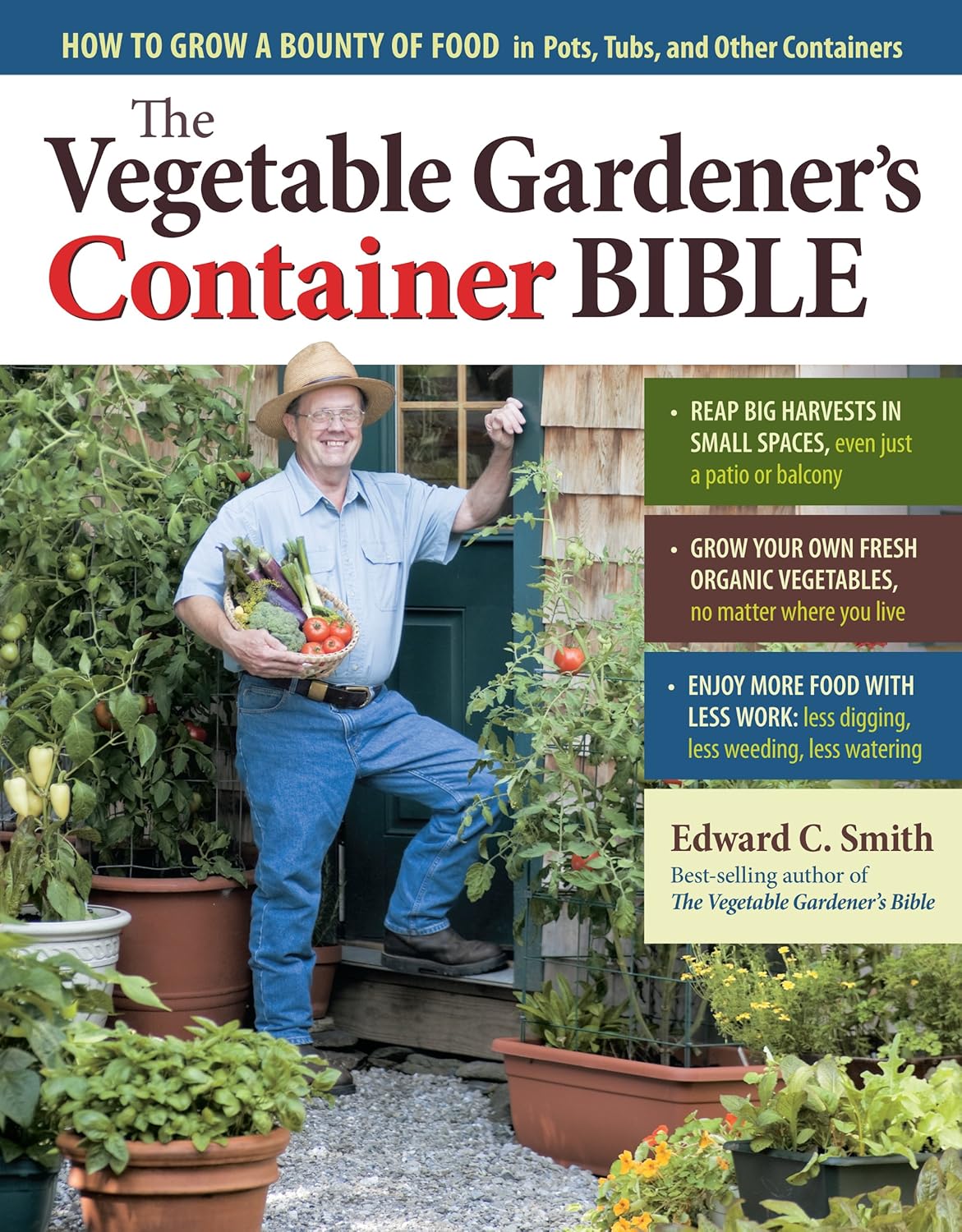
The Vegetable Gardener's Container Bible by Edward C. Smith - Complete Guide to Growing Food in Pots, Tubs & Containers
Pros
- 4.7-star rating across over 1,200 reviews signals consistently high reader satisfaction
- Covers the full process from container selection to harvest in a single accessible volume
- Photo-heavy layout makes techniques clear for visual learners and first-time gardeners
- Practical variety recommendations are based on real container trials by the author
Cons
- Focused entirely on edible plants so ornamental or flower container gardening is not covered
- Print format means you cannot search or keyword-scan the way a digital guide allows
If you have ever stared at a sunny balcony or unused patio corner and wished you could turn it into something productive, this book hands you the exact roadmap. Ed Smith writes with the clarity of someone who has actually grown tomatoes in a five-gallon bucket and wants you to succeed on your first try, not your third.
The photography alone earns its shelf space. Rather than generic stock images, the visuals walk you through real container setups so you can immediately picture how a half-barrel of lettuce or a patio planter of cherry tomatoes would look in your own space. It is the kind of book you open in February when you are planning and reach for again in July when something looks off.
If you want a reliable harvest from a small outdoor space without spending years figuring out which containers and varieties actually work, this one delivers.
Styles it works with: Cottage, Modern Farmhouse, Organic Modern, Boho
Best placed in: Patio or balcony bookshelf, kitchen windowsill reading stack, home office garden planning area
May not suit: Households looking for ornamental or indoor plant guidance rather than edible gardening, or readers in climates with no outdoor growing season
Buy it if:
- You have a balcony, patio, or small yard and want to grow your own vegetables this season
- You have tried container gardening before and struggled with soil, watering, or low yields
- You want a single reference that covers plant selection, containers, pests, and harvest without needing multiple books
Consider waiting if:
- You are mid-season and need advice right now since shipping time may delay your start
Skip it if:
- You already have an established large-plot vegetable garden and are not interested in container methods
- You are looking for ornamental container planting rather than edible crops
Check the latest price and availability on Amazon before it sells out.








Write Your Review
No reviews yet. Be the first to share your experience!