

> Editorial Note: I’m Sofia Reyes, a bathroom and wellness editor focused on small-bath organization and materials that hold up to real humidity. The evaluations here reference OEKO-TEX certifications, ASTM moisture-resistance standards, and aggregated owner reviews.
The most common vanity mistake isn’t the finish or the faucet, it’s buying a width that fights the door swing or crowds the toilet. Size is the one spec you can’t fix later without moving plumbing, so it’s worth measuring twice before you fall for a look. Get the dimensions right and the vanity fits the room, the pipes, and daily traffic without a single regret. If you’re planning the rest of the space, the same measuring eye you’d bring to a best vanity mirror with lights, a best bathroom storage cabinet, a best shower curtain, a best bath towel set, or a best bath mat belongs on the vanity size first.
How Wide Should Your Vanity Be?
Start with the wall, not the showroom. Measure the full run of open wall, then subtract clearance on each side so doors and drawers open freely and the cabinet doesn’t jam against a side wall or the toilet. Leave at least 4 inches between the vanity edge and any adjacent wall, and confirm the room’s entry door clears the front of the cabinet.
Match the width to the room’s job. A powder room usually fits an 18 to 24 inches vanity, and a wall-mounted unit reads even lighter in that footprint. A standard full bath handles a 30 to 48 inches cabinet comfortably, which is the range where most single-sink options live. A primary bath with room to spare suits a 48 inches vanity, single or double, which is why 48-inch combos are so widely stocked.
Don’t forget the floor in front. Plan for about 30 inches of clear standing room between the vanity face and the opposite wall or fixture so you can open a drawer and step back without bumping the tub. That clearance matters more in a tight bath than another few inches of countertop.
Do You Have Room for a Double Sink?
Almost always the answer comes down to one number: 60 inches. Two sinks need enough top for each basin, faucet, and a strip of usable counter between them, and squeezing doubles into anything narrower leaves both sinks cramped and the storage useless. As a rule, a double-sink vanity wants 60 inches of width or more to feel right.
A 48 inches vanity sits on the fence. You can find 48-inch double-sink units, but the basins run small and the between-sink counter nearly disappears, so a single large sink at that width is often the smarter call. If two people share the bath at the same time every morning, stretch to 60 to 72 inches and give each station real elbow room. If mornings are staggered, one generous single sink at 36 to 48 inches usually serves better and frees up counter and drawer space.
Weigh storage against the second basin, too. Every sink and its plumbing steals a chunk of cabinet interior, so a double vanity holds less usable storage per inch than a single. Apartment Therapy’s small-bath editors make the same point: in a shared but space-limited bath, one good sink plus more drawers often beats two tight basins.
What Depth and Height Should You Measure For?
Width gets the attention, but depth and height decide daily comfort. Standard vanity depth runs about 21 inches from wall to front edge, which balances basin size against walking room. In a narrow bath, a shallow 15 to 18 inches depth preserves the walkway while still fitting a real sink, and that trade is often what makes a tight room usable.
Height has shifted upward for a reason. The older standard sat near 32 inches, but comfort-height vanities now run about 34 to 36 inches, which is easier on the back for most adults, roughly matching kitchen-counter height. A lower 30 to 32 inches height still makes sense in a kids’ bath or where a shorter household member is the main user.
Account for what sits on top. An integrated or drop-in sink keeps the effective height at the countertop, but a vessel sink adds roughly 5 to 6 inches above the counter, which can push a comfort-height base too tall. If you love the vessel look, start with a lower base so the rim lands at a usable height instead of at your ribs.
How Does Plumbing Change the Size You Can Fit?
This is where a clean-looking size choice can quietly fail. Locate your existing supply lines and drain before you shop, because a vanity that looks perfect on the wall still has to clear the pipes coming out of it. Moving the drain means opening walls or floors, so it’s far cheaper to size the cabinet around the plumbing than the reverse.
Interior layout matters as much as width. A full-drawer vanity looks sleek but often collides with the drain, so a center-door cabinet or U-shaped drawers that route around the pipe keep the storage usable at the same footprint. If a specific width only comes as full-drawer, confirm the drain lands where the cabinet can actually accommodate it.
A wall-mounted vanity adds a height variable. Because a floating cabinet doesn’t reach the floor, the rough-in for the drain and supply lines has to match a raised position, and standard floor-vanity plumbing may sit too low. Confirm the rough-in height works with a floating unit before you commit, or you’ll be sizing around a pipe that’s in the wrong place.
Which Size Materials Hold Up in a Humid Bath?
Size and material intersect once you factor humidity, because a bigger top and cabinet mean more surface for moisture to attack. For countertops at any width, non-porous quartz resists water and stains without sealing, which is why it’s the low-maintenance default on the 48 inches units most people buy. Natural stone looks striking but is porous, so a large stone top needs periodic sealing to fend off water spots.
Cabinet construction decides whether a wide box survives the room. Solid-wood frames and plywood panels handle steam far better than particleboard, which swells and crumbles once water reaches an unsealed edge, and a wider cabinet simply gives that failure more places to start. Look for water-resistant finishes and sealed edges, especially near the sink cutout where splashes land.
Check the drawer boxes at whatever size you choose. Dovetail joinery with soft-closing, full-extension glides signals a cabinet built to last, and full-extension hardware also lets a deep drawer actually reach its full capacity. OEKO-TEX certification on any fabric elements confirms low-chemical materials, worth noting in a room you breathe steam in daily.
Helpful Products
These three cleared a 4.2-plus owner rating and all land at the versatile 48 inches width that fits most full baths, with soft-closing doors and water-resistant stone or quartz tops on solid-wood frames. Start with the quartz-top steel-blue unit for the lowest upkeep; choose the fluted freestanding option if you want more visible drawer storage at the same footprint.

Pros
- Ships fully assembled, eliminating hours of installation work and the risk of assembly errors
- Dovetail drawer construction is a premium joinery method that holds up far better than stapled or glued drawer boxes
- Quartz countertop outperforms marble and laminate surfaces for scratch, stain, and heat resistance in a busy bathroom
- Steel blue cabinet color is a standout choice that photographs well and translates to a spa-like feel in real bathrooms
- Soft-close hardware on both doors and drawers reflects thoughtful, quality-focused design
Cons
- LTL freight delivery requires you to be available to coordinate scheduling, which can add days to your timeline if you miss the carrier call
- At 48 inches wide, it requires a moderately sized bathroom and will overwhelm smaller powder rooms under about 60 square feet
- With only 54 reviews at time of writing, long-term durability data on the MDF and solid wood construction is still limited
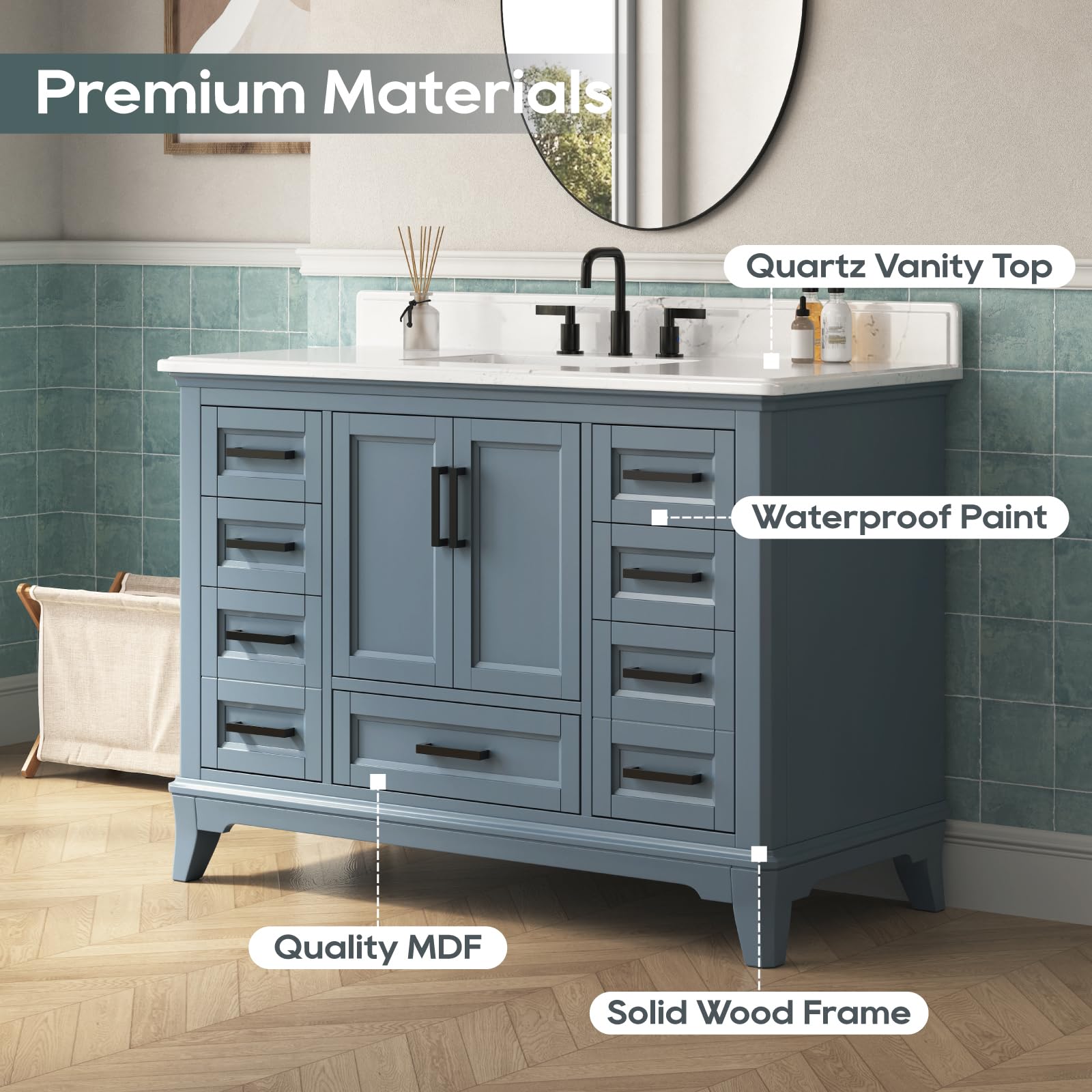
What immediately sets this vanity apart is the steel blue finish. In a category dominated by safe whites and grays, this color brings a calm, sophisticated energy to the bathroom without leaning too trendy. Paired with the matte black handles and white quartz countertop, the combination feels intentional and polished, like something you would see in a boutique hotel rather than a big-box showroom.
The practical details are just as impressive as the aesthetics. Seven dovetail drawers is a genuinely generous amount of storage, and dovetail joinery means those drawers will not loosen or wobble after a few years of daily use. The quartz top handles hot tools, water rings, and product spills without complaint, and the soft-close hardware keeps morning routines quiet. The fully assembled delivery is the kind of thoughtful detail that makes a real difference on installation day.
For a buyer who wants a complete, design-forward vanity that does not require a contractor or a weekend project, this unit checks every practical box while still making a visual statement. If you want a bathroom that looks intentionally decorated without trading away storage or durability, this one delivers.
Styles it works with: Modern Transitional, Contemporary, Coastal Modern, Minimalist
Best placed in: Primary bathroom as the main vanity, a dedicated guest bathroom, or a spacious master ensuite where it becomes a focal point
May not suit: Powder rooms or bathrooms under roughly 55 to 60 square feet where 48 inches of width would crowd the space; homes with a traditional or rustic farmhouse aesthetic where the steel blue and matte black palette may clash with warm wood tones and vintage fixtures
Buy it if:
- You are renovating a primary or guest bathroom and want a single purchase that covers the cabinet, countertop, and sink with no assembly required
- You want a color-forward vanity that stands out from the standard white and gray options flooding the market
- Storage is a priority and you need organized drawer space for two people sharing a bathroom
Consider waiting if:
- You are mid-renovation and your plumber has not yet confirmed the rough-in drain location, since the sink position needs to align before ordering a pre-assembled unit
Skip it if:
- Your bathroom measures under 55 square feet, as 48 inches of vanity width will leave inadequate clearance for the door and comfortable movement
- You need a traditional or warm-toned aesthetic, since the steel blue and matte black combination will not coordinate with oil-rubbed bronze fixtures or honey-toned wood floors
Check the latest price and availability on Amazon before it sells out.

DELUXELIVING 48 Inch Bathroom Vanity with Sink | Solid Wood, Carrara Marble Top, 7 Drawers, Fully Assembled
Pros
- Solid wood construction provides genuine moisture resistance and durability versus engineered wood alternatives
- Truly fully assembled out of the box -- only the countertop needs to be glued down before use
- Seven dovetail drawers with full-extension slides offer premium storage capacity for a 48-inch unit
- Non-porous engineered marble top eliminates the maintenance burden of natural stone
- White-glove truck delivery with professional driver reduces the chance of freight damage
Cons
- Delivery covers first-floor front door only, so upper-floor or condo residents will need to arrange their own moving help for a heavy assembled unit
- Faucet and mirror are excluded from the package, adding to the true out-of-pocket cost beyond the listed price
- At 49 reviews the rating pool is still small, so long-term durability data is limited compared to more established vanity brands
Most bathroom vanities at this price point cut corners with MDF carcasses that swell and crack the moment humidity enters the picture. DELUXELIVING chose solid Yellow Poplar instead, which is the same species fine furniture makers have trusted for decades. That decision alone separates this piece from the flat-pack crowd, and you can feel it the moment you open those soft-close doors.
The engineered Carrara marble top deserves its own mention. It has the veined, spa-like look that usually costs twice as much in natural stone, but because it is non-porous you never have to think about sealing it. Pair that with the warm greige cabinet finish and the golden hardware, and the whole vanity reads as a designer piece rather than a home-center purchase.
Living with it day to day is just as satisfying. Seven full-extension drawers means hair tools, toiletries, and spare towels all have a home, and the soft-close mechanism keeps the morning routine quiet. If you want a bathroom that looks professionally designed without the trade-off of a long assembly project or an ongoing marble-maintenance routine, this one delivers.
Styles it works with: Modern Transitional, Contemporary Glam, Soft Minimalist, Organic Modern
Best placed in: Primary bathroom as the main vanity, large guest bathroom as a statement piece, a spacious powder room where the marble top and golden hardware can take center stage
May not suit: Very small bathrooms under 60 inches wide where a 48-inch cabinet leaves minimal clearance; strongly rustic or traditional interiors where the clean-lined greige finish and polished marble may feel out of place
Buy it if:
- You are remodeling a primary or guest bathroom and want a single-order solution that arrives ready to use without a contractor
- You have previously dealt with MDF vanities warping or swelling and want something built to last in a humid environment
- You want the aesthetic of marble and custom cabinetry without a custom price tag or the upkeep of real stone
Consider waiting if:
- You need a specific finish color not currently available, as the current lineup is limited and color availability may expand
Skip it if:
- Your bathroom is on an upper floor without elevator access and you cannot arrange additional help to move a heavy, fully assembled unit
- You need a double-sink configuration or a vanity under 40 inches, as this specific model does not accommodate those requirements
Check the latest price and availability on Amazon before it sells out.

NOVAMAISON 48" Modern Walnut Bathroom Vanity with White Sink - Fluted Panel Design, Soft-Close Doors, 4 Drawers
Pros
- Sophisticated fluted design with gold accents looks far more expensive than the price point
- SMC sink material resists scratches and stains better than traditional ceramic
- Generous storage with four drawers and two cabinets keeps bathroom essentials organized
- Soft-close hardware prevents noise and extends cabinet lifespan
- Anti-tipping device included for household safety
Cons
- No faucet, drain, or backsplash included so budget an extra $100-200 for fixtures
- Ships in two separate packages which may arrive on different days
- New product with no verified customer reviews yet to confirm long-term durability
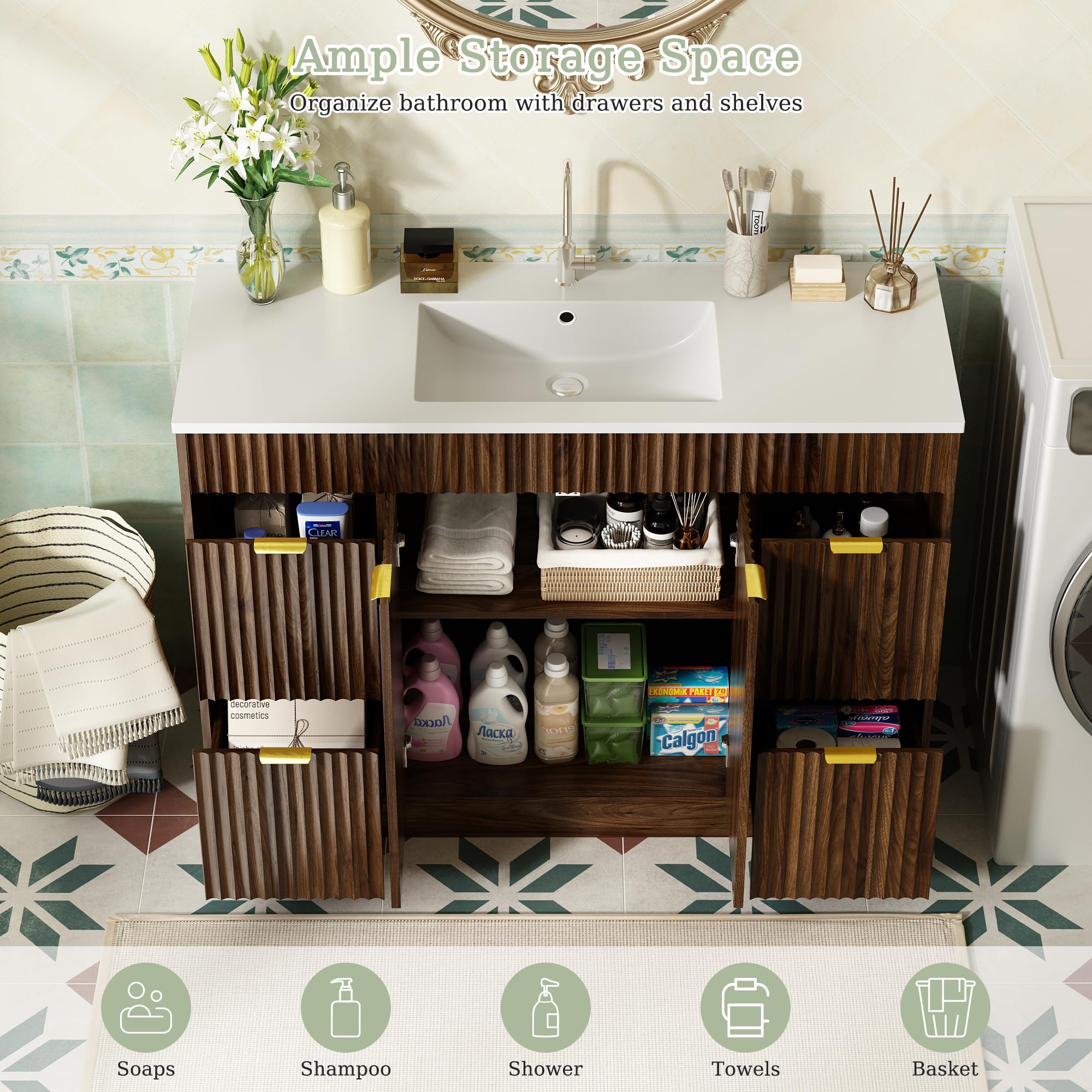
This vanity nails the balance between style and function that most bathroom furniture misses. The wave-fluted panels and brushed gold handles give you that boutique hotel vibe, while the walnut finish adds warmth without feeling dated. It is the kind of piece that makes guests ask where you got it.
What really sets it apart is the storage layout. Four actual drawers (not fake fronts) mean you can organize makeup, hair tools, and skincare by category instead of digging through one giant cabinet. The soft-close feature is a game-changer if you have early risers or light sleepers. No more cabinet slams echoing through the house at 6 AM.
If you want a bathroom that feels like a designed space without hiring an interior designer or spending thousands on custom cabinetry, this one delivers.
Styles it works with: Modern, Contemporary, Transitional, Coastal Modern
Best placed in: Guest bathrooms, primary bathroom with limited square footage, bathroom renovations targeting a spa-like feel
May not suit: Traditional or farmhouse-style homes with heavy rustic elements, bathrooms narrower than 50 inches wall-to-wall, renters who cannot install the anti-tipping hardware
Buy it if:
- You are renovating a small to medium bathroom and need storage without sacrificing floor space
- You want a polished, designer look but your budget caps out around $500 for the vanity itself
- You have young kids or share a bathroom and need quiet soft-close doors and drawers
Consider waiting if:
- You want to see verified customer photos and reviews before committing to a new product launch
Skip it if:
- Your bathroom is wider than 54 inches and you have room for a double-sink vanity
- You need an all-in-one package with faucet and drain already included
Check the latest price and availability on Amazon before it sells out.
Frequently Asked Questions
What is the standard bathroom vanity size?
Standard single-sink vanities range from 24 to 48 inches wide, with 60 inches or more for doubles. Standard depth is about 21 inches, and comfort height now sits near 34 to 36 inches. Powder rooms typically fit 18 to 24 inches, while a 48 inches vanity suits a full primary bath with room to spare.
How wide does a vanity need to be for two sinks?
As a rule, about 60 inches. Two basins need room for each faucet plus usable counter between them, and anything narrower leaves both sinks cramped. A 48-inch unit can technically hold two small basins, but a single large sink at that width usually works better. For real double-sink comfort, plan on 60 to 72 inches.
How much clearance does a bathroom vanity need?
Leave at least 4 inches between the vanity and a side wall, and about 30 inches of clear floor in front so you can open drawers and step back. Keep the room’s entry door swing clear of the cabinet. In a tight bath, a shallow 15 to 18 inches depth preserves the walkway without shrinking the sink much.
What is the right height for a bathroom vanity?
It depends on who uses it. Comfort-height vanities run about 34 to 36 inches, which is easier on the back for most adults and matches kitchen-counter height. The older 30 to 32 inches standard still suits kids’ baths or shorter users. Remember a vessel sink adds roughly 5 to 6 inches, so start lower if you want one.
Can a large vanity fit where the plumbing doesn’t line up?
It depends on the offset. Small mismatches work with flexible supply lines and a cabinet with an open back, but moving the drain means opening walls and adds real cost. Choose a center-door or U-drawer layout so storage routes around existing pipes, and size the cabinet to the drain rather than forcing the drain to the cabinet.
Is a shallow-depth vanity worth it in a small bathroom?
Yes, in most tight baths. A 15 to 18 inches deep vanity frees up walking room while still fitting a real sink, and that recovered clearance often makes the difference between a cramped room and a usable one. You give up a little counter and drawer depth, but the extra floor space is usually the better trade.
Does a bigger vanity mean more storage?
Not always. Every sink and its plumbing steals cabinet interior, so a wide double-sink unit holds less usable storage per inch than a single of the same width. A single-sink 48 inches vanity with drawers often beats a 60-inch double for actual capacity. Full-extension, soft-close drawers also reach more of their volume than shallow-glide boxes.


Write Your Review
No reviews yet. Be the first to share your experience!