

> Editorial Note: I’m Lauren Ro, and I write furniture buying guides. The picks here are judged on the specs that predict how a piece ages — frame joinery, foam density, and load ratings — checked against BIFMA and FSC certifications plus aggregated owner reports.
A kids’ bookcase fails for boring reasons: shelves too deep for small hands, a footprint that eats 30 inches of wall, or particleboard that swells the first time a water bottle tips. So I built this roundup around dimensions and materials first, styling second. If you’re still narrowing the spec, these help: mdf vs solid wood furniture, how many shelves should a bookcase have?, adjustable bookcase, water stains on wood furniture, and wire vs wood closet system. Five picks below, each solving a different room problem.
How We Evaluated
I compared listed materials, tier count, shelf depth, and footprint against ASTM F2057, the tip-over standard that governs clothing storage units and informs how any tall kids’ furniture should be anchored. I also weighted low-VOC finishes, since GREENGUARD Gold certification caps chemical emissions for products used in children’s spaces. Review volume on several of these is still thin, so I leaned on stated specs and construction type rather than crowd sentiment. Assembly complexity and whether replacement hardware ships in the box both factored in.
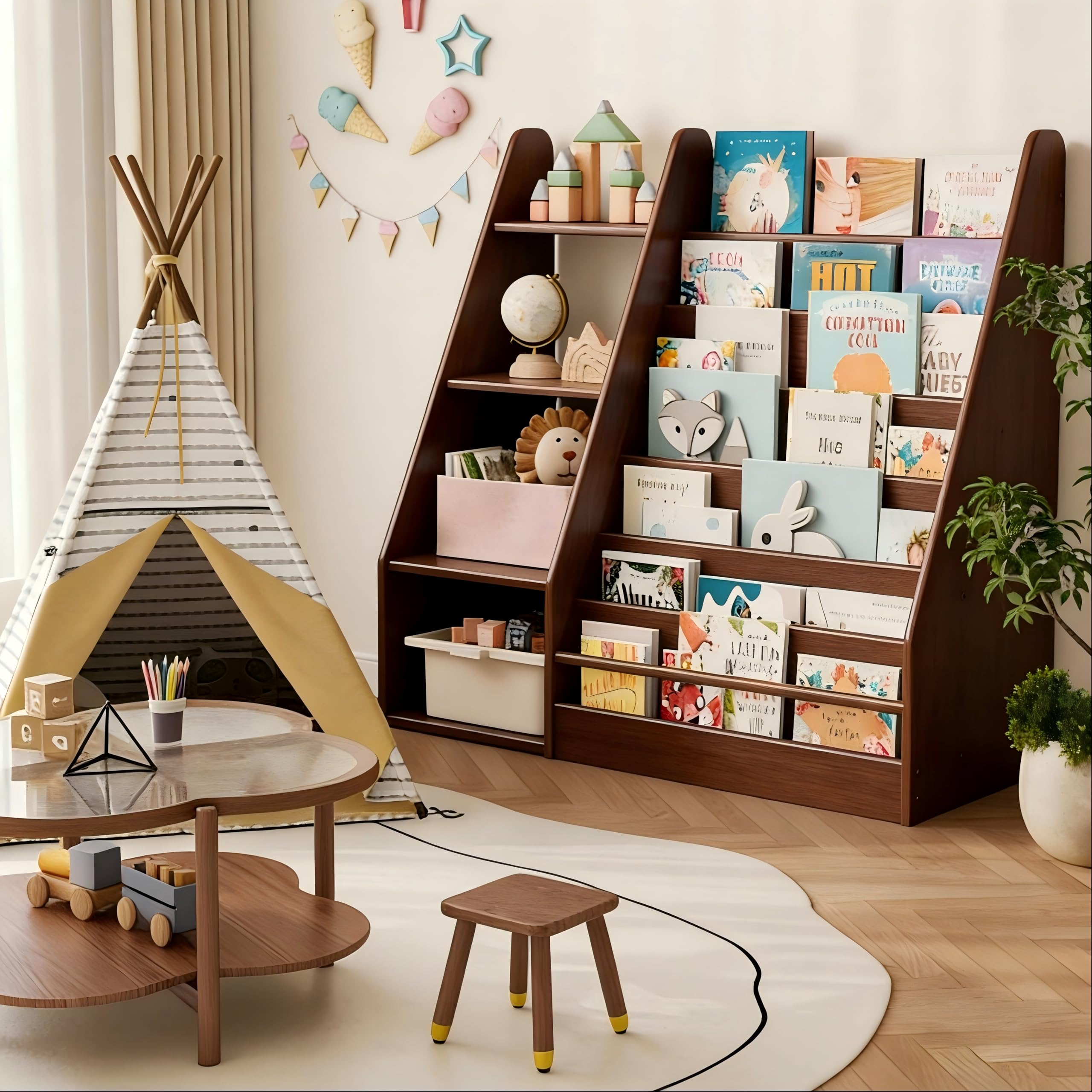


1. DONGMUWUJEE Solid Wood Kids Bookshelf and Storage Organizer — most capacity per square foot of floor
Seven layers is the headline, and it’s the reason this one wins. Most toddler shelves give you three tiers and then force a second unit for overflow; this consolidates a 60-book library plus bins into a single footprint. Solid wood construction means the shelf edges take knocks without the crumbling you get from laminated particleboard. The trade-off is height. Seven tiers puts the top rows out of reach for anyone under four, so plan on the upper two shelves being parent-managed storage and anchor the unit to a stud.
2. SpaceAid 3-Tier Scalloped Bookshelf — front-facing Montessori display for pre-readers
Scalloped sides and three open tiers, sized so a two-year-old can see covers instead of spines. That matters more than it sounds: cover-forward display is the core Montessori argument, and it measurably changes how often young kids self-select a book. Three tiers keeps total height low, which sidesteps most tip-over risk without hardware. Capacity is the honest limit here. You’re storing roughly 20 to 25 picture books, not a growing collection, and there’s no adjustability as your reader moves to chapter books.
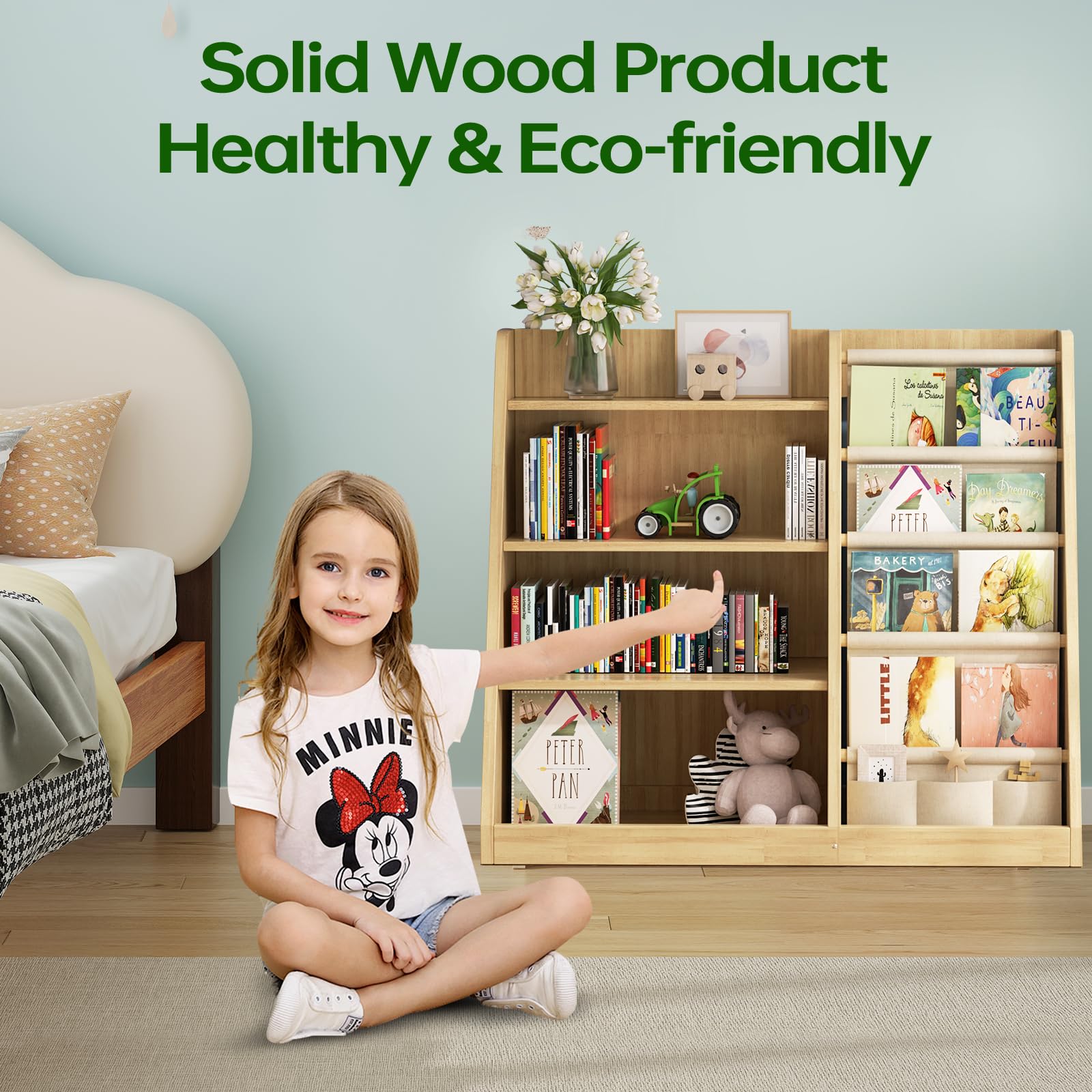
3. NANATI Solid Pine Wood Kids Bookshelf — double-sided and light enough to move daily
Solid pine, double-sided, portable. This is the pick for shared bedrooms and playroom corners where the shelf needs to work as a room divider or migrate between a reading nook and the living room. Pine is softer than hardwood and will dent, but it also keeps the unit light enough for one adult to reposition without disassembly. Double-sided access nearly doubles usable capacity in the same footprint. Look for FSC-certified pine if sourcing matters to you, and expect visible knots as part of the grain character.
4. EXPERLAM Kids Bookshelf and Toy Storage Organizer — hybrid sling rack plus toy bins
Four tiers with a fabric sling book rack, which solves the mixed-clutter problem better than a pure bookcase. Slings hold floppy paperbacks and board books upright without spine-cracking, while the lower tiers take bins for blocks and figures. That combination means one unit handles books and toys, so you’re not buying two. The compromise: fabric slings sag over a few years and hold less weight than a fixed wood shelf, so keep heavy hardcovers on the wood tiers and rotate paperbacks into the slings.
5. AMMEHOELA Wood Kids Bookshelf, Walnut Wood Grain Pattern — the one that matches adult furniture
Walnut grain pattern instead of primary-color paint. If the bookcase lives in a living room or a nursery you don’t want to redecorate at age six, this is the aesthetic play. A darker wood-grain finish also hides fingerprints and scuffs far better than white lacquer, which shows every mark within a month. Note the wording: it’s a wood grain pattern, so treat this as a finish choice rather than solid walnut. Wipe spills promptly, because patterned surfaces telegraph water rings quickly.
Comparison Table
| Pick | Brand | Configuration | Best for | Main trade-off |
|---|---|---|---|---|
| 1 | DONGMUWUJEE | 7-layer solid wood | Large libraries, small floor area | Top tiers out of kid reach |
| 2 | SpaceAid | 3-tier scalloped, front-facing | Toddlers and pre-readers | Roughly 20–25 books |
| 3 | NANATI | Double-sided solid pine | Shared rooms, frequent moves | Soft pine dents |
| 4 | EXPERLAM | 4-tier with sling rack | Books plus toy bins | Slings sag over time |
| 5 | AMMEHOELA | Walnut grain finish | Rooms with adult furniture | Finish, not solid walnut |
What Actually Matters Before You Buy
Measure the wall, then subtract. A 32-inch alcove won’t take a 30-inch unit once you account for baseboard and trim, and shelf depth above 10 inches encourages kids to stack two rows deep and lose the back row entirely.
Check load rating per shelf, not total. A shelf holding 15 to 20 lbs handles about 25 picture books; anything less and you’re limited to decor. Solid wood keeps that rating consistent across years of loading, while thin laminate sags in the middle span.
Anchoring is non-negotiable above roughly 30 inches of height. Wirecutter and Apartment Therapy both flag furniture anchoring as the highest-value safety step in a child’s room, and it takes two screws and ten minutes.
Front-Facing vs Traditional Shelving
Cover-forward racks and standard spine-out shelves serve different ages, and picking wrong wastes the unit. Under four, kids identify books visually, so the SpaceAid scalloped design or EXPERLAM’s slings get used far more. Past five, capacity beats visibility, and the DONGMUWUJEE seven-layer setup carries a chapter-book collection the smaller units can’t.
Footprint decides the rest. NANATI’s double-sided build gives you the most storage per square foot when a wall isn’t available, and it works as a soft divider in shared rooms. AMMEHOELA’s walnut-pattern finish wins in open-plan spaces where the shelf reads as furniture. Buy for the room first.
Frequently Asked Questions
Is solid wood worth it over MDF for a kids’ bookcase?
For load-bearing shelves, yes. Solid wood holds its rating without sagging and survives edge impacts that chip laminate. MDF is fine for back panels and decorative sides. The DONGMUWUJEE and NANATI picks both use solid stock rather than veneered board.
What height is safe for a toddler’s room?
Keep freestanding units under about 30 inches for a child under four. Three-tier designs like the SpaceAid land in that range naturally. Anything taller should be wall-anchored, and heavy items belong on the bottom two shelves regardless of total height.
Do these need to be anchored to the wall?
Any unit a child could climb should be anchored. ASTM F2057 sets stability requirements for storage furniture, and manufacturers ship anti-tip straps because loaded upper shelves shift the center of gravity forward. Two screws into a stud, not drywall alone.
How much weight can each shelf hold?
Small wooden kids’ shelves typically carry 15 to 25 lbs per tier. That’s roughly 25 picture books or 12 hardcovers. Fabric slings, like the ones on the EXPERLAM, handle noticeably less and are better suited to paperbacks and board books.
Should I choose a sling rack or fixed shelves?
Slings for ages one to four, fixed shelves after. Slings display covers and stop thin paperbacks from collapsing, but they stretch under repeated loading. Fixed wood shelves carry more and last longer. The EXPERLAM gives you both in one frame.
How do I keep the finish looking new?
Wipe spills within minutes, since standing water raises grain and leaves rings on patterned finishes. Use a damp cloth and dry immediately, never a soaking mop. For low-emission peace of mind, look for GREENGUARD Gold or comparable low-VOC finish claims.
Bottom Line
The DONGMUWUJEE seven-layer solid wood organizer takes it. Nothing else here stores a full childhood library in that footprint, and solid wood keeps the shelf ratings honest as the collection grows. Pick the SpaceAid 3-tier scalloped shelf instead if your child is under four, where cover-forward display drives actual reading and the low height removes most tip-over concern. One caveat: review volume across these listings is still limited, so confirm current dimensions and shipped hardware on the product page before ordering.



Write Your Review
No reviews yet. Be the first to share your experience!