

> Editorial Note: I’m Liam Wright, an outdoor and garden editor. I grew up in my family’s landscaping business and now cover what actually survives a season of UV, rain, and freeze-thaw cycles. The picks here are evaluated against ASTM weatherability standards and manufacturer durability ratings.
A hose timer pays for itself the first vacation your garden survives without you. Set it once, drive away, come back to beds that didn’t scorch. The two things that fail cheap: plastic inlet threads that crack under freeze-thaw, and dim LCD screens you can’t read at noon with the sun behind you. Everything else on a timer is convenience. Those two are survival. Pair one with a best lawn sprinkler and a solid best garden hose, add a best garden hose splitter if you’re feeding two lines, and finish the setup with a best hose nozzle and a best garden hose reel to keep the whole run tidy.
How We Evaluated
Five criteria decided these picks. First, zones — one outlet handles a single line; two outlets run independent schedules from one faucet. Second, inlet material: brass survives freeze-thaw where plastic threads crack and weep. Third, programming depth — rain delay, manual override, and automatic scheduling should all be present. Fourth, screen readability in direct sun and battery type (most run on 2 AA or AAA cells for a full season). Fifth, weather resistance measured against ASTM UV and moisture standards, plus an owner rating floor of 4.0. EPA WaterSense guidance on scheduled watering shaped how we weighed programming flexibility.


Pros
- Highly programmable with intervals from every hour to weekly schedules
- Rain delay feature (24/48/72 hours) reduces water waste
- IP55 waterproof rating and 116 PSI pressure tolerance for outdoor durability
- Manual override lets you water on-demand outside scheduled times
- Built-in metal filter prevents clogging from sediment
Cons
- No customer reviews yet to confirm real-world performance claims
- Requires 2 AA batteries which need periodic replacement
- Programming interface may take trial and error for first-time users
If you've ever come home from a weekend trip to find your tomatoes wilted or your flower beds bone-dry, this timer solves that problem without the expense of installing an in-ground system. The rain delay mode is genuinely useful during unpredictable spring weather since it automatically pauses watering after storms and resumes your schedule once the delay period ends.
What sets this apart from basic twist-dial timers is the programming flexibility. You can water your vegetable garden twice daily for 20 minutes each, while scheduling your lawn sprinkler for 45 minutes every three days, all from the same device by swapping it between hoses. The LCD display is large enough to read in bright sunlight, which matters more than you'd think when you're adjusting settings mid-summer.
If you want consistent watering for multiple garden zones without hiring an irrigation contractor, this one delivers at under $20.
Styles it works with: Cottage Garden, Modern Farmhouse, Edible Landscaping, Xeriscaping
Best placed in: Outdoor hose bibs near garden beds, patio container setups, greenhouse water lines, backyard lawn sprinkler connections
May not suit: Homes without outdoor faucets, apartments with balcony gardens only (no hose access), renters who cannot modify exterior plumbing, properties with complex multi-zone irrigation already installed
Buy it if:
- You travel regularly and need plants watered automatically for weeks at a time
- Your water bill spikes from forgetting to turn off sprinklers manually
- You're starting a vegetable garden and want consistent moisture without daily attention
- You have multiple garden zones that need different watering schedules
Consider waiting if:
- You need smart home integration or WiFi control from your phone
- Your local weather is highly variable and you want soil moisture sensing instead of just rain delay
Skip it if:
- You only have balcony plants with no outdoor hose connection
- Your water pressure exceeds 116 PSI (check with a gauge first)
- You need multiple timers running simultaneously on one faucet without a splitter
Check the latest price and availability on Amazon before it sells out.

RAINPOINT Programmable Sprinkler Timer - 1 Outlet Garden Hose Water Timer with Rain Delay & LCD Display for Lawn Irrigation
Pros
- Highly customizable watering schedules with duration from 1 minute to nearly 4 hours
- Rain delay feature (24/48/72 hours) prevents water waste during rainy periods
- Easy-to-read LCD display shows all settings and battery status at a glance
- Manual mode allows immediate watering without affecting programmed routines
- Battery-powered design works anywhere without needing nearby electrical outlets
Cons
- Single outlet limits use to one watering zone at a time
- Requires 2 AA batteries which are not included in the package
- No smart home integration or app control for remote management
This timer takes the guesswork out of lawn and garden care. Instead of trying to remember watering schedules or rushing home to turn on sprinklers, you set it once and it handles everything automatically. The rain delay feature is particularly smart because it pauses your schedule during wet weather and then picks right back up when conditions are right.
What makes this timer stand out is how practical it is for real-world use. The large LCD screen is genuinely easy to read (no squinting at tiny displays), and the manual override button means you can water whenever needed without reprogramming everything. It runs on standard AA batteries, so you can install it at any outdoor faucet without worrying about power outlets or extension cords.
If you want consistent, automated watering that adapts to weather conditions without investing in a full smart irrigation system, this one delivers.
Styles it works with: Traditional, Cottage Garden, Modern Farmhouse, Practical Outdoor Living
Best placed in: Outdoor hose bibs near vegetable gardens, front yard faucets for lawn sprinklers, backyard spigots for drip irrigation systems, side yard connections for soaker hoses
May not suit: Properties requiring multiple simultaneous watering zones (this has only one outlet), renters who cannot install timers on shared outdoor faucets, yards with complex irrigation needs requiring zone-based smart controllers
Buy it if:
- You need automated watering but do not want to install an in-ground sprinkler system
- You travel frequently and need your lawn or garden watered reliably while you are away
- You want to save water by avoiding overwatering and taking advantage of rain delays
- You have a vegetable garden, flower beds, or potted plants that need consistent watering schedules
Consider waiting if:
- You need smart home integration or app control for remote monitoring
- You want to control multiple watering zones simultaneously from one timer
Skip it if:
- You need a multi-outlet timer to run several hoses or sprinkler zones at once
- You require Wi-Fi connectivity and smartphone control as essential features
Check the latest price and availability on Amazon before it sells out.

QUOBAS Brass Programmable Hose Timer - 120 PSI, Rain Delay, IPX5 Waterproof LCD Display for Garden & Lawn Irrigation
Pros
- Solid brass inlet and outlet resist corrosion and create leak-proof connections
- Rain delay function (24/48/72 hours) saves water and protects plants from overwatering
- Wide scheduling range accommodates everything from frequent short waterings to weekly deep soaks
- IPX5 waterproof rating protects electronics from rain and spray
- 10-12 month battery life means minimal maintenance once installed
Cons
- Requires 2 AA batteries (not included), adding to initial setup cost
- Zero customer reviews makes real-world reliability difficult to assess
- No smart home integration or app control for remote monitoring
What sets this timer apart is how it takes the guesswork out of garden watering while actually saving you money on your water bill. The brass construction means it will last through seasons of sun, rain, and freezing winters without the cracking and leaking problems you get with cheaper plastic models. The rain delay feature is genuinely clever - it pauses your watering schedule when nature does the job for you, which is perfect during those unpredictable spring and summer storms.
The programming might sound complicated, but the large LCD screen makes it surprisingly straightforward. You can set different schedules for your lawn (maybe every other day for 20 minutes) and your vegetable garden (daily for 10 minutes), all from one device. No more rushing home to turn sprinklers on and off, or coming back from vacation to find brown grass or flooded flower beds.
If you want consistent, automated watering that adapts to weather without the premium price of smart controllers, this one delivers.
Styles it works with: Modern Farmhouse, Contemporary, Traditional, Cottage Garden
Best placed in: Front yard hose bibs for lawn watering, backyard faucets for vegetable gardens, side yard connections for drip irrigation zones, greenhouse water supply lines
May not suit: Homes with very low water pressure below 8 PSI, apartments without outdoor faucet access, renters who cannot modify plumbing fixtures
Buy it if:
- You forget to water regularly or travel frequently and need automated care for plants
- Your water bill is high from overwatering or leaving sprinklers running too long
- You want separate watering schedules for lawn, garden beds, and potted plants without buying multiple timers
Consider waiting if:
- You need WiFi connectivity to control watering from your phone while away from home
Skip it if:
- Your outdoor faucet has non-standard threading that does not fit 3/4 inch garden hoses
- Your water pressure is below 8 PSI or you need a timer that works with pressure washers above 120 PSI
Check the latest price and availability on Amazon before it sells out.

Pros
- Dual zones allow independent watering schedules for different garden areas
- Brass fittings are more durable than standard plastic hose timers
- Rain delay prevents overwatering and reduces water bills
- Manual mode works without disrupting your saved programs
Cons
- No customer reviews yet to confirm long-term reliability
- Requires battery power which needs periodic replacement
- Higher price point than single-zone timers
This timer takes the guesswork out of keeping your lawn and garden healthy without the expense of a full irrigation system. The two independent zones mean you can water your thirsty vegetable garden daily while running your established shrubs just twice a week, all from one faucet.
The brass connections are a thoughtful upgrade over cheaper plastic models. They handle the constant on-off cycles better and won't crack if you accidentally leave them out through an early frost. The rain delay is genuinely useful during unpredictable spring weather when you might get surprise storms between your watering days.
If you want consistent watering automation without spending thousands on in-ground sprinklers, this one delivers.
Styles it works with: Modern Farmhouse, Contemporary, Transitional, Traditional
Best placed in: Outdoor faucets near garden beds, side yard hose bibs, front porch spigots with access to multiple zones
May not suit: Apartments without outdoor faucet access, homes with complex multi-zone gardens needing 3+ separate schedules, renters who cannot modify outdoor plumbing
Buy it if:
- You have two distinct garden areas that need different watering frequencies
- You travel frequently or forget to water and want your plants to survive
- You are tired of cheap plastic timers that leak or fail mid-season
Consider waiting if:
- You want to see verified customer reviews before committing at this price point
Skip it if:
- You only need to control a single hose or sprinkler and can save money with a 1-zone model
- You need more than two independent watering zones
Check the latest price and availability on Amazon before it sells out.

Pros
- Easy LCD programming for setting watering schedules and durations
- Built-in rain delay helps conserve water automatically
- Water-resistant construction suited for year-round outdoor use
- Six-year warranty is generous for this price point
- Battery operation allows placement anywhere near a hose bib
Cons
- Single outlet only supports one hose zone at a time
- No smartphone app or smart home integration
- Battery power means periodic replacement is required to keep schedules running
If you have ever forgotten to water the garden during a busy week, this little timer solves that problem quietly and affordably. It clips onto your outdoor faucet and takes over the job of remembering, so your lawn and flower beds stay healthy without you standing there with a hose.
The LCD screen is straightforward, no fumbling with tiny dials or guessing at settings. You set your watering days and duration once, and it just runs on its own, even pausing itself when the built-in rain sensor detects wet weather.
If you want consistent, worry-free watering without babysitting a hose every evening, this one delivers.
Styles it works with: Modern Farmhouse, Cottage Garden, Minimalist Outdoor, Traditional Landscape
Best placed in: outdoor faucet or hose bib, garden shed exterior wall, side yard irrigation point
May not suit: larger properties needing multiple watering zones at once, or households wanting full smart home app control
Buy it if:
- You want a simple, affordable way to automate watering for one garden bed or lawn zone
- You forget to water regularly and need a set-and-forget solution
- You want a rain delay feature to avoid wasting water during storms
Consider waiting if:
- You need to control multiple hose zones from one device
Skip it if:
- You require smartphone or smart home app integration for remote control
Check the latest price and availability on Amazon before it sells out.
1. Programmable Digital Timer — The Big-Screen Pick Most People Should Buy
This programmable digital timer earns the highest owner rating in the group at 4.7, and the reason shows up the first time you program it in daylight. The digital display is large enough to read at arm’s length without crouching, which matters more than spec sheets admit. You get three modes that cover almost every yard: rain delay to skip watering after a storm, manual for a quick soak, and full automatic scheduling for set-and-forget cycles. Watering frequency runs from once every few hours to once every seven days, and duration adjusts in one-minute steps up to several hours. The housing shrugs off UV and splashing, holding up against ASTM weatherability expectations across a season. It’s a single-outlet unit, so one hose line only. But for a gardener who wants the clearest screen and the most flexible schedule without paying for a second zone, this is the one to start with.
2. RainPoint Single-Outlet — Best for One Hose Line, No Fuss
The RainPoint single-outlet timer is the plain-spoken option, and that’s the point. One faucet, one line, one schedule — no menus you’ll never touch. It carries a 4.4 rating and covers the essentials: programmable start times, adjustable run length, rain delay, manual, and automatic modes. Where it differs from the two-zone RainPoint further down this list is scope. This unit controls exactly one outlet, so there’s less to configure and fewer settings to get wrong. Setup takes a couple of minutes. For a single raised bed, a container garden on a patio, or one sprinkler feeding a modest lawn, that simplicity is a feature, not a limitation. The inlet is plastic, so treat it gently in cold climates and pull it indoors before the first hard freeze. If your whole watering need is one line and you want the RainPoint reliability without a second zone you’ll never use, this is the right RainPoint for you.
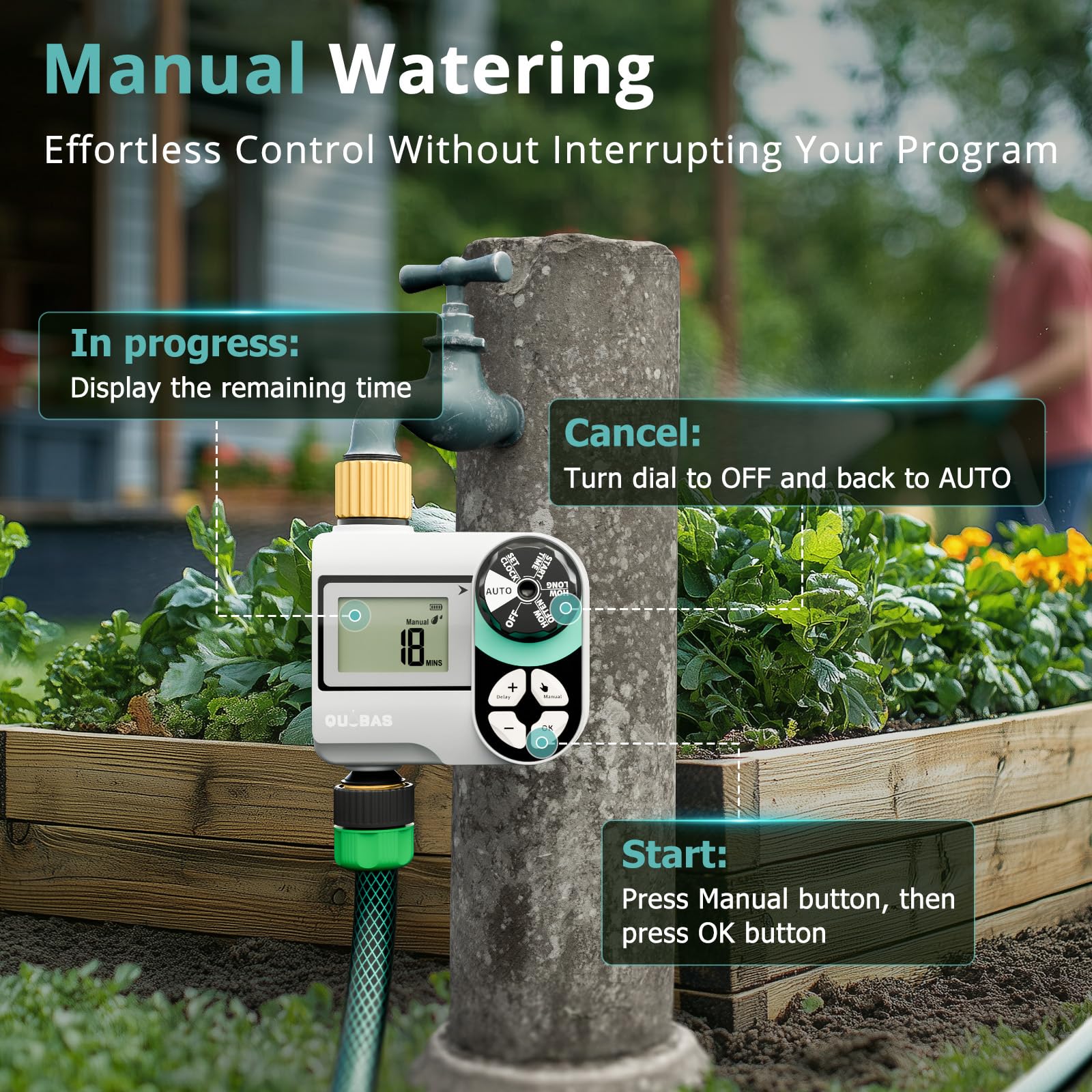
3. QUOBAS Brass Inlet — The Connection That Won’t Crack or Leak
Plastic inlet threads are where cheap timers die. The QUOBAS solves that with a brass inlet that grips the faucet firmly and resists the freeze-thaw cracking that opens slow leaks by season two. It holds a 4.4 rating and pairs the brass connection with a waterproof HD screen that stays legible in bright sun. Programming covers the full set — scheduled cycles, rain delay, manual, and automatic — so you’re not giving up features for the sturdier build. The metal fitting also seats more securely under water pressure, which reduces the drips that plague plastic-threaded units over time. It’s a single-outlet timer, so one line at a time. If you live somewhere with real winters, or you’ve already replaced one cracked plastic timer and don’t want to do it again, the brass inlet is worth the small premium. This is the pick built to outlast the warranty.
4. RainPoint 2-Zone — Two Independent Schedules From One Faucet
Here’s the RainPoint that earns its keep when you’ve got two watering jobs that don’t share a rhythm. The 2-zone model runs two independent outlets from a single faucet, each with its own schedule, so your vegetable beds can drink every morning while the lawn zone runs deep twice a week. It carries a 4.3 rating and — unlike the single-outlet RainPoint above — uses brass on both inlet and outlet, a meaningful durability upgrade for a unit managing more connections. Each zone programs separately for start time, frequency, and duration, with rain delay and manual override on both. That independence is the whole reason to choose this over two single timers: one battery set, one faucet, two watering logics. If you’re splitting a front-and-back yard or a bed-and-container setup off one spigot, this is the cleaner solution. Just budget the extra minute to program each zone right the first time.
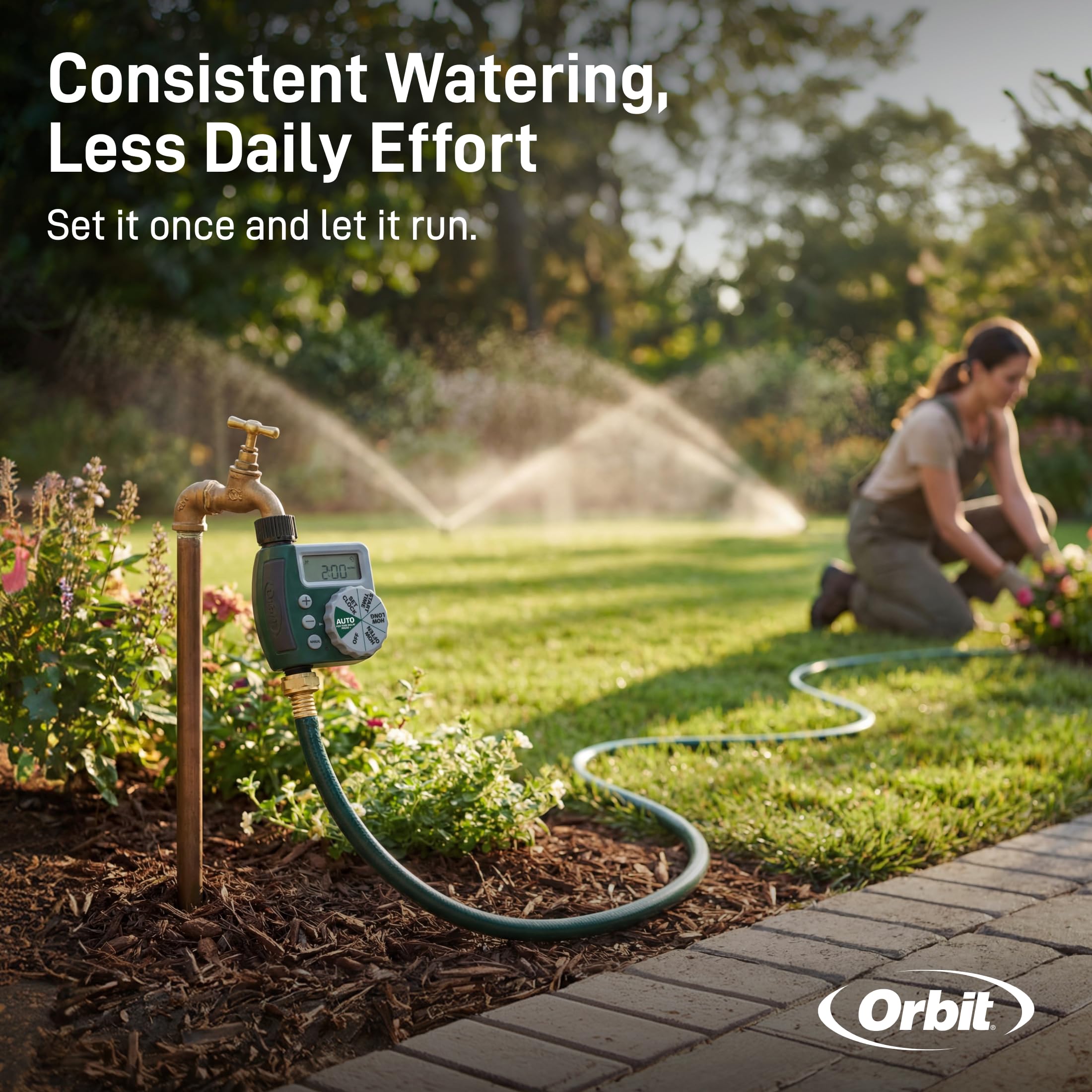
5. Orbit Programmable — The Reliable Budget Standard
Orbit has been making watering hardware for decades, and this programmable timer is the dependable baseline. It holds a 4.2 rating and keeps things straightforward: one outlet, an LCD screen, built-in rain delay, and a weather-resistant housing that takes sun and rain without fuss. Programming is simple — set a start time, a duration, and a frequency, and it runs. There’s no brass inlet here, so it sits in the same plastic-threaded category as the single-outlet RainPoint, meaning the same winterizing advice applies. What you’re buying is a known quantity from a brand with a long track record and easy parts availability. For a first-time timer buyer, a rental where you don’t want to over-invest, or a backup unit for a second spigot, the Orbit does the job at the lowest cost of entry. It’s not flashy. It just works.
Comparison Table
| Pick | Zones | Inlet | Rain Delay | Rating |
|---|---|---|---|---|
| Programmable Digital | 1 | Plastic | Yes | 4.7 |
| RainPoint Single | 1 | Plastic | Yes | 4.4 |
| QUOBAS Brass | 1 | Brass | Yes | 4.4 |
| RainPoint 2-Zone | 2 | Brass in/out | Yes | 4.3 |
| Orbit Programmable | 1 | Plastic | Yes | 4.2 |
How to Choose a Hose Timer
Start with zones. If you water one line on one schedule, a single-outlet timer is simpler and cheaper. If two areas need different frequencies — say daily drip on vegetables and twice-weekly deep soaks on turf — a two-zone unit off one faucet beats juggling two separate timers.
Inlet material decides longevity. Brass threads resist the freeze-thaw cracking that splits plastic fittings and starts slow leaks by the second season. In freezing climates, brass is the safer long-term buy. In mild regions, plastic is fine if you winterize.
Programming should cover rain delay, manual, and automatic. Rain delay alone saves water after storms, which lines up with EPA WaterSense guidance on skipping unnecessary cycles. Check the screen in direct sun before you commit — a dim LCD is the most common regret.
Battery matters too. Most units run a full season on 2 AA or AAA alkaline cells. Swap them each spring so a dead battery doesn’t skip a watering during a heat wave.
Winterizing is non-negotiable in cold zones. Drain the timer, pull the batteries, and store it indoors before the first hard freeze. University extension turf programs consistently flag frozen fittings as the top off-season failure. Five minutes of teardown beats a cracked inlet in April.
One Zone or Two?
The honest question is whether your watering jobs share a schedule. One zone works when a single line covers everything on the same rhythm — a patio container cluster, one raised bed, or a small lawn on one sprinkler. It’s less to program and less to break.
Two zones earn their price when frequencies diverge. Vegetables often want a short daily drink; lawns want deep, infrequent soaks that push roots down. Running both from one two-zone timer means one faucet, one set of batteries, and two independent logics — cleaner than daisy-chaining timers and splitters.
If you’re unsure and might expand, buy the two-zone now. You can run one outlet today and open the second when the garden grows. Going the other way — outgrowing a single timer mid-season — means buying twice.
Frequently Asked Questions
Do hose timers work without water pressure or electricity?
They need water pressure to open and close the valve, but not household electricity. These units run on batteries — typically 2 AA or AAA cells — so they work anywhere a hose reaches. Most need a minimum pressure of around 10 PSI to seat the valve properly, which nearly every municipal and well system exceeds.
Will a hose timer survive winter outdoors?
No, not in freezing climates. Water left inside the valve expands as it freezes and cracks the housing or inlet. Drain the timer, remove the batteries, and store it indoors before the first hard freeze. University extension programs list frozen fittings as the leading off-season failure for outdoor timers.
Is brass really better than plastic for the inlet?
Yes, in cold regions especially. Brass threads resist the freeze-thaw cracking that splits plastic fittings and starts slow leaks by season two. In mild climates where you winterize properly, plastic holds up fine. If you’ve already replaced one cracked timer, brass is the upgrade that ends the cycle.
How many batteries does a hose timer use, and how long do they last?
Most run on two AA or AAA alkaline batteries and last a full watering season on one set. Swap them every spring as routine maintenance so a dead cell doesn’t skip a cycle during a heat wave. Rechargeable NiMH cells work but hold slightly lower voltage, which can affect the display.
Can one timer water two separate areas on different schedules?
Only a two-zone timer can. Single-outlet units run one schedule on one line. A two-zone model, like the RainPoint 2-zone here, controls two independent outlets from one faucet — each with its own start time, frequency, and duration. That’s the clean answer for a garden with two different watering needs.
Does a rain delay feature actually save water?
Yes. Rain delay skips scheduled cycles for a set number of hours or days after rainfall, so you’re not watering soaked soil. It’s a small feature with real payoff — EPA WaterSense guidance points to skipping unnecessary cycles as one of the simplest ways to cut outdoor water waste.
Bottom Line
The programmable digital timer is the one most people should buy — highest rating, the clearest screen, and full scheduling flexibility for a single line. If you water two areas on different rhythms, the RainPoint 2-zone with its brass inlet and outlet is the smarter setup off one faucet. And in any climate that freezes, pay the small premium for brass and pull the timer indoors before winter. A cracked plastic inlet is the one failure that ends a timer early.





Write Your Review
No reviews yet. Be the first to share your experience!