

> Editorial Note: I’m Liam Wright, an outdoor and garden editor. I grew up in my family’s landscaping business and now cover what actually survives a season of UV, rain, and freeze-thaw cycles. The picks here are evaluated against ASTM weatherability standards and manufacturer durability ratings.
You set the table, pour the drinks, and step inside for two minutes. A gust rolls through and the umbrella is flat on the patio, drink glasses scattered, one rib bent. Sound familiar? A patio umbrella that keeps toppling isn’t a defective umbrella most of the time. It’s a physics mismatch between the canopy area catching wind and the weight holding it down. Once you see it that way, the fix gets simple. If you’re rethinking the whole setup this season, it pairs naturally with a best gas fire pit table, a best wood burning fire pit, a best outdoor sofa, the right best patio umbrella, or even a best raised garden bed anchoring the yard. Below are the three reasons yours tips, what’s actually happening underneath, and how to stop it for good.
Reason 1: It Goes Over in the Lightest Breeze (Undersized Base)
This is the big one. If your umbrella tips in a breeze you’d barely feel on your skin, the base is too light for the canopy. A standard 9-foot market umbrella catches a surprising amount of air. Think of the open canopy as a sail roughly 60 square feet in size. Even a 10-mph gust puts real lateral load on the pole, and a hollow plastic base or a 20-pound cast puck can’t fight it.
The rule of thumb from most umbrella manufacturers: a freestanding 9-foot umbrella needs at least 50 pounds of base weight, and a 11-foot cantilever needs 75 to 125 pounds. Anything less and you’re gambling. Table-mounted umbrellas can get away with less because the table ring shares the load, but the base still matters as the primary anchor.
Here’s the trap. Many umbrellas ship with a base sized to hold the pole upright on a calm day, not to resist wind. That’s a stability spec, not a safety spec. Manufacturers keep shipping weight low to save on freight. So the base does its showroom job and fails the first windy afternoon.
The fix is direct. Match base weight to canopy size, then add 10 to 15 pounds of margin for gusty sites. Weighted or water-filled bases in the 40-to-80-pound range solve this for the vast majority of freestanding setups.
Reason 2: It’s Fine Until You Leave It Open (Wind Load and Canopy Area)
Your umbrella holds all morning, then flips the moment a front moves through. That’s not a base failure alone. That’s wind load scaling faster than you’d think. Wind force on a canopy roughly quadruples when wind speed doubles. A 5-mph breeze is nothing. A 20-mph gust hits with about 16 times the force of that 5-mph breeze against the same canopy.
The bigger the canopy, the worse it gets. A 9-foot round catches more air than a 7.5-foot, and a rectangular 10-by-6-foot canopy is a genuine sail. If you sized your base for the canopy but still see tipping in strong gusts, the canopy area is simply beyond what any reasonable base can safely hold open.
Two habits stop this. First, close the umbrella whenever you leave the patio or when sustained wind climbs past 20 mph. It takes five seconds and saves the ribs. Second, use the tilt and vent features. Many quality canopies have a wind vent, a mesh gap near the top that lets pressure escape instead of building into lift. ASTM weatherability guidance and manufacturer ratings both flag vented canopies as meaningfully more stable in gusts.
No base substitutes for closing the canopy in a storm. Treat wind above 25 mph as a hard stop.
Reason 3: It Leans and Then Drops (Loose Pole Fit or Uneven Ground)
Sometimes the umbrella doesn’t blow over so much as it slowly leans, then goes. Two culprits here. The first is a sloppy pole-to-base fit. Umbrella poles come in two common diameters, roughly 1.5 inch and 1.9 inch, and if the base collar is too wide for your pole, the pole rocks inside it. That wobble becomes a lever, and every small motion loosens the setup until it drops.
Most decent bases include plastic or rubber shims to snug a narrow pole into a wider collar. If yours came with a bag of little wedges you tossed aside, that’s what they’re for. A tight pole fit alone eliminates a lot of “mystery” tipping.
The second culprit is uneven ground. On a sloped patio, flagstone, or grass, the base sits off-level and the umbrella’s center of gravity shifts toward the low side. Now gravity is helping the wind. A base that would hold fine on flat concrete tips easily on a 3-degree slope.
Level the base first. Use a shim under the low edge or move to flatter ground. If you’re on grass or soil, a screw-in ground anchor or a heavier water-filled base compensates for the softer footing.
How to Fix It Fast
Start with the base, because it solves roughly 80% of tipping. Confirm your canopy size, then pick a base that meets or beats the manufacturer’s weight spec with a little margin. Snug the pole with shims so there’s zero wobble in the collar. Level the base on uneven ground. Then build the habit of closing the canopy when wind picks up or you leave the patio.
If you’ve done all that and it still goes over in normal conditions, the canopy is oversized for a freestanding setup, and you should move to a cantilever design with a cross-base you can weight down or bolt to the deck. That’s the honest ceiling of what a portable base can do.
The Products That Actually Help
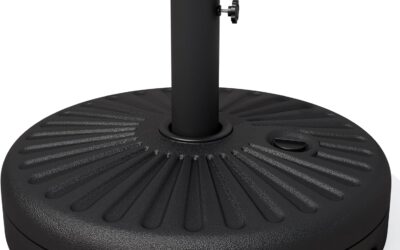
A heavier base is the real solve here, not a gadget or a strap. The three below all clear a 4.3 owner rating and cover the weight range that stops freestanding umbrellas from tipping. Start with the US Weight 40-pound if you have a table-mounted umbrella that needs a solid anchor. Jump to the EliteShade water-filled stand if you want portability and a base you can empty for winter storage. Go with the JEAREY 81.5-pound-capacity stand if you run a large freestanding or offset umbrella that needs the most hold-down force.

[acms_list asin=”B0CQTSXYZ8,B07VXLFGGW,B0DLVXT3SM”]
The US Weight base is a molded 40-pound weight that sits low and wide, ideal under a patio-table umbrella where the table ring handles alignment and the base just needs to pin the pole. It doesn’t need filling, so it’s ready the moment it arrives. The EliteShade fills with water to hit its rated weight, which keeps shipping cheap and lets you drain and stack it in the off-season. The JEAREY tops out around 81.5 pounds when filled, the heaviest of the three, and it’s the one to reach for when your canopy is 10 feet or larger or you’re anchoring an offset umbrella that puts load off to one side.
Frequently Asked Questions
How heavy should my patio umbrella base be?
It depends on canopy size, but the floor is 50 pounds for a freestanding 9-foot umbrella. Bump that to 75 to 125 pounds for a cantilever or an 11-foot canopy. Table-mounted umbrellas can run lighter because the table ring shares the load, but 40 pounds is a safe minimum even then.
Will a water-filled base hold as well as a solid one?
Yes, once it’s filled to its rated capacity. A water-filled base at 60 pounds holds exactly like a 60-pound cast base. The advantage is shipping and storage. You drain it in fall and it weighs almost nothing to move. Just check it’s full each spring, since a half-filled base is a light base.

Can I use my umbrella on grass or soil?
Yes, but you need more weight or a ground anchor. Soft ground lets a base sink and tilt, which shifts the center of gravity and invites tipping. Use a heavier water-filled base, or drive a screw-in ground anchor for a firmer footing than a surface base gives.
My umbrella wobbles in the base even when it’s calm. Why?
Almost always a pole-diameter mismatch. Umbrella poles run about 1.5 or 1.9 inch, and if your pole is narrower than the base collar, it rocks. Use the shims that came with the base to snug the fit. Zero wobble in calm air is the target.
At what wind speed should I close my umbrella?
No hard number fits every canopy, but close it once sustained wind passes 20 to 25 mph. Wind force climbs sharply as speed rises, so a gust front can double the load in seconds. When you leave the patio, close it regardless. Five seconds beats a bent rib.
Bottom Line
Eight of ten tipped umbrellas trace back to one thing: a base too light for the canopy. Match base weight to canopy size, add a little margin, and snug the pole so it can’t wobble. That’s most of the battle. For freestanding 9-foot umbrellas, a 50-to-80-pound base ends the problem. Close the canopy above 25-mph wind. And if you’re running an 11-foot offset umbrella on a windy, exposed deck, skip the portable base and bolt down a cantilever cross-stand. Some sites just need hardware, not a heavier puck.



Write Your Review
No reviews yet. Be the first to share your experience!