

> Editorial Note: I’m Erin Schwartz, and I cover home decor with a bias toward what actually works in a real room. The guidance here weighs scale, layout, and materials against Apartment Therapy and Wirecutter coverage rather than styling a space that nobody lives in.
Most people hang the rod too low and too narrow, tight to the window frame. That one habit shrinks the window, drops the ceiling, and makes even good curtains look like an afterthought. Fix the placement first, then the hardware. Start with how to choose curtains for your living room: a practical guide, blackout vs room darkening curtains: the real difference (2026), the best curtains under $30 in 2026 (that don’t look cheap), how to decorate a large living room: a step-by-step guide (2026), and best small window curtains 2026 for kitchens, rvs, and baths.
How High and Wide Should You Hang a Curtain Rod?
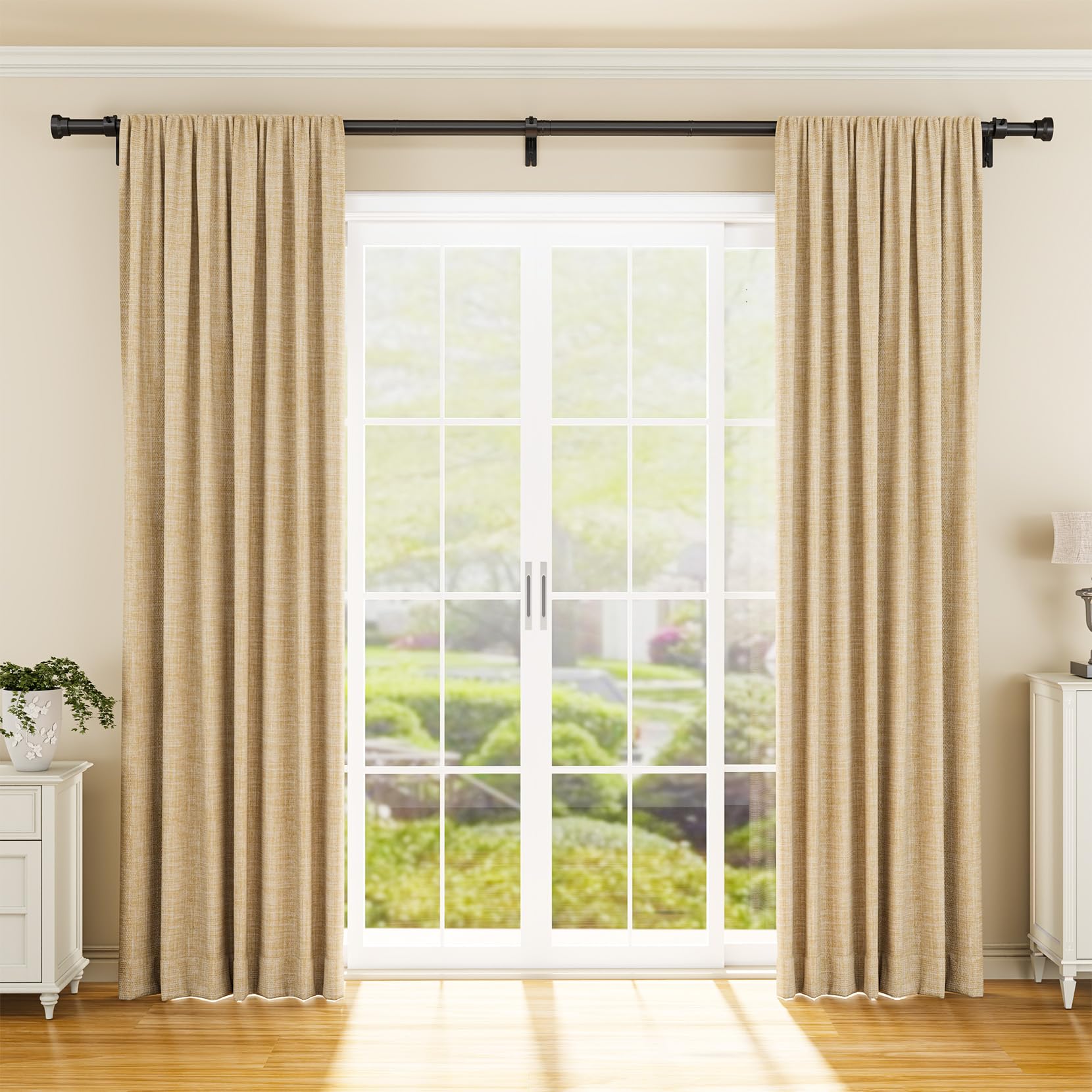
Go higher and wider than feels natural. Mount the rod 4 to 6 inches above the window frame, and if your ceiling is under 9 feet, split the difference between the frame and the ceiling line for the tallest read. Extend the rod 8 to 12 inches past the frame on each side so the open curtains stack off the glass instead of covering it. That’s how you get more daylight and a window that looks bigger than it is.
Height is the lever most people ignore. Apartment Therapy and Wirecutter both push the same move: hang high, hang wide, and let the fabric fall long. Curtains should kiss the floor or break half an inch above it. No high-waters. A panel that stops at the sill reads cheap no matter what you paid for it.
One measurement to write down before you drill: rod length. Add the frame width plus your 8-to-12-inch overhang on both sides, then confirm your rod’s adjustable range covers it. A rod maxed out at full extension sags in the middle. Buy one with room to spare.
What Tools and Anchors Do You Need?
Short list, and you probably own most of it. A drill with a bit sized to your anchors, a Phillips screwdriver, a tape measure, a pencil, and a level. A stud finder if you’re going into a wall you haven’t mapped. Painter’s tape helps you mark without pencil ghosts on fresh paint.
Anchors are where installs live or die. Standard drywall alone holds almost nothing under load, so the hardware matters more than the drill. Self-drilling threaded anchors handle light sheers. Toggle bolts or heavy-duty molly bolts carry weight when you can’t hit a stud. Into a stud, a #8 wood screw bites straight in with no anchor at all.
Match the anchor to the wall and the drapes. Light linen on a wide window still adds up once you tug it twice a day, and lined blackout panels can double that pull. Buy anchors rated above your load, not right at it. The packaging lists a pull-out rating in pounds, usually 20 to 50 for toggles and far less for plastic expansion plugs. Read it before you drill.
The Step-by-Step Install
Work one bracket at a time and let the level do the thinking. Rushing the marks is what leaves you with a crooked rod and a wall full of extra holes.
1. Measure and mark bracket height, 4 to 6 inches above the frame, on both sides. Measure from the ceiling, not the frame, so a crooked window doesn’t throw you off. 2. Set your horizontal marks 8 to 12 inches past the frame on each side, equal distances. 3. Hold a bracket to the first mark, check plumb with the level, and pencil the screw holes. 4. Find studs. Where a mark lands on a stud, skip the anchor. Where it lands on hollow drywall, drill and seat your anchor first. 5. Drive the screws, mount both brackets, then lay the level across them and adjust before the third screw goes in on a three-hole bracket. 6. Drop the rod in, add a center support bracket if the span runs past 60 inches, and hang the curtains.
Add the center bracket on any wide window. It’s the single fix that stops the mid-rod droop most people blame on the curtains.
Installing Into Drywall, Studs, or Tile
The wall decides the hardware, not the other way around. Studs are the gold standard: screw straight into wood and the bracket won’t budge. Hollow drywall needs an anchor every time, and heavy drapes need a wall anchor or a stud, never a bare drywall screw. A screw threaded into paper-faced gypsum pulls out the first time someone yanks the panels closed.
For drywall between studs, toggle bolts spread the load behind the wall and hold far more than plastic expansion anchors. That’s your move for blackout panels, layered drapes, or anything lined. Match the drill bit to the toggle’s folded width so the wings clear the hole.
Tile and plaster want a different approach. Drill tile with a carbide or diamond bit on low speed, no hammer setting, and start through a strip of painter’s tape so the bit doesn’t wander and crack the glaze. Go slow and let the bit cut instead of leaning on it. Once you’re through the tile into the substrate behind it, switch to the anchor that suits that layer, since the tile itself carries none of the load.
Plaster over lath is its own animal. It crumbles at the surface but holds well once you reach the wood lath underneath, so pre-drill a clean pilot hole and seat the screw into solid material. Skip the impact driver here. Steady pressure and a sharp bit keep the face from spidering.
Common Problems: Sagging, Uneven, and Pulling Out
Three failures cover almost every bad install. A sagging rod means the span is too long for the diameter or you skipped the center bracket. Add a center support, or step up to a thicker rod. A 1-inch rod carries a wide window that a 5/8-inch rod can’t.
Uneven rods trace back to marking off the window frame instead of the ceiling. Frames are rarely square, so measure both brackets down from the ceiling and the rod reads level to the eye. If it’s already up and tilted, re-drill one side. Fill the old hole later.
Pulling out is an anchor problem, full stop. A bracket that tears free took drywall screws where it needed toggles. Move up one anchor class, or shift the bracket a couple inches to catch a stud. Don’t re-seat a stripped anchor in the same blown-out hole. It won’t hold, and you’ll be back on a ladder in a week.
Helpful Products
All three rods below clear a 4.3 owner rating and cover a different window width, so match the rod to your span before anything else. Pick the YaFex if you’re spanning a wide living-room window that needs a thicker 1-inch profile and a range up to 144 inches. For a standard-to-large window in matte black, the Thestoa fits 48 to 92 inches at a 5/8-inch diameter, and the GXOACKJ handles narrow windows from 32 to 48 inches.


Pros
- Rust-resistant stainless steel construction works in humid environments
- Adjustable design eliminates guessing the right size before purchase
- Complete hardware kit included with brackets, screws, and anchors
- Matte black finish matches popular modern and farmhouse aesthetics
- 25 lb weight capacity handles most standard curtain panels
Cons
- No customer reviews yet to verify long-term durability claims
- 5/8 inch diameter may look too thin for larger windows or heavy drapes
- Connection point where rod extends could be visible depending on curtain fullness
This curtain rod solves the most annoying part of buying window hardware: guessing the exact size you need. The adjustable design extends from 48 to 84 inches, so whether you are moving apartments or hanging curtains in multiple rooms with different window widths, one rod does the job. The matte black finish looks sharp against white walls and works beautifully in modern farmhouse, industrial, or minimalist spaces.
The rust-resistant coating is a practical bonus if you are using this in a bathroom, kitchen, or covered patio where humidity is a factor. The orb finials give it a more polished look than basic end caps, and at under $15, you can outfit your whole home without breaking the budget.
If you want an adjustable, rust-proof curtain rod that looks good in modern spaces without paying $40 per window, this one delivers.
Styles it works with: Modern Farmhouse, Industrial, Minimalist, Scandinavian
Best placed in: Living room windows, bedroom windows, kitchen windows, covered outdoor patios
May not suit: Very wide windows over 84 inches, formal traditional decor that needs thicker ornate rods, homes needing extra heavy-duty support for layered blackout curtains
Buy it if:
- You need a curtain rod that adjusts to fit different window sizes as you move or redecorate
- You want a rust-resistant option for humid rooms like bathrooms or kitchens
- You are decorating on a budget and need to outfit multiple rooms affordably
- You prefer matte black hardware to match modern farmhouse or industrial decor
Consider waiting if:
- You want to read verified customer reviews before committing since this product has none yet
Skip it if:
- Your windows are wider than 84 inches and you need a longer rod
- You are hanging very heavy layered curtains that exceed 25 lbs
- You need a thicker diameter rod (1 inch or more) for a more substantial look on large windows
Check the latest price and availability on Amazon before it sells out.








Write Your Review
No reviews yet. Be the first to share your experience!