

> Editorial Note: I’m Erin Schwartz, and I cover home decor with a bias toward what actually works in a real room. The guidance here weighs scale, layout, and materials against Apartment Therapy and Wirecutter coverage rather than styling a space that nobody lives in.
Three cubes is the awkward middle. Too small to anchor a wall, too big for a closet shelf, and yet it’s the size most apartments actually need. The five units below span 9.3-inch narrow verticals to full-width fabric-bin frames, and the spec differences matter more than the price gaps. If you’re still deciding on format, my guides to cube storage vs bookshelf and cube vs shelf storage cover the structural trade-offs, while cube storage bins and storage cubes handle what goes inside. For tighter footprints, start with cube storage for small spaces.
How We Evaluated
I compared listed dimensions, panel material, shelf span, and assembly method across all five units, then cross-checked reported durability patterns against the load expectations for particleboard shelving. Shelf span is the variable that predicts sag. A 12-inch-wide shelf and a 24-inch shelf in the same material behave completely differently under 20 pounds of books. None of these carry BIFMA commercial certification, which is normal at this price tier and worth knowing before you load one with vinyl records.
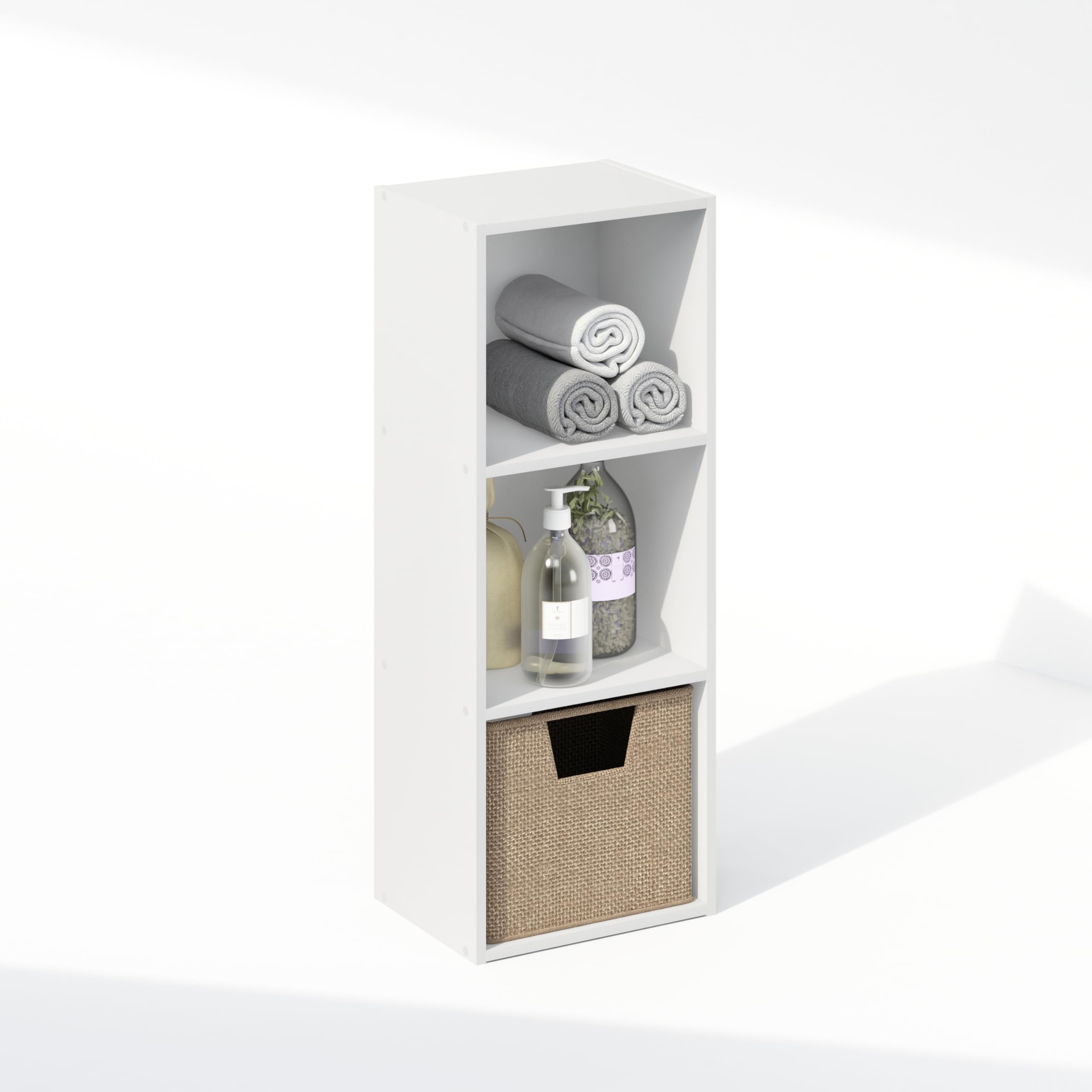
1. Furinno LUDER 3-Cube Bookshelf — the narrow vertical that fits where nothing else does
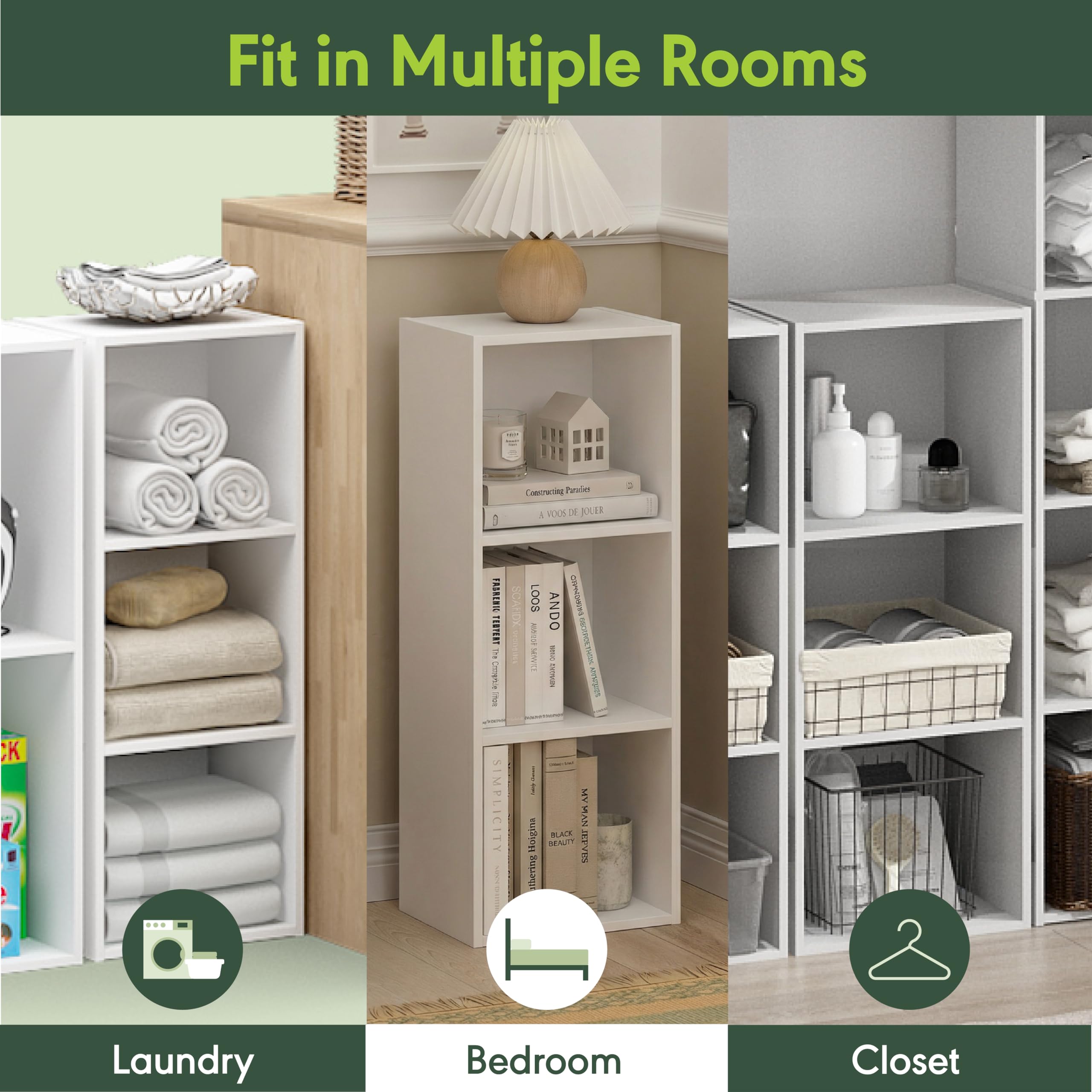
At 9.3 by 12 by 31.5 inches, this is the unit for the 10-inch gap beside a desk or between a sofa and a wall. The short shelf span is the real advantage: less unsupported width means less deflection under load, so paperbacks and binders sit flat instead of bowing the shelf over a year. It’s a tool-free assembly using pre-drilled panels and cam locks. The trade-off is capacity. You get roughly one row of standard paperbacks per cube, and the narrow base means it needs wall anchoring in any home with kids or pets.
2. Amazon Basics 3-Cube Bookcase, Black — built to accept fabric bins without a gap
This one’s designed around bin compatibility, which sounds minor until you buy 13-inch fabric cubes and find they don’t seat in your frame. The black finish hides scuffs on the shelf edges better than white does, which matters in an entryway or a mudroom where bags scrape past. Vertical orientation gives you three stacked openings in a small floor footprint. Particleboard construction means the back panel is thin, so anchor it and don’t treat it as a step stool. Straightforward, honest, unremarkable in the good way.
3. Amazon Basics 3-Cube Bookcase, White — the bright-room pick with a visible-wear caveat
Mechanically identical to the black version, with one real difference: white laminate shows edge chipping and yellowing near sunlight far more clearly. Apartment Therapy has flagged this pattern on white laminate furniture repeatedly, and it’s the honest reason to choose it deliberately rather than by default. Where white wins is visual weight. In a small bedroom under 100 square feet, a white unit reads as wall rather than furniture. Same bin compatibility, same assembly, same need for a wall strap.
4. Furinno Reed 3-Tier Closet Organizer — open-shelf storage for inside a wardrobe
Different animal. This is a 3-tier open shelf sized for closet interiors, meant to divide dead vertical space above folded stacks. No back panel and no cube walls, so airflow is better for linens and sweaters, and you can slide items in from either side. That openness is also the limitation. Nothing contains a leaning stack of shirts, so it works best with bins or with genuinely tidy folding. For a closet that’s currently one shelf and a rod, it converts unused air into three usable levels.
5. Furinno LUDER 3-Cube Bookshelf — the second finish option for matched pairs
Same 9.3 by 12 by 31.5 frame as the first pick, offered in an alternate colorway. Buying two and flanking a window or a doorway is where it earns its place, because matched narrow verticals read as built-in millwork rather than as furniture you assembled on the floor. Cost per unit stays low enough that two of these often undercut one mid-size bookcase. Identical caveats apply: particleboard, thin backing, anchor it. Check the current finish name on the listing before ordering a second one.
Comparison Table
| Unit | Format | Listed size (in) | Best fit |
|---|---|---|---|
| Furinno LUDER (B074) | Narrow vertical, 3 open cubes | 9.3 × 12 × 31.5 | Gaps under 11 inches |
| Amazon Basics Black | Cube frame, bin-ready | Standard 3-cube vertical | Entryways, high-traffic |
| Amazon Basics White | Cube frame, bin-ready | Standard 3-cube vertical | Small, bright rooms |
| Furinno Reed | 3-tier open shelf | Closet-depth tower | Wardrobe interiors |
| Furinno LUDER (B09H) | Narrow vertical, alt finish | 9.3 × 12 × 31.5 | Matched pairs |
What Actually Determines Whether a 3-Cube Unit Lasts
Measure the opening before you measure the unit. Fabric bins are commonly sold at 11 or 13 inches, and a frame built for one won’t hold the other cleanly. Then check shelf span. Under 20 pounds, a 12-inch shelf in 15mm particleboard stays visually flat far longer than a 24-inch one.
Anchoring isn’t optional on tall, narrow units. ASTM F2057 exists because of tip-over incidents involving exactly this proportion, and every unit here ships with a strap for a reason. Finally, look for GREENGUARD or similar emissions certification if the unit lives in a bedroom, since engineered wood is the main indoor formaldehyde source in most homes.
Narrow Vertical vs. Bin-Ready Frame
These solve different problems. The Furinno LUDER format wins on fit, sliding into gaps a standard cube frame can’t reach, and its short shelves resist sag. But open cubes display clutter instead of hiding it.
The Amazon Basics frames win on concealment. Drop in three fabric bins and visual chaos disappears, which is why Wirecutter’s organizing coverage keeps returning to bin-based systems for shared spaces. They need more floor width, though. If your wall has 24 inches, go bin-ready. Under 12 inches, the LUDER is your only real option here.
Frequently Asked Questions
How much weight can a 3 cube storage unit hold?
Expect 15 to 25 pounds per shelf on particleboard units like these. Books hit that ceiling fast. A single shelf of hardcovers can exceed 30 pounds, so spread heavy items across all three levels rather than loading the top.
Do I really need to anchor it to the wall?
Yes, on any vertical unit over 30 inches. ASTM F2057 tip-over standards exist because tall, narrow furniture fails predictably when a drawer or shelf is climbed. The included strap takes five minutes.
Will 13-inch fabric bins fit these?
Only the Amazon Basics frames are built for standard fabric cube organizers. The Furinno LUDER openings are roughly 12 inches wide, so oversized bins won’t seat. Check listed interior width, not exterior dimensions.
Can these go in a garage or basement?
Not advisable. Particleboard swells when humidity exceeds about 60 percent, and swelling is permanent. Coated wire or resin shelving handles damp spaces far better.
How long does assembly take?
Both Furinno lines use tool-free cam-lock assembly and typically finish in 15 to 20 minutes. The Amazon Basics units need a screwdriver. Work on carpet or cardboard to avoid scratching the laminate.
Is FSC-certified material available at this price?
Rarely. FSC chain-of-custody certification is uncommon under $50 for engineered wood furniture. If sustainable sourcing is a priority, solid pine or bamboo units are the realistic step up.
Bottom Line
The Furinno LUDER 3-cube is the pick for most people, because 9.3 inches of width goes places nothing else here fits, and short shelf spans resist sag better than wide ones. Choose the Amazon Basics 3-cube in black if you want clutter hidden behind fabric bins and have at least 24 inches of wall. All five are particleboard, so treat load limits and wall anchoring as requirements rather than suggestions.



Write Your Review
No reviews yet. Be the first to share your experience!