

> Editorial Note: I’m Sofia Reyes, a bathroom and wellness editor focused on small-bath organization and materials that hold up to real humidity. The evaluations here reference OEKO-TEX certifications, ASTM moisture-resistance standards, and aggregated owner reviews.
Crunchy towels are almost never the towel’s fault. The real culprit is buildup: too much detergent plus fabric softener residue that coats the cotton loops and stiffens them over time. Fix the laundry habits and even an old, scratchy set usually comes back to life. For more on picking the right ones, see best bath towels, best bath towel set, best hand towels, how to remove mold from shower curtain, and best bathroom rug.
Why Do My Towels Get Stiff and Scratchy?
Three things turn soft towels rough: detergent buildup, fabric softener residue, and over-drying. Each one works differently, but they stack.

Detergent doesn’t fully rinse out when you use too much. The leftover surfactants dry into a crusty film between the cotton loops, and that film is what your skin feels as roughness. Hard water makes it worse, because mineral deposits bond with soap and lock the residue in place.
Fabric softener is the bigger surprise. It works by coating fibers in a waxy layer, which feels soft for a wash or two and then traps everything underneath. The American Cleaning Institute notes that this coating also blocks water absorption, so your towels get stiffer and less useful at the same time.
Then there’s heat. Over-drying bakes the remaining residue hard and scorches the cotton fibers, which is why towels straight from a too-hot dryer can feel like cardboard. Good Housekeeping has flagged high dryer heat as one of the fastest ways to wreck towel texture.
The takeaway? Most stiffness traces back to what you’re adding, not the towel quality. Strip the buildup, ease off the additives, and the loops relax again.
When a set is too far gone for a vinegar reset, weave decides how the next one behaves. Our picks for the best waffle weave towels dry in three to four hours instead of hanging damp all day, which is where the musty smell starts.
How Much Detergent Should You Actually Use?
Use about half of what the bottle recommends. That’s the single most effective change for most people.
Detergent caps are sized for heavily soiled loads and the assumption that you’ll fill the machine. A normal towel load isn’t that dirty, so the extra soap has nothing to do except cling to the fabric. For a standard load, roughly 1 to 2 tablespoons of liquid detergent is plenty. High-efficiency machines need even less, since they run on low water volume and can’t rinse heavy doses.
Watch for the signs of overdosing: stiff towels, a faint soapy smell after drying, or suds still visible in the final rinse. Any of those means you’re using too much.
If you’ve got hard water, the fix isn’t more detergent. It’s a water softener additive or an extra rinse cycle to carry minerals away. Adding soap to fight hard water just feeds the buildup problem.
One more habit worth dropping: don’t overload the drum. Towels need room to tumble and rinse freely. Pack them in tight and the detergent can’t flush out, no matter how little you used. Fill the machine about three-quarters full and leave space at the top.
Should You Use Fabric Softener on Towels?
No, or at least not the way most people do. Liquid fabric softener is the main reason towels lose absorbency over time.
The mechanism is simple. Softener deposits a thin hydrophobic coating that feels plush at first but repels water, which defeats the entire point of a towel. After a few months of regular use, you end up with towels that feel slick but don’t actually dry you. OEKO-TEX certified cotton starts out highly absorbent, and a softener coating cancels that benefit out.
If you love the smell and the just-washed feel, use softener sparingly: a small splash every fourth or fifth wash, never every load. That gives you the scent without sealing the fibers shut. A quality liquid like a lavender-and-vanilla formula works fine in tiny amounts on a rotation.
The better long-term move is to skip liquid softener for towels entirely and switch to a mechanical method. Wool dryer balls soften by physically separating and fluffing the loops as they tumble, no coating involved. They keep absorbency intact and cut drying time too. Wirecutter’s laundry guides reach the same conclusion: dryer balls beat liquid softener for towels you actually want to dry off with.
So the honest answer is: softener isn’t banned, but it’s the wrong default. Treat it as an occasional luxury, not a staple.
The Vinegar and Baking Soda Reset
When towels already feel crunchy, reset them with two cheap pantry items. This strips months of buildup in two cycles.
Start with the vinegar wash. Run your towels through a hot cycle with ½ cup (4 oz) of plain white distilled vinegar and no detergent. The mild acid dissolves the soap and softener residue clinging to the fibers and neutralizes odors at the same time. Don’t worry about a vinegar smell. It rinses out completely.
Next, the baking soda pass. Run a second hot cycle with ½ cup (4 oz) of baking soda, again with no detergent. Baking soda lifts the loosened gunk and softens hard water minerals, leaving the cotton loops free to fluff back up.
Two rules matter here. Never mix the vinegar and baking soda in the same load, because they neutralize each other and you lose both effects. And skip fabric softener for this reset entirely. Adding it back would undo the work.
After both cycles, dry on medium heat with dryer balls. You should feel the difference immediately. Most towels regain a noticeable amount of softness from a single reset, and you can repeat it every couple of months as maintenance. It’s gentler and cheaper than replacing a set that just needed a deep clean.
How to Dry Towels So They Stay Fluffy
Drying is where soft towels are made or ruined. The goal is gentle heat, movement, and stopping at the right moment.
Shake each towel out before it goes in the dryer. A quick snap opens the matted loops so they tumble loose instead of drying flat and clumped. It takes two seconds and makes a real difference in texture.
Use medium heat, not high. High heat feels faster, but it scorches cotton fibers and bakes in any residue. Medium dries thoroughly with less fiber damage. Toss in a few wool dryer balls too. They bounce between the towels, keep them separated, and lift the nap as they go, which is the mechanical version of what softener fakes chemically.
Don’t over-dry. Pull towels out while they’re just barely dry, or even slightly damp, and let them air-finish for a few minutes. Over-drying is the fastest route to that stiff, crispy feel, and it wastes energy. Dryer balls help here as well by cutting total drying time by up to 25 percent.
If you line-dry, snap the towels first, then give them 10 minutes in the dryer afterward to soften the air-stiffened fibers. Sun-dried towels smell great. They just need that quick tumble to stay plush.
How Often Should You Wash and Replace Towels?
Wash bath towels every 3 to 4 uses, and replace them roughly every 2 years. Both numbers matter for softness and hygiene.
Washing too often grinds the fibers down faster and exposes them to more detergent and heat, which accelerates stiffness. Washing too rarely lets bacteria and dead skin accumulate in a fabric that stays damp in a humid bathroom. Every 3 to 4 uses is the sweet spot, assuming the towel dries fully between uses. Hang towels spread out, not bunched on a hook, so they actually dry.
Replace bath towels every 2 years or so with regular use. Cotton loops break down over time, and past a certain point no reset will bring back the loft. You’ll notice thinning fabric, fraying edges, and a permanent rough feel that vinegar can’t fix. That’s the towel telling you it’s done.
Two small habits extend the life of a set. Rotate your towels so the same ones aren’t washed every cycle, and never leave a damp towel balled up overnight. Mildew sets in fast in a warm bathroom, and it brings both odor and stiffness with it.
Take care of the fibers and the softness mostly takes care of itself.
Helpful Products
A few inexpensive tools make soft towels the default instead of a chore. Below are an occasional-use liquid softener and two sets of wool dryer balls for the chemical-free route.

Downy Ultra Soft Fabric Softener Calm Lavender Vanilla Bean 56 fl oz 83 Loads Liquid Softener
Pros
- Long-lasting 4-day scent keeps bedroom linens and bath towels smelling fresh between washes
- Dye-free, gentle formula is safe for delicate fabrics including lace, wool blends, and fine linens
- High load count (83 loads) makes the $8.47 price tag an excellent value per wash
- Easy dispenser-pour application requires no measuring cup guesswork
Cons
- No customer reviews yet, so long-term durability of the scent and softness claims cannot be independently verified
- Lavender and vanilla scent is strong and polarizing, which may not suit fragrance-sensitive households or those who prefer unscented options
- Liquid format requires a fabric softener dispenser or center agitator, so it is not compatible with all washing machine setups
There is something genuinely comforting about pulling freshly laundered sheets out of the dryer and being met with a soft wave of lavender and vanilla. Downy Ultra Soft Calm does exactly that. It is not an overwhelming perfume-heavy scent but rather a warm, understated aroma that lingers just long enough to make your bedroom or linen closet feel like a retreat.
What sets this apart from a standard fabric softener is the dye-free formula. For anyone who invests in quality bedding, throw blankets, or delicate curtain panels, the peace of mind that comes with knowing your softener is not introducing harsh dyes to your fabrics is worth a lot. The 4x softness boost is real and noticeable, especially on towels and cotton pillowcases that tend to go stiff after repeated washes.
At under $9 for 83 loads, it fits naturally into a home care routine without feeling like a splurge. If you want luxuriously soft, long-lasting fresh-smelling laundry without worrying about fabric damage or harsh ingredients, this one delivers.
Styles it works with: Soft Minimalist, Modern Farmhouse, Scandinavian, Cozy Cottage
Best placed in: Laundry rooms that serve the primary bedroom, linen closets stocked with guest bedding, bathroom towel storage where freshness and softness are daily priorities
May not suit: Households with fragrance sensitivities or allergies to lavender-based scents; homes where all laundry products must be fully fragrance-free for medical reasons
Buy it if:
- You want your bedroom linens and bath towels to feel softer and smell fresh for several days between washes
- You prefer a dye-free softener that is gentle enough for delicate throws, linen curtains, and fine fabric items around the home
- You are looking for a cost-effective everyday softener that delivers a premium scent experience without a premium price tag
Consider waiting if:
- You want to read a larger pool of verified customer reviews before committing, since this listing currently has no reviews to reference
Skip it if:
- Your household includes members with fragrance sensitivities or known lavender allergies
- Your washing machine does not have a fabric softener dispenser or center agitator compartment
Check the latest price and availability on Amazon before it sells out.

Handy Laundry Wool Dryer Balls 6-Pack - 100% New Zealand Wool, Natural Fabric Softener, Reduces Drying Time by 25%
Pros
- 100% New Zealand wool construction with no synthetic fillers means genuinely natural softening
- Lasts 1,000-plus dryer loads, making the per-use cost almost negligible over time
- Measurably reduces drying time and energy use, which shows up on your utility bill
- Safe for sensitive skin and fragrance-free households since there are no chemical coatings
- Over 94,000 ratings averaging 4.6 stars reflects consistent real-world satisfaction
Cons
- Wool balls can produce a light clunking noise in the dryer that some users find noticeable
- Results on static cling can vary in very dry climates or with synthetic fabric blends
- Does not add fragrance on its own, so users who prefer scented laundry need to add essential oils separately
There is something genuinely satisfying about swapping out a product you buy over and over for something that just works quietly in the background for years. These wool dryer balls are exactly that kind of upgrade. Toss all six into the dryer and they do real work: separating clothes so hot air moves through more evenly, softening fabric through gentle mechanical action, and cutting down the time each load takes. No chemicals, no waste, no weekly shopping list item.
What makes the Handy Laundry version stand out in a crowded category is the material quality. The 100% New Zealand wool is dense and tightly felted, which means the balls hold their shape load after load instead of flattening out after a few months. For families with kids, allergy sufferers, or anyone who has ever read the ingredient list on a dryer sheet and felt uneasy, switching to these is a straightforward decision.
They sit in the dryer drum between uses, take up almost no space, and require zero maintenance. That low-effort permanence is exactly what makes them feel at home in a well-run household. If you want softer, faster-drying laundry without the ongoing cost and chemical load of disposable softeners, this one delivers.
Styles it works with: Minimalist, Modern Farmhouse, Eco-Conscious, Scandinavian
Best placed in: Laundry room shelf or basket, mudroom utility area, bathroom linen closet near the washer and dryer
May not suit: Households where every family member requires strongly scented laundry since these add no fragrance on their own; very small laundry spaces where adding six balls to a compact dryer drum feels crowded
Buy it if:
- You want to eliminate dryer sheets and liquid softener from your routine for good without sacrificing soft, fluffy results
- You have sensitive skin, young children, or allergy-prone family members who react to chemical fabric softeners
- You run multiple laundry loads per week and want a measurable reduction in drying time and electricity use
Consider waiting if:
- You are mid-way through a large supply of dryer sheets you already purchased and want to use them up first
Skip it if:
- Strongly scented laundry is non-negotiable for your household and you are not open to adding essential oils yourself
- You use a shared building dryer where leaving your own balls in the machine between uses is not practical
Check the latest price and availability on Amazon before it sells out.
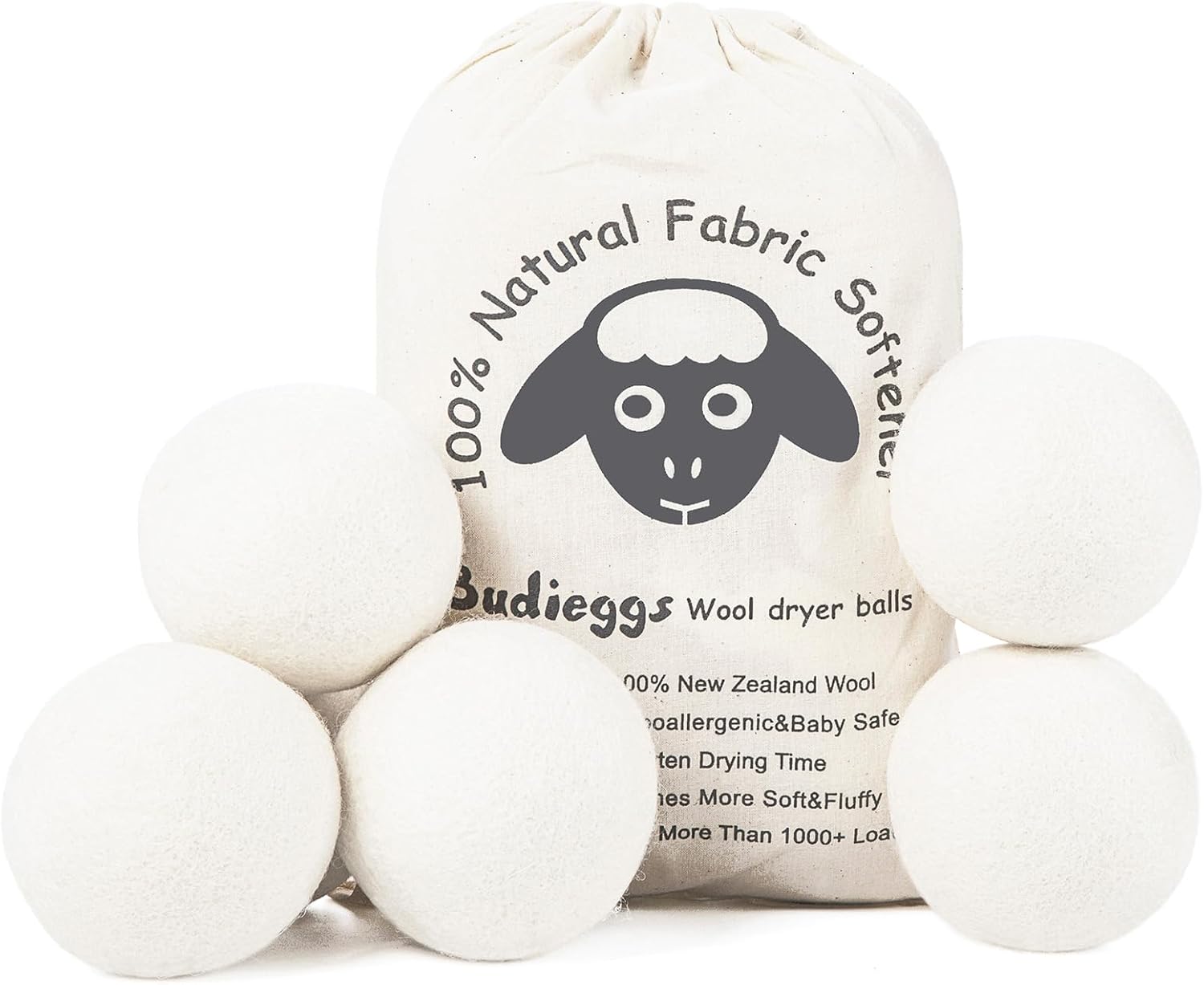
Budieggs Organic XL Wool Dryer Balls 6-Pack | 100% New Zealand Wool | Chemical-Free Fabric Softener | 1000+ Loads
Pros
- Genuinely chemical-free and hypoallergenic, making it one of the safest dryer ball options for babies and sensitive skin
- Outstanding long-term value: 6 balls at under $10 for over 1,000 loads works out to less than a penny per load
- Quieter in the dryer compared to plastic dryer balls, which tend to clunk loudly against the drum
- Essential oil compatibility adds a practical customization option that liquid softeners and dryer sheets cannot easily match
- Comes ready to gift in a cotton bag, which removes the need for extra packaging or wrapping
Cons
- May increase static cling if laundry is over-dried, requiring attention to cycle timing or use of moisture-sensitive settings
- Handmade construction means each ball can vary slightly in size, shape, and color, which may bother buyers expecting uniform appearance
- Does not add fragrance on its own, so buyers who rely on scented dryer sheets will need to purchase essential oils separately
There are not many laundry upgrades that pay for themselves in the first month, but the Budieggs Wool Dryer Balls come close. For less than $10 you get six XL balls made from 100% New Zealand wool that work quietly in the background of your laundry routine, softening fabrics, cutting down drying time, and skipping the chemical load entirely. That is a meaningful shift, especially in homes where someone has sensitive skin or allergies.
What stands out beyond the eco pitch is how the balls actually perform on everyday fabrics. Towels come out fluffier, shirts come out with fewer wrinkles, and baby onesies come out without the waxy coating that some dryer sheets leave behind. The cotton gift bag they arrive in is a small but thoughtful touch that makes these genuinely giftable, not just functional.
If you want softer laundry and lower monthly costs without sacrificing safety for sensitive skin, this one delivers.
Styles it works with: Eco-minimalist, Modern Farmhouse, Scandinavian, Natural or Organic Living aesthetics
Best placed in: Laundry room shelf or basket, linen closet alongside towels and bedding, nursery storage caddy for baby laundry supplies
May not suit: Households that prefer heavily scented laundry without the extra step of adding essential oils separately; very large households running back-to-back jumbo loads may want a second 6-pack to keep balls rotating efficiently
Buy it if:
- You have a baby, a family member with allergies, or anyone with sensitive skin who reacts to chemical fabric softeners or dryer sheet coatings
- You want to permanently eliminate the recurring cost of dryer sheets and liquid softener from your grocery list
- You are looking for a practical, well-packaged gift for a baby shower, housewarming, or holiday that feels intentional rather than generic
Consider waiting if:
- You want a specific scent built in and have not yet chosen an essential oil to pair with the balls, since fragrance requires a separate purchase
Skip it if:
- You run exclusively large or extra-large loads back to back and are not prepared to buy a second set, since a single 6-pack may wear faster under heavy daily use
- You strongly prefer heavily scented laundry and find the step of adding essential oil drops before each cycle too inconvenient
Check the latest price and availability on Amazon before it sells out.

Write Your Review
No reviews yet. Be the first to share your experience!