

> Editorial Note: I’m Hannah Lin, an Interior Living Researcher who’s spent 9+ years analyzing the home furniture market. This guide draws on BIFMA, GREENGUARD, and FSC certifications, plus owner reviews aggregated from Wirecutter, Apartment Therapy, and the major home design subreddits.
The fastest way to ruin a nonstick pan is the thing most people do first: scrub a hot pan under cold water. That thermal shock warps the base and shortens the coating’s life by years. Cleaning nonstick isn’t hard, but it rewards patience over force, and it pairs surprisingly well with the same low-effort approach that keeps the rest of a kitchen looking calm and curated alongside your best gallery wall frames, best console table for entryway, best large floor mirror, best wall mirror for living room, and best table lamp for living room. Here’s exactly how to keep a nonstick surface slick, safe, and stick-free for the long haul.
What’s the right way to clean it after every use?
Let the pan cool first. A nonstick surface that goes from 400°F straight into a cold sink can warp in seconds, and a warped base means uneven heating forever after. Give it 10 to 15 minutes on the stovetop until it’s just warm to the touch.
Then keep it simple. Warm water, a drop of dish soap, and a soft sponge or dishcloth handle 90% of everyday messes. Wipe in gentle circles, rinse, and dry with a towel instead of leaving it to air-dry, since standing water can dull the coating over time.
Skip the abrasive side of the sponge. Steel wool, scouring pads, and gritty powders scratch the polymer layer, and once that layer is compromised, food starts grabbing exactly where you scrubbed. Wirecutter’s cookware editors make the same point in their long-term nonstick reviews: the scratches you can barely see are the ones that turn into stick spots.
One habit worth building. Wipe the pan while it’s still slightly warm, not stone cold. A thin film of oil lifts far more easily at room-warm than after it’s set into a hard, tacky ring. That single change saves most of the elbow grease people waste on cold pans.
How do I remove stuck-on or burnt food without wrecking the coating?
Almost never reach for a knife or metal scraper. Instead, deglaze. Add about half an inch of water to the pan, set it over low heat, and let it simmer for 3 to 5 minutes. The steam softens the burnt layer so it slides off with a wooden or silicone spatula. No scratching required.
For stubborn brown spots that survive a simmer, make a baking soda paste: two tablespoons of baking soda to one tablespoon of water. Spread it on the cooled pan, wait 15 minutes, then wipe with a soft sponge. Baking soda is mildly abrasive but soft enough that it lifts residue without gouging the surface.
Avoid the internet’s favorite bad idea. Boiling vinegar or running a pan through a scorching “self-clean” cycle can degrade the coating and, on cheaper pans, release fumes you don’t want in a closed kitchen. Apartment Therapy’s kitchen guides flag high-heat cleaning shortcuts as the number-one cause of premature coating failure in reader-submitted photos.
Patience wins here. A pan that needs a second deglaze session is normal. Two gentle rounds beat one aggressive scrub that leaves permanent marks.
Can I put a nonstick pan in the dishwasher?
It depends on the pan, but the honest answer for most is no. Dishwasher detergent is far harsher than dish soap, and the high-heat dry cycle bakes the coating in a way handwashing never does. Even pans labeled “dishwasher safe” tend to lose their slickness noticeably faster than handwashed ones.
Check the base or the manufacturer’s card. Higher-end stainless-clad and reinforced ceramic pans sometimes earn a genuine dishwasher rating rated against ASTM abrasion standards, but the coating still ages faster with each cycle. If you love a pan, wash it by hand.
The riser panels and racks matter too. When a nonstick pan knocks against other metal in a crowded dishwasher, the impact chips edges and rims. That’s often where peeling starts. Two minutes at the sink protects an investment that should last 3 to 5 years or more.
How do I store it so the coating lasts?
Never stack bare pans directly inside each other. The base of one pan grinding against the coating of another is one of the quietest, most common ways nonstick gets scratched in a cabinet. If you’ve got a stack, that friction adds up every time you pull one out.
Use a barrier. A felt pan protector, a folded dish towel, or a paper plate between each pan stops metal-on-coating contact entirely. Pan protectors run about $10 for a set and pay for themselves the first time they save a pan.
Hang them if you can. A wall rail or a lid organizer keeps each pan separate and visible, which also happens to look intentional rather than cluttered. Store the pan fully dry, since trapped moisture between stacked pans can leave water spots that etch the finish over months.
Helpful Picks
These three cover the range most home cooks actually need: a compact everyday egg pan, a heavy-gauge 12-inch workhorse, and a budget granite-coated option that’s easy to replace. All clear a 4.6 owner rating and use coatings that respond well to the gentle handwashing method above.
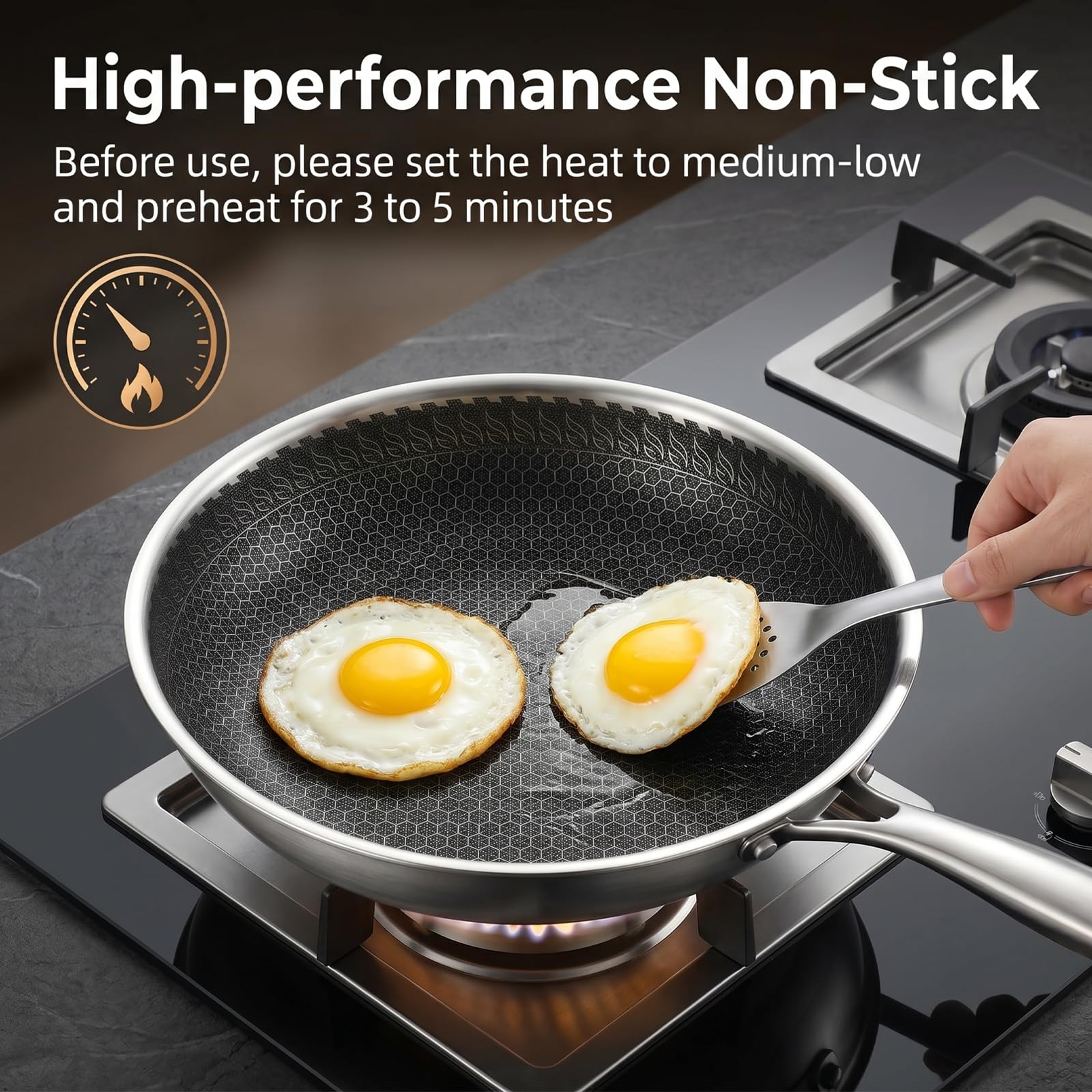

GPY 9-Inch 316L Stainless Steel Nonstick Frying Pan with Lid | Honeycomb Surface, All Cooktops, PTFE & PFOA Free
Pros
- 316L stainless steel is a step above standard 304 steel, offering superior corrosion and acid resistance for longevity
- Tri-ply construction with aluminum core ensures rapid, even heat distribution for consistent cooking results
- Detachable handle and dishwasher-safe design make storage and cleanup genuinely convenient
- PTFE and PFOA free honeycomb coating provides nonstick performance without the health concerns of traditional nonstick pans
- High 4.7-star rating from early buyers suggests quality control and real-world performance match the listed features
Cons
- Only 8 reviews on record, so long-term durability of the honeycomb coating under daily use is not yet confirmed by a large user base
- At 9 inches this pan is best suited for single servings or small households and may feel limiting when cooking for three or more people
- Honeycomb nonstick coatings can degrade faster than bare stainless if metal utensils or abrasive scrubbers are used, requiring careful handling habits
The GPY 9-inch skillet solves one of the most common kitchen frustrations: choosing between a truly nonstick surface and a pan that does not leach harmful chemicals into your food. The honeycomb coating creates a physical pattern of small air pockets that reduce contact between food and the pan surface, so eggs slide out cleanly and fish fillets lift without tearing, all without a single drop of PTFE or PFOA involved.
What sets this pan apart from most nonstick options at this price point is the 316L stainless steel body. Most budget pans use 304 stainless or even plain carbon steel. The 316L grade adds molybdenum to the alloy, making it more resistant to acidic foods like tomato sauces and citrus marinades that slowly corrode cheaper metals over time. The tri-ply construction means the base stays flat and distributes heat evenly, which matters most when you are searing a steak or melting butter without burning the edges.
The glass lid and detachable handle are small details that quietly improve daily life in the kitchen. You can check on simmering vegetables without releasing steam, and the pan stores flat without a fixed handle taking up drawer space. If you want genuinely nonstick performance and long-term durability without sacrificing peace of mind over chemical coatings, this one delivers.
Styles it works with: Modern Minimalist, Scandinavian, Contemporary, Clean Farmhouse
Best placed in: On a gas or induction range as a daily-use skillet, displayed on an open kitchen shelf as part of a curated cookware set, or stored in a cabinet with the handle detached to save space
May not suit: Households regularly cooking for four or more people where a 12-inch or larger pan is the practical minimum; kitchens that rely heavily on metal spatulas or stainless tongs, as the honeycomb coating requires silicone or wooden tools to stay intact
Buy it if:
- You cook for one or two people and want a high-quality nonstick pan that does not compromise on food safety
- You use an induction cooktop and struggle to find nonstick pans that work reliably on it
- You want a pan that transitions from stovetop searing to oven finishing without needing to switch cookware mid-recipe
Consider waiting if:
- You prefer to wait until a larger review base confirms long-term honeycomb coating durability before committing
Skip it if:
- You regularly cook large-batch meals and need a 12-inch or larger skillet as your primary pan
- You cook with metal utensils exclusively and are unwilling to switch to silicone or wood, which the honeycomb surface requires
Check the latest price and availability on Amazon before it sells out.

Tramontina Professional 12-Inch Nonstick Frying Pan | Heavy-Gauge Aluminum, Oven Safe, NSF Certified
Pros
- Outstanding heat distribution from heavy-gauge aluminum eliminates uneven cooking and hot spots
- Nonstick coating is reinforced and holds up well to regular daily use without flaking or degrading quickly
- Versatile from stovetop to oven with a practical handle that adapts to both uses
- Backed by a lifetime warranty and NSF Certification, which are rare assurances at this price point
- Consistently praised across thousands of reviews for easy cleanup and reliable food release
Cons
- Not compatible with induction cooktops, which rules it out for a growing number of modern kitchens
- Oven-safe limit of 400 degrees F is lower than some competing models in the same lineup, limiting high-heat roasting or broiling tasks
There is something quietly satisfying about a pan that just works every single morning. The Tramontina Professional 12-Inch Fry Pan is one of those tools that earns its place on the stove not through flashy design, but through consistent, reliable performance. The reinforced nonstick surface genuinely releases food cleanly, the aluminum body heats up in a hurry, and the silicone grip handle feels solid in the hand without making your palm sweat over a hot burner.
In a real kitchen, this pan holds its own against options costing two or three times as much. The 12-inch size is the sweet spot for households cooking for two to four people, wide enough to sear a couple of chicken thighs side by side or scramble eggs for the whole family without crowding. The low-profile shape makes it easy to flip and toss without a workout, and the stainless steel handle with its removable grip looks clean and purposeful rather than plasticky.
If you want a genuinely nonstick, oven-ready skillet that performs like a professional tool without the professional price tag, this one delivers.
Styles it works with: Contemporary, Minimalist, Industrial, Modern Farmhouse
Best placed in: Hung on a kitchen pot rack as a display piece, stored in a cabinet drawer next to the stove, or kept on an open kitchen shelf for everyday access
May not suit: Kitchens equipped exclusively with induction cooktops, as this pan is not induction compatible; also less ideal for cooks who regularly roast or broil above 400 degrees F and need a single pan that handles extreme oven heat
Buy it if:
- You cook daily on a gas, electric, or ceramic glass cooktop and want a reliable nonstick pan that handles everything from eggs to sauteed vegetables to seared proteins
- You want the confidence of a lifetime warranty and NSF Certification without paying premium cookware prices
- You need a pan that transitions from stovetop to oven at 400 degrees F for one-pan meals like frittatas or oven-finished chicken
Consider waiting if:
- You are considering a kitchen upgrade to an induction range in the near future, as this pan would not work with that cooktop type
Skip it if:
- Your kitchen runs entirely on induction and you cannot use a non-induction pan at all
- You regularly cook at oven temperatures above 400 degrees F and need a pan rated for higher heat
Check the latest price and availability on Amazon before it sells out.

CAROTE 8-Inch Nonstick Granite Frying Pan Skillet | PFOA-Free, Induction Compatible, Easy Clean Egg & Omelet Pan
Pros
- Genuinely nonstick surface that performs well with eggs, crepes, and delicate foods right out of the box
- Compatible with induction, gas, electric, and ceramic cooktops thanks to its stainless steel base
- Exceptionally easy to clean with minimal effort and no soaking required
- Strong value for the price backed by tens of thousands of positive customer ratings
- Lightweight build makes it easy to handle for everyday use
Cons
- Nonstick coating on budget pans like this typically degrades faster than cast iron or stainless steel with heavy daily use
- The 8-inch size limits it to single-serving portions and is not practical for cooking for a family
- Handle may feel less substantial compared to higher-end cookware brands
If your morning routine involves scrambled eggs sticking to the pan or spending more time scrubbing than eating, the CAROTE granite skillet is the kind of small upgrade that quietly improves your day. The granite-finish nonstick surface is genuinely smooth, and food slides off cleanly without needing a pool of butter or oil to help it along.
Beyond performance, there is something reassuring about cooking on a surface that is certified free of PFOA and PFOS. It is a detail that matters more now that people are paying closer attention to what their cookware is made of. The pan heats up fast and distributes heat evenly, so you are not dealing with hot spots that burn one side of your omelet while the other stays raw.
If you want a dependable, low-maintenance everyday skillet without spending $60 or more on a name-brand alternative, this one delivers.
Styles it works with: Modern Minimalist, Scandinavian, Contemporary, Transitional
Best placed in: Hung on a kitchen pegboard or pot rack, stored in a compact apartment kitchen cabinet, displayed on an open kitchen shelf as part of a curated cookware set
May not suit: Households that cook at high heat regularly since nonstick coatings are not designed for searing or broiling, and cooks who prefer the aesthetic of bare cast iron or stainless steel cookware in their kitchen
Buy it if:
- You cook eggs, omelets, or pancakes most mornings and want cleanup to take under a minute
- You are outfitting a first apartment or rental kitchen and need a capable pan without a big upfront investment
- You already have an induction cooktop or are planning to switch and need confirmed-compatible cookware
Consider waiting if:
- You are hoping to find it bundled in a full CAROTE set at a better per-piece value during a sale
Skip it if:
- You cook at high heat regularly or want a pan you can transfer from stovetop to a very hot oven, since nonstick coatings have temperature limits
- You are cooking for more than two people and need a larger surface area than 8 inches can provide
Check the latest price and availability on Amazon before it sells out.
Frequently Asked Questions
Should I use cooking spray to make cleanup easier?
No. Aerosol cooking sprays leave a sticky, invisible residue that builds up at high heat and eventually turns gummy on the coating. That buildup is harder to remove than the food you were trying to avoid. Use a small amount of oil or butter applied with a paper towel instead.
Is it safe to keep using a scratched nonstick pan?
It depends on how deep the scratch is. A light surface scuff is generally fine for a while, and modern PFOA-free coatings don’t shed the way older ones did. But once you see the metal underneath or the coating starts flaking, retire the pan. Food will stick there permanently, and flakes shouldn’t end up in your meals.

Can I use metal utensils if I’m careful?
No, not on standard nonstick. Even careful metal contact leaves micro-scratches that widen over time. Wood, silicone, and nylon tools cost a few dollars and protect the surface completely. It’s the cheapest insurance you’ll buy for cookware.
Does baking soda damage the coating?
Almost never at the ratios used for cleaning. A soft baking soda paste is mild enough to lift burnt residue without gouging the polymer, as long as you wipe rather than grind it in. Skip it only on delicate ceramic-coated pans that specify a soap-only routine.
Why does food start sticking to a pan I’ve cleaned well?
It depends, but usually it’s invisible oil buildup, not a failing coating. A thin polymerized film from repeated high-heat cooking makes the surface tacky. A soak in warm soapy water plus a baking soda wipe often restores the slickness people assume is gone for good.
How often should I deep clean it?
It depends on how hard you cook. For daily use, a monthly baking soda treatment keeps residue from compounding. If you mostly make eggs and reheats, every couple of months is plenty. The goal is preventing buildup before it sets, not scrubbing on a strict schedule.
When should I just replace a nonstick pan?
Yes, replace it when the coating peels, flakes, or shows bare metal, or when food sticks no matter how you cook. Most quality nonstick pans last 3 to 5 years with gentle handwashing. A warped base that no longer sits flat is another clear sign the pan’s done its job.







Write Your Review
No reviews yet. Be the first to share your experience!