

> Editorial Note: I’m Hannah Lin, an Interior Living Researcher who’s spent 9+ years analyzing the home furniture market. This guide draws on BIFMA, GREENGUARD, and FSC certifications, plus owner reviews aggregated from Wirecutter, Apartment Therapy, and the major home design subreddits.
The most common pendant mistake is hanging the fixture too high, which leaves an island looking dim and top-lit instead of warm and grounded. The right pendant fixes that in one afternoon, and it also anchors a room the way a good best gallery wall frames or best console table for entryway anchors a wall. Before you buy, think about the same things you’d weigh for a best large floor mirror, a best wall mirror for living room, or even a best table lamp for living room: scale, height, finish, and how the light actually falls.
How High Should a Pendant Hang?
Height is the first decision because it controls glare, headroom, and how balanced the room feels. Over a kitchen island or counter, the bottom of the shade should sit 30 to 36 inches above the surface. That range keeps the bulb out of your sightline when you’re standing, so you get task light on the counter instead of a bright spot in your eyes.
Over a dining table, drop the fixture a little lower, around 28 to 34 inches above the tabletop. People are seated there, so a lower hang creates intimacy without blocking the person across from you. In an entryway or hallway, keep at least 7 feet of clearance from the floor to the bottom of the shade so nobody ducks.
Ceiling height changes the math. For every foot above the standard 8-foot ceiling, add roughly 3 inches to the hanging length. A 10-foot ceiling wants the pendant about 6 inches lower than an 8-foot ceiling would. Most fixtures ship with extra rod or chain, so measure twice before you cut or set the cable. Apartment Therapy’s kitchen guides land on the same 30-to-36-inch counter rule, and it holds up in real homes.
What Size Pendant Fits the Space?
Size is where scale mistakes happen. A pendant that’s too small reads like an afterthought. Too big and it swallows the room.
For a single pendant over a nightstand or small table, a 10 to 12-inch diameter shade works. Over a kitchen island, use the island length to plan a group. A common formula: island length in inches, divided by the number of pendants, gives you the on-center spacing. A 6-foot island usually takes two or three fixtures spaced 24 to 30 inches apart.
There’s a quick sizing trick for a dining-table pendant. Measure the table width in inches, subtract 12, and that’s a good maximum fixture width. A 40-inch-wide table pairs well with a pendant up to about 28 inches across. That leaves visual breathing room on both sides.
Mini pendants, like a slim clear-glass cylinder, disappear into a busy kitchen and let the backsplash show. Larger drum or hammered-glass shades become the focal point instead. Decide which job you want the light to do before you pick a diameter. Wirecutter’s lighting coverage stresses the same point: match fixture scale to the surface below, not to the whole room.
Which Finish and Glass Style Should You Pick?
Finish sets the mood, and it’s the detail people notice first. Matte black gives a modern, industrial edge and hides fingerprints better than polished metal. Brass and warm gold read softer and lean traditional or transitional, which suits older homes and warm wood tones. Brushed nickel stays neutral and blends with stainless appliances.
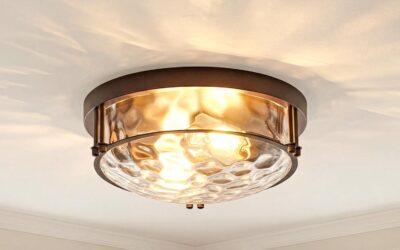
Glass style controls how the light spreads. Clear glass throws a crisp, direct beam and shows off the bulb, so use a decorative Edison or globe bulb behind it. Hammered or seeded glass scatters the light and softens shadows, which flatters a dining area. Frosted or opal glass diffuses the most and cuts glare, a smart pick if the fixture sits at eye level.
Match metal finishes loosely, not perfectly. Your pendant doesn’t have to match the cabinet hardware exactly. Pulling one warm tone and one cool tone together often looks more collected than a full matched set. Keep an eye on GREENGUARD-certified fixtures and finishes if indoor air quality matters to you, since that certification limits chemical emissions from coatings. It’s a small check that pays off in a tight kitchen.
How Much Light Do You Actually Need?
Brightness gets skipped, and it shouldn’t. Pendants are measured in lumens, not watts. For task areas like a kitchen island, aim for roughly 300 to 400 lumens per fixture, or plan the group to cover the counter. Over a dining table, softer is better, so 200 to 300 lumens per pendant keeps the mood relaxed.
Color temperature matters just as much. Warm white at 2700K to 3000K feels cozy and works for dining and living spaces. Cooler 3500K to 4000K light reads crisp and helps with kitchen prep. Mixing temperatures in one open room looks off, so pick a lane and stay in it.
Check whether the fixture is dimmable and what bulb it takes. LED pendants that are dimmable give you both bright prep light and low dinner light from the same fixture. If a pendant is hardwired with integrated LEDs, confirm the color temperature before you buy, since you can’t swap the bulb later. A quick fragment worth remembering. Lumens for brightness, Kelvin for mood. Nail both and the light does its job.
Helpful Picks
These three cleared a 4.5-plus owner rating where a rating was listed, and they cover the three shapes most kitchens and dining rooms need: a slim clear-glass mini, a matte-black hammered-glass pendant, and a warm brass LED set for wider spans.


Franklin Iron Works Franklin Iron Charleston 13 1/2" Wide Brass LED Pendant Light Set of 2
Frequently Asked Questions
How many pendants do I need over a kitchen island?
It depends on the island length. A 4-foot island usually takes one larger fixture or two minis. A 6 to 7-foot island looks balanced with two or three pendants spaced 24 to 30 inches on center. Odd numbers tend to look more natural over a long run.
Can I install a pendant light myself?
Yes, if you’re comfortable turning off the breaker and matching wire colors. Most pendants connect black-to-black, white-to-white, and ground-to-ground at an existing ceiling box. If there’s no box, or you’re adding a new circuit, hire a licensed electrician instead of guessing.
Are LED pendants worth it over regular bulbs?
Yes, for most people. LEDs run cooler, last around 15,000 to 25,000 hours, and cut energy use sharply. The one caveat is integrated LED fixtures, where the light source is built in and can’t be replaced, so check the color temperature and warranty first.
What color temperature is best for a dining room?
It depends on the vibe you want, but 2700K to 3000K warm white is the safe pick for dining. It flatters food and skin tones and keeps the room relaxed. Save cooler 3500K-plus light for prep zones and offices.
Should my pendant finish match my cabinet hardware?
No, not exactly. A loose match usually looks more collected than a perfect one. Pulling one warm and one cool metal together across a room reads intentional, so a brass pendant over nickel hardware is fine.
How low can a pendant hang over a table?
It depends on ceiling height and use, but 28 to 34 inches above the tabletop is the standard range. Go lower for intimacy, higher if people need to see across the table. Keep 7 feet of floor clearance in any walkway.
Do pendant lights give off enough light for a whole kitchen?
No, not on their own. Pendants are task and accent lighting, so pair them with recessed cans or under-cabinet strips for full coverage. Plan roughly 300 to 400 lumens per island pendant and layer the rest.





Write Your Review
No reviews yet. Be the first to share your experience!