

> Editorial Note: I’m Maya Chen, a bedroom and sleep editor covering mattresses, bed frames, and bedding. The picks here are evaluated against CertiPUR-US foam standards, Sleep Foundation evaluation protocols, and owner durability reports from r/Mattress.
The Derila Ergo shows up in your feed more than almost any other pillow, and the ads promise a lot. Here’s what the marketing skips: a contour pillow only works if its ridge height matches the gap between your neck and the mattress — and that gap changes the moment you roll from your back to your side. That single spec decides whether the Derila fixes your morning stiffness or leaves your chin tucked to your chest. Before you decide, it helps to compare it against the wider field of best cervical pillow options, the broader memory foam pillows for neck pain category, dedicated neck support pillow designs, the best pillow for side sleepers, and the natural-fill alternative in our buckwheat pillow guide.
How We Evaluated
We looked at four things that actually predict whether a contour pillow works: loft (ridge height in inches), foam density and rebound, cover breathability, and how well the shape holds up after 60-plus nights of compression. Derila markets the Ergo at roughly 21.25 x 13 inches with a dual-height butterfly contour, which is a small footprint for a pillow meant to serve back and side sleepers both. We weighed that claim against owner reports on r/Mattress and Sleep Foundation’s guidance that side sleepers usually need 4 to 6 inches of loft, while back sleepers do better at 3 to 5. We didn’t lab-measure firmness, so density notes reflect aggregated owner feedback plus the manufacturer’s stated specs. Certification matters too: CertiPUR-US foam means the memory foam is free of formaldehyde and heavy metals, which is worth checking on any budget contour pillow.


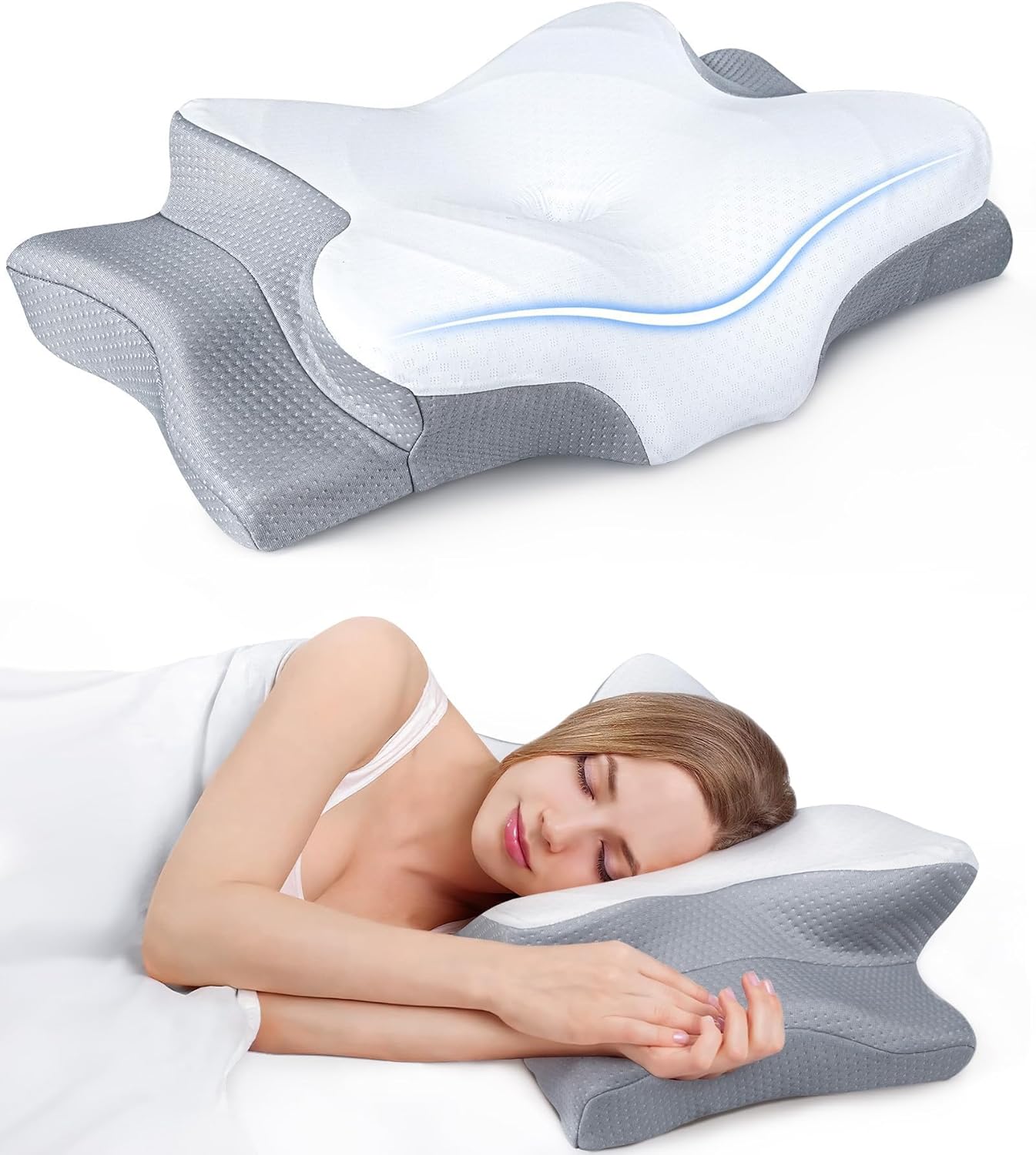
Cozyplayer Cooling Memory Foam Cervical Pillow - Adjustable Contour Neck Support for Side, Back & Stomach Sleepers
Pros
- Highly adjustable with removable insert and reversible design for personalized height
- Cooling technology and breathable mesh prevent night sweats better than standard memory foam
- 15-degree tilt angle maintains natural cervical curve recommended by sleep researchers
- Strong warranty and trial period backed by 15,636+ customer reviews at 4.3 stars
- Arrives vacuum-sealed with dual-layer packaging to protect during shipping
Cons
- Requires 2-week adjustment period as your body adapts to the contoured shape, which may cause initial discomfort
- Memory foam needs 48 hours of airing out before first use to dissipate manufacturing odor
- Not suitable for those with serious cervical spine conditions without consulting a doctor first
Most neck pillows force you to choose between firm orthopedic support or plush comfort, but this one bridges that gap with a hollow concave center that cradles your head while keeping your spine aligned. The cooling fabric is a standout feature that actually works. It uses a dense 3D mesh that pulls heat away from your skin, so you are not flipping to the cool side all night.
The adjustable height system is where this pillow really shines for real bedrooms. You can pull out the bottom insert to lower it by nearly an inch, or flip it 180 degrees to change the curve. That flexibility means it works whether you sleep on your side, back, or stomach, and it adapts as your needs change. The 100-night trial takes the pressure off, so you can test it through a full season without rushing your decision.
If you want serious neck support that actually keeps you cool without giving up on comfort, this one delivers.
Styles it works with: Modern Minimalist, Scandinavian, Contemporary, Wellness-focused interiors
Best placed in: Master bedroom for adults with neck pain, guest bedroom for visitors who need extra support, home office daybed for midday rest breaks
May not suit: Children's rooms (designed for adult cervical support), bedrooms with very soft mattresses that already sink deeply (pillow works best on medium-firm surfaces), households preferring traditional fluffy pillows without adjustment period
Buy it if:
- You wake up with neck stiffness or shoulder pain from your current pillow
- You sleep hot and need cooling technology that actually reduces skin temperature
- You want adjustable height options instead of buying multiple pillows to test
- You are willing to spend two weeks letting your body adapt to ergonomic support
Consider waiting if:
- You need a pillow immediately and cannot wait 48 hours for airing out
- You prefer to test in-store before committing, even with a 100-night trial
Skip it if:
- You have a diagnosed cervical spine condition and have not consulted your doctor about contour pillows
- You strongly prefer traditional soft pillows and are not open to an adjustment period
Check the latest price and availability on Amazon before it sells out.
1. Derila Ergo Cervical Neck Pillow — The One Everyone’s Seen Advertised
The Derila Ergo is the reason you’re reading this, so let’s be direct about what it is and isn’t. It’s a compact contour pillow — about 21.25 x 13 inches — with a butterfly-shaped memory foam core, a central dip for your head, a raised cervical ridge for your neck, and cutout wings meant to cradle your shoulder when you turn onto your side. The design logic is sound. A cervical ridge that fills the neck gap can help keep the spine neutral, which may reduce the morning stiffness that comes from a flat pillow letting your head drop back.
Where owner reports get mixed is loft. The Ergo runs lower than a traditional pillow, which back sleepers and smaller-framed sleepers tend to like right away. Broad-shouldered side sleepers, though, often find the ridge too short to fill the wider gap between a bigger shoulder and the ear — and that’s exactly where a contour pillow either earns its keep or doesn’t. The memory foam has a slow, dense rebound that holds its shape through the night rather than flattening like down. If you sleep hot, note that dense foam traps warmth; the cover breathes moderately but won’t feel cool the way a gel-infused pillow does. It’s a reasonable pick for a dedicated back sleeper who wants a firmer, structured contour. Just go in knowing the small footprint is a feature for some necks and a dealbreaker for others.
2. Besyodo Cervical Pillow — For Sleepers Who Want More Ridge to Work With
If the Derila’s biggest weakness is a short ridge, the Besyodo cervical pillow answers it with a more pronounced contour and a larger overall body. It’s still an ergonomic memory foam design built around neck support, but the extra size gives side sleepers more surface to settle a shoulder into. The taller cervical rise fills a wider neck gap, which is the exact scenario where the Derila can leave a bigger sleeper wanting.
The trade-off is bulk. A larger contour pillow feels less travel-friendly and takes up more real estate on a smaller bed. Owners who switched from a flat pillow describe a break-in stretch of a few nights while the neck adjusts to being held in one position — normal for any structured foam pillow. There’s no published rating we’d stake a claim on yet, so treat it as the higher-loft alternative to the Derila rather than a proven better buy. If you’re a side sleeper who read the Derila reviews and worried about height, this is the one to compare against first.
3. Ergo Pillow for Sleep Apnea and Snoring — The Positional-Sleep Angle
This generic Ergo contour pillow, rated 4.2 stars, leans into a different job: encouraging the head-and-neck alignment that positional therapy relies on. The pitch is snoring and mild sleep-apnea support through posture, and the honest framing is that pillow position may help some people who snore worse on their back — it is not a medical device and won’t replace a CPAP or a clinician’s evaluation.
As a pillow, it’s a familiar contour shape with a central well and a raised neck bar, priced in the budget tier. The 4.2 rating reflects the usual split: sleepers whose neck gap matches the ridge love it, and those who need a taller or lower loft return it. Foam quality sits a notch below the premium picks — expect a slightly faster break-down over a year of nightly use. Consider it if the alignment-and-snoring angle is what pulled you toward the Derila in the first place, but keep expectations to comfort and posture, not a cure.
4. Cozyplayer Ultra Pain Relief Adjustable Pillow — The Fix for Loft That Never Fits
The Cozyplayer, at 4.3 stars, solves the single problem that sinks most contour pillows: fixed height. It’s an adjustable cervical pillow with a cooling cover, so you can add or remove fill to dial the loft to your exact neck gap instead of hoping the factory guessed right. For the sleeper who bounced off the Derila because it sat too low, adjustability is the most reliable path to a pillow that actually fits.
The cooling cover is the second win here. Dense memory foam runs warm, and Cozyplayer’s odorless, breathable shell helps shed heat better than the Derila’s standard cover — a real difference if you wake up sweating. The catch is that adjustable pillows ask for setup. You’ll spend the first week fine-tuning, and some sleepers never quite settle on a height they love. But for combination sleepers who switch between back and side, the ability to change loft mid-week is worth the fiddling. It’s the most flexible pick on this list.
5. Coop Home Goods Eden — The Adjustable Pick With the Track Record
The Coop Home Goods Eden earns the highest rating here at 4.5 stars, and it earns it by pairing adjustability with proven materials. It’s a queen-size shredded memory foam pillow with a gel-infused cross-cut foam fill and a zippered cover, so you unzip, add or remove foam, and set the loft precisely. The fill is CertiPUR-US certified, and the Lulltra cover is designed to sleep cooler than solid foam — a combination the Derila doesn’t match.
This isn’t a molded contour pillow, so it won’t give you a rigid cervical ridge. Instead, it supports the neck through adjustable firmness and shape, which back, side, and stomach sleepers can all tune. Owners consistently praise the durability: the shredded fill fluffs back rather than compressing into a permanent dent the way solid contour foam eventually does. It’s pricier than the Derila and lacks the plug-and-play simplicity of a fixed shape. But if you want one pillow that adapts to nearly any sleeping position and holds up past the one-year mark, this is the safest bet in the group.
Comparison Table
| Pick | Type | Loft Approach | Cooling | Rating |
|---|---|---|---|---|
| Derila Ergo | Fixed contour | Low, dual-height | Standard cover | Not yet rated |
| Besyodo Cervical | Fixed contour | Taller ridge | Breathable cover | Not yet rated |
| Ergo (Sleep Apnea) | Fixed contour | Mid ridge | Standard | 4.2 |
| Cozyplayer Ultra | Adjustable | Add/remove fill | Cooling cover | 4.3 |
| Coop Eden | Adjustable shredded | Fully tunable | Gel-infused | 4.5 |
Who the Derila Ergo Is Actually For
Match the pillow to how you sleep, not to the ad. If you sleep on your back and want a firm, structured contour that holds a low, neutral loft all night, the Derila Ergo makes sense — its compact ridge is built for exactly that neck gap. Smaller-framed sleepers and those who find most pillows too tall tend to be the happiest owners.
If you have broad shoulders or sleep primarily on your side, the fixed low loft is a real risk. Side sleeping widens the gap between your ear and the mattress, and a short ridge lets your head tilt down toward the bed. In that case, a taller fixed contour like the Besyodo, or an adjustable pillow like the Cozyplayer or Coop Eden, will serve your spine better. Hot sleepers should also weigh the cooling picks — dense contour foam holds heat, and no amount of clever shaping fixes a pillow that’s sweating you awake. The Derila can be the right pillow. It’s just the right pillow for a specific sleeper, and the marketing doesn’t tell you which one.
Fixed Contour vs. Adjustable: Which Route Wins
The core choice on this list isn’t a brand — it’s whether you buy a shape or buy a system. Fixed contour pillows like the Derila and Besyodo give you a defined ridge with zero setup. You unbox it and sleep. That’s ideal if you already know your loft and your neck gap matches the design.
Adjustable pillows like the Cozyplayer and Coop Eden ask for a week of tuning but remove the biggest gamble in pillow-buying: guessing your loft before you’ve slept on it. For anyone who’s returned two or three contour pillows because the height was wrong, adjustability is the more forgiving path. The rule of thumb: buy fixed if you know your fit, buy adjustable if you don’t — or if you’re a combination sleeper whose ideal loft changes with position.
Frequently Asked Questions
Does the Derila Ergo actually help with neck pain?
It may help, for the right sleeper. A contour pillow keeps the neck in a neutral line, which can reduce the strain that causes morning stiffness. But it only works if the ridge height matches your neck gap — too low and your head drops back, too high and your chin tucks. It’s a comfort-and-alignment tool, not a medical treatment for chronic pain.
Is the Derila good for side sleepers?
Only sometimes. The low loft suits smaller-framed side sleepers, but broad-shouldered sleepers often find the ridge too short to fill the wider ear-to-mattress gap. If you’re a bigger side sleeper, a taller contour or an adjustable pillow is the safer choice.
How does the Derila compare to a regular memory foam pillow?
The Derila has a molded shape with a fixed cervical ridge, while a standard memory foam pillow is a uniform slab or shredded fill. The contour enforces alignment; the slab lets your head settle where it wants. Contour pillows help sleepers who need structure and frustrate those who prefer to move freely at night.
Will the Derila sleep hot?
Dense memory foam traps heat, and the Derila’s standard cover breathes moderately at best. If you run warm, a gel-infused or cooling-cover pillow like the Coop Eden or Cozyplayer will manage temperature better.
How long does a contour pillow like the Derila last?
Solid contour foam typically holds its shape for one to two years before it starts compressing into a permanent dip. Shredded adjustable fills like the Coop Eden’s tend to last longer because you can add foam to restore loft as it settles.
Is it worth buying, or is it just good marketing?
It’s a legitimate contour pillow, not a scam — but the ads oversell it as universal. It’s worth it if you’re a back or smaller-framed sleeper who wants a low, structured loft. If you’re unsure of your fit or sleep on your side, an adjustable pillow is the smarter money.
Bottom Line
The Derila Ergo is worth it for one specific sleeper: the back or smaller-framed sleeper who wants a firm, low contour that holds its shape all night. If you sleep on your side or don’t yet know your ideal loft, skip it and go adjustable — the Coop Home Goods Eden is the safest all-position pick at 4.5 stars, and the Cozyplayer runs cooler for a lower price. The honest caveat for the whole category: no contour pillow fixes neck pain on its own. It only helps when the ridge height matches your neck, and that fit is personal.





Write Your Review
No reviews yet. Be the first to share your experience!