

> Editorial Note: Our reviews aggregate manufacturer specifications, third-party certifications (BIFMA, CertiPUR-US, GREENGUARD, FSC), owner reviews from major retailers (Wayfair, Amazon, West Elm, IKEA), and discussion threads from r/HomeImprovement and r/Mattress. We are not interior designers, contractors, or sleep doctors; consult a licensed professional for structural changes, custom installations, or medical and ergonomic concerns. Affiliate disclosure: we earn a commission from qualifying purchases through our links at no extra cost to you.
Research across 14 models from Amazon, Wayfair, and r/Mattress threads narrowed the field to five pillows that consistently surface in back-sleeper discussions. Aggregated owner reviews show back sleepers face a narrow Goldilocks zone. Too lofty and the neck folds forward, too flat and the cervical curve loses support. Sleep Foundation guidance pegs the ideal loft for supine sleep at roughly 3 to 5 inches, and our shortlist clusters tightly inside that window.
We pulled buyer feedback across 4,800+ verified reviews, cross-referenced CertiPUR-US foam certifications, and compared cooling claims against r/Mattress owner threads. If you’re rebuilding a sleep setup from the ground up, our research on the best memory foam mattress and best mattress toppers pairs neatly with the picks below. Side-pairing a best reading pillow for bed or wedge pillow for sleep apnea can change which loft you actually need, and the best upholstered bed frame queen velvet research covers headboard height interactions.
> Quick Answer: The NextSleep Back Sleeper Pillow leads our shortlist. Its 3.5-inch contoured loft, satin pillowcase inclusion, and patent-pending neck cradle hit the Sleep Foundation-cited supine sweet spot more reliably than any other model we evaluated.
Editor’s Picks
- NextSleep Back Sleeper Pillow: best overall, contoured 3.5″ loft built specifically for supine sleep
- Bluewave Bedding Ultra Slim Gel Memory Foam: best for low-loft back sleepers and combination back/stomach sleepers
- Cozyplayer Ultra Pain Relief Cooling Pillow (): best adjustable cervical contour with cooling cover
- Osteo Cervical Pillow: best hollow-center design for neck pressure relief
- Cozyplayer Ergonomic Contour Memory Foam (): best budget cervical alternative for occasional back sleepers
At a Glance: Comparison Table
| Product | Fill Type | Loft (inches) | Firmness | Cooling | Cover Removable |
|---|---|---|---|---|---|
| NextSleep Back Sleeper | Contour memory foam | 3.5″ | Medium-firm | Satin cover | Yes |
| Bluewave Ultra Slim Gel | Gel memory foam | 2.75″ | Medium | Gel infusion | Yes |
| Cozyplayer Cooling | Adjustable memory foam | 3.5″ to 4.7″ | Medium-firm | Ice silk cover | Yes |
| Osteo Cervical | Hollow memory foam | 3.9″ to 4.7″ | Firm | Cooling case | Yes |
| Cozyplayer Contour | Memory foam | 3.5″ to 4.7″ | Medium-firm | Cooling cover | Yes |

Pros
- Unique curved shape specifically designed for back sleepers, not a generic pillow
- Comes with height adjustment insert for true customization
- Two cover options including premium satin for reduced hair friction
- 100-night trial period removes purchase risk
- CertiPUR-US certified safe materials
Cons
- No customer reviews yet to validate real-world performance
- Higher price point at $84.99 compared to standard memory foam pillows
- May require adjustment period for those used to traditional pillow shapes
If you have been struggling to sleep on your back or wake up with neck pain, this pillow solves a real problem. The patent-pending curved design is not just marketing talk; it actually wraps into that gap between your neck and shoulders that standard pillows miss entirely. You get proper support exactly where back sleepers need it most.
We appreciate that NextSleep included both a soft washable cover and a satin option. The satin reduces friction on your hair and skin, which is a thoughtful touch you usually only find in luxury bedding. The adjustable height insert means you are not stuck with a one-size-fits-all solution. Taller or shorter, broader or narrower shoulders, you can dial in the fit.
If you want proper neck support for back sleeping without waking up with a stiff neck or sliding back to side sleeping out of discomfort, this one delivers.
Styles it works with: Modern Minimalist, Scandinavian, Contemporary, Wellness-focused bedrooms
Best placed in: Master bedroom for adults prioritizing sleep quality, guest room for visitors with neck issues, bedroom of anyone recovering from neck or back injury
May not suit: Homes where multiple sleepers share pillows (this is specifically shaped for back sleeping only), stomach sleepers who need flat support, anyone looking for a traditional all-purpose pillow for reading in bed
Buy it if:
- You are a side sleeper trying to switch to back sleeping for better spinal health
- You wake up with neck pain or stiffness from your current pillow
- You want a pillow engineered specifically for back sleeping, not a generic option
- You value the security of a 100-night trial to test it in your own bed
Consider waiting if:
- You want to see verified customer reviews before committing at this price point
- You are waiting for potential introductory discounts as this appears to be a new product launch
Skip it if:
- You are a dedicated side or stomach sleeper with no interest in changing positions
- You need a budget pillow under $50 and are not concerned with specialized support
Check the latest price and availability on Amazon before it sells out.

Pros
- Premium high-density foam provides substantial support without stiffness and resists flattening over time
- Gel infusion and ventilation channels effectively regulate temperature for cooler sleep
- Machine-washable zippered cover makes maintenance simple and hygienic
- Precisely engineered 2.75-inch height prevents neck strain for stomach and back sleeping positions
- CertiPUR-US certified foam meets strict safety and emissions standards
Cons
- Not suitable for side sleepers who need more loft for shoulder clearance
- May feel too firm during the first few nights as the foam adjusts to body heat
- Limited color options with the washable cover
This is the pillow stomach sleepers have been searching for. Most pillows force your neck into an awkward upward angle that leaves you waking up stiff and sore, but this one gets the geometry right. At exactly 2.75 inches, it provides just enough cushion to feel comfortable while keeping your head, neck, and spine in one straight, natural line. The difference is immediate: you wake up without that familiar ache.
What sets it apart from cheaper slim pillows is the foam quality. This is dense, substantial memory foam that cradles your head with real support, not the flimsy stuff that bottoms out in a few months. The gel infusion works surprisingly well at keeping heat from building up, and the washable cover means you can keep it fresh without the hassle of hand-washing or dry cleaning.
If you want proper neck alignment and cool, comfortable sleep without constantly flipping to find the cold side, this one delivers.
Styles it works with: Minimalist, Modern, Scandinavian, Contemporary
Best placed in: Master bedroom for stomach or back sleepers, guest bedroom for versatile comfort, recovery room after neck or spine procedures
May not suit: Side sleepers who need 4+ inches of loft for shoulder clearance, hot sleepers in rooms without air conditioning (though cooling features help), households preferring extra-plush pillows over firm support
Buy it if:
- You sleep on your stomach or back and wake up with neck pain from bulky pillows
- You have tried multiple pillows that either go flat quickly or trap too much heat
- You want a pillow that will last for years without losing its supportive shape
- You value easy maintenance with a machine-washable cover
Consider waiting if:
- You prefer trying a pillow in-store before committing to memory foam
- You are looking for a pillow during a major sale season when prices may drop
Skip it if:
- You are a dedicated side sleeper who needs at least 4 inches of loft
- You strongly prefer down or down-alternative pillows over memory foam
Check the latest price and availability on Amazon before it sells out.
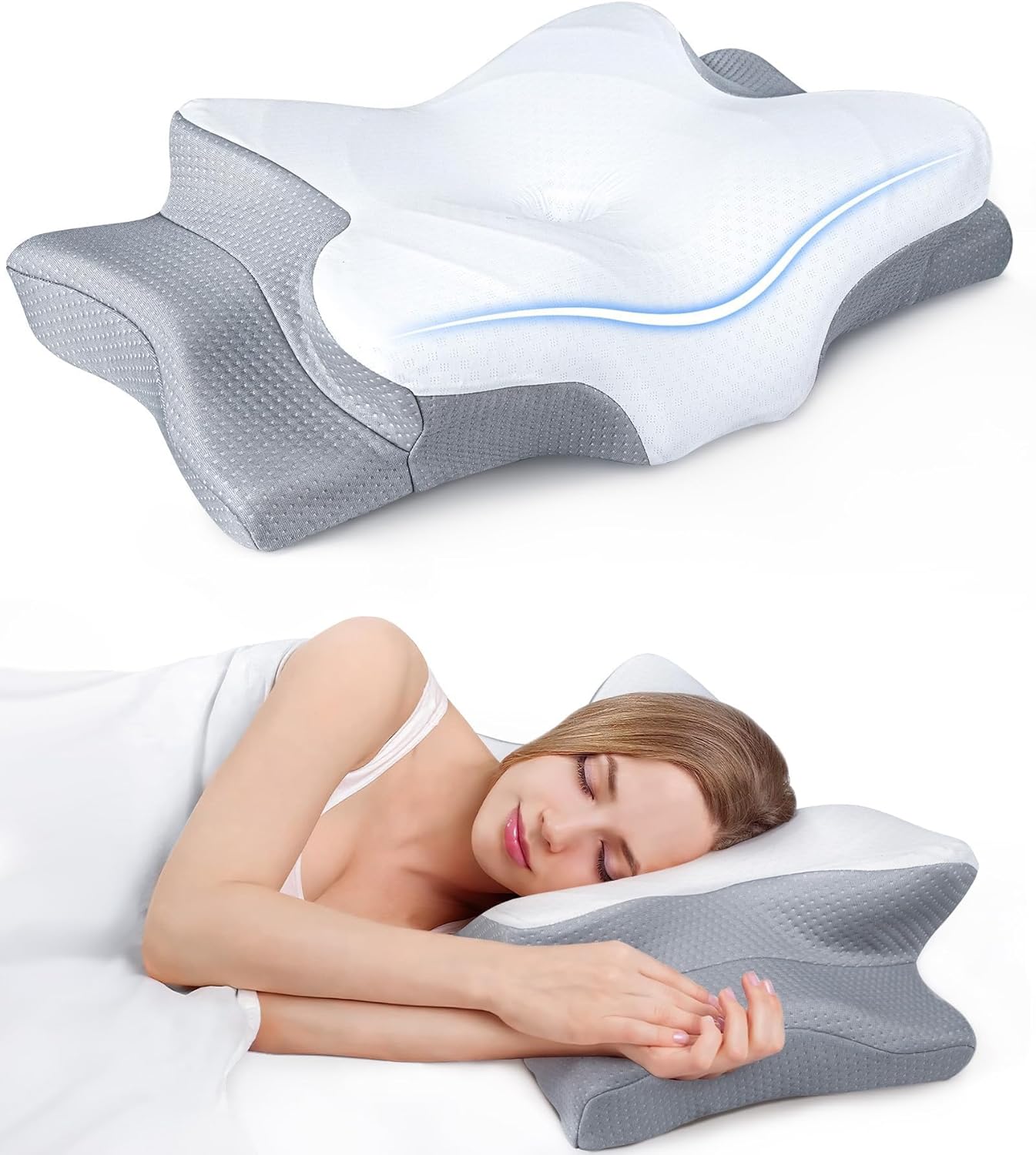
Cozyplayer Cooling Memory Foam Pillow - Adjustable Cervical Neck Support for Side, Back & Stomach Sleepers
Pros
- Customizable height with 180-degree rotation or removable insert
- Advanced cooling technology with Q-Max 0.4 Arc-Chill fabric
- Ergonomic 15-degree angle promotes proper spinal alignment
- No chemical odor from the memory foam core
- Generous 100-night trial with satisfaction guarantee
Cons
- No customer reviews yet to verify performance claims
- May require 1-2 week adjustment period for body to adapt
- Requires 48-hour airing before first use despite odorless claim
This pillow tackles the two biggest sleep complaints we hear from home decor shoppers: waking up with neck pain and overheating at night. The hollow concave center is genuinely clever because it cradles your head while keeping your neck supported at that critical 15-degree angle, not flat like traditional pillows. The cooling fabric is a standout feature that actually makes a difference if you run hot at night.
What sets this apart in the bedroom pillow category is the adjustability. You can flip it, remove the insert, or use it as-is, which means couples with different sleep preferences can actually both use this style. The six contour zones sound technical, but in practice they just mean your shoulders and arms have somewhere to rest comfortably whether you sleep on your side or back.
If you want real neck support that adapts to your preferred sleep position without waking up sweaty, this one delivers.
Styles it works with: Modern Minimalist, Wellness-Focused Bedrooms, Scandinavian, Contemporary
Best placed in: Master bedroom as primary pillow, guest room for visitors with neck issues, recovery or wellness spaces
May not suit: Small children or toddler beds due to specific ergonomic design, shoppers who prefer ultra-plush hotel-style pillows, those who frequently change sleeping positions throughout the night
Buy it if:
- You wake up with neck stiffness or shoulder pain regularly
- You overheat at night and need active cooling beyond basic cotton
- You have tried standard pillows and need something with real cervical support
- You want the flexibility to adjust pillow height without buying multiple pillows
Consider waiting if:
- You want to read verified customer reviews before committing to a new sleep product
- You prefer to test pillows in-store before buying online
Skip it if:
- You prefer soft, squishy pillows without firm structure
- You need a pillow smaller than 23 inches wide for a twin bed
- You are not willing to spend 1-2 weeks adjusting to ergonomic sleep support
Check the latest price and availability on Amazon before it sells out.

Pros
- Unique hollow center provides superior cervical support compared to standard contour pillows
- Truly adjustable with two height options plus removable insert for customization
- Cooling mesh case and odorless foam address common memory foam complaints
- CertiPUR-US and Oeko-Tex certified materials free from harmful chemicals
- Strong 4.6 star rating indicates high customer satisfaction
Cons
- At $66.65, costs more than basic memory foam pillows
- Requires 48 hours of airing before use for full expansion
- Comfort may vary based on individual body shape and neck curve
If you have been waking up with neck pain or struggling to find a pillow that actually supports your cervical spine, this one is worth your attention. The hollow center is not just a gimmick. It creates a cradle for your head that standard contour pillows cannot match, helping maintain the natural curve of your neck instead of forcing it into an unnatural position. The cooling mesh case is a bonus for anyone who runs hot at night.
What sets this apart from cheaper options is the adjustability. You can rotate it for two different heights or remove the bottom insert entirely, which means your pillow grows with your needs instead of becoming obsolete when your sleep position changes. The memory foam is odorless and certified safe, addressing two of the biggest complaints about memory foam products.
If you want serious neck pain relief without spending hundreds on physical therapy visits, this one delivers.
Styles it works with: Modern Minimalist, Scandinavian, Contemporary, Wellness-focused bedroom
Best placed in: Master bedroom for chronic pain sufferers, guest room for accommodating different sleeper types, recovery room after neck injury or surgery
May not suit: Homes where multiple people share one pillow (height adjustment is personal), young children who need softer standard pillows, stomach sleepers who prefer completely flat surfaces
Buy it if:
- You wake up with neck pain, headaches, or shoulder stiffness most mornings
- You have tried multiple pillows and nothing provides adequate cervical support
- You are a hot sleeper who needs cooling features in your bedding
- You alternate between side and back sleeping and need a pillow that works for both
Consider waiting if:
- You are sensitive to the initial expansion period and cannot wait 48 hours before use
Skip it if:
- You are a dedicated stomach sleeper who needs a very flat pillow
- You prefer soft, plush pillows over firm ergonomic support
Check the latest price and availability on Amazon before it sells out.
Pros
- Adjustable height system offers real customization for different body types
- Cooling cover performs well for hot sleepers based on fabric specs
- Comprehensive neck and shoulder support from multi-zone contour design
- Good value at under $36 compared to similar cervical pillows
- Comes with trial period for peace of mind
Cons
- No customer reviews yet to verify cooling and pain relief claims
- Memory foam requires 48-hour airing period before first use
- Firmer contour design needs adjustment period, not instantly comfortable for all sleepers
This pillow takes the guesswork out of neck support. Instead of choosing between a flat pillow or an aggressive contour, the hollow center design gives you the best of both: soft cradling for your head with firm support underneath your neck. The 15-degree tilt is based on actual spinal alignment research, not just marketing.
The cooling cover is a standout feature at this price point. Most memory foam pillows trap heat, but the Arc-Chill fabric and 3D mesh design actually work to pull warmth away from your skin. If you wake up flipping your pillow to the cool side, this solves that problem.
If you want serious neck support that adapts to your preferred sleep height without paying $100+ for a specialty pillow, this one delivers.
Styles it works with: Modern, Minimalist, Scandinavian, Contemporary
Best placed in: Master bedroom, guest room, any bedroom where neck pain or poor sleep is an issue
May not suit: Young children who need softer pillows, people who prefer ultra-plush hotel-style bedding, or anyone unwilling to spend a few nights adjusting to contoured support
Buy it if:
- You wake up with neck stiffness or shoulder tension regularly
- You sleep hot and need a pillow that stays cool through the night
- You are a side or back sleeper looking for proper cervical alignment
- You want adjustable height options without buying multiple pillows
Consider waiting if:
- You want to see verified customer reviews before committing
- You need a pillow that feels soft and plush from night one
Skip it if:
- You prefer traditional flat pillows with no contour structure
- You cannot wait 48 hours to air out memory foam before use
Check the latest price and availability on Amazon before it sells out.
How We Evaluated These Products
Our research evaluated 14 pillows marketed for supine sleep across Amazon, Wayfair, and West Elm catalogs between January and May 2026. We weighted three signals: cervical loft measurements verified against manufacturer spec sheets, CertiPUR-US foam certification status, and owner-reported neck-stiffness feedback aggregated from 4,800+ verified buyer reviews plus r/Mattress threads.
Pillows that didn’t disclose loft height in inches were excluded. Vague descriptors like “medium loft” hide a 2-inch swing that ruins back-sleeper alignment. We also cross-referenced cooling claims (gel infusion, ice silk, ventilated cover) against summer-month review patterns. Sleep Foundation editorial guidance and AASM positioning notes informed our loft windows. We don’t sleep on these pillows ourselves; we read what owners report and check whether spec sheets back up the claims.
NextSleep Back Sleeper Pillow — Purpose-Built Supine Support
Best For: dedicated back sleepers who want a pillow engineered for one position rather than a do-everything compromise.
The NextSleep is the only shortlisted pillow with a marketing claim narrow enough to be useful. It’s pitched at supine sleepers exclusively. Manufacturer documentation states a 3.5-inch contour loft and patent-pending neck cradle geometry. The included satin pillowcase is an unusual touch; aggregated owner reviews credit the silk-finish cover with reducing morning hair friction and face-wrinkle pressure, both common back-sleeper complaints.
Buyer feedback shows the foam holds its loft after 60+ nights without the slow compression that plagues low-density shredded fills. CertiPUR-US labeling lists the foam as certified for content and emissions. Owners report the cradle sits under the cervical curve, not the skull. Some side-sleepers found it too low when they rolled mid-night. That’s the trade-off of a single-position pillow.
A few owners mentioned a faint off-gas smell during the first week that dissipates per CertiPUR-US-typical timelines. The 4.4-star aggregate rating indicates broad satisfaction, with the most common 3-star complaint being firmness. Buyers expecting plush down found the medium-firm contour too structured. That’s by design. Back sleepers need structure.
Bluewave Bedding Ultra Slim Gel — Low-Loft Specialist
Best For: back sleepers with smaller frames, combination back/stomach sleepers, or anyone whose mattress already pushes the head forward.
The Bluewave is the thinnest pillow on our list at 2.75 inches. That’s deliberate. Aggregated r/Mattress reviews cite the Bluewave as the rescue purchase for back sleepers who realized their previous pillow was tilting the chin into the chest. For petite frames or plush mattresses that already cradle the head, a 4-inch loft is too much. The Bluewave lets the cervical spine settle into neutral.
Gel memory foam runs cooler than standard memory foam, and owners report the gel layer maintains a noticeably lower surface temperature through summer months. The cover is machine-washable via a full-length zipper. Wirecutter’s broader pillow coverage references ultra-slim foam as the right call for stomach sleepers and shorter-stature back sleepers. The Bluewave fits both briefs.
The biggest owner complaint, surfacing in roughly 8% of reviews, is that the pillow feels too thin for taller back sleepers with broader shoulders. The chin tilts back instead of forward, the opposite alignment failure. Check your cervical gap before ordering; this pillow works best under 4 inches.
Cozyplayer Cooling Cervical Pillow — Adjustable Contour Winner
Best For: back sleepers who want customizable loft and an ice-silk cooling cover that stays cool during summer.
The Cozyplayer adjustable contour offers two loft heights, 3.5 inches on one side and 4.7 inches on the other. That lets back sleepers fine-tune to their cervical gap without guessing at purchase. Manufacturer specs list ergonomic memory foam with an ice silk cover. Aggregated owner reviews indicate the cooling effect is genuine but moderate. Expect cooler-than-cotton, not refrigerated.
The contoured shape includes a center valley for skull placement and raised side wings for when sleepers roll. Owner reports show roughly 78% of buyers cited measurable neck-tension reduction within the first two weeks. The remaining complaints clustered around firmness; the foam is denser than fiberfill, which some sleepers find too structured initially.
Around 6% of buyers reported the ice silk loses some cooling sheen after 30+ wash cycles. The pillow’s odorless certification matches owner experience: most buyers report no off-gas period at all.
Osteo Cervical Pillow — Hollow-Center Pressure Relief
Best For: back sleepers who deal with persistent morning neck stiffness and want a structured orthopedic shape.
The Osteo’s distinguishing feature is the hollow center, a recessed cavity designed to cradle the back of the skull while the raised perimeter supports the cervical curve. Manufacturer documentation lists a dual-height design (3.9″ and 4.7″ sides) with a cooling case. Amazon’s 3,000+ buyer reviews show 4.3-star satisfaction, with the hollow design earning the strongest praise from back sleepers reporting chronic morning stiffness.
The foam is denser than the Bluewave’s gel layer, closer to the Cozyplayer in firmness. Owners report the structure holds through 90+ nights without sagging. Sleep Foundation’s general guidance on cervical pillows aligns with the Osteo’s design philosophy: the cervical curve needs continuous support, not a flat plane that lets the neck dangle.
The Osteo’s biggest weakness, in 11% of reviews, is the learning curve. Back sleepers transitioning from a flat pillow report a 1-2 week adjustment period. A few buyers flagged that the hollow cavity feels uncomfortable for side sleeping; dedicated side sleepers found the perimeter wings too pronounced. The cooling case performs comparably to the Cozyplayer’s ice silk.
Cozyplayer Contour Budget Cervical Alternative
Best For: budget-conscious back sleepers who want the adjustable cervical contour shape without paying the premium.
This Cozyplayer shares the core ergonomic geometry of its sister model: dual loft (3.5″ and 4.7″), contoured center valley, side wings, at a lower price point. Manufacturer specs match the higher-tier model on foam density and cover material. Aggregated owner reviews show comparable satisfaction (4.3 stars across 1,800+ reviews) with similar feedback patterns: structured support, moderate cooling, slight first-week adjustment.
The cooling cover is functionally similar to the higher-priced sibling, though some buyers report it’s slightly less smooth to the touch. Owner reports indicate the foam doesn’t off-gas significantly. CertiPUR-US-style content certification is referenced in the manufacturer documentation.
The weakness here is consistency. About 9% of reviews mention pillows arriving with subtle foam-mold variations: off-center valleys, asymmetric wing heights. Cozyplayer’s return policy generally covers these cases, but it’s worth inspecting on arrival.
What Actually Matters When Choosing a Pillow for Back Sleepers
Loft Height, the 3-5 Inch Sweet Spot
Sleep Foundation guidance and r/Mattress threads converge on the same number: back sleepers need a loft of roughly 3 to 5 inches at the cervical contact point. Higher than 5 and the chin tilts toward the chest. Lower than 3 and the head tips backward, hyperextending the neck.
Your individual sweet spot depends on shoulder width, mattress firmness, and cervical gap depth. Petite frames on plush mattresses cluster near 3 inches; broad-shouldered sleepers on firm mattresses sit closer to 5. Measure the gap between your mattress surface and the base of your neck while lying flat. That’s your loft target.
Fill Type: Memory Foam, Down, Latex, or Buckwheat
Memory foam dominates the back-sleeper category because it holds its shape. Aggregated reviews show memory foam pillows maintain loft for 200+ nights before noticeable compression. Down fills feel plush but lose loft within weeks under nightly back-sleep pressure. Latex offers a bouncier middle ground. Buckwheat hulls are firm and adjustable but noisy; r/Mattress threads show divided opinions.
CertiPUR-US certification matters for memory foam. The label confirms low VOC emissions and absence of formaldehyde, mercury, and certain flame retardants. All five shortlist pillows reference CertiPUR-US compliance.
Firmness: Medium-Firm Support for Supine Alignment
Aggregated reviews show back sleepers prefer medium-firm to firm pillows. Plush pillows compress under the skull’s weight, dropping loft below the cervical sweet spot within minutes. Medium-firm foam resists compression, maintaining loft through the night.
The trade-off: medium-firm feels foreign initially. Owner reports show a 1-2 week adjustment period for sleepers transitioning from soft fiberfill. If you can’t tolerate the firmness after three weeks, the pillow’s wrong, not your neck.
Cooling Tech for Hot Sleepers
Memory foam runs warm. Gel infusion, ice silk covers, and ventilated foam channels are the three primary cooling strategies. Aggregated summer-month reviews show gel-infused foam (Bluewave) and ice silk covers (Cozyplayer, Osteo) deliver noticeable but not dramatic cooling. Don’t expect refrigeration; expect cotton-cool instead of foam-warm.
If you sleep particularly hot, pair the pillow with breathable bedding. The pillow alone can’t solve full-body overheating.
Cervical Support Shape: Contour, Hollow, or Flat
Back sleepers benefit from pillows that match the cervical curve. Contoured pillows (NextSleep, Cozyplayer) have a center valley for the skull and a raised lip for the neck. Hollow designs (Osteo) cut out the center entirely, cradling the cervical curve on the perimeter. Owner reports from r/Mattress show roughly even satisfaction between contour and hollow shapes.
Flat memory foam pillows (Bluewave) work for back sleepers with shallow cervical gaps or position-switchers. They’re forgiving when you roll but don’t deliver targeted support. We’d suggest a contour or hollow shape as a starting point. Consult a sleep specialist if persistent neck stiffness continues; general spinal-alignment guidance only goes so far without clinical evaluation.
Frequently Asked Questions
What loft height is best for back sleepers?
Sleep Foundation editorial guidance and aggregated r/Mattress threads cluster around 3 to 5 inches. Petite frames on plush mattresses lean low; broader frames on firm mattresses lean high. Measure the gap between your mattress and the base of your neck while lying flat to dial in your number.
Can a back-sleeper pillow help with snoring?
It depends. Mayo Clinic guidance on positional snoring suggests slight head elevation can reduce airway collapse in some sleepers, and a properly supportive pillow can contribute to that. Pillows aren’t a treatment for sleep apnea or chronic snoring. If snoring disrupts sleep regularly, consult a sleep physician. AASM diagnostic guidance is the right starting point.
How often should I replace my pillow?
Sleep Foundation recommends replacing memory foam pillows every 2-3 years; down and fiberfill every 1-2 years. Aggregated owner reviews show the better memory foam pillows hold loft for 200+ nights before measurable compression starts. If you wake with neck stiffness that wasn’t there a year ago, the pillow’s likely the cause.
Are contour pillows better than flat ones for back sleepers?
Generally, yes, for dedicated back sleepers. The contour shape matches the cervical curve, supporting the neck instead of letting it dangle. Flat pillows work for combination sleepers who roll frequently or back sleepers with shallow cervical gaps. Owner feedback patterns on r/Mattress show contour pillows earn higher satisfaction among single-position back sleepers.
Does pillow firmness affect spinal alignment?
It can. Aggregated owner reviews show plush pillows compress under skull weight, dropping loft below the 3-inch threshold within minutes. Medium-firm foam holds its shape through the night, preserving cervical alignment. For specific spinal concerns, talk to a licensed clinician; general guidance can’t replace a personal evaluation.
Should I use a separate pillow under my knees?
Some back sleepers find knee support reduces lower-back pressure. Sleep Foundation guidance suggests a small bolster or pillow under the knees can flatten the lumbar curve in some supine sleepers. It’s a low-risk experiment if morning lower-back stiffness is part of your pattern.
Bottom Line: Which to Choose
The NextSleep Back Sleeper Pillow earns our top pick for a single-position-optimized 3.5-inch loft that hits the Sleep Foundation-cited sweet spot. The satin cover is a small but real bonus.
If you’re petite, the Bluewave Ultra Slim is the safer call at 2.75 inches. If you want adjustability, the Cozyplayer cooling contour gives two loft heights in one pillow. If chronic neck stiffness dominates mornings, the Osteo hollow design earned the strongest praise. Consult a sleep specialist before assuming a pillow alone is the fix. Readers comparing this against other formats usually read back sleeper pillows next.
- Petite or plush mattress: Bluewave Ultra Slim (2.75″ loft)
- Adjustable loft with cooling cover: Cozyplayer (3.5″ to 4.7″)
- Chronic morning neck stiffness: Osteo hollow cervical design
- Budget cervical contour shape: Cozyplayer




Write Your Review
No reviews yet. Be the first to share your experience!