

> Editorial Note: I’m Maya Chen, a bedroom and sleep editor covering mattresses, bed frames, and bedding. The picks here are evaluated against CertiPUR-US foam standards, Sleep Foundation evaluation protocols, and owner durability reports from r/Mattress.
The most common crib mistake isn’t the crib. It’s the gap. Parents buy a beautiful frame, drop in a mattress that’s a hair too small, and end up with a space wide enough to trap an arm or worse. Get the fit right first, then worry about looks, finish, and how the piece will grow with your kid. If you’re building out the rest of the room, the same care applies to your best platform bed frame, your best nightstand for bedroom, your best dresser for bedroom, your best memory foam mattress, and even the wall art for bedroom. Here’s how to choose a crib that’s safe now and useful for years.
Is the crib safe by current standards?
Start here, since nothing else matters if the frame fails a safety check. In the US, every full-size crib sold new must meet CPSC 16 CFR 1219 rules, which banned drop-side rails back in 2011. So skip hand-me-downs and yard-sale finds older than that. Two measurements do most of the work.
Slat spacing comes first. The rule is simple: no more than 2 3/8 inches between slats, roughly the width of a soda can. If a can slips through easily, the gap’s too wide and a baby’s head or limb can follow.
Corner posts come second. They should sit flush or rise no higher than 1/16 inch above the end panels, because tall posts snag clothing and become a strangulation risk. Cutouts in the headboard or footboard are another red flag.
Look for a JPMA certification seal, which means the crib passed independent lab checks against ASTM F1169 standards. That seal isn’t legally required, but it tells you the maker paid for third-party verification instead of self-attesting. A stable, wobble-free assembly matters too. Shake the finished frame. It shouldn’t rock.
Should you go convertible or standard?
It depends on how long you want the piece to earn its space. A standard crib does one job and does it cheaply. A convertible crib costs more up front but transforms as your child grows, which spreads the price over years instead of months.
The numbers in the name tell you the conversions. A 5-in-1 typically moves from crib to toddler bed to daybed to full-size bed with headboard and footboard. A 6-in-1 adds a full bed with both a headboard and a footboard board as separate stages. More conversions usually means a longer runway, sometimes into the teen years.
Two catches worth knowing. Toddler-rail and full-bed conversion kits are often sold separately, adding $40 to $120 later. And a “full-size conversion” still needs you to buy a full mattress and, in most cases, a bed frame or rails. Factor that in before you assume one crib carries a kid to college.
For most families, a convertible earns its keep. You’re buying one solid frame instead of three, and the resale or hand-down value holds better. Just confirm the conversion kits are still made for your model, since discontinued kits strand you at the toddler-bed stage.
What about the mattress and the fit?
The mattress is where safety and sleep quality meet, and it’s the part people underspend on. A crib mattress should be firm, not plush. Sleep Foundation guidance is blunt on this: soft surfaces raise suffocation risk for infants, so a mattress that feels too hard to an adult is usually right for a baby.
Fit is non-negotiable. A standard full-size crib fits a mattress at least 27 1/4 inches by 51 5/8 inches, no more than 6 inches thick. The classic check: if you can fit more than two fingers between the mattress and the frame, the mattress is too small. That gap is exactly where limbs get stuck.
Foam or innerspring both work if firm. If you go foam, look for CertiPUR-US certification, which limits VOCs and bans certain flame retardants and heavy metals. A GREENGUARD Gold label on either the crib or the mattress means low chemical emissions, which helps in a small, closed nursery where air doesn’t move much.
Skip the extras that get marketed hard. No pillows, no bumpers, no thick toppers. Just a fitted sheet on a firm mattress. That’s the whole setup, and it may help lower risk during the first year.
Which finish and materials hold up?
Solid wood and engineered wood both show up in this price range, and neither is automatically better. Solid hardwood like beech or birch resists dents and survives multiple conversions without loosening at the joints. Engineered wood with a real veneer keeps costs down and stays dimensionally stable in humid rooms. What matters more is the finish.
You want a non-toxic, low-VOC finish, and again GREENGUARD Gold is the shorthand for that. Teething babies chew rails, so a lead-free, water-based finish isn’t optional. Check the top rails specifically, since that’s the contact zone.
Hardware quality separates cribs that stay tight from ones that squeak by month eight. Metal-to-metal fasteners and steel mattress-support frames beat plastic brackets every time. Read owner reviews for the words “wobbly” and “stripped screws.” Those two complaints predict a short life.
Helpful Picks
All three below carry GREENGUARD Gold certification, clear a 4.4 owner rating, and convert well past the crib stage. Start with the first if you want the longest runway, or jump to the third if budget’s tight.

Delta Children Perry 6-in-1 Convertible Crib | Greenguard Gold Certified | Walnut Espresso | Grows With Baby
Pros
- Greenguard Gold and JPMA dual certification is a rare combination at this price point, covering both chemical safety and structural standards
- Six conversion modes including full-size bed with headboard and footboard means this is genuinely the last bed frame you need to buy for this child
- Adjustable 3-position mattress support is a practical feature that extends the safe usable life of the crib
- Walnut Espresso finish is versatile enough to anchor a nursery now and blend into a teen bedroom later
- Sustainable New Zealand Pine construction feels more substantial than particleboard alternatives in this price range
Cons
- Toddler guardrail and full-size conversion rails are sold separately, so the true cost of all6 configurations is higher than the listed price
- No customer review data is currently available to validate real-world assembly experience or long-term durability claims
- At 55inches long and 30.5 inches deep, this crib requires a generously sized nursery, which may be a constraint in smaller rooms or apartments
The Perry crib earns its place in a nursery because it was clearly designed by people who understand that parents are buying furniture, not just baby gear. The Walnut Espresso finish is warm and grounded, the kind of tone that works equally well next to a soft sage gallery wall or a clean white shiplap accent. It does not look like it needs to be hidden away once the baby phase passes.
What genuinely sets this apart from standard convertible cribs is the Greenguard Gold certification. At this price, most competitors offer one safety credential. Delta Children went through the more rigorous Greenguard Gold process, which tests against over 10,000 chemicals. For a piece of furniture where your newborn will spend 12 to 16 hours a day breathing inches away from the wood and finish, that distinction matters more than almost any design feature.
The 6-in-1 conversion path is legitimately practical rather than a marketing stretch. The included daybed and sofa rail means you get real value immediately, and the full-size bed conversion means this frame can anchor a guest room or teenager's bedroom for years. If you want a nursery anchor that earns its floor space well into the next decade without compromising on indoor air quality, this one delivers.
Styles it works with: Modern Farmhouse, Transitional, Scandinavian Minimalist, Mid-Century Warm Neutral
Best placed in: Dedicated nursery as the primary furniture anchor, a shared sibling bedroom where it can later convert to a daybed or sofa configuration, or a flex room that transitions from nursery to guest room over time
May not suit: Nurseries under 120 square feet where the 55-inch length will dominate the floor plan, or homes decorated in very cool or industrial palettes where the warm walnut espresso tone may clash with existing finishes
Buy it if:
- You are setting up a first nursery and want a single crib purchase that covers the infant, toddler, and full-size bed stages without replacing furniture every few years
- Indoor air quality is a priority for your family, especially if you have sensitivities or live in a home with limited ventilation, and you want documented Greenguard Gold assurance rather than vague 'non-toxic' claims
- You are building out a coordinated nursery and want a crib that matches the Delta Children Perry dreser and changing table for a pulled-together, furniture-quality look
Consider waiting if:
- You are hoping to purchase the toddler guardrail or full-size rails as a bundle deal, since those accessories are currently sold separately and may affect your total budget timing
Skip it if:
- Your nursery is under 100 square feet, as the assembled dimensions of55 inches by 30.5 inches will leave very little circulation space alongside a dreser and rocker
- You prefer a crisp white or cool grey nursery palette, since the Walnut Espresso finish is a warm brown tone that works best with complementary warm or neutral decor
Check the latest price and availability on Amazon before it sells out.

Graco Benton 5-in-1 Convertible Crib, GREENGUARD Gold Certified, White, Grows from Infant to Full-Size Bed
Pros
- Five conversion stages offer genuine long-term value from infancy through childhood
- Multiple safety certifications including GREENGUARD Gold and JPMA provide peace of mind
- Classic white finish and clean lines blend with virtually any nursery decor
- Four-position mattress base adapts as your child grows more mobile
- Priced well below many competitors offering similar convertibility
Cons
- Toddler guardrail kit and full-size bed conversion kit are sold separately, adding to total cost
- Mattress not included, so budget for that on top of the crib price
- Made from a mix of pine wood, engineered wood, and composites rather than solid hardwood throughout
The Graco Benton is one of those nursery investments that quietly pays for itself over the years. Rather than buying a crib now and a toddler bed later (and maybe a daybed after that), this single piece carries your child from their first night home through grade school. It looks clean and classic in white, with just enough traditional detail to feel intentional without locking you into one decorating style.
What sets it apart at this price is the combination of GREENGUARD Gold certification and genuine five-stage convertibility. You get cleaner air in the nursery and a bed that evolves with your family, all for under $180. The four-position mattress base is a practical touch that new parents will appreciate during those late-night checks on a sleeping newborn.
If you want a safe, attractive crib that grows with your child without requiring a complete furniture swap every two years, this one delivers.
Styles it works with: Traditional, Modern Farmhouse, Coastal, Transitional
Best placed in: Dedicated nursery room, master bedroom corner for early months, shared sibling bedroom
May not suit: Very small rooms where full-size bed conversion would overwhelm the space later on, or ultra-modern nurseries seeking a mid-century or acrylic crib aesthetic
Buy it if:
- You want one crib that lasts from newborn through elementary school age
- Indoor air quality matters to you and you prioritize low-emission certifications
- You are decorating a nursery on a budget but refuse to compromise on safety standards
Consider waiting if:
- You want the toddler rail and conversion kit bundled in so you can budget the true total cost at once
Skip it if:
- You need a mini or portable crib for a compact space
- You prefer solid hardwood construction with no enginered wood components
Check the latest price and availability on Amazon before it sells out.
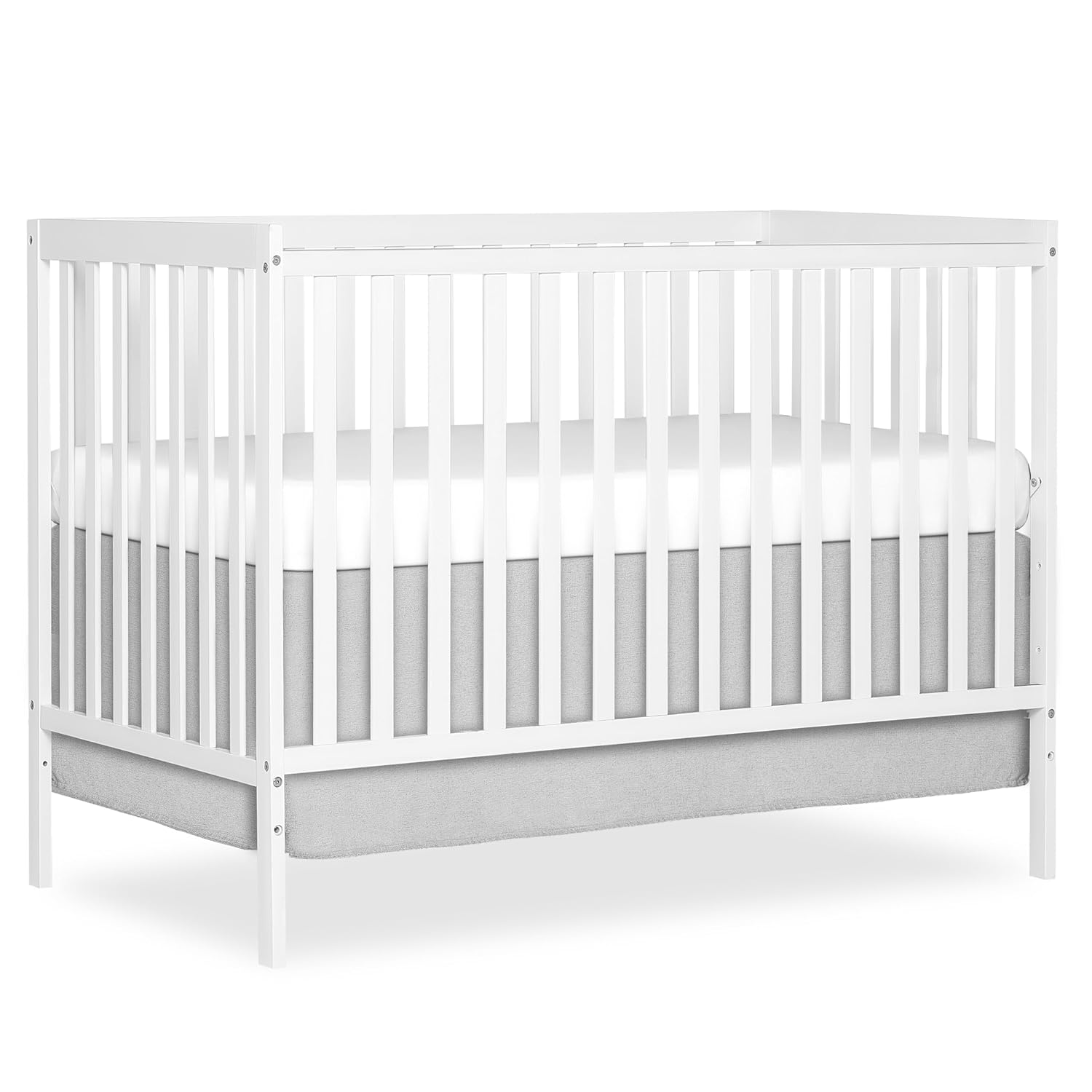
Dream On Me Synergy 5-in-1 Convertible Crib in White - GreenGuard Gold Certified, New Zealand Pinewood, 3 Heights
Pros
- Five conversion stages provide years of use from one purchase
- GreenGuard Gold and Baby Safety Alliance certifications offer strong safety assurance
- Solid New Zealand pinewood feels sturdy and looks polished in person
- Competitive price point well below average for a 5-in-1 convertible crib
- Clean white finish works with virtually any nursery decor
Cons
- Conversion kits for toddler and full-size bed sold separately, adding to total cost
- Mattress not included, so budget an additional purchase
- Assembly required and may take time for those unfamiliar with furniture building
The Dream On Me Synergy hits a sweet spot that is hard to find in the convertible crib market. It pairs real sustainability credentials (New Zealand pinewood, GreenGuard Gold certification) with a price tag that does not punish your wallet. The clean white finish and simple lines make it feel more expensive than it is, and it slots right into a nursery without dominating the room.
What stands out most is the practical longevity built into this crib. Five conversion stages means this single piece of furniture can realistically serve your child from infancy through their early school years. The three mattress height settings are a small detail that parents appreciate daily, especially during those early months of constant reaching in and lifting out.
If you want a safe, certified crib that grows with your child without requiring a premium budget, this one delivers.
Styles it works with: Modern Minimalist, Scandinavian, Coastal, Classic Traditional
Best placed in: Dedicated nursery, parents' bedroom corner, shared sibling room
May not suit: Very compact rooms where53 inches of length feels tight, or families wanting a mini crib for smaller spaces
Buy it if:
- You want one crib that transitions through multiple stages without replacing furniture every year or two
- Chemical safety and low-VOC certification are non-negotiable for your nursery
- You prefer a neutral white finish that works with any theme as your child's tastes evolve
Consider waiting if:
- You need a specific color other than white that may become available in future releases
- You want to bundle the purchase with the conversion kit to avoid paying separately later
Skip it if:
- You need a mini or portable crib for a very small nursery or frequent travel
- You want an all-inclusive package with mattress and conversion rails included at one price
Check the latest price and availability on Amazon before it sells out.
Frequently Asked Questions
Are convertible cribs worth the extra money?
Yes, for most families. You’re buying one frame that lasts into the toddler and full-bed years instead of replacing furniture twice. Just confirm the conversion kits are still manufactured for your model, and budget $40 to $120 for rails or bed rails you’ll need later.
Is a used or hand-me-down crib safe to use?
It depends on the age. Any crib made before June 2011 can legally include drop-side rails, which are banned now, so avoid those entirely. A newer used crib can be fine if it has all original hardware, no recalls, no cracked slats, and slat spacing under 2 3/8 inches.
Do I need a GREENGUARD Gold certified crib?
No, it’s not legally required, but it’s a strong signal. GREENGUARD Gold means the crib passed low chemical-emission checks, which matters in a small nursery with poor airflow. In a room where a baby sleeps 12 or more hours a day, that certification is worth prioritizing.
How firm should a crib mattress be?
Firm enough that it feels almost too hard to you. Sleep Foundation guidance ties soft sleep surfaces to higher suffocation risk, so a plush mattress that molds to a baby’s shape is the wrong choice. Press the center: it should barely give.
What’s the correct gap between the mattress and the crib?
Almost none. If you can slide more than two fingers between the mattress edge and the frame, the mattress is too small and needs replacing. A standard full-size crib takes a mattress at least 27 1/4 by 51 5/8 inches.
Can a crib mattress go straight into the toddler-bed conversion?
Yes, usually. Most full-size crib mattresses stay in place through the toddler-bed and daybed stages, since those conversions reuse the same mattress platform. You’ll only need a new mattress at the full-size bed conversion, which requires a standard full mattress.
How long can a child use a convertible crib?
It depends on the conversion count and the kit availability. A 5-in-1 or 6-in-1 can carry a child from birth into the grade-school or teen years through the full-bed stage. That runway only holds if the manufacturer still makes the toddler rail and full-bed conversion kit for your model.



Write Your Review
No reviews yet. Be the first to share your experience!