

> Editorial Note: I’m Olivia Bennett, a storage and organization contributor. I approach storage as a systems problem rather than a product one — fit to actual room dimensions, load ratings, and how the system holds up under daily use.
The mistake almost everyone makes: buying bins before measuring the wall. You end up with a beautiful storage cart that blocks the closet door or a toy shelf too tall for a 3-year-old to reach. Organize the space first, then buy to fit. The same logic that works for a best closet organizer system applies here, and if you’ve ever sorted a reach-in closet with a best closet rod, you already know the drill. This guide borrows a few tricks from wall storage too, like best floating shelves for living room, plus the vertical thinking behind a best hanging closet organizer and even a best shoe rack. Kids’ stuff is smaller and messier, but the system holds.
The Ground Rules Before You Start
Three non-negotiables. First, leave at least 30 inches of clear floor for play and traffic, measured from the busiest storage unit outward. Second, keep daily-use toys below 36 inches so a toddler can reach them without climbing. Third, cap any open shelf’s load at what the manufacturer rates, not what fits. A shelf holding 25 lbs of blocks needs a 25-lb rating with margin, or it sags within a season.
Step 1: Empty the Room and Sort Into Four Zones
Pull everything out. All of it. You can’t plan a system around clutter you can’t see. Once the floor is bare, sort into four piles: keep-and-daily, keep-and-occasional, donate, and toss. Most playrooms shed 30 to 40 percent of their volume at this stage, which changes how much storage you actually need to buy.
Measure your keep piles against the room. A 10×12 ft room gives you roughly 120 sq ft, but usable storage-wall length is what matters. Run a tape along each wall and subtract doors, windows, and radiators. You’re usually left with 8 to 14 feet of true storage wall.
Group by category next, not by owner. Blocks with blocks, art supplies with art supplies. Kids find things faster by type than by name, and mixed bins get dumped, never sorted. This sort dictates how many bins and cubbies you’ll need in Step 3. Write the count down. Guessing here is how you end up with three empty bins and one overflowing basket.
Step 2: Map the Room by Height Zones
Think in three horizontal bands, because a playroom serves a child whose reach changes every year. The floor-to-36-inch band is prime real estate: this is where daily toys live so kids can access and return them alone. Independence here cuts your cleanup labor roughly in half.
The 36-to-60-inch band holds occasional-use and supervised items: board games, larger sets, craft supplies you’d rather meter out. Above 60 inches goes to storage and decor only, never anything a child should reach. Anchor tall units to the wall studs with the included tip-over strap. Furniture tip-overs are a documented injury risk, and ASTM safety standards specifically address anchoring for children’s storage furniture.
Sketch it. A rough box drawing with the three bands marked, plus each wall’s usable length from Step 1, becomes your buying blueprint. Mark where the low bins go, where cubbies stack, where a single tall unit anchors. This map is what stops you from over-buying. Fifteen minutes with a pencil saves a return trip and a wrong-size cart.
Step 3: Assign Storage by Toy Type
Now match containers to categories, not the other way around. Small loose parts (LEGO, beads, figurines) want shallow bins around 5 to 6 inches deep so kids can see the bottom. Deep bins swallow small toys and become junk drawers. Bulky items like stuffed animals and balls go in open baskets or large tilted bins that don’t need a lid, because lids are the number-one reason a toy never gets put away.
Cubbies win for mixed collections. A grid of 10×14-inch openings lets you dedicate one cube per category, and the visual boundary teaches kids where things return. Label at their eye level with pictures for pre-readers, words for older kids.
Reserve one drop zone. Every playroom needs a single catch-all bin for the odds that defy category. Cap it at one. When it overflows, that’s your signal to re-sort, not to add a second bin. This is the release valve that keeps the whole system honest between deep cleans.
Step 4: Build in a Ten-Minute Reset
A system only works if it resets faster than it breaks. Design for a daily ten-minute tidy, not a weekly overhaul. Every item needs a home within one motion of where it’s used: art bin under the craft table, block basket beside the play rug. If putting something away takes more than one step, kids won’t do it and neither will you.
Keep 20 percent of every container empty. A bin packed to the brim has nowhere to receive the day’s mess, so toys pile on top instead. That headroom is what makes the reset possible. Rotate, don’t accumulate. Store half the toys out of sight and swap every few weeks. Fewer visible options mean faster cleanup and, oddly, longer attention on what’s out. The whole system stays light, and that’s the point.
The Right Products Make It Easier
The picks below all clear a 3.9 owner rating and match a specific band from the height map. Choose by what your Step 3 sort turned up: bin-heavy sorts want the multi-bin organizer, uniform collections want stacking bins, mixed categories want cubby trays. Start with #1 if your keep pile skews toward loose small parts.

Pros
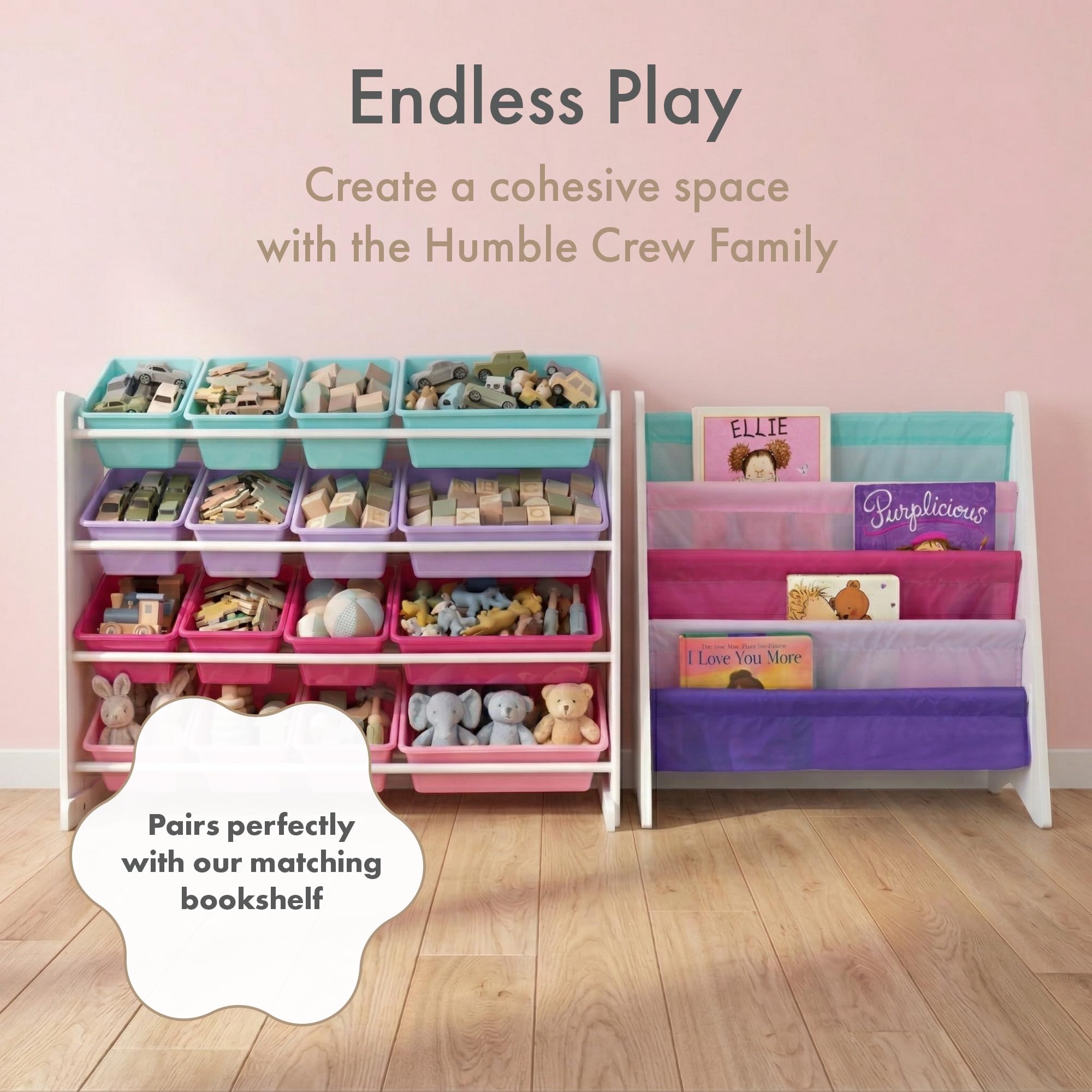
- 16 removable bins in two sizes handle everything from stuffed animals to puzzle pieces without mixing categories
- Engineered wood frame with steel dowels holds up to 20 lbs per tier and resists daily rough handling from kids
- Includes a wall anchor anti-tip kit and stabilizing braces, which is a genuine safety feature and not just a box-check
- Open bin design actively builds toddler independence by letting little hands find and put away toys without adult help
- Five model variations in the same product line make it easy to scale up or down to fit the actual room
Cons
- The white and pastel color palette is designed for children's spaces and will look out of place in neutral adult-styled rooms or modern minimalist interiors
- At 42 inches wide the unit requires a clear dedicated wall run, which can be limiting in very small bedrooms or nurseries with competing furniture
- No review data is currently available to confirm long-term durability of the bin clips or frame finish after extended daily use
What stands out immediately about the Humble Crew 16-Bin Organizer is how deliberately it was designed around the way kids actually interact with their stuff. The bins sit at reachable heights, the open fronts make every toy visible at a glance, and the two bin sizes mean bulky items like foam blocks or stuffed animals get their own space alongside smaller pieces like crayons or car sets. It does not try to be furniture that hides the chaos. It organizes it out in the open in a way children can actually maintain.
In a real playroom or bedroom the unit has a clean, structured look that parents appreciate. The white frame with colored bins adds a soft pop of color without clashing with most existing decor, and the four-tier layout draws the eye upward rather than spreading across the floor. It reads as intentional rather than utilitarian, which matters when the playroom is also a space adults spend time in.
The safety details are genuinely reassuring rather than performative. Steel dowels, stabilizing braces, rounded corners, and an included wall anchor kit mean the unit is built with active toddlers in mind from the frame out. If you want a toy storage system that teaches kids cleanup habits without turning into a daily battle for parents, this one delivers.
Styles it works with: Modern Farmhouse, Scandinavian, Playful Contemporary, Transitional
Best placed in: Along a playroom accent wall, in a bedroom corner opposite the bed, or in a classroom or daycare reading nook where children need independent access to materials
May not suit: Homes with a strictly adult or luxury interior aesthetic where visible toy bins would disrupt the design language. Also a tight fit in nurseries under 10 feet wide where a 42-inch footprint competes with a crib and dresser.
Buy it if:
- You have a toddler or preschooler and want a storage system they can actually use on their own without your help every time
- Your playroom or kid's bedroom has a free wall run of at least 44 inches and you need vertical storage that does not crowd the floor
- You want an all-in-one toy organization solution under $50 that includes bins, a wall anchor kit, and enough capacity to handle a full toy collection
Consider waiting if:
- You need a specific colorway like all-white or espresso that is not currently in stock, since the product line does offer alternate finishes worth checking
Skip it if:
- You need a closed-front unit that conceals toys entirely and doubles as a furniture piece in a formal living or dining area
- Your available wall space is under 36 inches wide, in which case the 9-bin or 12-bin configurations in this product line would be a better fit
Check the latest price and availability on Amazon before it sells out.

Really Good Stuff Stackable Plastic Bins Set of 6 Rainbow Colors - Classroom & Home Organizer 14x10x5.75 in
Pros
- Six bins per set offers better value than competing four-packs
- Bright rainbow colors make organization visually intuitive for young children
- Sturdy plastic holds up to daily classroom or playroom use
- Easy to wipe clean after spills or mesy art projects
- Stackable form factor maximizes vertical storage space
Cons
- Plastic construction looks utilitarian rather than decorative in living spaces
- Open-top design means contents collect dust if left unused
- Individual bins may be too shallow for larger chapter books or tall items
These bins solve one of the most common frustrations in homes with kids: the never-ending clutter of books, art supplies, and small toys that somehow ends up everywhere except where it belongs. The rainbow color system is genuinely useful because it gives children a visual cue for where things go, turning cleanup into a simple matching game rather than a chore.
In a real room, these look right at home on a bookshelf, stacked in a closet, or lined up along the wall of a playroom. They are not trying to be decorative statement pieces, and that is actually a strength. They blend into the background while doing the hard work of keeping your space functional and tidy.
If you want a simple, durable way to organize a child's space without spending time on elaborate storage systems, this set delivers.
Styles it works with: Playful Modern, Montessori-Inspired, Classroom Casual, Family Functional
Best placed in: Playroom shelving units, kid's bedroom closet, homeschool reading nook, craft room work table
May not suit: Minimalist or neutral-toned living rooms where bright plastic would clash with the aesthetic, or spaces where you need lided storage to keep dust out
Buy it if:
- You need a color-coded system to help kids sort and find their own books or supplies
- You want stackable bins that maximize limited shelf or closet space
- You run a classroom, daycare, or homeschool setup that needs durable daily-use storage
Consider waiting if:
- You only need one or two bins and would prefer a smaller pack at a lower price point
Skip it if:
- You need bins with lids for long-term or dust-free storage
- You want a more polished look for adult living spaces like a living room or office
Check the latest price and availability on Amazon before it sells out.

Pros
- Mobile casters allow easy repositioning without lifting
- Low-VOC certified materials safe for enclosed kids' spaces
- Bins are removable and nestable for flexible use
- Compact 38.5in width fits against most walls without dominating a room
- Durable enough for daily classroom-level use
Cons
- At nearly $290, it is a significant investment for home use
- Only 17 reviews make long-term durability hard to confirm
- 3.9 rating suggests some buyers experienced quality or assembly issues
- Clear bins only, with no color options for matching room decor
If you have ever tripped over a pile of art supplies or watched your kid dump an entire toy bin looking for one crayon, this cabinet solves that problem with zero guesswork. The 12 clear bins let everyone in the house see exactly where things belong, and the scoop-front design means even toddlers can pull out and put back their own stuff.
What sets this apart from basic cube shelving is the mobility. Lock it against a wall during the week, then roll it aside for weekend dance parties or vacuum day. The GREENGUARD Gold certification is a genuine bonus if you care about air quality in rooms where kids spend hours playing or learning.
If you want a kid-safe, flexible storage system without sacrificing visibility or portability, this one delivers.
Styles it works with: Modern Playroom, Montessori-Inspired, Minimalist Kids' Room, Schoolhouse
Best placed in: Playroom wall, kids' bedroom corner, mudroom for shoes and lunch bags, homeschool area
May not suit: Formal living spaces or rooms with a curated adult aesthetic, as it has an institutional look. Also may feel oversized in very small bedrooms under 100 sq ft.
Buy it if:
- You run a homeschool, daycare, or after-school program and need certified-safe furniture
- Your playroom has become a free-for-all and you need a system kids can actually maintain themselves
- You want to roll storage between rooms orearrange frequently without heavy lifting
Consider waiting if:
- You want colored bins to match a specific room palette, as only clear is currently available
- You prefer to see more verified reviews before committing to a $290 purchase
Skip it if:
- You only need 4 to 6 cubbies and a smaller, cheaper unit would do the job
- You want furniture that blends into a styled adult living space rather than a kids' zone
Check the latest price and availability on Amazon before it sells out.
Humble Crew 16-Bin Toy Storage Organizer (HumbleCrew)
This solves Step 3 for the loose-parts problem better than anything else here. Its 4-tier frame with 16 removable bins gives you a bin per category without buying sixteen separate containers, and the removable design means a kid carries the whole bin to the play rug and back. At a 4.7 rating across thousands of owners, it’s the most trusted pick on this list. The tiered layout keeps everything under the 36-inch daily-reach line from Step 2, so a toddler works it independently. The bins are shallow enough to see the bottom, which is exactly what small toys need. Anchor the frame to the wall if your child climbs.
Really Good Stuff Classroom Stacking Bins (ReallyGoodStuff)
Built for the uniform-collection sort, this set of 6 bins measures 14″L x 10″W x 5.75″H each, so it slots into standard cubbies or stacks freestanding along a wall. That 5.75-inch depth is the sweet spot from Step 3, deep enough for a category, shallow enough to stay visible. The 4.6 rating reflects classroom-grade durability under daily abuse, which is the load profile a playroom shares. Use these when your categories are similar in size and you want a clean, repeatable grid. They stack without a frame, so you can add or subtract as the keep pile shifts.
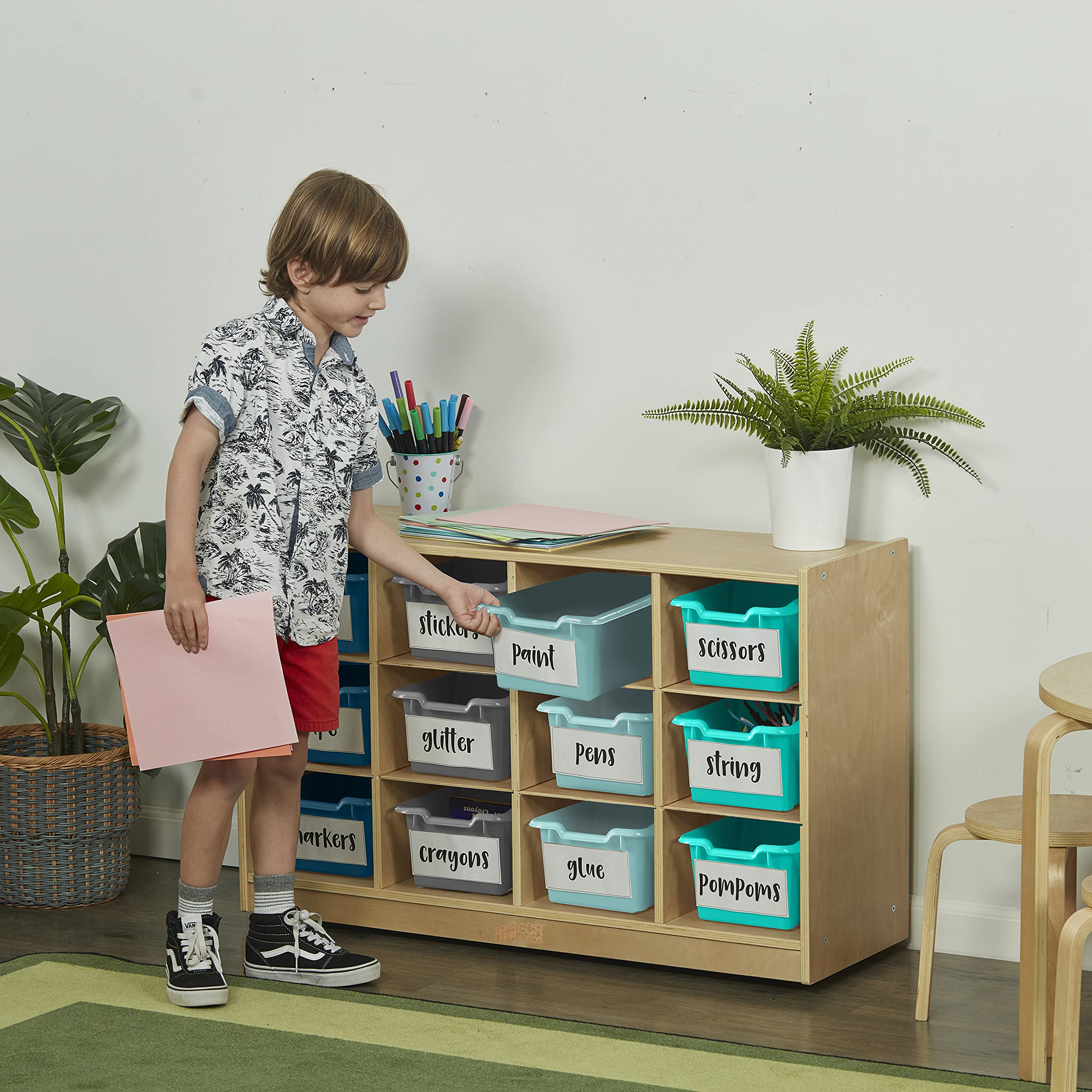
ECR4Kids 12-Cubby Tray Cabinet (ECR4Kids)
For mixed collections that need fixed homes, this 12-cubby cabinet with clear scoop-front bins is the cubby-grid solution from Step 3. Each clear tray shows its contents, so pre-readers find toys by sight. Its 3.9 rating is the lowest here, mostly for assembly complexity, so budget extra build time and check every fastener. Once assembled, the fixed-frame structure holds its shape better than stacked bins under rough use. Best for a room where categories are set and you want the visual boundary a dedicated cube provides. Anchor it, since the cabinet height puts upper trays near that 60-inch line.
Frequently Asked Questions
What if my room is tiny, under 100 square feet?
It depends, but go vertical and ruthless. Under 100 sq ft, you can’t spare the 30-inch traffic path if storage sprawls sideways, so stack upward instead. One tall anchored unit plus a single low bin row usually beats three short pieces. Cut your keep pile harder too. A small room punishes accumulation faster.
What if my room is shared with a sibling of a different age?
Split by height band, not by half the room. Give the younger child the floor-to-36-inch zone for their daily toys and the older sibling the 36-to-60-inch band for items with small parts. That vertical separation keeps choking hazards out of little hands without drawing a line down the floor that neither kid respects anyway.
What if my room doubles as a guest room or office?
Yes, this works with closed storage. Pick cabinets or bins with lids for anything guests will see, and keep the daily-reach open bins on a cart you can roll into a closet. The ten-minute reset from Step 4 matters more here, since the room has to flip functions on short notice.
What if my room has no closet at all?
No closet, no problem, but you’ll lean harder on tall anchored units. Without a closet’s hidden depth, every item lives on open or bin storage, so the rotation trick from Step 4 becomes essential. Store the off-rotation half in under-bed boxes or a hallway cabinet. Aim to keep only half your toy volume visible at once.
What if my kids won’t put anything away?
Almost always a system problem, not a kid problem. If cleanup takes more than one motion, they quit. Lower the bins to their reach, drop the lids, and add picture labels. Cap the count of open containers so there’s a clear home for everything. When the return path is easier than the pile, the habit follows.
Bottom Line
Measure before you buy, sort by type not owner, and build the whole thing around a ten-minute reset. The height-band map from Step 2 is the piece most people skip, and it’s the one that makes a playroom stay organized past week one. Match containers to what your keep pile actually holds: shallow bins for small parts, open baskets for bulky toys, fixed cubbies for mixed sets. Get the system right and the products are easy.



Write Your Review
No reviews yet. Be the first to share your experience!