

> Editorial Note: I’m Hannah Lin, an Interior Living Researcher who’s spent 9+ years analyzing the home furniture market. This guide draws on BIFMA, GREENGUARD, and FSC certifications, plus owner reviews aggregated from Wirecutter, Apartment Therapy, and the major home design subreddits.
The most common mistake isn’t skipping the wash. It’s rinsing the carafe every morning and assuming the machine behind it is clean too. Mineral scale builds up inside the water lines where you can’t see it, and that’s what turns a bright roast bitter by month three. If your coffee station lives on a styled surface with best gallery wall frames above it, a best console table for entryway nearby, or reflects into a best large floor mirror, a best wall mirror for living room, or the glow of a best table lamp for living room, a crusty machine undoes all of it. Here’s how to actually clean one.
How Often Should You Clean a Coffee Maker?
Rinse the removable parts daily. Deep-clean the whole machine every three months, and more often if you brew with hard water. That’s the short version, and it holds for drip machines, pod brewers, and espresso units alike.
Daily maintenance is simple. Wash the carafe, the brew basket, and the reusable filter with warm soapy water after the last pot. Coffee oils go rancid fast, and a thin film builds inside the carafe within a week if you only rinse with water. That film is what makes day-old coffee smell stale even from a machine you thought was clean.
The three-month deep clean targets scale. Every time you brew, minerals from your water settle inside the heating element and tubing. In hard-water regions those deposits can cut brew temperature below the 195°F to 205°F range that pulls proper extraction, which is exactly why over-scaled machines produce weak, sour coffee. Wirecutter’s coffee maker guidance points to descaling as the single biggest factor in keeping brew temperature stable over years of use.
Signs you’re overdue: the brew cycle takes longer than usual, the machine sputters or spits, or you see chalky white flecks near the water reservoir. Don’t wait for all three. Once you notice one, run a full cycle that week.
Vinegar or a Commercial Descaler?
Both work. The difference is smell, speed, and how gentle each is on internal seals. It depends on your machine and how much residual taste you can tolerate afterward.
White vinegar is the cheap route. Mix a 1:1 ratio of white vinegar and water, fill the reservoir, and run half a brew cycle. Pause it for 30 minutes so the solution sits in the tubing, then finish the cycle. The acid dissolves calcium and magnesium scale well. The catch is the smell, which lingers, so you’ll need two or three full cycles of plain water afterward to clear it. Skip vinegar entirely on espresso machines and some pod brewers, since the acidity can degrade rubber gaskets over time.
Commercial descalers cost more but rinse cleaner and usually leave no aftertaste. They’re formulated for the aluminum and plastic internals modern machines use, and manufacturers like Keurig, Nespresso, and De’Longhi often void warranty coverage if you use vinegar instead of an approved solution. Citric-acid based tablets and liquid descalers dissolve scale at the same rate as vinegar without the harsh odor. Apartment Therapy’s kitchen cleaning roundups consistently favor purpose-made descalers for anyone whose machine cost more than $80.
Quick rule. Cheap drip machine, vinegar’s fine. Pod or espresso unit, buy the descaler.
Step-by-Step: The Full Deep Clean
Start with the machine empty and cool. Total time runs about 45 minutes, most of it hands-off.
First, take apart everything removable. Pull the carafe, brew basket, and reusable filter, and wash them in warm soapy water. For stubborn coffee stains inside a glass carafe, add a tablespoon of baking soda and a cup of warm water, swirl, and let it sit 10 minutes before scrubbing. Rinse and set aside to dry.
Next, mix your solution. For vinegar, fill the reservoir with equal parts white vinegar and water. For a commercial product, follow the bottle ratio, which is typically one packet or a capful per full reservoir. Place the empty carafe on the warming plate and start a brew cycle.
Halfway through, stop the machine. Let the hot solution sit in the tank and tubing for 30 minutes. This dwell time is what breaks down bonded scale. Then restart and let it finish draining into the carafe.
Now flush. Empty the carafe, refill the reservoir with fresh water, and run a complete cycle. Repeat two more times for vinegar or once for a commercial descaler. Wipe down the exterior, the warming plate, and the reservoir with a damp cloth. Leave the lid open an hour so the interior dries fully, which stops mold from forming in the damp reservoir.
How Do You Clean a Single-Serve Pod Machine?
The process is nearly identical, with two extra spots that trap gunk. It depends on the model, but every pod brewer has a needle and a pod holder that need attention.
The exit needle clogs with coffee grounds and pod foil fragments. On most Keurig and Nespresso units you can lift out the pod holder and clean the needle with a straightened paperclip, working gently so you don’t bend it. Do this monthly if you brew daily. A clogged needle is the number one reason a pod machine brews half a cup and stops.
The drip tray and pod holder come out for a soapy-water wash, same as a drip basket. Wipe the puncture area where the pod seats, since old grounds cake there and drop bitter sediment into the next cup.
For descaling, run the machine’s cleaning cycle with descaler and no pod inserted. Many pod brewers have a descale light that triggers after a set number of brews, and that’s your signal, not a suggestion. Follow with two water-only cycles to rinse.
Helpful Picks
These three cleared a 4.4-plus owner rating and are formulated for the plastic and aluminum internals in modern drip, pod, and espresso machines. Start with the tablets if you want single-dose convenience; grab a liquid bottle if you descale several machines.
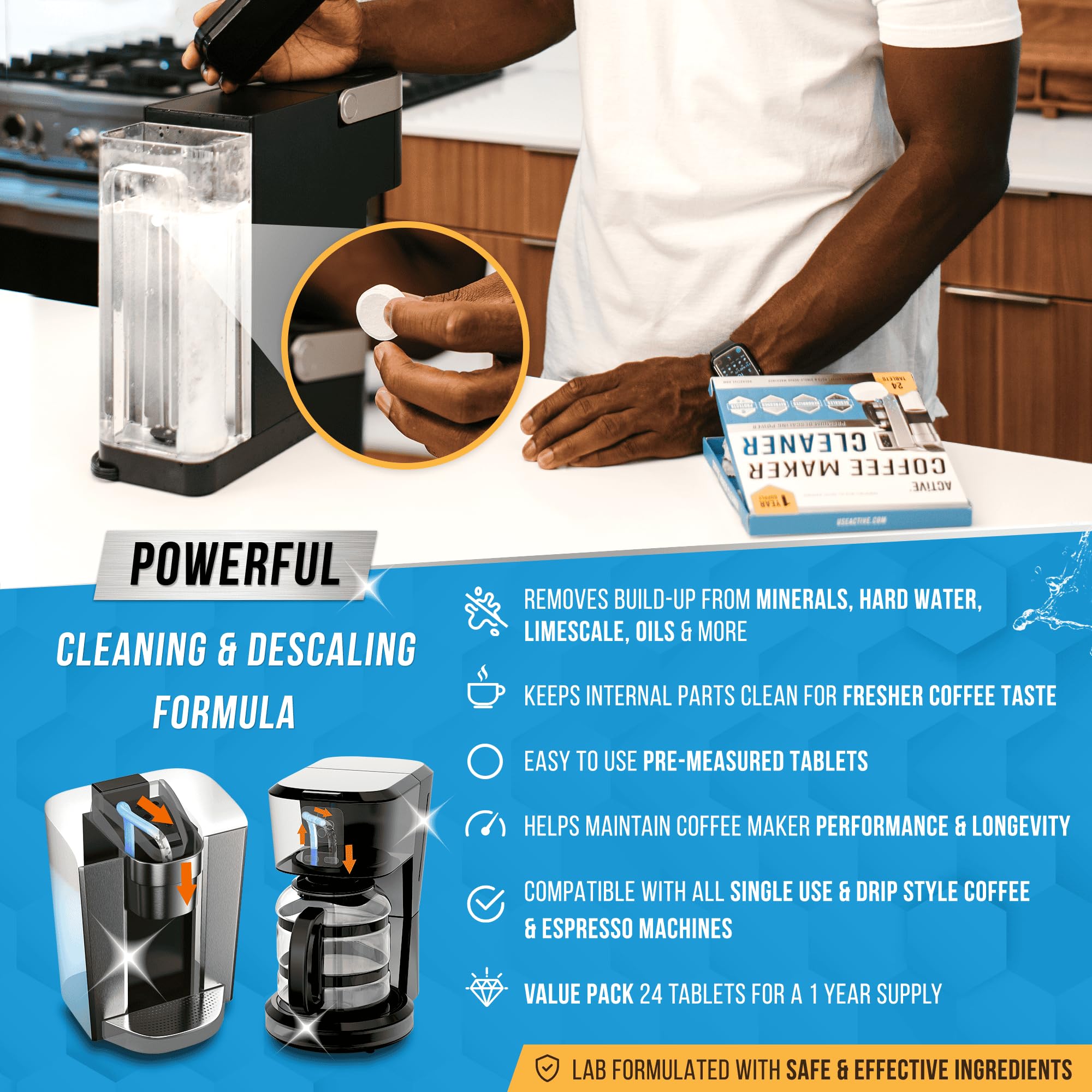

Pros
- Compatible with virtually every major coffee and espresso machine brand
- 24 tablets provide a full year of regular descaling on a single purchase
- Simple drop-in tablet format requires no measuring or mixing
- Unscented and leaves no aftertaste in subsequent brews
- Backed by over 13,000 reviews with a strong 4.6 average rating
Cons
- At $19.95 for 24 tablets, the per-use cost is higher than bulk liquid descalers
- May require multiple tablets per cycle for heavily scaled machines
- No indicator included to tell you when descaling is actually needed
If your morning coffee has started tasting flat or your machine is brewing slower than usual, mineral buildup is likely the culprit. These ACTIVE descaler tablets are the kind of low-effort, high-reward kitchen essential that keeps your daily ritual running smoothly. One tablet, one cycle, done.
What sets this apart from liquid descalers is the convenience factor. No measuring cups, no sticky bottles under the sink. The tablets are pre-dosed and unscented, so there is no chemical residue tainting your next cup. They work across Keurig, Nespresso, Ninja, Delonghi, and Miele machines, which is ideal if your household has more than one brewing setup.
If you want consistent, great-tasting coffee without the hassle of complicated machine maintenance, this one delivers.
Styles it works with: Any kitchen style since this is a consumable maintenance product stored out of sight. Works for minimalist, modern, farmhouse, or apartment kitchens alike.
Best placed in: Under the kitchen sink, in a pantry cabinet, or in a utility drawer near your coffee station for easy access on cleaning day.
May not suit: Households that exclusively use pour-over, French press, or other manual brewing methods that do not require machine descaling.
Buy it if:
- You own a Keurig, Nespresso, or drip coffee maker and have not descaled it in over three months
- You want a single universal solution that works across multiple machines in your home
- You prefer the simplicity of pre-measured tablets over mesy liquid descalers
Consider waiting if:
- You recently descaled your machine and still have several months before the next cycle is due
Skip it if:
- You only use manual brewing methods like French press or pour-over that have no internal water lines
- Your machine manufacturer requires a proprietary descaling solution to maintain warranty coverage
Check the latest price and availability on Amazon before it sells out.

IMPRESA 2-Pack Universal Descaling Solution for Keurig, Nespresso & Espresso Machines - Made in USA
Pros
- Extremely broad compatibility covers nearly all single-use and espresso machines
- Each bottle yields two uses, offering better value per session than single-use competitors
- Made in the USA with a formula that effectively removes limescale and mineral deposits
- Massive review base with a strong 4.4-star rating signals consistent real-world performance
- Low dosage per session (4 oz) means the solution lasts longer than most alternatives
Cons
- Not designed for fully automatic bean-to-cup machines that require specialized internal cleaning tablets
- No included cleaning pods or needle cleaning tools, so deep pod chamber maintenance requires a separate purchase
There is something quietly satisfying about a well-maintained coffee machine. The IMPRESA Descaler slots into that routine efortlessly. It is not glamorous, but it is genuinely useful, and for anyone who relies on a Keurig or Nespresso every single morning, a buildup of limescale is the slow, silent enemy of a great cup. This solution tackles that problem head-on with a USA-made formula that is both gentle enough for regular use and strong enough to clear out months of mineral deposits.
What stands out most is the value built into the 2-pack. Four descaling sessions from two compact bottles means you are set for well over a year without thinking about it again. The 4-ounce-per-session dosage is notably efficient compared to competing products that have you pouring in the entire bottle at once. It is a small detail, but it signals a formula that was actually thought through rather than just bottled and sold.
If you want a reliable, no-fuss way to protect your coffee machine investment without hunting for brand-specific solutions every few months, this one delivers.
Styles it works with: Modern Minimalist, Scandinavian, Contemporary, Classic American Kitchen
Best placed in: Kitchen countertop cabinet, coffee station drawer, pantry cleaning supply shelf
May not suit: Households that use traditional drip coffee makers exclusively, or those who own fully automatic bean-to-cup machines that require proprietary cleaning tablets from the manufacturer
Buy it if:
- You own a Keurig, Nespresso, Breville, Cuisinart, or similar single-serve or espresso machine and have never descaled it
- You want a cost-effective multi-use solution that covers your cleaning needs for12 or more months
- You have noticed your coffee tasting slightly off or your machine running slower than usual, both common signs of limescale buildup
Consider waiting if:
- You recently purchased a brand-new machine and already descaled it with the included solution, so you may want to wait a few months before your first session is due
Skip it if:
- Your machine manufacturer explicitly requires a proprietary descaling product to maintain warranty coverage
- You only use a traditional drip coffee maker and do not own a pod or espresso-style machine
Check the latest price and availability on Amazon before it sells out.

IMPRESA Coffee Machine Descaler 3 Pack (6 Uses) - Universal Formula for Keurig, Nespresso, Breville - Made in USA
Pros
- Universal compatibility covers Keurig, Nespresso, Breville, Delonghi, and most other single-serve machines
- 3-pack value provides 6 full uses, covering roughly 12 to 18 months of recommended maintenance
- Made in the USA with a machine-safe formula that won't void most manufacturer warranties
- Works beyond coffee makers on kettles and electric water heaters for whole-kitchen use
- Straightforward descaling process with no complicated mixing or measuring required
Cons
- Only compatible with single-use and pod-style machines, not designed for commercial or super-automatic espresso setups
- No brush or needle-cleaning component included, unlike the bundle version, so it addresses limescale only
- No customer review data available to validate real-world performance claims beyond manufacturer descriptions
If your morning coffee has started tasting a little flat or your machine is taking longer to brew, mineral buildup is almost always the culprit. The IMPRESA Descaler tackles that problem with a clean, no-fuss formula that works across nearly every pod and single-serve machine on the market. It's the kind of product that quietly does its job and makes everything else work better.
What makes this stand out on a crowded shelf is the combination of USA manufacturing, universal compatibility, and the value of getting six uses in one purchase. You're not buying a one-time fix; you're setting up a maintenance routine that keeps your machine performing like new for the long haul. The fact that it also works on kettles and water heaters is a genuinely useful bonus for a kitchen drawer.
If you want consistently great-tasting coffee without the cost of premature machine replacement, this one delivers.
Styles it works with: Modern Minimalist, Scandinavian, Contemporary, Farmhouse Kitchen
Best placed in: Kitchen counter beside your coffee station, a coffee bar cart, or stored under the sink as part of your cleaning supplies rotation
May not suit: Households with commercial-grade or fully automatic bean-to-cup espresso machines, or those who rarely use their machines and descale less than once a year
Buy it if:
- You own a Keurig, Nespresso, Breville, or similar pod machine and want a reliable, affordable descaling routine
- You want a multi-use supply that covers roughly a full year of maintenance in one purchase
- Your coffee has been tasting off or your machine is brewing slower than usual and you suspect mineral buildup
Consider waiting if:
- Your machine is still brand new and has not yet reached the 2 to 3 month mark for its first descale cycle
Skip it if:
- You own a commercial or super-automatic espresso machine that requires a manufacturer-specific descaling product
- You need an all-in-one cleaning kit that also addresses the brew needle and chamber, in which case the IMPRESA bundle version is the better fit
Check the latest price and availability on Amazon before it sells out.
Frequently Asked Questions
Can you run vinegar through a coffee maker to clean it?
Yes, for standard drip machines. Use a 1:1 vinegar-to-water mix, run a half cycle, let it sit 30 minutes, then finish. Follow with two or three plain-water cycles to clear the smell. Avoid vinegar on espresso and some pod machines, where the acid can wear rubber seals.
How often should I descale my coffee maker?
It depends on your water. Every three months is the baseline, but hard-water homes should descale monthly. Watch for slow brewing or white flecks near the reservoir, and treat either as your cue to run a cycle that week.

Is a commercial descaler better than vinegar?
It depends on the machine. Descalers rinse cleaner, leave no aftertaste, and won’t void a manufacturer warranty the way vinegar can. For a sub-$40 drip machine, vinegar saves money. For a pod or espresso unit, the descaler is worth the few extra dollars.
Can I use lemon juice or citric acid instead?
Yes. Citric acid powder mixed with water works like vinegar without the lingering odor, and it’s the active ingredient in most descaling tablets. Lemon juice works in a pinch but its pulp can clog the needle on pod machines, so strain it first.
Will dirty coffee maker make me sick?
Almost never, but it can grow mold and yeast in the damp reservoir if left uncleaned for weeks. Regular descaling and drying the interior with the lid open may help prevent buildup. If you see visible mold, deep-clean before the next brew.
Do I need to clean a new coffee maker before first use?
Yes. Run one or two water-only cycles through a brand-new machine to flush manufacturing residue and plastic taste. Wash the carafe and basket with soap first. Skip descaler on the first run, since there’s no scale yet.
How do I get rid of the vinegar smell after cleaning?
Run three full cycles of fresh, plain water back to back. If a faint smell remains, wipe the reservoir with a baking-soda paste, rinse, and run one more water cycle. That clears it. This is the main reason many owners switch to a no-rinse commercial descaler.



Write Your Review
No reviews yet. Be the first to share your experience!