

> Editorial Note: I’m Olivia Bennett, a storage and organization contributor. I approach storage as a systems problem rather than a product one — fit to actual room dimensions, load ratings, and how the system holds up under daily use.
The mistake almost everyone makes is stacking boxes flat, tallest on the bottom, and calling it done. Six months later the bottom lids bow, the pieces migrate between boxes, and pulling out one game means unstacking four. Storage isn’t a pile; it’s a system you can reach into with one hand. Before you buy a single bin, the same rules apply here that apply to any organized zone in your home, whether that’s a best closet organizer system, a best closet rod setup, best floating shelves for living room, a best hanging closet organizer, or even a best shoe rack. This guide walks through four steps that fix the storage problem for good, plus the containers that make each step easier.
The Ground Rules Before You Start
Three non-negotiables. First, never stack original game boxes more than 6 high; cardboard rated for retail shelving starts deforming under sustained top-down load. Second, leave at least 2 inches of clearance above any shelf-stored game so you can lift it straight out without dragging. Third, measure your largest box before buying anything. Standard family games run about 10.5 x 10.5 inches; oversized titles hit 12 x 12 inches or more. Buy for the biggest, not the average.
Closet shelves fill up faster than anyone plans for. The coat storage guide covers containing the off-season half so the shelf above stays usable.
Both jobs come down to what shares a shelf with what. The china storage guide covers the pieces that should never be stacked at all.
Step 1: Inventory and Sort by Frequency, Not Size
Start by pulling every game out and sorting into three piles: weekly players, monthly players, and once-a-year titles. This is the anchor step because it decides shelf real estate. Games you reach for weekly go at eye level, between 42 and 60 inches off the floor, so nobody’s crouching or reaching over their head on game night.
Monthly games go below or above that band. Seasonal and rarely-touched titles go highest or deepest, wherever access is worst, because you’ll only fight for them twice a year. Count while you sort. If you own 30-plus games, you’re planning a dedicated shelf unit, not a corner of the closet.
Measure the tallest and widest box as you go and write the numbers down. That single spec drives every purchase after this. Wirecutter’s organizing editors make the same point about kitchen and closet systems: sort by how often you use something, then assign the easy-reach zones to daily items. Board games follow the identical logic. Frequency first. Size second.
Step 2: Decide Between Original Boxes and Repackaging
Now choose your storage philosophy. Original boxes preserve resale value and box art, but they waste space and fail under weight. Repackaging into uniform containers saves 30 to 50 percent of shelf depth and stops lid collapse, but you lose the artwork and, for collectors, some resale value.
For most households, a hybrid wins. Keep the big-box crowd-pleasers in their original packaging stored spine-out like books, and repackage the small-box card games and expansions into stackable bins. Card-heavy games are the worst offenders for wasted air; a deck-builder in its retail box uses four times the volume of the cards inside.
If you repackage, use zip bags for loose pieces and a rigid container rated for the stack weight. A general rule: any plastic bin holding games should carry a load rating above 15 lbs, since a full 12 x 12 inch box of components can weigh 3 to 5 lbs on its own. Don’t guess. Check the listed capacity before you fill it.
Step 3: Store Vertically, Like Books
Here’s the rule that changes everything: store games on their edge, spine-out, exactly like a bookshelf. Flat-stacking is what causes lid bow and buried games. Vertical storage lets you read every title at a glance and pull one without disturbing its neighbors.
For this to work, your shelf depth needs to match your box width. A 12-inch-deep shelf handles nearly every game on the market; a standard 11.25-inch bookshelf board leaves the largest titles overhanging by half an inch, which is fine visually but risks a slide-off. Add a simple bookend or divider every 8 to 10 inches so the row can’t domino when you remove one box.
Heavy games still go low. A single premium box with metal components can hit 8 lbs, and you don’t want that weight above shoulder height. Keep vertical rows for anything under about 4 lbs; reserve the bottom shelf for the heavyweights. That’s the whole trick. Read it, grab it, done.
Step 4: Contain the Small Pieces and Label the System
The last failure point is loose components. Meeples, dice, and cards migrate, and a game with missing pieces is a game nobody plays. Bag each game’s small parts in a labeled zip pouch inside its box, or drop expansions and card games into a latching organizer that keeps everything sealed during transport.
Label the container end that faces out. A strip of tape and a marker works, but a label maker at 12-point text reads cleanly from 6 feet away. Group by type on the label if you share the collection: “2-player,” “party,” “kids,” “heavy strategy.” That turns a wall of boxes into a menu.
One clearance note. If you’re using latching bins on a shelf, leave 1 inch of side clearance so the latches clear the neighbor when you pull a bin out. Skip that gap and you’ll scrape a latch every single time. Small spec, big daily annoyance saved.
The Right Products Make It Easier
The containers below all clear a 4.6 owner rating and are built for the two jobs that break most systems: repackaging small-box games (Step 2) and sealing loose pieces for transport (Step 4). Start with the Lifewit set if you’re organizing a large collection into a uniform grid. Jump to the Vtopmart if portability and a tight latch matter most, and pick the IRIS USA if you want US-made rigidity for heavier component loads.

Pros
- Clear plastic gives full visibility from every angle, so finding the right box is instant
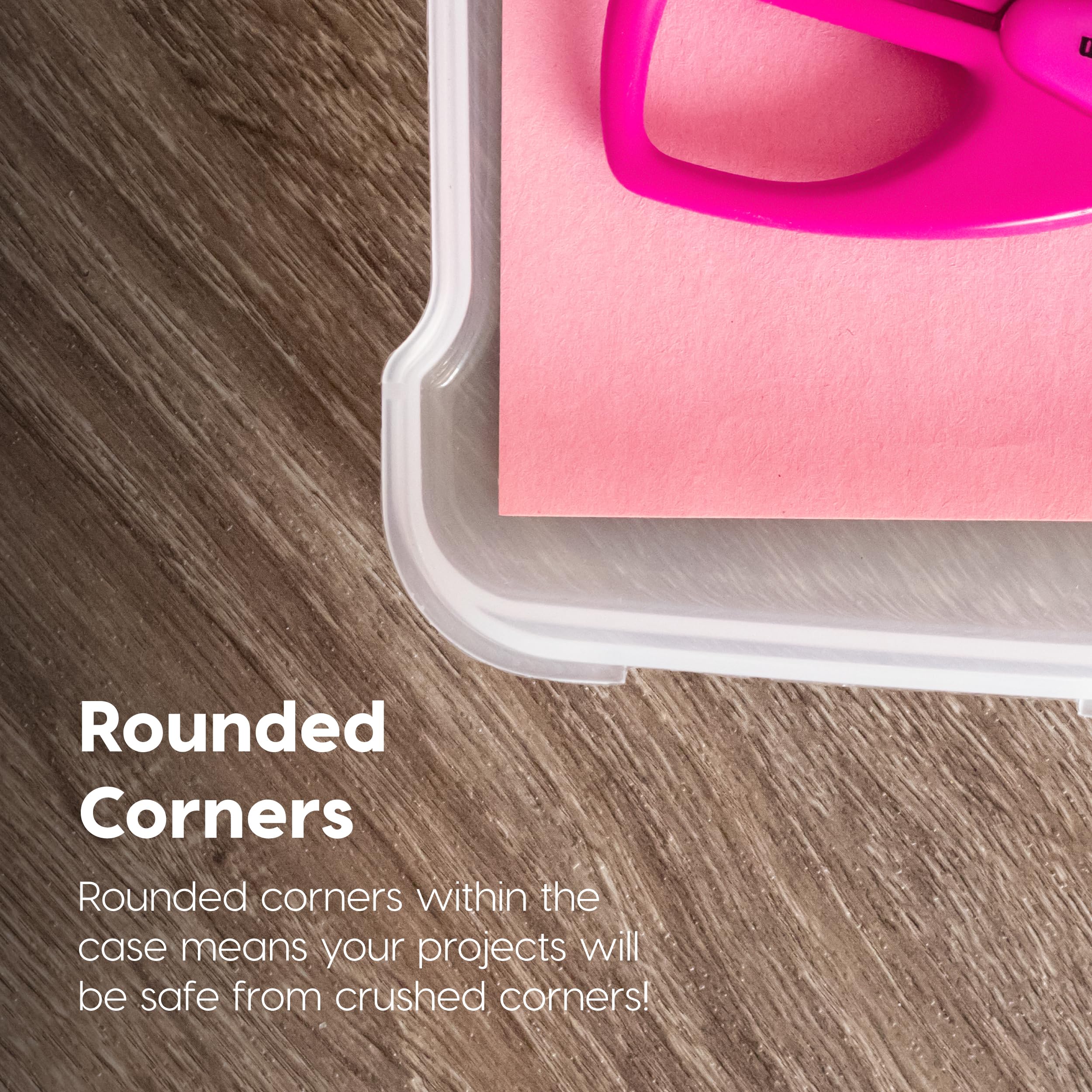
- Secure snap latches and rounded corners protect contents and feel sturdy without being bulky
- Stackable design lets you build a clean, organized wall of storage in any room
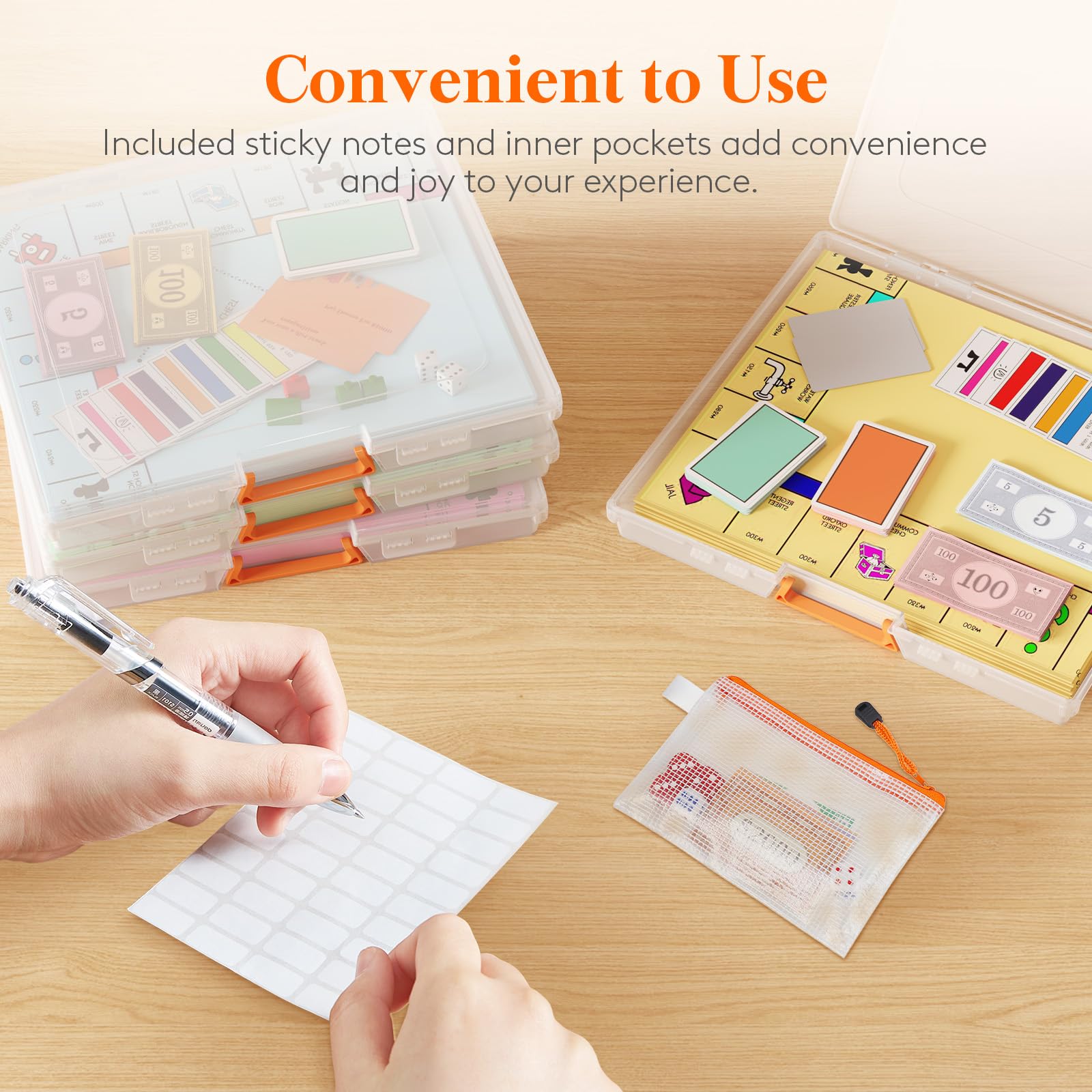
- Included labels and storage bags add immediate practical value right out of the box
- 4.6-star rating across 137 reviews suggests consistent quality and buyer satisfaction
Cons
- At 1.6 inches deep, the boxes are too shallow for chunky 3D game pieces or thick rulebooks
- The transparent plastic aesthetic is purely functional and may feel clinical in warmly styled or traditional rooms
- Handle must be attached during setup, which adds a small assembly step before first use
If your shelf looks like a game night explosion that never got cleaned up, these Lifewit boxes are the fix you have been putting off. The clear walls and slim profile turn a chaotic collection of board games, craft supplies, or documents into something that actually looks intentional on a shelf or in a cabinet.
What sets them apart from typical storage bin is the combination of portability and structure. The snap-tight lid keeps everything sealed when you grab the handle and carry the box to the table, and the internal pocket with bags and labels means even the smallest tokens stay exactly where you put them. The stackable design is a genuine space-saver in rooms where every inch matters.
If you want a clean, organized shelf full of board games or crafts without investing in a custom shelving system, this one delivers.
Styles it works with: Minimalist, Scandinavian, Modern, Contemporary
Best placed in: Living room media cabinet or game shelf, home office filing area, craft room supply station
May not suit: Warmly styled or rustic rooms where transparent plastic contrasts with wood and textile-heavy decor; households with very young children who may struggle with the snap latches independently
Buy it if:
- You own multiple board games and want a uniform, shelf-ready storage system that keeps every component in one place
- You need flat document or A4 paper storage that is portable and clearly labeled without buying a full filing cabinet
- You are a crafter or hobbyist who wants to grab a specific project box and carry it to your workspace without sorting through a pile
Consider waiting if:
- You need only one or two boxes and the6-pack quantity is more than your current storage project requires
Skip it if:
- You store games with large3D miniatures or thick components that will not fit in a 1.6-inch deep box
- Your decor leans heavily rustic or traditional and clear plastic will visually clash with your existing shelving
Check the latest price and availability on Amazon before it sells out.

Pros
- Clear PET construction gives an instant view of contents from across the room without removing lids
- Snap-tight latches hold firmly during transport and stacking without requiring tools or extra effort
- Generously sized at 13.1 x 12.48 x 2.1 inches to accommodate full-size board games and large paper sheets flat
- Stackable in two orientations, which adapts to both deep shelves and upright cuby storage
- Three-pack value makes it easy to organize multiple categories at once
Cons
- At only 2.1 inches tall, the boxes are too shallow for games or puzzles with thick three-dimensional components
- The clear plastic aesthetic is functional but not decorative, so it may look out of place in styled open shelving where aesthetics matter
There is a specific kind of frustration that comes from owning a board game collection or a craft room that has quietly become a pile. Boxes split at the corners, puzzle pieces wander, and 12x12 paper warps because nothing quite fits it properly. The Vtopmart storage boxes solve that in a direct, no-fuss way: a flat, clear, latch-closing box sized to actually hold what you are putting in it.
What stands out beyond the dimensions is how practical the details are. The carry handle is not decorative -- it is positioned to let you carry the box with one hand while holding something else. The snap latch does not just rest closed; it locks the lid down so the box can be tipped or stacked without anxiety. And the PET material gives a clean, uncluttered look that reads as organized rather than just stored.
In a craft room or a game closet, these stack tidily and let you read the contents at a glance, which means less time hunting and more time doing. If you want a genuinely useful storage system for flat oversized items without sacrificing visibility or portability, this one delivers.
Styles it works with: Minimalist, Scandinavian, Modern Farmhouse, Contemporary
Best placed in: Craft room shelving units, living room game closet or cabinet, home office supply shelf, or a dedicated hobby corner in a family room
May not suit: Open display shelving in styled living rooms where visible storage needs to be decorative rather than purely functional. Also not ideal for households storing bulky 3D games like those with large figurines or chunky plastic components, as the 2.1-inch depth will not accommodate them.
Buy it if:
- You have a growing board game or puzzle collection that is currently stacked in damaged original boxes or crammed into a closet with no system
- You work with12x12 scrapbook paper or large flat art supplies and need a container that fits them without bending or rolling
- You want stackable, visible storage that can be reconfigured horizontally or vertically depending on your shelf layout
Consider waiting if:
- You are planning a larger storage overhaul and want to confirm your shelf dimensions and total quantity needed before ordering a set of three
Skip it if:
- Your games or craft items include thick three-dimensional components that exceed 2 inches in height, as the boxes will not close fully over them
- You need storage that doubles as decorative display and need something that visually matches wood, wicker, or fabric bin aesthetics
Check the latest price and availability on Amazon before it sells out.

IRIS USA 6-Pack Clear Board Game Storage Containers with Handle and Snap Lid | Fits 8.5x11 Papers | Made in USA
Pros
- Crystal-clear walls let you identify contents instantly without opening the lid
- Snap-tight latch prevents accidental spills during storage or on the go
- Six-pack value makes it practical to organize an entire collection at once
- BPA-free, USA-made plastic feels solid and holds its shape under stacking weight
Cons
- The outside footprint is noticeably larger than the inside capacity, so measure your shelf space carefully before buying
- The clear plastic can show fingerprints and dust easily, requiring regular wiping to keep shelves looking tidy
- At just over 2 inches tall inside, the cases are too shallow for thicker board game boxes or chunky 3D puzzle sets
If your craft room, game shelf, or home office has slowly become a pile of loose papers, puzzle boxes, and half-finished projects, these IRIS USA cases are the kind of simple fix that actually sticks. Each case snaps shut cleanly, stacks without wobling, and lets you see exactly what is inside without lifting a single lid. That transparency is genuinely useful when you are grabing supplies mid-project or pulling out a game on a busy Friday night.
What sets this 6-pack apart from generic bins is the build quality. The thick BPA-free plastic feels substantial in hand, the handle is molded in rather than tacked on, and the snap latch has a satisfying click that signals everything is sealed. They look tidy lined up on a shelf and hold their clean appearance even after months of use. The clear design works quietly alongside almost any room aesthetic without demanding attention.
If you want a tidy, grab-and-go storage system for games, crafts, or papers without buying a dedicated piece of furniture, this one delivers.
Styles it works with: Minimalist, Scandinavian, Modern Farmhouse, Functional Eclectic
Best placed in: Open shelving in a living room game corner, a craft room or hobby desk shelf, a home office storage wall, or a playroom cabinet
May not suit: Homes with a warm ornate decor style where exposed clear plastic feels out of place; very small apartments where the generous outside dimensions (13 x 12.25 inches) may eat into limited shelf space more than expected
Buy it if:
- You have a growing board game or puzzle collection and want everything visible and stackable one shelf
- You do scrapbooking, diamond painting, or paper crafts and need a portable case that protects supplies between sessions
- You work from home and want a clean, low-cost way to store A4 files or project papers without a filing cabinet
Consider waiting if:
- You only need one or two organizers and the6-pack quantity feels like more than your current storage needs
Skip it if:
- You need to store bulky or tall board game boxes since the 2.125-inch interior height is too shallow for most standard game boxes
- You prefer woven, wooden, or fabric storage solutions that blend with a warmer, more traditional room aesthetic
Check the latest price and availability on Amazon before it sells out.
Lifewit 6 Pcs Board Game Storage Boxes (Lifewit)
This six-pack is the direct answer to Step 2’s repackaging problem. At 12.2 x 10.6 inches, each box swallows a standard 12 x 12 inch card-game footprint with room for sleeves, and the secure latch keeps a full box sealed when you tip it vertical on the shelf. Six matching containers give you the uniform grid that makes spine-out storage actually look organized rather than mismatched. The clear-ish plastic also solves half of Step 4 for you, since you can see the contents without a label. For a collection of 30-plus small-box games, buying in a six-pack is cheaper per unit than single bins and, at a 4.6 rating, owners consistently note the latches hold through moves. It’s the pick for building a whole system at once.
Vtopmart 3 Pack Board Game Storage (Vtopmart)
Reach for this three-pack when transport is part of your life, game nights at a friend’s place, a cabin, a classroom. The snap-tight latch lid is the standout: it’s the one that survives being carried by the built-in handle without popping open, which directly solves Step 4’s loose-piece migration. Sized to fit 12 x 12 inch papers, it stacks cleanly and locks together, so a short tower rides in a car trunk without sliding. Three units suit a curated collection rather than a full library. At a 4.6 rating, owners repeatedly call out the handle and lid seal as the reasons they’d rebuy. If your games leave the house, this is the container built for the trip.
IRIS USA Board Game Storage Containers, 6-Pack (IRIS USA)
Pick the IRIS USA set when rigidity matters more than anything, meaning heavier component loads and long-term shelf life. Made in the USA with a snap-tight lid and a built-in handle, these six containers are the stiffest of the three, which is what you want under the 3-to-5 lb component boxes from Step 2. The rigid walls resist the bow that plagues thinner bins when you store them vertically and pull them often. Six units match the Lifewit for building a full grid, but the heavier-duty plastic tilts this toward collectors with metal-and-wood component games. At a 4.6 rating, durability is the recurring theme in owner feedback. It’s the long-haul choice.
Frequently Asked Questions
What if my room is too small for a dedicated shelf unit?
It depends on your wall height, but you almost always have more vertical room than floor space. A single 6-foot bookcase with a 12-inch depth holds 40-plus vertically stored games in about 3 square feet of floor. Go up, not out. Over-door racks and the top shelf of a closet absorb the seasonal titles you rarely reach for.
What if my closet shelf is only 11 inches deep?
No problem for most games, but the largest 12 x 12 inch boxes will overhang by about an inch. Store those flat on the bottom or turn them so the shorter dimension faces out. For everything under 11 inches wide, vertical spine-out storage works fine on that depth. Add a divider every 8 inches so nothing tips.
What if my games are different sizes and won’t stack neatly?
Yes, this is exactly why repackaging exists. Standardize the small-box games into uniform bins from Step 2, and store only the large original boxes spine-out like books. Mixing a few big flat boxes on the bottom shelf with a grid of matched bins above solves the ragged-stack look without repackaging everything.
What if my space is humid, like a basement or garage?
It depends on how humid, but cardboard suffers below 30 percent and above 60 percent relative humidity. In a damp basement, skip original boxes entirely and repackage into sealed plastic bins with a latch, since ASTM moisture research shows rigid polypropylene resists warping far better than coated cardboard. Add a small desiccant pack per bin. Keep bins off a concrete floor on a 2-inch riser.
What if my kids need to reach their own games?
Yes, and it’s an easy fix once you apply Step 1’s frequency rule to their height instead of yours. Put kid games in the 24-to-42 inch band so a child reaches them without a stool. Use light, latching bins they can carry, and label with pictures if they’re pre-readers. Keep the heavy strategy titles up high and out of small hands.
Pro Tips for Long-Term Board Game Storage and Preservation
Proper board game storage is about more than just clearing shelf space; it is about protecting the integrity of your components for years of future play. To maximize the lifespan of your collection, start by avoiding direct sunlight and extreme humidity, which can warp game boards and cause cardboard to peel. For optimal organization, store games vertically like books rather than stacking them; this prevents the weight of heavy boxes from crushing the bottom games and makes it significantly easier to pull a specific title without creating a mess. If you are dealing with a large collection, consider using clear, stackable bins for small card games or investing in modular shelving units that allow for adjustable heights. Always ensure that all loose tokens and pieces are secured in airtight plastic bags or specialized component organizers to prevent lost pieces during transit or storage. By implementing these systematic habits, you protect your investment and ensure your favorite games remain in ‘like-new’ condition.
Is it better to store board games vertically or horizontally?
Storing board games vertically is generally recommended. It acts like a bookshelf, allowing you to easily retrieve one game without lifting a heavy stack of others, which reduces wear on the boxes and prevents the contents of the bottom games from being crushed under the weight of the ones on top.
Bottom Line
Store games vertically and sort by how often you actually play them, and you’ve solved 80 percent of the problem before buying anything. The Lifewit six-pack is the pick for most people building a full uniform system, while the Vtopmart three-pack wins if your games travel and the IRIS USA set is worth it for heavier collections. Measure your largest box first. Everything else follows from that one number.








Write Your Review
No reviews yet. Be the first to share your experience!