

A useful home backup starts with a short list: the refrigerator, a few lights, your internet equipment, and somewhere to charge a phone. The best portable power station for home backup is the one that can support those loads for the time you need, with a practical way to recharge afterward. A huge output number alone will not tell you that.
For 2026, the EcoFlow DELTA 3 Max is our overall recommendation for balancing stored energy with appliance output. The Jackery Explorer 1000 v2 suits a smaller essentials budget, while the HomePower 3600 Plus offers substantially more capacity and an expansion path. There are also good reasons to choose a smaller station if communications and lighting are your main priorities.
These are rechargeable battery systems. They supply electricity without burning fuel during use, but they have finite reserves. Think in terms of keeping selected devices running through an interruption, then decide whether your needs justify larger batteries, solar panels, or a professionally designed home backup system.
The Best Portable Power Stations at a Glance
| Power station | Best fit | Listed capacity | Listed continuous output |
|---|---|---|---|
| EcoFlow DELTA 3 Max | Overall balance for home essentials | 2,048Wh | 2,400W |
| Jackery Explorer 1000 v2 | Value for a modest backup plan | 1,024Wh | 1,500W |
| Anker SOLIX S2000 | More energy for moderate loads | 2,010Wh | 1,500W |
| EcoFlow DELTA 3 | Fast replenishment and USB-C use | 1,024Wh | 1,800W |
| BLUETTI Elite 30 V2 | Short outages and small electronics | 288Wh | 600W |
| Anker SOLIX C1000 Gen 2 | Higher output in the 1kWh class | 1,024Wh | 2,000W |
| ZeroKor 280Wh solar generator kit | A small battery with an included panel | 280Wh | 300W |
| Jackery HomePower 3600 Plus | Larger, expandable essentials backup | 3,584Wh | 3,600W |
Capacity describes the energy reserve; continuous output describes the combined load the inverter can supply. Peak and appliance-boost figures are different ratings and are not used as continuous output in this comparison. Solar panels are optional unless a particular kit below explicitly includes one.
How We Chose These Power Stations
This is a researched comparison of published product specifications, supported by electrical and outage-preparedness guidance. The recommendations prioritize battery capacity, continuous output, stated charging performance, and how those features fit a household’s essential loads. They do not represent hands-on testing or measured appliance runtimes.
The picks cover several jobs because a refrigerator backup and a phone-charging reserve are different purchases. More capacity earns its place when an outage lasts longer; higher output matters when an appliance demands more power at once. An included solar panel adds another way to replenish energy, but does not turn a small battery into a large one.
Advertised charging times are identified as claims, with no assumption that different manufacturers used identical conditions. Runtime examples are calculations with explicit assumptions. Product details apply to the particular version discussed: similar names, newer generations, and bundles can have different specifications. Check the selected configuration and its manual before ordering accessories or planning a permanent connection.
Best Overall: EcoFlow DELTA 3 Max
Key specs: 2,048Wh capacity; 2,400W continuous output; LFP battery; advertised 0–80% charging in 1.13 hours.
Pros
- Combines a 2kWh energy reserve with output above the smaller stations here.
- Relatively quick advertised partial recharge for its capacity.
Cons
- A large appliance load can still consume the reserve quickly.
- Solar panels are optional for this configuration.
The DELTA 3 Max makes the strongest starting point for a household that wants more than device charging. Its 2,400W continuous rating gives you room to plan around an eligible refrigerator plus smaller electronics, provided their combined running demand and the refrigerator’s startup requirement fit the station. That balance is why it takes the overall spot.
The energy reserve is equally relevant. A 2,048Wh battery offers twice the nominal storage of the 1,024Wh models in this guide. That does not establish twice the measured runtime under every condition, because conversion losses and overhead vary, but it gives a meaningful cushion when comparing similar loads. It can also let you reserve more energy for the refrigerator while using lights and chargers sparingly.
EcoFlow advertises charging from empty to 80% in 1.13 hours. A fast partial refill could be useful when electricity returns briefly between interruptions, as long as the charging circuit can support the required input. The claim does not describe charging to full or replenishment from an optional solar panel.
There is also a promoted 3,400W X-Boost figure. Keep that separate from the 2,400W continuous rating when sizing a load, and confirm appliance compatibility in the manual. More ambitious marketing numbers should not decide whether a compressor or sensitive device belongs on the station.
Choose this model when roughly 2kWh looks appropriate for your outage plan and you want more output headroom than the S2000. Move toward the larger Jackery if the energy calculation is already tight before you add any reserve.

Pros
- Exceptionally fast charging saves hours compared to competitors
- High 3400W output handles nearly any household appliance without overload
- Near-instant 10ms transfer time protects sensitive equipment during outages
- Durable LiFePO4 battery outlasts standard lithium-ion by years
- Smart app provides real-time monitoring and cost-saving scheduling features
Cons
- No customer reviews yet to verify real-world performance claims
- Higher upfront cost compared to lower-capacity portable power stations
- Solar panels sold separately, adding to total investment for off-grid use
The DELTA 3 Max solves the biggest frustration with portable power stations: the endless wait for recharging. While most units take 4-6 hours to reach 80%, this one does it in just over an hour. That means you can top it off during a lunch break, between storm warnings, or while running errands, and have full backup power ready when you need it.
What really sets it apart is the combination of speed and power output. The 3400W capacity handles everything from your fridge and microwave during an outage to power tools at a remote job site. The under-10ms switchover time means your computer does not even flicker when the power goes out, and the ultra-quiet operation means you can sleep soundly while it keeps your CPAP machine or medical devices running all night.
If you want serious backup power that charges fast enough to actually use daily without disrupting your routine, this one delivers.
Styles it works with: Modern Utility, Industrial, Minimalist, Contemporary
Best placed in: Garage or utility room for home backup, RV cargo area or under-bed storage, basement near your electrical panel for whole-home integration
May not suit: Small apartments with limited floor space for a 12 x 9.4 x 19.44 inch unit, homes that need a permanently installed whole-house backup system rather than portable power, renters who cannot justify the investment before moving
Buy it if:
- You lose power regularly and need to keep your fridge, medical devices, or home office running during outages
- You RV or camp frequently and want to run full-size appliances without relying on noisy generators or crowded campground hookups
- You need portable backup power that recharges fast enough to use multiple times in a single day or emergency situation
Consider waiting if:
- You want to see real customer reviews before investing in a newly released model
- You are waiting for a sale or bundle deal that includes solar panels
Skip it if:
- You only need to charge phones and laptops, which a much smaller and cheaper power bank can handle
- Your power outages last days at a time and you need solar panels, which add significant cost to this system
Check the latest price and availability on Amazon before it sells out.
Best Value for Essentials: Jackery Explorer 1000 v2
Key specs: Listed 1,024Wh capacity; 1,500W continuous output; 3,000W peak rating; LiFePO4 battery; advertised 50-minute fast charge; listed 10ms UPS transfer.
Pros
- A middle-size energy reserve for a focused backup plan.
- Includes an advertised fast-charge option and automatic backup capability.
Cons
- Less continuous output than the other 1,024Wh selections here.
- The peak rating does not increase sustained appliance capacity.
The Explorer 1000 v2 is a sensible value choice when your aim is to cover a few essentials rather than keep every room operating normally. Its appeal is the combination of a roughly 1kWh reserve, 1,500W continuous output, and a stated fast-charge option. Those features address a fairly common need: bridging a shorter interruption without buying a much larger battery.
Start by deciding which appliance gets priority. If it is a refrigerator, check startup demand first and then account for lighting, internet equipment, and chargers. A station can have enough energy for the hours you want yet still lack the instantaneous output needed to start a particular motor. Conversely, passing that startup check does not establish an overnight runtime.
The advertised 3,000W peak rating is useful information, but the continuous limit remains 1,500W. Two appliances that each fit individually may exceed it together. Using a microwave or another demanding appliance may require disconnecting other loads, and compatibility still depends on the appliance’s electrical input and the station’s instructions.
Jackery lists a 50-minute fast-charge claim. Confirm the required mode and operating conditions instead of assuming every ordinary recharge takes that long. The stated 10ms UPS function is also worth investigating for compatible electronics, though a transfer interval is not a guarantee that a particular computer will remain on.
This is the pick for a buyer whose load list is modest and whose budget is better spent on adequate storage than excess output. Compare it with the C1000 Gen 2 if you need more continuous watts, and with the S2000 if your concern is keeping a smaller load running longer.

Pros
- Ultra-fast 50-minute charging cuts wait time dramatically compared to older models
- 10ms UPS switchover keeps CPAP machines, modems, and medical devices running during power cuts
- Compact and lightweight design makes it easy to carry with one hand
- LiFePO4 battery chemistry provides exceptional longevity and safety compared to standard lithium-ion
- App control lets you optimize charging speed versus battery health based on your needs
Cons
- Solar panels sold separately add significant cost if you want off-grid charging capability
- Only compatible with Jackery-brand solar panels, limiting your panel upgrade options
- No customer reviews yet to confirm real-world performance and reliability
The Explorer 1000 v2 solves the biggest frustration with portable power stations: the endless wait for a full charge. When a storm knocks out your power or you need backup for a weekend trip, this unit goes from empty to 100% in just 50 minutes. That means you can top it off during your lunch break and have reliable power for the evening.
What really sets this apart is the 10ms UPS switchover. Your internet router, CPAP machine, or home office setup stays running when the grid goes down, with no manual intervention needed. The 23.3-pound weight and foldable handle mean you can actually carry it from the garage to the bedroom or toss it in your truck without throwing out your back.
If you want dependable backup power that charges faster than ordering takeout, without the fumes and maintenance of a gas generator, this one delivers.
Styles it works with: Modern, Industrial, Minimalist, Contemporary
Best placed in: Garage or utility room for home backup, bedroom nightstand during power outages, RV cabinet or truck bed for road trips, basement workshop near power tools
May not suit: Homes requiring whole-house power backup (this runs essential devices only), buyers wanting solar charging without purchasing separate Jackery panels, apartments with no storage space for a 12.87 x 8.82 x 9.72 inch unit
Buy it if:
- You experience frequent power outages and need to keep medical devices, internet, or refrigeration running
- You camp or RV regularly and want clean, quiet power without dealing with gas generators
- You need fast emergency charging capability and can't wait 5-8 hours for a full battery
- You value long-term reliability and want a power station that lasts over 10 years
Consider waiting if:
- You already own non-Jackery solar panels and want flexibility to use any brand for charging
- A lower capacity model would meet your needs and save $200-300
Skip it if:
- You need to power a whole house during extended outages (this handles essential devices only)
- You require solar panels included in the package price
- Your power needs exceed 1500W continuous draw
Check the latest price and availability on Amazon before it sells out.
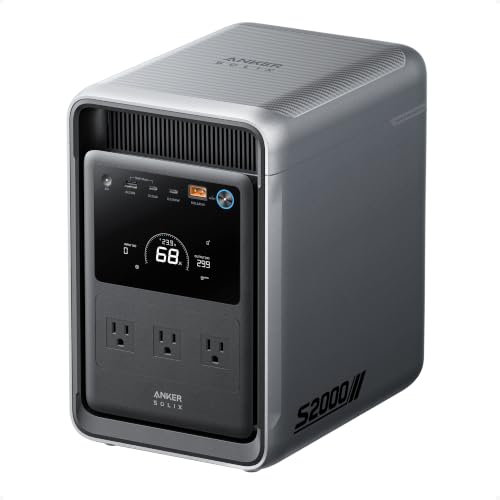
Best Capacity for Moderate Loads: Anker SOLIX S2000
Key specs: 2,010Wh capacity; 1,500W output; LiFePO4 battery.
Pros
- Nearly twice the nominal storage of a 1,024Wh station.
- Suits a plan that values energy reserve over high appliance output.
Cons
- Its 1,500W limit requires care with demanding appliances.
- Extra stored energy does not solve a startup-output mismatch.
The SOLIX S2000 is the clearest example here of why watt-hours deserve their own column. Its 2,010Wh battery is close in size to the DELTA 3 Max’s reserve, while its output is limited to 1,500W. For a homeowner supporting moderate loads, that combination can make more sense than choosing a smaller battery with a higher wattage headline.
Consider a hypothetical setup averaging 100W. Before accounting for losses, 2,010Wh represents 20.1 hours of energy at that draw. Actual usable time will be lower and will depend on the station and connected equipment. This is a planning calculation, not a claimed result for a refrigerator, router, or any other appliance.
The distinction becomes particularly useful when comparing this Anker with the 1,024Wh models. If your devices already fit comfortably within 1,500W, buying more output may do little for your main concern. More stored energy is the feature that addresses a longer interruption.
Keep the load list disciplined, though. A kettle or heater can take up most or all of that output allowance and rapidly spend the battery. Choose the S2000 for a measured, moderate-demand backup plan; favor a higher-output model when the essential appliance itself requires more watts.
Pros
- Exceptionally long 15-year lifespan with LiFePO4 battery technology
- Compact footprint saves storage space compared to competitors
- Low 6W idle draw extends runtime by 20% versus similar capacity units
- Supports up to 400W solar input for off-grid recharging
- Fast UPS switchover under 10ms protects computers and electronics
Cons
- No customer reviews yet to verify real-world performance claims
- Missing 12V DC port limits compatibility with some camping and automotive devices
- 1500W continuous output may not handle high-draw appliances like space heaters or power tools
The Anker SOLIX S2000 strikes a rare balance between serious backup capacity and manageable size. At just 35.7 pounds and roughly the dimensions of a small cooler, it stores easily in a closet or garage but delivers enough power to keep your fridge, wifi, and essential devices running through extended outages. The LiFePO4 battery is the real standout here, rated for 10,000 cycles over 15 years, which means this investment pays for itself many times over compared to replacing cheaper units every few years.
We appreciate the thoughtful dual-outlet design with always-on ports in the rear for appliances like refrigerators and front-facing outlets for devices you plug in and out regularly. The under-10ms UPS switchover is fast enough to protect home office setups without interruption. Six recharging methods including 400W solar input give you genuine flexibility whether you are preparing for storm season or planning off-grid adventures.
If you want reliable home backup power without dedicating half your garage to a bulky generator, this one delivers.
Styles it works with: Modern, Industrial, Minimalist, Utilitarian
Best placed in: Utility closet, garage corner, home office floor, basement storage area
May not suit: Homes prioritizing decorative aesthetics over function, spaces where the compact industrial look clashes with traditional or ornate decor
Buy it if:
- You experience frequent power outages and need reliable backup for refrigerators and medical devices
- You want a portable power station that will last 15 years without replacing the battery
- You need emergency power but lack space for traditional backup generators
- You camp or RV regularly and want a compact unit that supports solar recharging
Consider waiting if:
- You want to see verified customer reviews and real-world runtime data before committing
- You are waiting for a sale or promotional bundle with solar panels
Skip it if:
- You need to power high-draw appliances over 1500W like electric heaters or large power tools
- You require 12V DC ports for specific camping or automotive accessories
Check the latest price and availability on Amazon before it sells out.
Best for Fast Replenishment: EcoFlow DELTA 3
Key specs: 1,024Wh capacity; 1,800W AC output; 100W USB-C output; LiFePO4 battery; advertised full charge in 56 minutes.
Pros
- Advertises a full recharge in under an hour.
- Provides a specified 100W USB-C output for compatible electronics.
Cons
- Its energy reserve remains in the 1kWh class.
- The recharge claim does not establish solar charging time.
The standard DELTA 3 is appealing when your backup plan includes opportunities to recharge. Its 1,024Wh capacity is moderate, but the advertised 56-minute full charge could make a short period of restored electricity more useful. That matters for someone dealing with repeated interruptions, provided a suitable, stable charging supply becomes available between them.
Fast charging cannot help while the grid stays down and no other input is connected. Before giving it much weight, picture the actual outage: will electricity return intermittently, or do storms in your area commonly leave your home disconnected until repairs are finished? In the second situation, extra stored watt-hours may contribute more than a shorter AC recharge time.
The 1,800W AC rating gives the DELTA 3 more continuous output than the Explorer 1000 v2, though both are listed here with the same nominal battery capacity. That can be useful for a compatible appliance that falls between their output limits. It does not mean the EcoFlow will run a smaller load longer. Output capability and energy reserve solve different parts of the problem.
The specified 100W USB-C output is another practical distinction. A compatible laptop can connect through USB-C without occupying an AC outlet and its wall adapter. Confirm the laptop’s required charging profile and use an appropriately rated cable. A port’s maximum rating describes its capability, while the connected device determines how much power it accepts.
For a home office, consider the whole chain that needs electricity: laptop or desktop, monitor, modem, router, and any separate network equipment. A laptop’s internal battery may let you reserve station energy for equipment that immediately stops when unplugged. Also remember that powering your own router cannot restore an internet service disrupted outside your home.
The advertised charging speed needs the right conditions, and the household circuit has other obligations. Account for appliances sharing that circuit and follow the manual for the charging connection. A station that accepts energy quickly can still be inconvenient if the only available outlet is already supporting a heavy load.
Choose the DELTA 3 when its mix of 1,800W output, stated USB-C capability, and rapid advertised recharge fits your routine. If you expect to start an outage fully charged and then have no replenishment opportunity, compare its 1,024Wh reserve closely with the larger batteries before deciding.

Pros
- Industry-leading 56-minute full charge time saves hours of downtime
- LiFePO4 chemistry provides 25% more durability than standard lithium-ion batteries
- Handles 13 simultaneous outputs with varied port types for maximum flexibility
- IP65 weather resistance makes it reliable for outdoor use year-round
- 5-year warranty and proven EcoFlow ecosystem compatibility
Cons
- No customer reviews yet to verify real-world performance claims
- 27.6 pound weight makes it less portable than smaller capacity units
- Requires separate purchase of extra batteries to reach advertised 5kWh expansion
The Delta 3 solves the biggest frustration with portable power stations: waiting forever for a recharge. Whether you're dealing with a multi-day power outage or trying to get back on the road after a camping weekend, that 56-minute charge time means you're back in business before lunch. The LiFePO4 battery technology isn't just marketing speak, it genuinely lasts longer and stays safer than older lithium-ion designs, especially if you're using this regularly instead of letting it sit in a closet.
What really sets this apart is how it grows with you. Start with the base 1024Wh unit, and if you later realize you need more capacity for longer outages or bigger trips, you can expand it up to 5kWh without replacing the whole system. The 13 simultaneous outputs mean everyone in the family can charge their devices while you're also running the fridge and a couple of lights, no fighting over outlets.
If you want reliable backup power that charges faster than a pizza delivery without gambling on an untested brand, this one delivers.
Styles it works with: Modern Utility, Industrial, Minimalist, Outdoor Living
Best placed in: Garage or utility room for home backup, RV storage compartment, camping gear closet, home office for uninterrupted work during outages
May not suit: Small apartments with limited storage space, homes where 27 pounds is too heavy to move easily, decorative living spaces where exposed tech equipment doesn't fit the aesthetic
Buy it if:
- You live in an area with frequent power outages and need to keep essentials running for 12-24 hours
- You're a regular camper or RVer who wants to run appliances off-grid without generator noise
- You need fast recharge capability because you can't wait 8-10 hours between uses
- You want a power station that will last a decade with regular use instead of degrading after 2-3 years
Consider waiting if:
- You want to see verified customer reviews before committing to a new model release
- You're waiting for seasonal sales on EcoFlow products, which typically happen around major holidays
Skip it if:
- You need something under 20 pounds that you can easily carry up stairs or into a tent
- Your power needs are under 500Wh and you'd save money with a smaller capacity model
- You specifically need a unit with integrated solar panels rather than separate panel compatibility
Check the latest price and availability on Amazon before it sells out.
Best for Small Electronics: BLUETTI Elite 30 V2
Key specs: 288Wh capacity; 600W rated output; LFP battery; listed 10ms UPS transfer; advertised 0–80% charging in 45 minutes.
Pros
- A focused option for communications, charging, and small lights.
- Advertises quick partial recharging and automatic backup capability.
Cons
- Much less stored energy than the 1kWh and 2kWh options.
- The promoted Power Lifting figure is separate from rated output.
The Elite 30 V2 belongs on a home backup list because not every outage plan centers on a refrigerator. If your priority is a charged phone, internet equipment, and a small light, a 288Wh reserve may be a reasonable starting point. Match the expected hours to measured consumption before choosing it.
Its 600W rated output is relatively generous beside that battery size, but it should not encourage an appliance-heavy plan. A hypothetical steady 300W load would consume 288Wh in less than an hour even before losses. With smaller electronics, the same energy can be spread over a more useful period.
BLUETTI also advertises 1,500W Power Lifting. For shopping comparisons, use the 600W rated figure and consult the manual about what Power Lifting supports. It should not be treated as a universal 1,500W supply for any device you plug in.
The listed 10ms UPS transfer and 45-minute charge to 80% add convenience for suitable uses. Neither establishes uninterrupted operation for every electronic device, nor an empty-to-full recharge time. Choose this model for a narrow essentials list and short interruptions, with a larger station taking priority if refrigeration is central to your plan.

Pros
- Lightweight at 9.4 lbs makes it easy to move between rooms or pack for trips
- Fast 380W wall charging reaches usable power levels in under an hour
- 10ms UPS response protects sensitive electronics during power interruptions
- Multiple charging options including solar, AC wall, and car adapter provide flexibility
- Power Lifting Mode delivers 1500W for brief high-draw appliance use
Cons
- 288Wh capacity limits runtime for high-draw devices like space heaters or full-size refrigerators
- No customer reviews yet to verify real-world performance claims
- Power Lifting Mode at 1500W works only with resistive loads, not all appliance types
The BLUETTI Elite 30 V2 solves the biggest frustration with emergency power: bulk and weight. At just 9.4 pounds, you can grab it during a storm warning and move it from room to room as needed, or toss it in the car for a weekend camping trip without the back strain. The 288Wh capacity handles the essentials during a blackout, keeping your Wi-Fi router, phones, and laptop running for hours while you wait for power to return.
What sets this model apart is the 10ms UPS switching. If you work from home or rely on a CPAP machine at night, those milliseconds matter. Your devices stay on without interruption when the grid fails. The 45-minute fast charging means you can top it up during brief power windows, and the solar capability gives you true off-grid freedom if an outage stretches longer than expected.
If you want reliable backup power for home essentials and outdoor gear without hauling a 30-pound battery, this one delivers.
Styles it works with: Modern Minimalist, Industrial, Contemporary, Outdoor Living
Best placed in: Home office desk or closet for backup power, bedroom nightstand for CPAP protection, mudroom or garage for camping gear storage, RV or vehicle trunk for road trips
May not suit: Homes needing whole-room backup like refrigerators or sump pumps, users requiring multi-day power without recharging access, spaces with no ventilation for heat dissipation during charging
Buy it if:
- You need emergency backup for home office equipment, medical devices like CPAP machines, or internet routers during frequent power interruptions
- You camp or travel in an RV and want to run small appliances, charge devices, and power lights without idling your vehicle
- You live in an area with storm-related outages and need fast-charging backup power you can move easily between rooms
Consider waiting if:
- You need higher capacity for longer outages or want to power larger appliances like full-size refrigerators
- You prefer to see verified customer reviews before purchasing a newer model release
Skip it if:
- You need whole-home backup or want to run central air conditioning, electric heating, or large power tools
- You require multi-day runtime without any charging option available
Check the latest price and availability on Amazon before it sells out.
Best Output in the 1kWh Class: Anker SOLIX C1000 Gen 2
Key specs: 1,024Wh capacity; 2,000W continuous output; 3,000W peak rating; LiFePO4 battery; advertised full charge in 49 minutes.
Pros
- Highest continuous output among the 1,024Wh selections in this guide.
- Advertises a full recharge in less than an hour.
Cons
- The higher output does not bring a larger energy reserve.
- Brief peak capability should not be used as the continuous limit.
The C1000 Gen 2 is the choice when your essential appliance needs more output than a lower-wattage 1kWh station can provide. Its 2,000W continuous rating is above the standard DELTA 3 and Explorer 1000 v2 ratings, while its listed capacity remains 1,024Wh. That makes it a useful alternative for a specific load requirement rather than an automatic runtime upgrade.
For example, an eligible appliance drawing 1,700W would exceed a 1,500W station’s continuous limit, but it falls below this Anker’s stated continuous rating. You would still need to check startup behavior, connection requirements, and any other simultaneous loads. That example illustrates output selection, not a compatibility promise for a particular microwave or tool.
Energy consumption is the trade-off to keep visible. Running a hypothetical 1,700W load for ten minutes takes about 283Wh before conversion losses. A few short sessions can therefore spend a substantial share of a 1,024Wh battery. High output is convenient for occasional use, but emergency cooking and heating deserve a separate energy budget.
Anker advertises a full recharge in 49 minutes. It is a helpful feature to investigate if you need to refill between interruptions, although the small difference between headline charging times should not outweigh capacity, supported loads, or the charging circuit available at home. Confirm the settings needed to achieve the quoted time.
The 3,000W peak specification also remains a brief-demand rating, not additional energy storage. Choose this station when a measured requirement explains the need for 2,000W continuous output. If your essential devices use far less power, a larger-capacity alternative may buy more useful backup time than the higher inverter rating.

Pros
- Exceptionally fast 49-minute charging time beats most competitors by hours
- High 2000W continuous output handles power-hungry appliances and tools
- 10-year lifespan with 4000-cycle rating provides excellent long-term value
- Compact and portable at under 25 pounds with integrated handle
- True UPS functionality protects sensitive medical and computer equipment
Cons
- No customer reviews yet to verify real-world performance and reliability
- Solar panels sold separately add significant cost to achieve advertised 1.8-hour solar charging
- At 25 pounds, still too heavy for extended hiking or backpacking trips
The SOLIX C1000 Gen 2 solves the biggest frustration with portable power stations: the agonizing wait to recharge. While most units take 6-8 hours to refill, this one does it in 49 minutes. That means less anxiety during storm season and more actual camping time instead of waiting around for batteries to charge.
What really sets it apart is the combination of serious power output and manageable size. The 2000W capacity handles everything from full-size refrigerators to power tools, yet it's compact enough to tuck in a closet or car trunk without dominating your storage space. The 10-year lifespan means this isn't a gadget you'll replace in two years, it's an investment in long-term peace of mind.
If you want reliable backup power that charges fast and lasts for years without lugging around a generator the size of a suitcase, this one delivers.
Styles it works with: Modern Minimalist, Industrial, Contemporary, Tech-forward spaces
Best placed in: Utility room or garage for emergency backup, home office for uninterrupted remote work, RV or van interior for off-grid living, outdoor patio or deck for entertaining
May not suit: Small apartments with limited floor storage, homes where the gray industrial design clashes with traditional or ornate decor, households needing silent operation during nighttime power outages (fan noise during heavy loads)
Buy it if:
- You live in an area with frequent power outages and need to keep refrigerators, medical devices, or work equipment running
- You're a weekend camper or RV owner who wants genuine off-grid capability without hauling heavy gas generators
- You value fast recharging and can't afford to wait half a day between uses
- You need reliable UPS backup for sensitive equipment like CPAP machines or home servers
Consider waiting if:
- You're hoping for customer reviews to confirm the advertised performance before committing at this price point
- A holiday sale might bring the price down in the next few months
Skip it if:
- You need something under 15 pounds for backpacking or extended carrying
- Your power needs are under 500W and a smaller, less expensive station would suffice
- You require absolute silent operation and can't tolerate any fan noise
Check the latest price and availability on Amazon before it sells out.
Best Small Solar Starter Kit: ZeroKor 280Wh Solar Generator
Key specs: 280Wh capacity; 300W output; listed 110V pure sine wave AC; included 60W solar panel; USB QC3.0 and DC connections.
Pros
- Includes a panel instead of requiring a separate solar purchase.
- Provides AC, DC, and USB connection options for modest needs.
Cons
- Both battery storage and output are limited for appliance backup.
- A 60W panel needs sustained sunlight to replace meaningful energy.
This ZeroKor kit fits a different kind of preparedness plan: keep a small collection of electronics supplied, with a panel available to replenish the battery when conditions allow. The included 60W panel is its main distinction. It makes the solar component part of the initial purchase, rather than an accessory to research later.
The 280Wh reserve and 300W output set firm boundaries. Treat this as a device-and-lighting option, with compatibility checked for each connection. It is not the selection for someone whose primary requirement is extended full-size refrigerator operation. Even if an appliance’s running demand looks low, its startup requirement may exceed a small inverter’s capability.
The listed pure sine wave AC output is a useful specification for equipment that needs that waveform. It does not replace checking voltage, wattage, and the appliance manufacturer’s instructions. USB and DC connections can be useful when they match your devices, but do not assume an unspecified USB port provides the charging speed of the 100W USB-C output identified on the DELTA 3.
Solar recovery needs realistic expectations. Dividing 280Wh by the panel’s 60W rating gives about 4.7 hours. That is a theoretical minimum at constant full rated panel output with no losses and no devices drawing energy. It is not a forecast of charging time. Sun angle, cloud, shade, temperature, and charging losses can all extend the process.
A small panel also cannot sustain a large continuous load merely because it is connected. If your devices draw more energy over the day than the panel returns, the battery will eventually empty. Start with a charged station, prioritize essential charging, and treat solar as a replenishment opportunity whose contribution varies with the weather.
Consider where the panel can receive sunlight while the station stays in a suitable dry location. Follow the kit instructions for cable routing and placement, and keep cables clear of walking routes. A sunny spot that requires unsafe access or obstructs a doorway is not a practical charging location during an outage.
Choose this kit if an included panel and modest electronics backup match your goal. Its attraction is a small, defined package; buyers who need larger appliance reserves should size the battery first and then choose compatible solar equipment to support it.

Pros
- Includes 60W foldable solar panel in the package for complete off-grid setup
- Multiple outlet types (AC, DC, USB, QC3.0) charge various devices at once
- Lightweight at 5 pounds with compact dimensions for easy transport
- Pure sine wave output safely powers sensitive electronics
- Built-in protection systems and cooling fan for safe operation
Cons
- 300W limit excludes higher-draw appliances like coffee makers and hair dryers
- No customer reviews yet to verify real-world performance and reliability
- Requires regular charging cycles to maintain battery health, not ideal for long-term storage as emergency-only backup
This portable power station solves the biggest frustration of outdoor adventures: keeping your essential devices charged without access to wall outlets. The included 60W solar panel means you are not just buying a battery, you are getting a complete renewable energy system that can keep running as long as the sun shines.
What sets this apart is the thoughtful mix of outlet types. Two AC outlets handle your laptop or small fan, three USB ports keep phones and tablets charged, and the DC port works with 12V camping gear. The built-in flashlight with SOS mode adds a safety element that pure power banks lack. At just over 5 pounds, it is light enough to carry on hiking trips but substantial enough to power a weekend campsite.
If you want reliable backup power for camping or emergency preparedness without dealing with noisy gas generators, this one delivers.
Styles it works with: Outdoor, Camping, Emergency Preparedness, Off-Grid Living
Best placed in: Garage emergency shelf, RV storage compartment, camping gear closet, home office backup station
May not suit: Homes needing whole-house backup power, users requiring appliances over 300W like full-size refrigerators or power tools, those wanting set-it-and-forget-it emergency systems without regular charging maintenance
Buy it if:
- You camp regularly and need reliable power for phones, laptops, lights and small fans
- You want a complete solar charging system without buying panels separately
- You need lightweight emergency backup that one person can easily carry and set up
Consider waiting if:
- You want to see verified customer reviews before purchasing since this has zero reviews currently
Skip it if:
- You need to run appliances over 300W like coffee makers, hair dryers or mini refrigerators
- You want emergency-only backup that can sit unused for months without maintenance charging
Check the latest price and availability on Amazon before it sells out.
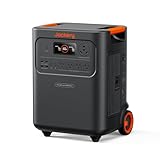
Best for Larger Expandable Backup: Jackery HomePower 3600 Plus
Key specs: 3,584Wh capacity; 3,600W AC output; LFP battery; advertised expansion up to 21kWh; solar panels optional.
Pros
- Largest starting energy reserve among these eight selections.
- Offers an expansion path for longer essential-load coverage.
Cons
- The advertised expanded capacity requires additional equipment.
- A large battery alone does not establish whole-home compatibility.
The HomePower 3600 Plus is the strongest choice here for a household whose essential-load calculation has outgrown the 1kWh and 2kWh categories. Its starting capacity is 3,584Wh, with 3,600W of AC output. That gives it both the largest listed reserve and the highest continuous output in this group, before adding any expansion equipment.
Those specifications create room for a more substantial plan, but the plan still needs boundaries. Prioritize the appliances you need, confirm their startup requirements, and total the demand that could occur simultaneously. A refrigerator and several small devices are a different assignment from electric heating, cooking, and laundry, even if everything has an ordinary-looking plug.
To put the reserve in perspective, a hypothetical constant 200W load would use the nominal battery energy in about 17.9 hours before losses. A 1,000W load would bring that theoretical time down to about 3.6 hours. Neither figure is a measured result, and real AC runtime will be shorter. They show why a large battery can feel generous with a restrained load and much smaller with demanding equipment.
Jackery advertises expansion up to 21kWh. That is a system-level capacity claim, not the storage included with this standalone station. Before committing to expansion, confirm the compatible batteries, connection equipment, space requirements, and total cost. Additional watt-hours can extend duration; do not assume they raise the main station’s output or add a different output voltage.
For refrigeration, use an appliance thermometer as well as an energy estimate. The FDA’s outage guidance says to keep a refrigerator at 40°F or below and keep its door closed as much as possible; an unopened refrigerator generally stays cold for about four hours without power. Those limits are a reason to plan refrigeration carefully, rather than assuming a battery display proves food remained cold enough.
A connection to household circuits needs separate evaluation. Check the exact equipment and installation arrangement with a qualified electrician. The 3,600W output rating alone does not establish that the station can support a particular home’s wiring, 240V equipment, or automatic transfer arrangement. For direct appliance use, follow the station and appliance instructions and keep total connected demand within the applicable limits.
Placement deserves attention before buying an expandable system. The HomePower 3600 Plus manual calls for unobstructed vents and a cool, dry environment with adequate airflow. It also states that the unit is not waterproof or dustproof. A location that accommodates the station today should also leave room for approved accessories if expansion is part of the purchase decision.
Choose this Jackery when the larger starting reserve solves a measured need, with expansion as a considered next step. It offers more scope for essential-load backup than the smaller models, while your household’s demand and recharge plan determine how long that advantage lasts.
Pros
- Exceptional 3600W output handles high-draw appliances like pumps and dryers
- Four flexible charging options including solar, AC, DC, and gas generator
- LFP battery technology tested to prevent thermal runaway at 302°F
- 34% more compact and 29% lighter than comparable 3.6kWh models
- Expandable capacity system grows with household power demands
Cons
- 77-pound weight requires wheeled transport even with lightweight design
- No customer reviews yet to verify real-world performance claims
- $1,899 premium price point requires significant upfront investment
The HomePower 3600 Plus solves the anxiety of extended power outages without the noise, fumes, or maintenance headaches of traditional gas generators. With enough capacity to run your refrigerator, sump pump, and heating system simultaneously for days, it provides genuine peace of mind during storm season. The ceramic membrane battery cells mean you can store this in your garage through freezing winters or sweltering summers without worrying about safety or performance degradation.
What sets this apart is the expandability. Start with one unit today, and if your power needs grow or you want backup for a longer duration, you can add battery packs to reach 21kWh without replacing your entire system. The four charging methods mean you are never stuck waiting days for solar alone when you need power fast.
If you want whole-home backup power that works the moment you need it without calling an electrician or dealing with gasoline, this one delivers.
Styles it works with: Modern Utility, Industrial, Contemporary, Emergency Preparedness Aesthetic
Best placed in: Garage corner with easy outlet access, basement utility room near electrical panel, mudroom for quick deployment
May not suit: Small apartments without dedicated storage space for a 77-pound unit, homes without capacity to utilize 3600W output, renters who cannot modify electrical systems for transfer switch installation
Buy it if:
- You live in an area with frequent or extended power outages lasting multiple days
- You need to run medical equipment, sump pumps, or well pumps during emergencies
- You want backup power without the noise, fumes, and maintenance of gas generators
- You have 240V appliances like dryers or well pumps that need emergency power
Consider waiting if:
- You want to see real customer reviews before investing in this newly released model
- You are watching for potential holiday or seasonal sales on premium power stations
Skip it if:
- You only need to charge phones and laptops during brief outages and a smaller power bank would suffice
- Your budget maxes out below $1,500 and you need backup power immediately
- You cannot physically move or store a 77-pound unit in your living space
Check the latest price and availability on Amazon before it sells out.
What to Consider Before Buying
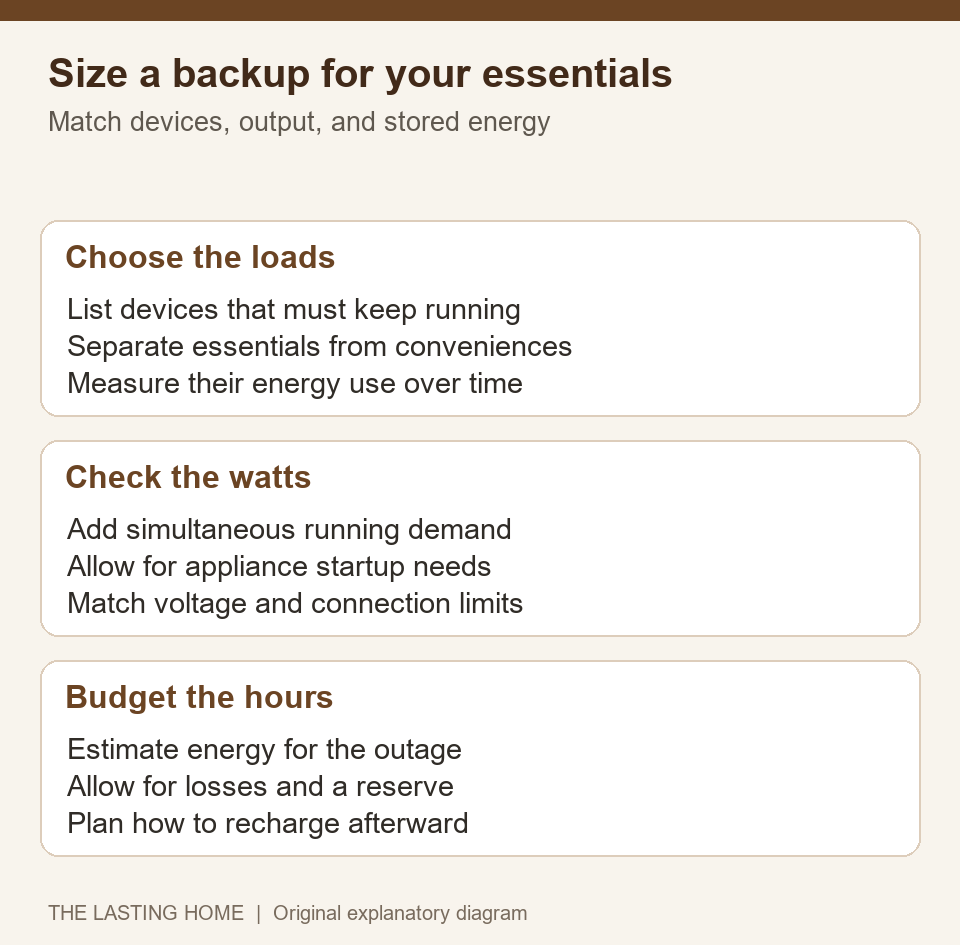
Write down the devices you need, the hours they must operate, and where the station will sit. That turns an abstract battery comparison into a household decision. Separate must-have loads from occasional conveniences before calculating either output or capacity.
Choose the required output and the energy reserve separately; a higher wattage rating alone does not extend backup time.
Maximum Output and Startup Demand
Continuous output is the total power a station can supply while operating normally. Add the electrical input of devices that may run together and leave room for startup demands. A motor can briefly require more power when starting than when running; a peak rating needs a specified duration and compatible load to be useful.
Check appliance nameplates and manuals. For a microwave, use electrical input rather than cooking output. A plug-in energy meter can help describe normal consumption, but an ordinary meter may not capture a brief startup spike. Ask the appliance or station manufacturer about uncertain combinations.
Do not combine continuous, peak, and boost ratings into one interchangeable number. Also check each outlet’s own limit: the inverter’s total rating does not mean every individual connection can deliver that entire amount.
Capacity and Realistic Runtime
Watt-hours measure stored energy. Virginia Cooperative Extension’s energy-use guide explains the relationship between watts and operating hours and notes that refrigerators cycle on and off. This is why appliance energy measured over time is more useful for duration planning than a single momentary reading.
For a steady load, nominal capacity divided by average watts gives a theoretical runtime. Usable energy is lower because the station consumes power and conversion is imperfect. There is no single loss percentage established for every station here.
As a planning example, assume a 1,024Wh battery delivers 80% of its nominal energy to a 100W load. The estimate is 1,024 × 0.80 ÷ 100, or about 8.2 hours. The 80% factor is an assumption, not a measured efficiency claim. Add reserve for uncertainty instead of planning to exhaust the battery exactly when power should return.
Battery Chemistry and Storage
LiFePO4 and LFP are names for lithium iron phosphate chemistry. Most selections here explicitly identify it, but chemistry alone does not establish a particular cycle life, warranty, or number of years of service. The ZeroKor kit’s chemistry is not specified in the information used for this guide.
Follow the manufacturer for charging temperatures, storage charge level, inspection intervals, and approved equipment. Avoid imposing one universal storage routine on every model. If the station develops damage or unusual behavior, stop using it and follow the manufacturer’s support instructions.
Portability and Placement
Check the exact weight and dimensions before purchase, particularly if your plan involves stairs. Those details are not established for the selected configurations in this comparison. Handle placement, lifting ability, and the route from storage to the appliance can matter as much as the word portable.
Choose a dry, stable location with the clearance required by the manual. Keep vents free and allow space for plugs and cables. Consider whether every household member who may need the station can reach its controls and make the intended connections.
Ports, Solar Inputs, and Home Connections
List the connectors your devices need, then check each port’s voltage, power rating, and any shared limits. Direct USB-C is useful only when the station, cable, and device support a compatible charging profile. An adapter cannot create output capability the station lacks.
For solar, verify the station’s allowed input voltage and current, panel specifications, connectors, and cable requirements. Panel wattage alone does not prove compatibility. For home circuits, consult a qualified electrician about an approved transfer arrangement. Never feed power into household wiring through a wall receptacle: the Electrical Safety Foundation explains how transfer switches prevent backfeeding.
Controls and Outage Readiness
Look for a display you can read and physical controls you understand. If a model supports an app, establish whether important settings also work without home internet. Check output timeout settings, particularly for devices that draw little power or cycle off for long periods.
Before an emergency, charge and operate the station according to its instructions, confirm your intended connections, and keep approved cables together. A runtime estimate on a display changes with the load; it is a planning aid rather than a promise about the next several hours.
UPS Functions and Transfer Time
A UPS feature can switch compatible connected equipment to battery when incoming AC power fails. A listed 10ms interval still includes a transfer period. Confirm the equipment’s tolerance, the supported operating mode, and any bypass-output limit in the station’s manual.
For a desktop computer or other interruption-sensitive load, confirm suitability before relying on a portable station as the backup. Equipment requiring uninterrupted power needs a solution matched to that requirement; a generic UPS label alone does not establish it. Continuous plug-in use should also follow the specific manufacturer’s instructions.
Noise and Recharging
Battery stations can produce fan noise during operation and charging. Output level, input speed, temperature, and placement can affect when cooling is needed. There are no independently verified sound measurements for these selections here, so do not assume a model is silent or quieter solely because it is smaller.
Finally, decide how you will replenish the battery after its first discharge. AC speed helps when electricity is available; solar depends on compatible equipment and adequate sunlight. Keep the station’s ventilation clear and follow its charging instructions. A useful home backup plan accounts for both the hours of stored energy and the next opportunity to replace them.





Write Your Review
No reviews yet. Be the first to share your experience!