

The DREO 1500W heater with 70-degree oscillation and ECO mode is the best starting point for most people seeking supplemental warmth in a large room. It combines a thermostat, remote and timer with a sweeping heat outlet, making it a practical option for an occupied seating area. That recommendation has a limit: a portable plug-in heater cannot guarantee comfortable temperatures throughout a drafty, open-plan space.
Choosing well means looking beyond the words “large room.” A heater that makes the sofa comfortable may leave a distant dining area chilly. Another model might offer convenient controls but little evidence about how evenly it distributes warmth.
Keep these priorities in mind:
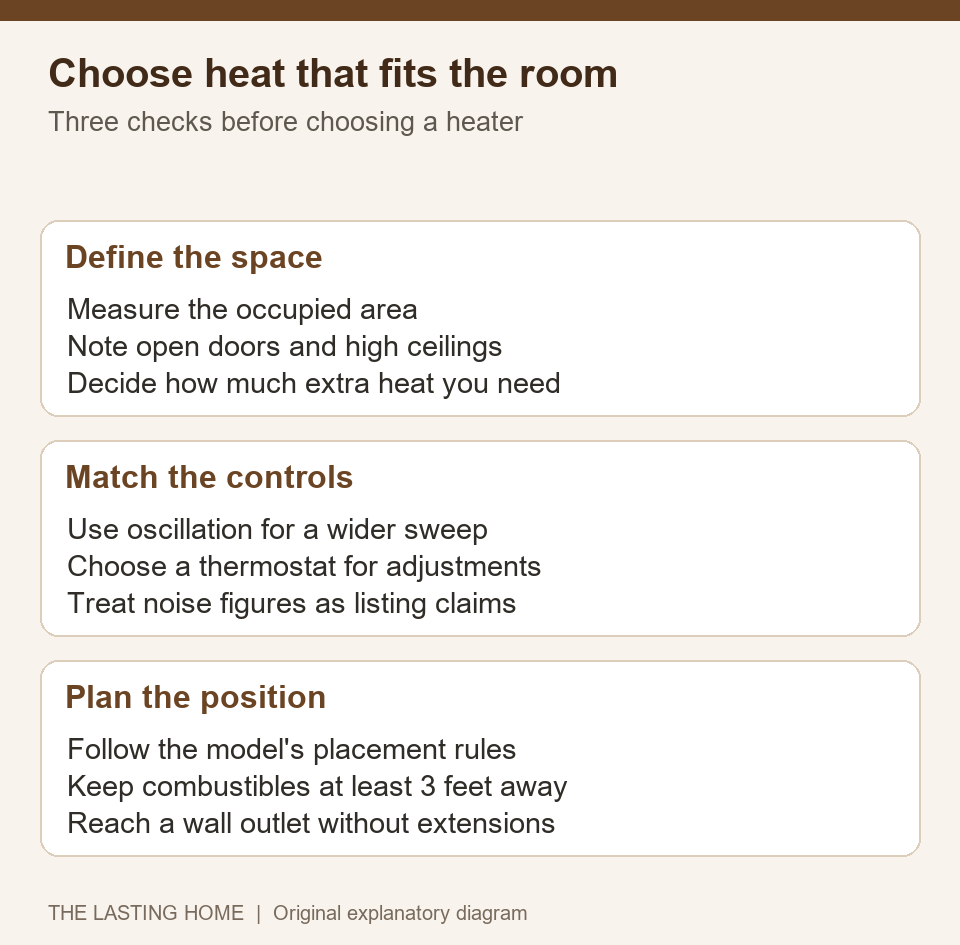
- Match the heater to the area you actually occupy and the heat already available.
- Favor useful temperature controls and unobstructed airflow over ambitious coverage claims.
- Check protective features and the safety label for the exact model.
- Treat quieter operation as a comfort feature, while still switching the heater off before sleeping.
Portable Heater Comparison
These five options cover broad airflow, quieter operation, flexible controls and personal warmth. The last two make more sense for a smaller occupied zone within a large room than for heating the entire space.
| Heater | Best fit | Listed power | Heat distribution | Controls and notable details |
|---|---|---|---|---|
| — | — | — | — | — |
| DREO 1500W with ECO mode | Balanced choice for a shared seating area | 1,500W | 70-degree oscillation | Thermostat, remote, 12-hour timer, ETL certification stated |
| DREO 25-inch heater | Noise-conscious home offices | Not specified | 70-degree oscillation | Thermostat, remote, child lock; listed 25 dB operation |
| WINHL portable five-mode heater | Convenient adjustments between activities | 1,500W | 70-degree oscillation | Thermostat, remote, five modes, 12-hour timer |
| GiveBest dual-wattage ceramic heater | Focused warmth with a lower heat setting | 1,500W/750W | Oscillation not specified | Thermostat, overheat and tip-over protection |
| Lasko 16-inch tabletop tower | Personal warmth near a work area | 1,500W | Oscillation; angle not specified | Thermostat, two heat settings, overheat protection |
This 2026 guide compares listed specifications alongside energy and electrical-safety guidance. Recommendations weigh practical controls, heat distribution and documented safeguards. Room-coverage claims remain dependent on the home, and missing specifications remain unconfirmed. The product discussions explain where each design makes sense and which details deserve checking before purchase.
Best Portable Heaters for Large Rooms and Smaller Zones
DREO 1500W with ECO Mode: Best Overall Starting Point
Best for: A living-room seating area where people want adjustable, distributed warmth.
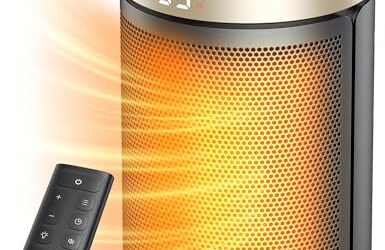
This DREO combines 1,500W output with a thermostat and 70-degree oscillation. That combination earns it the lead recommendation: the sweep can direct warm air toward more than one position, while the thermostat gives you a way to manage temperature as conditions change.
A remote and 12-hour timer make adjustments convenient from a chair. ECO mode is another useful control option, although its presence does not establish a particular percentage saving on your bill. The listing describes quiet operation without supplying a numerical sound level in its product description.
Reasons to choose it:
- Oscillation suits a seating arrangement wider than one chair.
- Remote, thermostat and timer cover the most useful everyday adjustments.
- The listing states ETL certification.
What to check: Confirm the exact model’s protective shutoffs and placement instructions. Neither the certification statement nor ECO mode establishes how much of your room will reach the selected temperature.
Choose it for supplemental comfort while you are present, with reasonable expectations about cold corners.

Pros
- Heats rooms in seconds with powerful 1500W ceramic element
- Exceptionally quiet at 34dB, quieter than most competitors
- Wide 70-degree oscillation covers large spaces evenly
- Comprehensive safety features including auto tip-over shutoff
- Energy-saving ECO mode reduces electricity costs
Cons
- No reviews yet to confirm long-term reliability
- Must plug directly into wall outlet, cannot use extension cords
- Gold color may not match all decor styles
This heater solves the two biggest complaints about space heaters: noise and uneven heating. At just 34 decibels, it runs quieter than a whisper, so you can finally warm your bedroom at night without that distracting hum. The 70-degree oscillation is a standout feature that sends heat into corners and across large rooms instead of creating one hot spot in front of the unit.
Safety is where DREO went all-in. The tip-over protection activates instantly if knocked over, the overheat sensor cuts power before any danger, and the 24-hour auto-shutoff ensures you never accidentally leave it running. The flame-retardant materials and ETL certification mean this passed serious third-party safety testing.
If you want a heater that warms a full room quietly without babysitting it for safety, this one delivers.
Styles it works with: Modern, Contemporary, Minimalist, Industrial
Best placed in: Living room corner near seating area, bedroom beside nightstand, home office under desk, basement workshop or garage workspace
May not suit: Homes with toddlers who might tip it (despite protection, still best kept away from little ones), spaces requiring ultra-compact heaters under 12 inches, traditional or farmhouse decor where the gold finish may clash
Buy it if:
- You need to heat a bedroom, living room, or office up to 270 sq ft quickly and quietly
- You want serious safety features like tip-over protection and automatic shutoff for peace of mind
- You are tired of space heaters that only heat the area directly in front of them
- You want to save on heating bills with the smart ECO mode that adjusts power automatically
Consider waiting if:
- You want to see verified customer reviews before purchasing, since this has zero reviews currently
- You are hoping for a color option that better matches your existing decor
Skip it if:
- You need to use an extension cord, as this requires direct wall outlet connection only
- You need a compact heater under 12 inches tall for tight spaces
Check the latest price and availability on Amazon before it sells out.
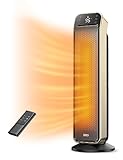
DREO 25-Inch Heater: Best for Noise-Conscious Spaces
Best for: A home office or sitting room where fan sound influences the purchase.
The clearest distinction here is the listing’s 25 dB quiet-operation claim. That makes this model worth considering when background noise matters, though it is a manufacturer figure rather than a measurement taken in your room. It should not be read as a promise of inaudible operation at every setting.
The 25-inch format includes 70-degree oscillation, a thermostat and remote. Child lock, overheating protection and tip-over protection are also explicitly listed. A child lock can help prevent changes to controls; it does not stop a child from touching or knocking the heater.
Reasons to choose it:
- A specific listed noise figure offers more information than a general “quiet” description.
- Oscillation and remote adjustments suit an occupied work area.
- The stated protective features are clearly identified.
What to check: Confirm its electrical rating before comparing heat output. Wattage needs confirmation from the product rating label. Its taller size also deserves a clear placement spot away from foot traffic.
Pros
- Exceptionally quiet at 25dB, quieter than most space heaters
- Fast heating with upgraded hyperamics thermal design
- Comprehensive safety features including V0 flame retardant material and reinforced plug
- Four heating modes plus ECO mode for energy efficiency
- Wide oscillation coverage ideal for large living spaces
Cons
- No customer reviews yet to verify real-world performance claims
- At 7.26 pounds and 25 inches tall, it takes up more floor space than compact models
- Price point is higher than basic space heaters without smart features
This DREO tower heater solves the two biggest complaints about space heaters: they are either too loud or too slow. With 11.5 ft/s heating speed and whisper-quiet 25dB operation, you get a warm room without the jet-engine roar that ruins your focus or sleep. The 70-degree oscillation means no cold spots by the windows, and the precise thermostat lets you set your ideal temperature down to the single degree.
What really sets this apart for a home decor perspective is how it blends into your space. The slim 25-inch tower design takes up minimal floor area, the gold finish adds a premium touch, and you can control everything by remote without getting up. Safety features like child lock and tip-over protection make it practical for real family life, not just showroom perfection.
If you want a heater that warms your entire living room or bedroom quickly without sounding like a hairdryer, this one delivers.
Styles it works with: Modern, Contemporary, Minimalist, Scandinavian
Best placed in: Living room corner near seating area, beside the bed in a master bedroom, home office under a desk, open-concept space between kitchen and living area
May not suit: Small bedrooms under 100 sq ft where a compact heater would suffice, homes with toddlers who might pull on the tall tower despite child lock, rooms with very low ceilings where the 25-inch height feels cramped
Buy it if:
- You need to heat a large room (100-270 sq ft) quickly and evenly
- Noise is a deal-breaker and you want genuinely quiet heating for sleeping or working
- You value safety features like child lock, tip-over shutoff, and flame retardant materials
Consider waiting if:
- You prefer to see customer reviews before committing to a new product release
- A sale or promotional discount might appear in the next few weeks
Skip it if:
- You only need to heat a small personal space under 100 sq ft where a compact heater works better
- Your budget is under $70 and you can compromise on quiet operation or smart features
Check the latest price and availability on Amazon before it sells out.
WINHL Portable Five-Mode Heater: Best for Flexible Controls
Best for: Someone who wants several operating choices and remote adjustments.
This WINHL offers a thermostat, five modes, 70-degree oscillation and a 12-hour timer alongside its listed 1,500W output. Its appeal is the range of adjustments: you can choose settings for different activities without walking back to the unit each time.
The mode count alone does not explain what every mode does. Check those functions before buying if a particular option, such as fan-only operation, is essential. The listing also describes quiet operation without a numerical sound rating, so there is no sound figure here to compare directly with the taller DREO.
Reasons to choose it:
- Remote control makes changes convenient across a room.
- Oscillation offers a broader sweep than a fixed outlet.
- Thermostat and timer provide alternatives to leaving it running indefinitely.
What to check: Review its certification label and protective shutoffs in the exact model’s instructions. Those details should not be borrowed from another WINHL heater.
It suits buyers who value control options more than an extensively documented noise specification.

Pros
- PTC ceramic element delivers instant warmth within seconds of switching on
- Wide oscillation sweep prevents uneven hot spots in small rooms
- Remote control and 12-hour timer offer convenient hands-free operation
- Compact footprint saves desk and nightstand space
- Safety shutoffs provide peace of mind in busy households
Cons
- Remote requires 2 AAA batteries that are not included in the box
- No customer reviews yet to verify real-world performance and longevity
- Designed for personal spaces only, not effective for heating entire large rooms
This little tower does exactly what a supplemental heater should: it takes the chill off your immediate corner without cranking the thermostat for the whole house. The ceramic element spins up fast, so you feel warmth within seconds of plugging it in, and the 70-degree oscillation means your entire desk setup or bedside gets even heat instead of a single blasting stream.
We appreciate the remote control and ECO mode. You can dial in your preferred temperature from the couch or bed, and the thermostat cycles the unit on and off to hold that setting without running nonstop. The compact size fits on a nightstand or office desk without dominating the surface, and the tip-over shutoff gives you confidence if kids or pets are roaming around.
If you want quick, focused warmth for a home office or bedroom corner without waiting on central heat or heating rooms you are not using, this one delivers.
Styles it works with: Modern Minimalist, Scandinavian, Contemporary Office, Cozy Farmhouse
Best placed in: Home office desk corner, beside the bed on a nightstand, bathroom counter during morning routines, small guest bedroom
May not suit: Large open-plan living rooms or high-ceiling spaces where you need whole-room heating, homes where you cannot plug directly into a 15A wall outlet, households that prefer decor-statement heaters with decorative finishes
Buy it if:
- You work from a home office and need quick warmth at your desk without heating the whole house
- You want bedside heat that you can control from under the covers with a remote
- You need a compact heater that fits on a nightstand or desk without taking over the surface
- You have kids or pets and want tip-over and overheat protection built in
Consider waiting if:
- You want to see verified customer reviews before committing to a new product launch
Skip it if:
- You need to heat a large living room or open-plan area beyond a personal workspace
- You only have access to power strips or extension cords instead of direct 15A wall outlets
Check the latest price and availability on Amazon before it sells out.
GiveBest Dual-Wattage Ceramic Heater: Best for Focused Warmth
Best for: One occupied area where a choice of two heat outputs is useful.
GiveBest’s main advantage is straightforward: the listed 1,500W and 750W settings provide a choice between full output and a lower heating level. The thermostat adds temperature control, and the listing identifies both overheat and tip-over protection.
The lower setting may be useful when the room already has background heating and only a little extra warmth is needed nearby. It draws less power while operating at that setting, but also supplies less heat. It is not automatically the cheaper way to maintain the same room temperature.
Reasons to choose it:
- Two stated wattages make the output choices easy to understand.
- A thermostat supports adjustments as the room warms.
- Overheat and tip-over protection are explicitly listed.
What to check: Oscillation is not specified, and the quiet-operation description has no numerical rating. Treat this as a focused heating option rather than assuming it will spread warmth evenly across a wide living room.
It is most convincing when your goal is personal comfort within a larger space.

Pros
- Exceptionally quiet for a fan-forced heater, suitable for sleeping or working
- Auto thermostat eliminates manual adjustments and prevents overheating
- Versatile 3-in-1 use: high heat, low heat, and cool fan mode
- Robust safety suite including V0 flame-retardant housing, tip-over shutoff, and overheat protection
- Outstanding value at under $30 with a track record backed by tens of thousands of verified buyers
Cons
- Only covers up to 200 sq ft, making it insufficient as a primary heat source for larger living rooms or open-plan spaces
- 2-prong cord with no grounded plug may not suit all outlet configurations
- No remote control or smart home integration, unlike higher-priced wall heater alternatives
The GiveBest heater punches well above its price point. It is the kind of thing you buy for a drafty home office and then quietly move to the bedroom, the bathroom, and eventually realize you cannot live without. The silver finish is understated enough to blend into most spaces without looking like an eyesore, and the compact footprint means it tucks beside a desk or nightstand without dominating the room.
What sets it apart from similarly priced heaters is the automatic thermostat. Most budget heaters blast at full power until you turn them off manually. This one cycles on and off to hold your preferred temperature, which means quieter operation, lower energy use, and no waking up at 2am in a sweat. The tip-over shutoff is also a genuine safety feature, not just a checkbox, with an audible beep to alert you if it gets knocked over.
If you want reliable, quiet spot heating for a small room without paying for features you will never use, this one delivers.
Styles it works with: Minimalist, Scandinavian, Modern, Contemporary
Best placed in: Home office desk corner, beside the bed on a nightstand floor, bathroom vanity area
May not suit: Large open-plan living rooms over 200 sq ft, or households with toddlers who could knock it over frequently despite the shutoff protection
Buy it if:
- You need affordable, portable heat for a home office, bedroom, or small bathroom and want automatic temperature control without the price tag of a smart heater
- You want a single device that works as both a heater in winter and a fan in summer
- You are heating a specific zone rather than an entire floor and want to avoid raising your central heating bill
Consider waiting if:
- You prefer a color other than silver and want to check for seasonal availability
Skip it if:
- You need to heat a room larger than 200 sq ft as your primary heat source
- You require Wi-Fi or app control for integration with a smart home setup
Check the latest price and availability on Amazon before it sells out.
Lasko 16-Inch Tabletop Tower: Best for a Personal Work Area
Best for: A smaller working zone where an oscillating format is useful.
This Lasko brings a thermostat and oscillation to a 16-inch tower marketed for tabletop use. It lists 1,500W power, two quiet heat settings, overheat protection and a cool-touch exterior. That makes it a relevant personal-warmth alternative when a larger floor tower does not suit the intended setup.
Its inclusion does not mean a short heater can warm an entire large room. The reason to consider it is its format and adjustable airflow near an occupied area. A cool-touch description also should not be extended to the outlet grille or treated as permission for contact.
Reasons to choose it:
- Oscillation offers more directional coverage than a fixed personal heater.
- Two heat settings and a thermostat allow basic adjustments.
- The shorter format may suit a dedicated personal heating position.
What to check: Read the manual’s approved placement directions before planning any tabletop setup. Keep papers, cables and other objects clear. Oscillation angle and tip-over protection are not specified in the product description.

Pros
- Space-efficient 16-inch height works on tables or floors
- Oscillation distributes warmth more evenly than fixed heaters
- Simple manual controls require no app or remote pairing
- ETL safety certification and 3-year warranty
- Affordable at $40 for 1500W ceramic heating power
Cons
- No reviews yet to confirm real-world performance and noise levels
- Manual controls only - no remote or timer for bedside convenience
- 6-foot cord may require extension cord for some room layouts
This Lasko tower heater solves the problem of bulky space heaters that dominate your floor space. At just under 16 inches tall, it perches on a nightstand or desk while delivering the same 1500W ceramic heat as full-size models. The oscillation feature is the real differentiator here, sweeping warmth across the room instead of creating a hot zone directly in front of the heater.
The manual controls sitting on top mean no fumbling for a remote when you're already under the covers, and the adjustable thermostat stops the unit from cycling endlessly once your room reaches the right temperature. The cool-touch housing and overheat protection add reassurance if you have kids or pets wandering through.
If you want supplemental heat for a bedroom or home office without sacrificing precious floor space, this one delivers.
Styles it works with: Modern Minimalist, Scandinavian, Contemporary, Small-space Urban
Best placed in: Bedroom nightstand, home office desk, bathroom counter during morning routines, compact apartment corners
May not suit: Large open-concept living rooms needing whole-space heating, homes requiring smart home integration or voice control, renters with outlets far from desired heating zones (6-foot cord limitation)
Buy it if:
- You need supplemental heat for a bedroom, home office, or bathroom without using floor space
- You prefer simple manual controls over app-based smart features
- You want oscillation to spread heat more evenly in small to medium rooms
Consider waiting if:
- You want to see customer reviews and real-world noise level reports before purchasing
Skip it if:
- You need remote control or timer functions for bedside operation
- Your outlet placement requires a cord longer than 6 feet without using an extension
Check the latest price and availability on Amazon before it sells out.
Match Heating Power to the Room and Airflow
Start by measuring the room, then consider how much of it needs extra heat. A closed office with normal-height ceilings presents a different task from a living area opening onto a hallway and kitchen. Ceiling height, insulation, window area, outdoor temperature and the existing heating system all affect the result.
A 1,500W label is an electrical input rating, not a room-size guarantee. An oscillating outlet changes where the warm airflow goes; it does not increase the heater’s maximum heat output. That distinction explains why two equal-wattage models can feel different from your chair without one creating substantially more heat.
For example, consider an 18-by-16-foot living room: its floor area is 288 square feet. If central heating already keeps it moderately warm, a portable heater may make an occupied seating group more comfortable. If that same room is very cold and connected to other unheated areas, one plug-in heater may never deliver the temperature you want throughout it. There is no reliable universal coverage number without knowing the room’s heat loss.
Think about the route between the outlet and the seating area. A bookcase, sofa back or partly closed door can interfere with the airflow you are paying for. Choose a permitted placement with a clear path into the occupied area, while maintaining every clearance in the manual.
At a nominal 120 volts, 1,500W represents about 12.5 amps: watts divided by volts. That is a substantial load, so another high-demand appliance on the same circuit can be a problem. Two wall outlets may share one circuit. Do not assume that moving a second heater to the opposite wall solves an overload.
If the room consistently needs more heat than one portable unit can provide, address heat loss or ask a qualified heating professional about a suitable permanent solution.
Room conditions, useful controls and an appropriate placement matter more than a large-room label alone.
Check Safety Features and Plan the Placement
Look for documented tip-over and overheat shutoffs. They serve different purposes: one responds to the heater being displaced from its operating position, while the other responds to excessive temperature. They reduce particular risks but do not make blocked airflow, damaged wiring or combustible surroundings acceptable.
Check the certification label on the exact unit. Intertek explains that the ETL Listed mark indicates independent certification to applicable safety standards. A general phrase such as “multiple protections” is less informative than clearly named safeguards and a recognizable certification mark. Do not assume that every model from a brand has the same certification.
Placement remains essential even with those features. The U.S. Consumer Product Safety Commission’s heating guidance calls for at least three feet between portable heaters and combustible materials, direct connection to a wall outlet, and switching heaters off when sleeping. Extension cords and power strips are unsuitable shortcuts when the cord will not reach.
Choose a stable, level surface permitted by the manufacturer, outside walking routes. Floor models belong in an approved floor position; do not raise them on stools or furniture to change airflow. For any model marketed for tabletop use, verify the manual’s placement and clearance requirements before deciding where it will go.
With children or pets, plan how to keep them away from the unit and cord. A remote is useful for adjustments, while a child lock limits control changes. Neither creates a physical barrier around hot surfaces. A heater also needs a position where curtains cannot swing toward it and a pet bed cannot be pushed against it.
Before use, inspect the cord, plug and housing. The Electrical Safety Foundation’s advice emphasizes reading the manufacturer’s warnings, avoiding damaged connections and never leaving a space heater unattended. A timer is a backup convenience, not a substitute for being present.
Compare Running Costs and Energy Controls
The main running-cost calculation is simple: kilowatts multiplied by operating hours multiplied by your electricity rate. The U.S. Energy Information Administration explains the distinction between watts and watt-hours: power describes the rate of use, while energy includes how long that power is used.
A 1,500W heater drawing full power for one hour uses 1.5 kWh. The examples below use an illustrative electricity rate of $0.20 per kWh, not a current local tariff or product price.
| Full-output use | Energy consumed | Illustrative energy cost |
|---|---|---|
| — | — | — |
| One hour at 1,500W | 1.5 kWh | $0.30 |
| Four hours at 1,500W | 6 kWh | $1.20 |
| Four hours daily for 30 days | 180 kWh | $36.00 |
Actual consumption changes when the thermostat cycles the heater or a mode reduces its draw. A four-hour session does not necessarily mean four hours at maximum power. Conversely, an especially cold room may keep the heater operating at high output for much of the session.
Electric resistance heaters convert essentially all the electricity they use into heat at the point of use. As Ontario’s Save on Energy buying guide explains, equal-wattage heaters used under the same conditions have similar energy consumption. An ECO label does not establish a separate, superior heat-conversion efficiency.
Thermostats and ECO modes are useful when they reduce unnecessary heating. There is no sound basis for promising a fixed saving without knowing the room, temperature setting and operating pattern. A lower wattage may simply need to run longer.
Adding a portable heater while keeping the main heating unchanged adds energy use. Saving overall depends on reducing heating demand elsewhere while maintaining appropriate temperatures throughout the home. Compare the whole heating arrangement rather than assuming a portable heater will automatically cut the bill.
Consider Noise and Comfort During Longer Sessions
Noise descriptions deserve careful reading. Among the listings compared here, only the DREO 25-inch model provides a numerical sound figure. The other quiet-operation claims do not support a measured ranking, and even numerical claims may use different distances, settings or room conditions.
Consider the kind of sound you find distracting. Continuous airflow, a thermostat clicking and the movement of an oscillating mechanism can be noticeable in different ways. A low listed number cannot tell you whether a particular sound will interrupt a video call or bother you during quiet reading.
Comfort also depends on airflow direction. A strong warm stream can feel pleasant briefly and excessive when aimed at the same chair for an entire afternoon. Oscillation may help distribute that stream across several positions, although furniture and room layout still shape the result.
For longer occupied sessions, choose a modest temperature target and make adjustments gradually. A thermostat senses conditions near its sensor; that reading may differ from the temperature across the room. An independent room thermometer near the occupied area can help you judge comfort without repeatedly increasing the setting.
If fan sound is your main objection, a fanless oil-filled radiator is another category to consider. Such heaters generally warm and cool more slowly. Their residual warmth comes from stored heat, so it should not be counted as energy created after switch-off. Turn any portable heater off before sleeping.
Avoid Mistakes That Leave the Room Cold
Buying on coverage claims alone. Treat advertised square footage as a starting question. Ask whether the room is enclosed, already heated and reasonably insulated. None of the selections here has a verified coverage guarantee for your home.
Ignoring drafts. A cold current near the sofa can undermine comfort even when a heater is working. ENERGY STAR’s guide to locating air leaks explains how escaping heated air draws replacement cold air into a home. Investigate persistent drafts instead of continually raising the heater setting.
Blocking the outlet to hide the heater. A unit behind furniture cannot distribute air as intended. Place it where its permitted airflow path and clearances work with the room layout. If no suitable location reaches a wall outlet directly, choose a different arrangement.
Treating the remote as permission to leave. Convenient controls do not change the need for supervision. Switch the heater off when leaving the room, then follow its shutdown instructions.
Letting dust accumulate. Follow the manufacturer’s cleaning method and frequency. Disconnect power and allow the heater to cool before permitted cleaning; do not open the housing, introduce liquid or improvise an internal cleaning method.
Continuing after electrical trouble. A hot plug or outlet, burning smell, damaged cord or repeated breaker trip needs attention. Stop using the heater and have the cause assessed rather than repeatedly resetting the breaker.
Frequently Asked Questions
What size portable heater works for a large room?
Many plug-in options offer 1,500W, but wattage alone cannot establish room coverage. In a large room, treat one as supplemental heating unless the room’s heating requirement supports something more. High ceilings, open doorways, poor insulation and cold outdoor conditions all make the task harder.
Are oil-filled radiators quieter than ceramic fan heaters?
Fanless oil-filled radiators avoid fan noise, so they may suit people who dislike airflow sound. They can still make thermostat or expansion sounds. Their slower response also feels different from a fan heater directing warm air toward you. Choose according to noise sensitivity and how quickly you want warmth.
Can a portable heater help in a drafty room?
It can improve comfort nearby, but it cannot stop heat escaping. Address obvious air leaks where appropriate and investigate persistent cold areas. If the heater runs continuously with little improvement, the room may need insulation, air sealing or a different heating solution rather than a more elaborate portable model.
Does oscillation make a heater more powerful?
No. Oscillation changes the direction of the airflow, helping several positions receive warmth in turn. It does not raise the electrical heating capacity or guarantee even temperatures throughout an open room. It is most useful when the sweep actually reaches the occupied area without furniture blocking it.
Is a remote control an essential safety feature?
A remote adds convenience and may reduce the need to reach toward the unit. It does not replace protective shutoffs, safe clearance or supervision. Keep controls away from children and use the heater’s own switch or shutdown procedure as instructed when finishing a session.
Which safety labels and protections should I check?
Look for a recognized safety listing, such as UL, ETL or CSA, appropriate to the exact model and market. Confirm tip-over and overheat protection separately rather than assuming a brand-wide specification. Before buying, check the model’s manual for approved placement so you know it will fit the room safely.
Write Your Review
No reviews yet. Be the first to share your experience!