

> Editorial Note: I’m Erin Schwartz, and I cover home decor with a bias toward what actually works in a real room. The guidance here weighs scale, layout, and materials against Apartment Therapy and Wirecutter coverage rather than styling a space that nobody lives in.
The single decision that shapes the whole install is recessed versus surface mount, and it’s better made before you buy the cabinet than after. A recessed unit sits flush inside the wall for a clean built-in look but demands cutting into studs, while a surface mount screws onto the wall in under an hour. If you’re still choosing the box itself, the tradeoffs in in wall medicine cabinet and recessed medicine cabinet with mirror matter as much as the install, and a small medicine cabinet, a medicine cabinet with mirror, or a budget medicine cabinet under $150 each carry their own fit rules. Once it’s up, how to organize a medicine cabinet is the easy part.
Decide Before You Cut: Recessed vs. Surface Mount
Look inside the wall before you commit. A surface-mount cabinet works on any wall because nothing goes behind the drywall, which makes it the only real option on an exterior wall packed with insulation or a wall crossed by pipes and wiring. A recessed cabinet needs an empty stud bay, and the standard 16-inch on-center stud spacing gives you roughly 14.5 inches of usable width between studs.
That width limit is why so many recessed cabinets run 14 to 16 inches wide. Anything wider means cutting a stud and framing a header, which is a bigger job than most first-timers want. Check for plumbing and electrical with a stud finder that detects live wires before you open the wall.
One more thing to weigh: depth. A surface-mount cabinet projects 4 to 6 inches off the wall, which can crowd a narrow bathroom or catch a shoulder in a tight vanity nook. A recessed unit sits nearly flush, gaining back that space, and it’s the better call in a powder room under 40 square feet where every inch of clearance counts.
Gather Tools and Set the Height
You’ll need a stud finder, a level, a drill, a drywall or keyhole saw for a recessed job, and the right anchors for your wall type. Mount the cabinet so the mirror’s center sits about 60 inches off the floor, the standard eye-level line, and leave a few inches of clearance above the faucet so the door clears the fixtures when it swings.
Measure and mark before anything else. A cabinet hung even half an inch off level reads crooked against every tile line around it, and once the screws are in the drywall you don’t get a clean second try. Keep the bottom edge of the cabinet at least 4 inches above the backsplash so water and toothpaste splatter don’t reach the frame.
Installing a Recessed Medicine Cabinet
Find and mark the studs, then hold the cabinet against the wall and trace its outline, keeping one edge tight to a stud so you have solid framing to screw into. Cut along the outline with a drywall saw, going slow near the top and bottom to avoid cutting into wiring. Set the cabinet into the opening to check the fit before you fasten anything.
Add horizontal blocking between the studs at the top and bottom of the opening if the cabinet doesn’t reach framing on its own. Cut two lengths of 2×4 to fit snugly between the studs, screw them in through the drywall or from inside the bay, and they give the cabinet flanges solid wood to bite into. Slide the unit in, level it, and drive screws through the side flanges into the studs. Seal the gap around the frame with a thin bead of caulk so bathroom humidity can’t get behind it, the same moisture logic that governs any built-in near a shower.
Cut slowly and expect to patch. A recessed install almost always leaves a small gap or a rough drywall edge behind the flange, which the cabinet trim covers once it’s mounted. If your cut ran wide, a bead of caulk or a thin trim piece closes it cleanly.
Installing a Surface Mount Medicine Cabinet
This is the faster route by far. Mark the mounting-hole locations on the wall, level them, and drill pilot holes. If your holes land on studs, screw straight in; if they fall on bare drywall, use toggle or molly bolts rated for the cabinet’s loaded weight, since a stocked cabinet full of bottles and jars is heavier than the empty box suggests.
Hold the cabinet to the marks, drive the screws partway, check level one more time, then tighten fully. A helper makes the lift easier, but a strip of painter’s tape marking your level line lets you manage a light cabinet solo. Most surface installs take under an hour start to finish, against a half-day or more for a recessed cut-in. If the wall is tile, swap the wood bit for a masonry bit and drill on low speed to avoid cracking the glaze.
Finishing and Common Mistakes
Reinstall the door and shelves, and adjust the hinges if the door doesn’t sit square. Wipe the mirror, load the shelves heaviest-items-low so the cabinet doesn’t feel top-heavy, and confirm the door swings clear of the light fixture and the faucet. A quick bead of caulk along a recessed frame is the last step, and let it dry for at least 24 hours before you get the surface wet.
The mistakes that cost people are predictable. Cutting into a wall without checking for pipes or wiring, skipping the level, and using undersized drywall anchors top the list. Apartment Therapy and Wirecutter both flag anchor choice as the failure point on surface installs, because the wrong anchor pulls loose the first time a full door swings open.
Helpful Products
The three cabinets below all clear a 4.5-star owner rating and share a mirrored front, so the real choice is fit. The Venlus (16×24) and TEHOME (16×24) are standard-width recessed units sized for a typical single stud bay, while the smaller TokeShimi (14×18) suits a tighter wall or a half-bath and lists stepless adjustable shelves and a tempered-glass, beveled aluminum frame. Match the cabinet’s width to your stud spacing first, then pick on finish. The Venlus and TEHOME lead at 4.6 stars with the TokeShimi just behind at 4.5.

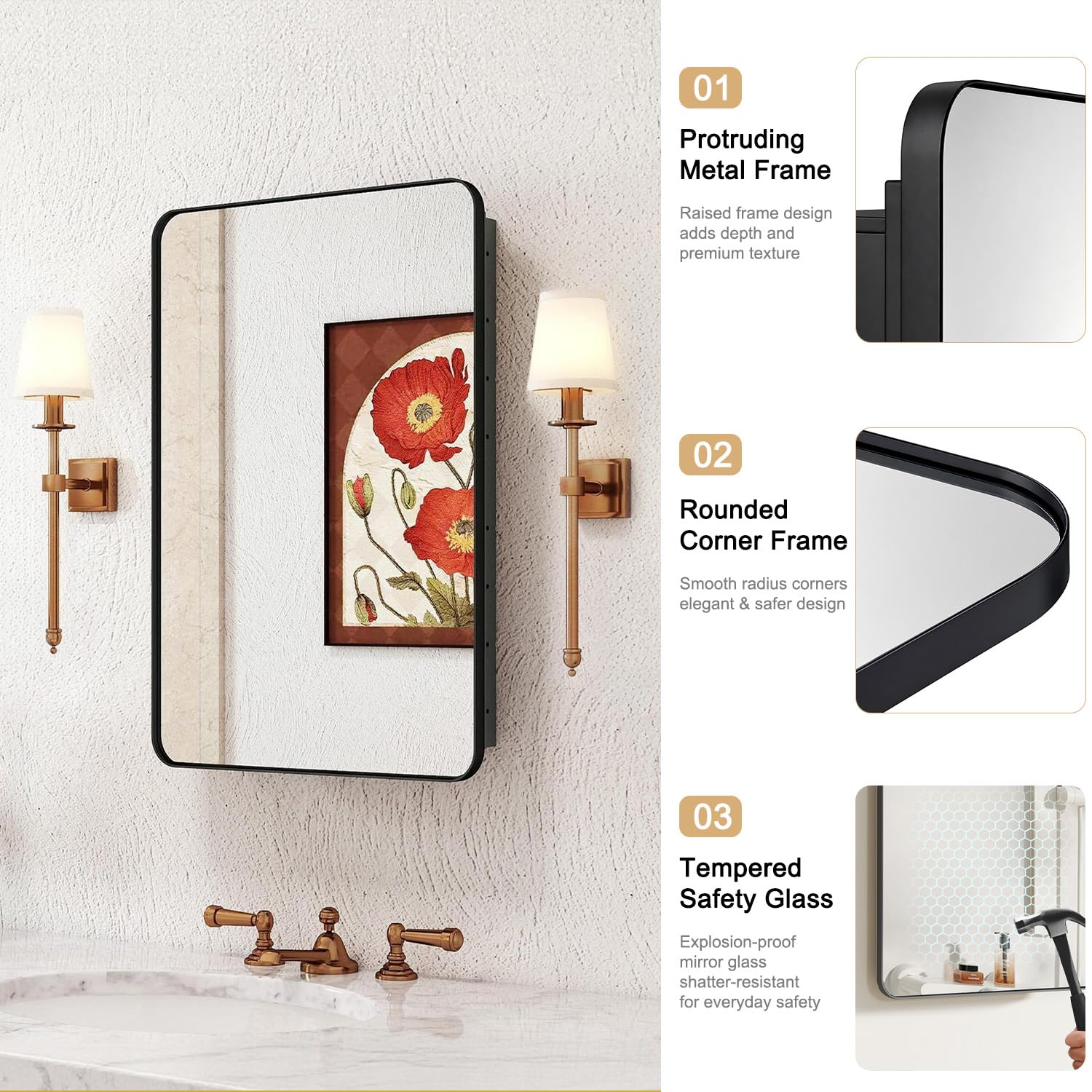
Venlus 16x24 Matte Black Medicine Cabinet with Mirror - Recessed or Surface Mount, Pre-Assembled, Reversible Door
Pros
- Pre-assembled design saves 30-60 minutes of frustrating setup
- High rating of 4.6 stars from 103 reviews suggests reliable quality
- Aluminum body won't warp, peel, or corrode in humid bathroom conditions
- Reversible door and dual installation options fit almost any bathroom layout
- Lead-free, eco-friendly glass is safer and more environmentally responsible
Cons
- Only 2.9 inches deep, so it won't hold wide product containers or multiple rows of items
- Recessed installation requires a 3.3-inch wall cavity, which may not exist in all bathrooms
- Matte black finish shows water spots and fingerprints more easily than white or silver
This Venlus cabinet solves one of the most annoying parts of bathroom upgrades: the assembly process. It shows up at your door fully put together, which means you can focus on the installation itself instead of wrestling with tiny hinges and misaligned shelves. The matte black finish looks sharp against white subway tile or marble countertops, and the magnetic closure gives it a quality feel that cheaper cabinets lack.
The reversible door is a smart touch for real-world bathrooms where the light switch or towel bar determines which way your cabinet needs to swing. You're not locked into a left-hand or right-hand model, so you can adjust on install day without returns or exchanges. The aluminum body handles steam and splashes without the warping or peeling issues you'd get from particle board or cheap metal.
If you want a modern, fuss-free medicine cabinet that installs quickly without sacrificing durability, this one delivers.
Styles it works with: Modern, Contemporary, Industrial, Minimalist
Best placed in: Master bathroom above vanity, guest bath for a polished look, powder room where space is tight
May not suit: Traditional or farmhouse bathrooms that need white or wood finishes, very small powder rooms where 16 inches wide feels too large, homes where you prefer chrome or brushed nickel hardware throughout
Buy it if:
- You're updating to matte black fixtures and want a cabinet that matches your new aesthetic
- You have the wall depth for recessed install or don't mind a slight surface-mount profile
- You value quick setup and would rather pay a bit more than spend an hour assembling a flat-pack cabinet
Consider waiting if:
- You're hoping for a sale below $80 and can wait for seasonal discounts
- You need to see it in person before committing to the matte black finish
Skip it if:
- You need more than 2.9 inches of storage depth for bulky items
- Your bathroom has a white or brushed nickel theme and matte black would clash
Check the latest price and availability on Amazon before it sells out.






Write Your Review
No reviews yet. Be the first to share your experience!