

> Editorial Note: I’m Olivia Bennett, a storage and organization contributor. I approach storage as a systems problem rather than a product one — fit to actual room dimensions, load ratings, and how the system holds up under daily use.
Most garages fail for one reason: everything ends up on the floor. People stack bins, lean rakes in corners, and pile boxes against the wall until the car no longer fits. The floor fills first because it’s the easy surface, but it’s the worst place to store anything you actually use. The fix is going vertical and overhead before you buy a single bin. Start with the walls and the ceiling, and the floor takes care of itself. For the gear that makes this work, see best garage storage systems, best garage storage shelves, best wall mounted shelves for garage, best garage cabinets, and best rolling storage cart.
The Ground Rules Before You Start
Declutter before you organize. You can’t build a system around stuff you don’t need, and most garages hold 30% more than the owner uses in a year. Zone by frequency: daily-use tools at eye level, seasonal items overhead, rarely-touched gear in corners. Measure before you mount anything. Track your usable wall height, note where the garage door track eats clearance, and confirm you have at least 16 inches of ceiling drop for overhead racks. Apartment Therapy calls measuring “the step everyone skips and everyone regrets.” They’re right.
Step 1: Empty It and Sort Into Zones
Pull everything out. All of it. You can’t see what you have when it’s buried three layers deep, so a full empty-out is the only honest starting point. Set up three zones on the driveway: keep, donate, toss.
Be ruthless with the toss pile. Dried paint cans, single gloves, the broken weed trimmer you meant to fix in 2023. All gone. The NEAT Method recommends a simple rule: if you haven’t used it in 12 months and it isn’t seasonal, it leaves.
Now sort the keep pile into four functional zones before anything goes back. Tools (hand tools, power tools, hardware). Sports and recreation (bikes, balls, camping gear). Seasonal (holiday decor, summer coolers, snow gear). Garden (rakes, hoses, fertilizer, pots). These four zones become the map for where things mount later.
Group like with like as you sort. Every loose screw, bracket, and bungee cord goes into a “small parts” pile of its own. That’s its own problem you’ll solve in Step 4. By the time the driveway is sorted, you’ll know exactly how much wall and ceiling space each zone needs.
Step 2: Get Everything Off the Floor and Onto Walls
The walls are your largest unused surface. A standard two-car garage has roughly 200 square feet of wall, most of it empty above waist height. Claim it.
Mount tool racks into the studs, not just drywall. Studs sit 16 inches on center in nearly all U.S. construction, so find them with a stud finder and anchor your rails to them. Drywall anchors alone will pull out under a loaded rake or a 30-pound power drill. A 48-inch rail spans three studs, which gives you a solid, level mounting line.
Hang the heaviest items like shovels, leaf blowers, and extension cords on the rack rated for the load. Lighter daily tools go at eye level between 48 and 60 inches off the floor, where you grab them without bending. Bikes lift onto wall hooks or a vertical bike mount, freeing the floor entirely.
The goal is simple. Nothing that can hang should sit on the ground. Once the walls carry the tools and sports gear, your floor opens up by half.
Step 3: Claim the Ceiling and Upper Walls
The space above your head is the most wasted real estate in any garage. Overhead racks turn it into prime seasonal storage. Most ceiling racks mount with a 16 to 24-inch drop, which keeps bins accessible by step stool while leaving headroom below.
Use the ceiling for things you touch a few times a year. Holiday bins, camping gear, the cooler, off-season tires. Standard overhead racks hold 250 to 600 pounds when lagged into ceiling joists, so distribute weight evenly and never hang a single rack off one joist.
The upper walls, that band above 6 feet, work for medium-weight, low-frequency items. Think labeled totes on high shelving or a long bracket shelf running the perimeter. Keep a clear 24-inch buffer around the garage door opener and its track so nothing fouls the mechanism.
One rule keeps overhead storage safe: uniform bins. Matching clear totes stack square, label-out, and won’t slide. Mismatched boxes shift and fall. Wirecutter makes the same point about overhead systems: consistency beats capacity.
Step 4: Corral Small Parts and Maintain It
Small parts are where every garage system quietly collapses. Loose screws, nuts, anchors, and fittings scatter across every surface until you can’t find the one you need. A wall-mounted parts-bin rack solves it in one move: dozens of removable bins, each holding a single category, mounted at eye level near your workbench.
Label every bin. A label maker or a strip of painter’s tape works; the point is that you read the bin instead of digging through it. Sort by type: wood screws here, drywall anchors there, hex bolts in their own bin. A 30-bin rack covers most home workshops.
Then maintain it. Book a monthly 15-minute reset: return strays to their zone, toss empties, refill the parts bins. That short habit is what separates a garage that stays organized from one that backslides in three weeks. The system only holds if you feed it.
The Right Organizers Make It Easier
These three picks map directly to the steps above: two wall-mount tool racks for getting gear off the floor, and a parts-bin rack for taming the small stuff.


TIDYME 48" Garage Tool Organizer Wall Mount - Heavy Duty 300 lbs Capacity, Carbon Steel, 3 Racks 6 Hooks
Pros
- Impressive 300 lb weight capacity handles heavy-duty tools without sagging
- Carbon steel construction offers durability for long-term garage use
- Adjustable hooks slide along the rack for flexible organization
- 48-inch length provides ample storage in a compact footprint
- Pre-drilled holes simplify wall stud installation
Cons
- Zero customer reviews make real-world performance difficult to assess
- Requires 16-inch stud spacing, which may not work in all garage layouts
- At 8.5 inches deep, it protrudes further from the wall than some compact alternatives
This TIDYME organizer solves the eternal garage problem: tools scattered across the floor, leaning in corners, or buried in bins where you can never find them. The 48-inch carbon steel rack mounts securely to wall studs and handles the weight of your heaviest garden tools, power equipment, and cleaning supplies without bending or pulling away from the wall.
What sets it apart is the sliding hook system. Instead of fixed positions, you can adjust hook spacing as your needs change. Park your leaf blower next to long-handled tools, then slide things around when you add a new weed trimmer. The 300 lb capacity means you are not constantly calculating weight limits or worrying about overloading one section.
If you want to clear garage floor space for parking or projects without investing in an expensive cabinet system, this one delivers.
Styles it works with: Industrial, Modern Utilitarian, Minimalist Garage, Workshop Aesthetic
Best placed in: Garage wall near entry door, Workshop tool wall, Utility room or mudroom for outdoor equipment, Basement storage area
May not suit: Garages without standard 16-inch stud spacing, Homes needing decorative storage solutions for visible living areas, Renters who cannot drill into walls
Buy it if:
- You need to clear garage floor space currently occupied by leaning tools and equipment
- You have standard 16-inch wall stud spacing and can drill mounting holes
- You want adjustable storage that adapts as your tool collection changes
- You are storing heavy items like metal rakes, full-size shovels, or corded power tools
Consider waiting if:
- You want to see verified customer reviews and photos of the product in real garages first
- You prefer a shorter or longer rack size to match your specific wall space
Skip it if:
- Your garage has non-standard stud spacing or you cannot locate studs for secure mounting
- You need a freestanding solution that does not require wall installation
- You are looking for a decorative organizer for visible living spaces rather than utility storage
Check the latest price and availability on Amazon before it sells out.
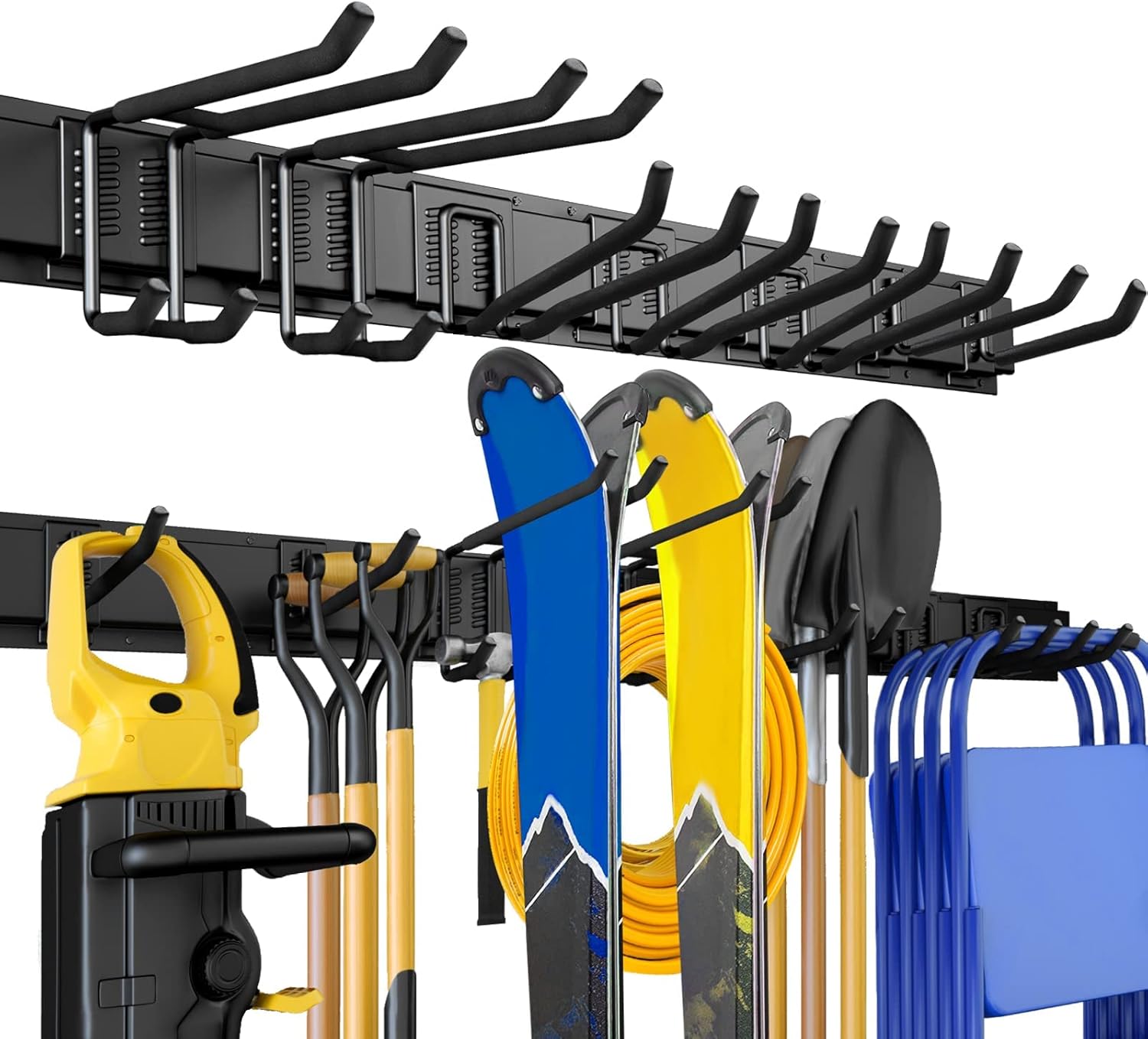
UUP 48" Heavy Duty Garage Tool Organizer - 440lbs Capacity Wall Mount with Adjustable Hooks for Garden Tools & Equipment
Pros
- 440-pound weight capacity handles heavy tools and equipment
- Seven hooks in different configurations (single, double-layer, and tool-specific) fit various item sizes
- Adjustable rail system lets you customize spacing without drilling new holes
- Heavy-duty steel construction with rust-resistant coating for long-term durability
- Rubber-lined hooks protect tools and prevent slipping
Cons
- No customer reviews yet to verify real-world performance claims
- Requires wall mounting with proper studs or anchors for advertised weight capacity
- May need additional hooks purchased separately for larger tool collections
This organizer solves one of the most frustrating parts of homeownership: the garage floor that slowly fills with rakes, shovels, and equipment until you can barely walk through. The UUP system gets everything off the ground and onto the wall where you can actually see what you own and grab what you need without moving three other things first.
What sets this apart is the adjustable track system. Unlike fixed-position racks, you can slide the hooks anywhere along the 48-inch rail. That means when you buy a new leaf blower or decide to reorganize for spring versus winter tools, you just move the hooks instead of drilling new holes. The rubber coating on the hook arms is a nice touch that prevents metal tools from sliding around or getting scratched.
If you want serious weight capacity and flexible organization without spending over $100 on a garage system, this one delivers.
Styles it works with: Industrial, Modern Farmhouse, Utilitarian, Minimalist garage aesthetics
Best placed in: Garage wall near entry door, garden shed interior wall, basement utility room, workshop above workbench
May not suit: Renters without permission to drill into walls, garages with limited wall space between windows or electrical panels, households needing decorative storage solutions for visible living areas
Buy it if:
- You have garden tools, shovels, rakes, or long-handled equipment currently piled on your garage floor
- You need to store heavy items like leaf blowers, weed eaters, or extension ladders on the wall
- You want a system that can be reconfigured without tools as your storage needs change
- Your garage or shed has at least 48 inches of clear wall space
Consider waiting if:
- You want to see verified customer reviews before purchasing (this is a newer product)
- You prefer a pre-assembled system that does not require any installation
Skip it if:
- You need storage shorter than 48 inches to fit between existing fixtures
- You rent and cannot mount heavy equipment to walls
- You only have a few lightweight tools that could work with adhesive hooks
Check the latest price and availability on Amazon before it sells out.

HORUSDY 30-Piece Wall Mount Storage Bin Organizer - Garage Tool Parts Rack with Color-Coded Removable Bins
Pros
- 30 bins provide serious storage capacity for the price point
- Three bin sizes (small red, small blue, large orange) accommodate different part types
- Bins detach from wall mount for portability to work area
- Color coding makes visual sorting intuitive and consistent
- Slat wall compatibility works with existing garage organization systems
Cons
- No customer reviews yet to verify long-term durability claims
- Bin capacity specs list confusing measurements (12 vs 76 cubic inches needs clarification)
- May require additional mounting hardware depending on your wall type
If you have ever spent 20 minutes searching for a single hex key in a cluttered toolbox, this organizer solves that exact problem. The color-coded bins turn chaotic junk drawers into a visual system where you can spot what you need in seconds. Red for small fasteners, blue for mid-size bits, orange for bulkier items. You decide the categories, and the colors keep you consistent.
What makes this practical for real garages is the removable bin feature. Instead of walking back and forth between your workbench and the wall, you grab the bin you need and bring it to your project. The slat wall mounting means you can rearrange bins as your needs change, and the durable plastic holds up to the temperature swings and occasional bump that come with actual garage use.
If you want organized tool storage that actually saves you time without spending hours setting up a complicated system, this one delivers.
Styles it works with: Industrial, Modern Utilitarian, Workshop Aesthetic, Functional Minimalist
Best placed in: Garage wall above workbench, basement workshop, shed interior, craft room organization wall
May not suit: Homes wanting decorative storage for living spaces, renters who cannot mount to walls, users needing weatherproof outdoor storage
Buy it if:
- You work on DIY projects regularly and need to find parts quickly
- Your current storage involves digging through mixed bins or drawers
- You have wall space in a garage or workshop that could use vertical organization
Consider waiting if:
- You want to see customer reviews accumulate before committing to this specific brand
Skip it if:
- You need storage for very large tools rather than small parts and hardware
- You cannot mount anything to your walls due to rental restrictions
Check the latest price and availability on Amazon before it sells out.
TIDYME 48″ Garage Tool Organizer Wall Mount
This is the rack for Step 2 in a standard garage. The 48-inch rail spans three studs at 16-inch spacing, so it mounts level and solid against the wall. Adjustable hooks slide along the rail, which means you set spacing to fit your actual tools rather than forcing tools into fixed slots. Move the hooks when your collection changes, since a long-handled rake needs different clearance than a hand trowel. At a 4.7 owner rating, the consistent feedback is that hooks stay put under daily grab-and-go use. For a mixed kit of garden and hand tools at eye level, this is the straightforward starting rail. Mount it between 48 and 60 inches off the floor and you’ll reach everything without bending.
UUP 48″ Garage Tool Organizer Wall Mount
Step up to this rack when your tools run heavy. The UUP rail carries a 440-pound rated load across its 48-inch span, which covers leaf blowers, loaded extension cords, and power tools that would overload a lighter system. Same 4.7 owner rating, same adjustable-hook design, but the heavier-gauge construction is the difference. If your Step 2 zone leans toward power equipment and garden tools rather than light hand tools, this is the rail to lag into your studs. Distribute the heaviest items toward the stud anchors and keep lighter gear toward the center.

HORUSDY 30-Piece Wall-Mounted Parts-Bin Rack
This solves Step 4. The owner-rated HORUSDY system mounts 30 removable bins on a wall frame, giving every screw, anchor, and fitting its own labeled home at eye level. Bins pull out so you can carry one to the workbench, then snap back. Thirty bins cover most home workshops, so sort by fastener type and label each one. Mount it near where you work so the small-parts reset takes seconds, not a hunt. This is the piece that keeps the whole system from sliding back into chaos.
Frequently Asked Questions
Where do I start if my garage is completely full?
Empty it. Pull everything onto the driveway and sort into keep, donate, and toss before you mount a single hook. You can’t design zones around clutter you haven’t seen, and a full empty-out is the only way to measure how much wall and ceiling space each category needs.
How do I store seasonal items I rarely touch?
Overhead. Holiday bins, coolers, and off-season gear belong on ceiling racks with a 16 to 24-inch drop, which keeps them out of the way but reachable by step stool. Use uniform, labeled totes so they stack square and don’t shift.
How much weight can a wall-mounted tool rack hold?
It depends on the rack and the anchor. A heavy-duty 48-inch rail like the UUP is rated to 440 pounds, but only when lagged into studs at 16-inch spacing. Drywall anchors alone will fail under load, so always find the studs first.
Do I need to find the studs, or are drywall anchors enough?
Find the studs. Anything carrying weight, including racks, shelves, and bike hooks, must anchor into the 16-inch-on-center framing. Drywall anchors pull out under a loaded rake or power tool. A 48-inch rail spans three studs, which gives you a level, secure mounting line.
How do I keep the garage organized after I set it up?
Run a monthly 15-minute reset. Return stray items to their zone, toss empties, and refill the parts bins. That short, regular habit is what keeps a system from backsliding. Organizing once does nothing if you don’t maintain it.









Write Your Review
No reviews yet. Be the first to share your experience!