

> Editorial Note: I’m Heather Adams, and I cover sofas, tables, mattresses, and bedding. The picks here are evaluated on the materials layer — foam density, coil gauge, frame construction, and fiber content — against CertiPUR-US, OEKO-TEX, and BIFMA standards.
Flat pillows and clumpy cushions come down to one variable: fill quality. The right stuffing holds loft for years, while cheap fiber mats down in weeks. Before you re-stuff, skim our companion guides on throw pillow inserts, throw pillow covers, adjustable pillow, memory foam pillow, and down pillow. Here’s what earned a spot, and the honest trade-offs on each.
How We Evaluated
We weighed loft retention, fiber resilience, cleanability, and cost per ounce. Picks were vetted against CertiPUR-US content claims where applicable and cross-checked with Sleep Foundation loft-recovery notes plus owner reports on r/Mattress. Bagged polyester fill was assessed differently from pre-formed inserts. Price per ounce mattered.


Pros
- Generous fill makes covers look full and high-end
- Four inserts at a low price point is strong value for the quantity
- Machine washable fabric keeps them clean and sanitary
- Versatile for both decorative and real back support use
- Strong 4.7 star rating across a large review base
Cons
- Arrives vacuum compressed, so they need time and a dryer cycle to regain full loft
- Fixed 18x18 size only, so they will not fit covers sized 16x16 or 20x20
- Microfiber fill is firmer and less plush than down, which may not suit those wanting a soft, sink-in feel
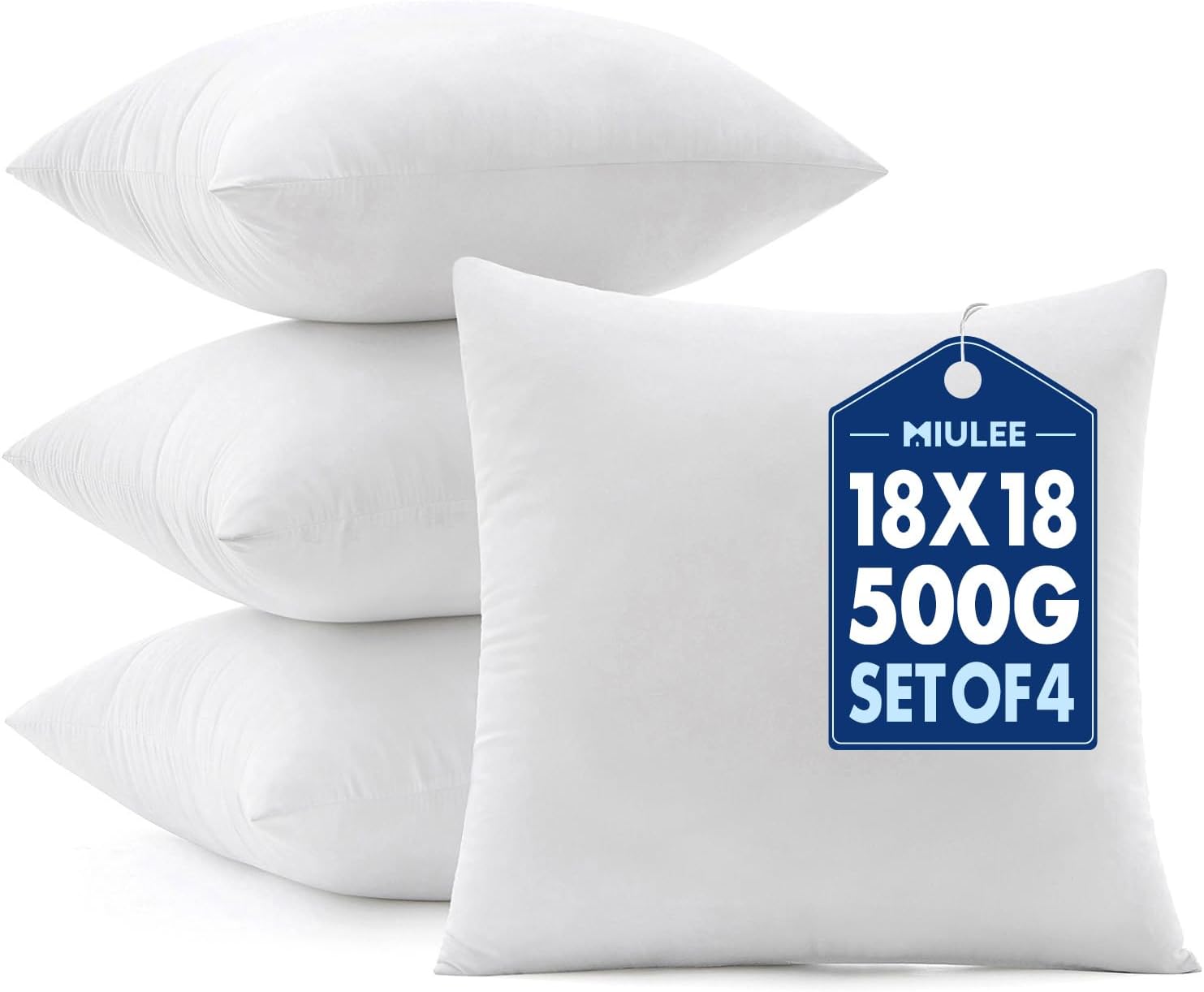
If you have ever pulled a sad, flattened pillow off your couch and wished it looked as full as the ones in a showroom, this set fixes that. The 1.1lb of microfiber fill per insert gives your covers real body, so they sit up plump and inviting instead of slumping into the cushions.
What makes them genuinely useful is the four pack. You can refresh both ends of a sofa and a couple of bed pillows in a single go, and they feel firm enough to actually prop you up while reading or watching TV. They are not the soft, sink-in feel of down, but that firmness is exactly why they hold their shape week after week.
If you want full, supportive throw pillows that keep their shape without the price of premium down, this one delivers.
Styles it works with: Modern Farmhouse, Scandinavian, Minimalist, and Boho setups that rely on layered, full looking throw pillows.
Best placed in: The corners of a living room sofa, layered against the headboard on a bed, or as lumbar support in a reading chair.
May not suit: Anyone with 16x16 or 20x20 covers, since these are strictly 18x18, or shoppers who prefer a soft, plush down feel over firm microfiber support.
Buy it if:
- You need to fill several 18x18 covers at once and want one affordable purchase
- Your current pillows have gone flat and you want a fuller, firmer look
- You want inserts that double as back support on a couch or chair
Consider waiting if:
- You are still deciding on cover sizes and might end up needing 16x16 or 20x20 instead
Skip it if:
- You want a soft, sink-in down or feather feel rather than firm microfiber
- Your covers are not the standard 18x18 size
Check the latest price and availability on Amazon before it sells out.
1. Poly-Fil Fairfield The Original Poly-Fil — the do-everything fiber fill
This one wins for general re-stuffing. Fairfield’s Original Poly-Fil is a siliconized polyester fiber that resists matting better than bargain stuffing, and it fluffs back after compression. Owners on r/Mattress report loft holding across multiple washes when air-dried. It handles pillows, cushions, and plush toys equally well.
The trade-off? It’s a loose fill, so you’ll spend time hand-packing for even density. Buy the larger bag if you’re filling more than two pillows. For versatility per dollar, nothing here beats it.
2. Poly-Fil Crafter’s Choice Dry Packing Fiber Fill — for craft-grade density control
The Crafter’s Choice CCDF10 ships in a 10-ounce bag built for dry packing, meaning it’s engineered to hold a firmer, denser shape than standard loose fill. That makes it the pick for amigurumi, stuffed toy limbs, and small cushions where you want structure, not squish.
The honest catch: at 10 ounces per bag, it’s a smaller quantity, so it isn’t cost-efficient for full-size bed pillows. Use it where firmness and shape retention matter more than plush softness. Craft-focused. Not a bulk buy.
3. Poly-Fil Fairfield The Original Poly-Fil (value pack) — best cost per ounce for big jobs
Same siliconized fiber as our top pick, sized for volume projects. If you’re refilling a couch’s worth of cushions or several 20×20 pillows, the larger Original Poly-Fil pack drops your cost per ounce noticeably versus small craft bags. The fiber quality is identical to Pick #1.
Why rank it third? Buying big only pays off if you’ll use it. For a single pillow, you’ll overpay for surplus you can’t store easily. Bulk buyers and serial DIYers should start here. Everyone else, size down.
4. Welacer Polyfill Stuffing — the budget fluff for decorative fills
Welacer’s polyfill leans soft and airy, marketed for cloud decorations, plush toys, and low-stakes cushions. It’s the cheapest fluff here, and for craft projects or display pieces where durability isn’t critical, it does the job at a lower entry price.
The trade-off is resilience. As a no-name fill, it doesn’t carry the loft-recovery track record Fairfield has earned in owner reports. Expect faster matting under daily use. Fine for decor. Skip it for pillows you’ll actually sleep on.
5. MIULEE 18×18 Pillow Inserts (4-Pack) — skip the stuffing entirely
Not everyone wants a bag of loose fiber. MIULEE’s 4-pack of 18×18 inserts uses 100% virgin fiber filling in pre-formed pillows, so you drop them straight into covers. No hand-packing, no mess. For throw-pillow refreshes at scale, this is the shortcut.
The catch is fixed sizing and fixed firmness. You can’t tune density the way loose fill allows, and 18×18 won’t fit every cover. But for four ready-to-use inserts at once, the convenience is real. Grab-and-go decor.
Comparison Table
| Product | Type | Best for | Trade-off |
|---|---|---|---|
| Poly-Fil Original | Loose siliconized fiber | All-purpose re-stuffing | Hand-packing needed |
| Poly-Fil Crafter’s Choice | Dry-packing fiber, 10 oz | Firm craft shapes | Small quantity |
| Poly-Fil Original (bulk) | Loose siliconized fiber | Volume projects | Overkill for one pillow |
| Welacer Polyfill | Budget soft fill | Decor and plush | Weaker loft recovery |
| MIULEE Inserts (4-pk) | Pre-formed 18×18 | Ready throw pillows | Fixed size and firmness |
How to Choose Pillow Stuffing
Start with the job. Loose polyester fiber like Fairfield’s Original gives you full control over firmness, and siliconized fibers resist clumping longer than untreated fill. For structured crafts, a dry-packing fiber holds shape. For throw pillows you just want done, pre-formed inserts save the hassle.
Watch fill weight against pillow size. A standard 20×20 throw pillow needs roughly 20 to 24 ounces of loose fiber for a firm feel, less for a soft one. Check content claims too. Look for virgin fiber over recycled if loft longevity matters, and confirm CertiPUR-US or OEKO-TEX language when low-emission materials are a priority for kids’ items.
Loose Fiber vs Pre-Formed Inserts
Loose fill wins on flexibility. You dial firmness, top off flattened pillows, and stuff odd shapes. That control costs time and a bit of mess, and getting even density takes practice. Fairfield’s siliconized fiber makes the job easier than generic fill.
Pre-formed inserts win on speed. MIULEE’s 4-pack means zero packing, and consistent 18×18 sizing across four pillows. The price is flexibility. You’re locked to one dimension and one firmness, and you can’t refresh loft without replacing the whole insert. Apartment Therapy and Wirecutter both note that insert sizing mismatches are the top complaint with ready-made options. Pick based on control versus convenience.
Frequently Asked Questions
How much stuffing do I need for a 20×20 pillow?
Budget 20 to 24 ounces of loose polyester fiber for a firm 20×20 pillow, less for a plush feel. Overstuff slightly, since fiber compresses with use. A large Fairfield bag covers two to three pillows this size.
Is polyester fiber fill washable?
Most siliconized polyester, including Fairfield’s Original, tolerates gentle machine washing. Air-dry or tumble on low to preserve loft. High heat can melt fibers and cause permanent clumping, so keep dryers cool.
Why does my pillow stuffing clump over time?
Cheaper untreated fibers tangle and mat under compression and moisture. Siliconized fills resist this longer. Fluff pillows weekly and wash sparingly. Welacer-style budget fills clump faster than Fairfield’s treated fiber.
Can I mix loose fill with an old insert?
Yes. Adding loose Fairfield fiber to a flattened MIULEE-style insert restores loft without a full replacement. Open a seam, top off, and re-stitch. It’s a quick fix for tired throw pillows.
Is virgin fiber better than recycled?
Virgin fiber generally holds loft longer and feels more consistent. Recycled fill costs less and suits decor. MIULEE uses 100% virgin fiber, which is why its inserts recover shape better than budget alternatives.
What stuffing is safest for kids’ items?
Look for OEKO-TEX or CertiPUR-US content claims and ASTM toy-safety references on the label. Fairfield’s polyester is a common choice for stuffed animals. Confirm any product page language before buying for small children.
Bottom Line
Fairfield’s Original Poly-Fil is the pick for most people. It’s versatile, resilient, and the siliconized fiber recovers loft where budget fills mat down. Buy the bulk pack if you’re filling multiple cushions. If you’d rather skip loose fill entirely, MIULEE’s 4-pack of 18×18 inserts drops straight into covers with zero packing, as long as that fixed size fits yours. Welacer stays a decor-only pick.



Write Your Review
No reviews yet. Be the first to share your experience!