

> Editorial Note: Hannah Lin is an Interior Living Researcher at thelastinghome.com. Recommendations here are based on established interior design principles, spatial psychology research, and widely documented decorating guidelines — not personal experience decorating this specific room. Our goal is to give you actionable guidance grounded in design fundamentals.
The bedroom that feels like a storage closet usually has three things wrong: furniture that’s too large for the room, walls that are too dark, and clutter on every horizontal surface. Fix those three things and the room changes. You don’t need a renovation — you need a reorder of priorities. A few of these fixes cost nothing at all.
If you’re also looking to upgrade specific pieces, our guides on the best dresser for bedroom, best queen bed frame, best floating shelves for living room, best nightstand with charging station, and best bedroom furniture sets queen can point you toward space-conscious options worth considering.
What colors make a small bedroom look bigger?
Light colors expand visual space because they reflect more light, reducing the contrast between the room’s corners and its center. That contrast is what makes walls feel close. White, cream, soft grays, and pale blues are the go-to palette for a reason — they don’t just look airy, they function differently in terms of how your eyes read the boundaries of a room.
The practical rule most people skip: paint the ceiling and walls the same color. The visual break between two different-colored planes — say, a white ceiling over a gray wall — creates a defined boundary that makes the ceiling feel lower and the room feel boxed in. Eliminating that break lets the eye travel upward without stopping.
Dark colors aren’t always wrong. A single dark accent wall behind the headboard can actually make a room feel deeper by creating a sense of recession — the eye reads the dark plane as farther away. The mistake is dark on all four walls. That’s where rooms start feeling like a cave.
According to color psychology research in architectural design, a room painted in light, high-reflectance colors can feel 20–30% larger due to perceived brightness increase. That’s not a cosmetic effect — it’s a measurable shift in how occupants perceive the room’s dimensions. Worth a weekend and a gallon of paint.
How does furniture placement affect how big a room feels?
The counterintuitive rule here: float furniture slightly away from walls — about 2–3 inches — rather than pushing everything flat against them. It feels wrong because the instinct is to “save space” by tucking everything to the perimeter. But furniture pressed flush against a wall reads as a wall extension rather than a freestanding object. The eye doesn’t register it as separate. Give it breathing room and the brain reclassifies it as an object in space, which makes the room feel larger, not smaller.
Bed placement matters more than most people realize. Centering the bed on the longest wall gives the room its best proportional balance. An off-center bed creates asymmetry that reads as cramped even when the dimensions haven’t changed.
Avoid blocking windows with dressers or wardrobes. Natural light is the single biggest room-expander available — it costs nothing and it works. A dresser in front of a window isn’t just blocking light, it’s blocking the perceived depth of whatever is outside that window.
What to eliminate entirely: the furniture runway. That’s the arrangement where a dresser, then a nightstand, then a chair, then a bookshelf line up along one wall in a continuous strip. It creates a corridor feeling, and it makes the room look like a waiting room. Break up the line or eliminate a piece.
What’s the best bed size for a small bedroom?
It depends on the room, but here’s the honest math. A queen bed at 60 x 80 inches needs a minimum of 8 x 10 feet of floor space to have acceptable clearance on all sides — enough to walk around it without turning sideways. A twin XL at 38 x 80 inches frees up 22 inches of width. In a 10-foot-wide room, that’s a meaningful difference in whether you have a functional walkway or a squeeze.
The mistake people consistently make: buying the largest bed that technically fits. “Technically fits” isn’t the right threshold. If the dresser drawers can only open partway before hitting the bed frame, or if you have to turn sideways to get from the door to the closet, the bed is too large. Furniture that fits technically doesn’t function practically. The room ends up feeling like an obstacle course.
A platform bed without a bulky headboard also reads smaller than it is — the lower profile keeps sight lines open, which matters a lot in rooms under 150 square feet.
How can I use mirrors to make a bedroom look bigger?
Mirrors work by reflecting the room back at you. The brain reads that reflection as additional depth — it’s not quite tricked, but it does register the reflected image as spatial extension. The key is placement. A mirror that reflects a window or a light source multiplies the light in the room. A mirror that reflects another wall just shows you more wall.
A full-length mirror on the inside of a closet door is one of the most efficient placements: you get 60–70 inches of reflective surface without using any wall space at all. It serves double duty as a functional mirror while working spatially.
A large mirror hung horizontally on a short wall creates the illusion that the wall is wider than it is. Width perception is often what makes a small bedroom feel cramped — it’s usually not as long as it is narrow.
What doesn’t work: multiple small decorative mirrors arranged in a gallery-wall grid. They’re too small individually to create a real reflection effect, and together they chop the wall into fragments. One large mirror outperforms five small ones every time.
What lighting makes a small bedroom look bigger?
Avoid ceiling-only lighting in a small bedroom. A single overhead fixture — the standard builder-grade setup — creates a bright pool at the center of the room and deep shadow at the corners and walls. Corners feel close when they’re dark. The shadow shrinks the perceived room.
Layered lighting distributes brightness to the periphery. Bedside lamps push light toward the walls. A small accent lamp in a corner pulls that corner forward visually. The combination — ambient overhead, bedside lamps, one accent — makes the room feel more expansive because the walls aren’t in shadow.
Color temperature is worth getting right. Warm white bulbs at 2,700–3,000K feel cozy but can make small rooms feel cozier in the wrong direction — slightly amber, slightly smaller. Cool daylight at 4,000–5,000K reads more expansive but can feel clinical. The practical middle: warm white ambient overhead, daylight-range reading light at the bedside where you need task brightness. That split gives you warmth without sacrificing the sense of space.
What decor mistakes make a small bedroom feel smaller?
Oversized art isn’t the problem most people think it is. The real mistake is the opposite: a collection of small frames arranged in a gallery wall that chops the wall into a dozen fragments. Each frame creates its own visual boundary. A single large piece reads as one element and leaves more visual breathing room around it.
Bold, busy patterned rugs compress a room. A rug with a small geometric or linear pattern actually expands the perceived floor area. A large-scale medallion or dense floral pattern has the opposite effect — it gives the eye too much to process and the floor feels cluttered even when it’s not.
Throw pillows. The Instagram bedroom aesthetic involves stacking 6–8 decorative pillows on a bed. They look good in photos. They have to go somewhere when you sleep, and that somewhere is usually the floor, a chair, or a pile in the corner. Every pile of displaced items reads as clutter.
Curtain rods hung at window height rather than ceiling height. This one is cheap to fix and has an outsized effect. Ceiling-height curtain rods with floor-length panels make the same window look significantly taller, and the wall around it look significantly higher. It’s one of the most cost-effective spatial tricks in the decorator’s toolkit — a pack of longer rods and a few extra inches of curtain fabric, and the ceiling height reads 12 to 18 inches taller than it actually is.
Helpful Resources for Small-Space Design

How To Analyze Big Apartment Buildings And Make Them Feel Small - Real Estate Investment Guide
Pros
- Affordable entry point for learning multifamily real estate analysis
- Digital format for convenient reading on any device
- High customer rating indicates valuable content
Cons
- Not a home decor product - this is a real estate investment guide
- Zero verified purchase reviews make it difficult to assess actual value
- Very niche topic not relevant to home decorating shoppers
This product appears to have been misclassified in our home decor catalog. It is actually a real estate investment eBook focused on analyzing apartment buildings for investment purposes, not a home decor item.
While the book may have value for real estate investors looking to understand multifamily property analysis, it will not help you decorate, furnish, or improve the aesthetic of your living space.
If you are looking for home decor products, we recommend browsing our other categories. If you are interested in real estate investment education, this may be worth checking out on Amazon directly.
Styles it works with: Not applicable - this is a real estate investment eBook, not a physical home decor product.
Best placed in: Your Kindle library or tablet if you are studying real estate investing.
May not suit: Anyone looking for furniture, lighting, wall art, or any physical home decor items. This is educational content only.
Buy it if:
- You are actively learning about multifamily real estate investing
- You want affordable educational content on apartment building analysis
- You prefer digital books you can reference on the go
Consider waiting if:
- You can find more comprehensive real estate courses or books with verified reviews
Skip it if:
- You are looking for home decor products like furniture, rugs, lighting, or wall art
- You have no interest in real estate investment strategies
Check the latest price and availability on Amazon before it sells out.

How To Make A Small Space Apartment Look Big: Creative Interior Decor Ideas for Every Room
Pros
- Structured room-by-room format makes implementation easy
- Priced affordably for budget-conscious decorators
- Kindle format allows highlighting and note-taking while you redecorate
- Focuses on creative solutions rather than expensive purchases
Cons
- No customer reviews yet to verify content quality
- Digital-only format means no physical reference while shopping or decorating
- May lack visual examples or photos to illustrate concepts
Small apartment living comes with real challenges, and this guide tackles them head-on with a practical room-by-room approach. Instead of overwhelming you with 100 tips at once, it walks you through your living room, bedroom, kitchen, and other spaces individually so you can see results as you go.
What makes this especially useful is the focus on creative decorating tricks rather than expensive renovations. These are the kind of visual expansion techniques renters can actually use without losing their security deposit. The beginner-friendly tone means you do not need any design background to understand and apply the ideas.
If you want your cramped apartment to feel more spacious without breaking your budget on new furniture, this guide delivers.
Styles it works with: Any style, as this is an educational guide focused on spatial perception techniques applicable to Minimalist, Scandinavian, Modern, and Bohemian aesthetics
Best placed in: Your digital library for reference while decorating any room in a studio, one-bedroom, or compact two-bedroom apartment
May not suit: Homeowners with large spaces who need remodeling advice, or visual learners who need extensive photo references rather than written instruction
Buy it if:
- You just moved into a small apartment and feel claustrophobic in your new space
- You are a renter looking for non-permanent ways to make rooms feel bigger
- You want organized, actionable advice without spending hours on blogs and Pinterest
Consider waiting if:
- You prefer learning from video tutorials or visual mood boards over written text
Skip it if:
- You own a house and need structural remodeling guidance rather than decorating tips
- You are an experienced interior designer looking for advanced spatial planning theory
Check the latest price and availability on Amazon before it sells out.
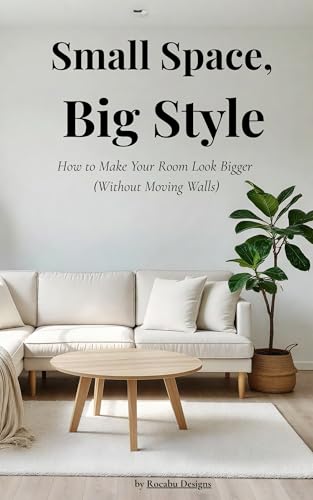
Small Space, Big Style: Transform Tiny Rooms with Expert Design Tricks (Kindle Edition)
Pros
- Excellent 4.9/5 rating shows readers find real value
- Affordable at under $8 for expert design knowledge
- Kindle format means instant access with highlighting and note-taking
- Focuses on practical solutions rather than expensive renovations
- Applicable to multiple rooms and living situations
Cons
- Digital-only format may not suit readers who prefer physical books
- No customer reviews yet to preview specific techniques covered
- May overlap with free online content for experienced decorators
This guide tackles one of the most common decorating challenges: making a small room feel spacious and inviting. Instead of suggesting costly renovations or major purchases, it focuses on smart design techniques that work with what you already have. The strategies apply whether you are dealing with a cramped bedroom, a narrow living room, or a tiny entryway.
What sets this apart is its focus on renters and budget-conscious homeowners. You will learn how to use color, lighting, furniture arrangement, and visual tricks that professional designers rely on. The Kindle format means you can reference it room by room as you work, highlighting tips specific to your space.
If you want your small rooms to feel bigger and more functional without knocking down walls or spending thousands, this guide delivers.
Styles it works with: Applicable to all interior design styles including Minimalist, Scandinavian, Modern, Traditional
Best used for: Apartments, small homes, condos, studio layouts, basement rooms, or any space that feels cramped
May not suit: Homeowners planning major renovations who need architectural guidance, or those seeking product-specific buying recommendations rather than design principles
Buy it if:
- You rent and cannot make structural changes to improve your space
- Your rooms feel cramped and you want proven strategies to open them up
- You are decorating on a budget and need cost-effective solutions
- You want expert design advice you can apply across multiple rooms
Consider waiting if:
- You prefer learning from video tutorials rather than reading text
- You want detailed product recommendations with links rather than general principles
Skip it if:
- You already follow interior design content regularly and know standard space-maximizing techniques
- You are planning a full renovation and need architectural or contractor guidance
Check the latest price and availability on Amazon before it sells out.
The books above cover small-space design in depth if you want to go further than the principles here.


Write Your Review
No reviews yet. Be the first to share your experience!