

> Editorial Note: I’m Sofia Reyes, a bathroom and wellness editor focused on small-bath organization and materials that hold up to real humidity. The evaluations here reference OEKO-TEX certifications, ASTM moisture-resistance standards, and aggregated owner reviews.
A faucet that drips after shutdown is losing its seal somewhere: the cartridge, a washer, or the valve seat. One drip every 2 seconds adds up to gallons a week. Compare the best bathroom faucet, best bathroom faucet brushed nickel, best bathroom faucets, best bathroom medicine cabinet, best bathroom storage, and best bathroom vanity before you decide how deep the repair should go.
Reason 1: The Washer That No Longer Seals
Compression washers wear out from repeated handle turns. When the rubber flattens, water keeps sneaking past the seat even after the handle feels closed. Classic drip, classic fix.
Check the drip location first. If water falls from the spout after both handles shut off, the washer or cartridge is the first thing to inspect. If the handle itself feels loose, the stem may be worn too. A single worn washer can waste 10 gallons or more over a week on a fast drip.
The washer sits at the bottom of the stem, held by a small brass screw. Most bathroom washers run 0.25 inches to 0.5 inches across. Turn off the supply valves under the sink before you open anything, then match the new washer to the old one by diameter. A washer 1 size too small leaks immediately. Good Housekeeping repair coverage often flags exact-match sizing as the step most people skip.
Reason 2: The Cartridge That Won’t Hold Pressure
Cartridge faucets fail when the internal seals age or mineral buildup stops the cartridge from seating flush. The drip often gets worse after hot water use, because heat expansion makes weak seals move. That means the faucet can look fine at rest and still leak.
Turn the water off under the sink, open the handle, and pull the cartridge. Look for scoring, grit, or a flattened O-ring. ASTM moisture-resistance standards don’t cover faucet internals directly, but they’re a reminder of how much repeated wet-dry cycling wears small parts. A bathroom faucet cycles dozens of times a day, so the seals see real mileage.
Match the cartridge by brand and model. Cartridges are not universal, and a cartridge that’s 2 mm too long won’t seat. Bring the old one to the store or match the model number. A new O-ring kit costs a few dollars; a full cartridge costs more but still less than a whole faucet.
Reason 3: The Valve Seat That Feels Rough
A rough valve seat lets water pass even when the washer is brand new. You may hear a faint hiss for 1 or 2 seconds before the drip starts. That’s metal meeting metal with no clean seal.
Mineral buildup is the usual cause in hard-water homes above 7 grains per gallon of hardness. A vinegar soak of 20 minutes can loosen light scale, but a pitted seat usually needs a seat wrench and a replacement seat. If the seat feels scratched when you run a fingertip over it, don’t expect a new washer to solve everything. The problem lives below the washer.
Some faucets have replaceable seats; others have a seat ground into the body. If it’s ground in, a seat-dressing tool can smooth minor roughness. If the pitting is deep, the faucet body is the limiting part, and replacement gets you a clean seal faster.
Reason 4: The Handle That Isn’t Closing Fully
Sometimes the faucet doesn’t drip because the seal is bad. It drips because the handle stops short. A half-turn that feels closed can still leave the valve open by 1 or 2 degrees, which is enough for a slow drip.
Check the stop position. If the handle meets resistance before it fully seats, the stem may need tightening or the cartridge may sit out of alignment. A loose escutcheon or handle set screw can hide the issue, so pull the trim off and watch the stem move directly. No full stop, no full seal.
Handle alignment matters most on single-lever faucets, where one cartridge controls both temperature and flow. If the lever won’t drop the last few degrees, the cartridge retaining nut may be over- or under-tightened. Snug it to hand-tight plus a quarter turn and recheck. Small adjustment, big difference.
Diagnose by When the Drip Happens
The timing narrows the cause faster than pulling parts. A drip that starts the instant you shut the handle points to a worn washer or cartridge seal. A drip that appears a minute or two after shutoff points to residual water clearing the spout, which is normal for a few seconds but not for a minute. A drip that only shows up after hot use points to a heat-sensitive O-ring or cartridge.
Shut both supply valves under the sink and watch for a minute. If the drip stops immediately, the hot or cold seal is leaking. If the drip continues with both valves closed, the valve seat or body is the problem, and water is pooling above the shutoff. That second result changes the repair from a $5 washer to a full faucet swap.
Note the drip rate too. A drip every 5 seconds is usually a small seal gap. A steady thin stream is a blown cartridge or a cracked body. The faster the flow, the more urgent the repair, since a steady stream can waste 30 gallons or more in a day and risk water damage under the cabinet.
Keep a small towel under the spout overnight and check it in the morning. A damp spot the size of a coin points to a slow seal leak you can schedule, while a soaked towel points to a fast leak that needs a same-day fix. That one overnight check tells you how fast you need to act.
What to Check Before You Buy Anything
Start with the cheapest part. Washers and O-ring kits cost a few dollars, cartridges cost more, and a full faucet is the priciest option. Many drips stop at the washer or cartridge stage, so work up the ladder rather than replacing everything at once.
Match the repair to the faucet type. Compression, cartridge, ball, and ceramic-disc faucets all fail differently and take different parts. A ceramic-disc faucet rated for 500,000 cycles rarely needs a washer; it needs new seals or a disc cartridge. A mismatch wastes a trip to the store and can make the leak worse.
The three products below cover the next step when repair isn’t worth it: a full faucet replacement, a brushed-nickel option for a style reset, and a complete faucet set for a full bath update. Match the failure to the part first, and only replace the whole fixture when the body is corroded or the handle is seized.

CHOEZON Black Medicine Cabinet with Mirror - Wall Mount Bathroom Storage, Adjustable Shelves, Reversible Door, 17.7x23.6 Inch
Pros
- Large mirror surface ideal for daily grooming and makeup application
- Adjustable shelving accommodates different bottle and product sizes
- Reversible door hinge allows flexible installation for any bathroom configuration
- Sleek black finish complements modern and contemporary bathroom styles
- Wall mounting frees up valuable counter and floor space
Cons
- No customer reviews yet to validate quality and durability claims
- Particleboard construction may not hold up as well as solid wood in humid bathroom environments
- Cannot be mounted on hollow or plaster walls, limiting installation options in some homes
This medicine cabinet solves one of the most common bathroom frustrations: cluttered countertops and nowhere to put your everyday essentials. The wall-mounted design uses vertical space efficiently, giving you a clean mirror surface plus hidden storage behind it. The black finish brings a crisp, modern look that pairs well with chrome fixtures or matte black hardware.
What sets this cabinet apart is the adjustable shelving inside. You can move the two shelves to three different heights, which means tall skincare bottles and short prescription containers can all fit without wasting space. The reversible door is another practical touch, letting you choose whether it swings left or right based on your sink and outlet placement.
If you want a simple storage upgrade that clears your counters without a full bathroom renovation, this one delivers.
Styles it works with: Modern, Contemporary, Minimalist, Industrial
Best placed in: Above bathroom sink or vanity, in powder rooms with limited counter space, in master bathrooms needing extra storage
May not suit: Bathrooms with hollow or plaster walls (requires solid wall mounting), spaces needing deeper storage for larger items, traditional or vintage-styled bathrooms where the black modern look may clash
Buy it if:
- You need to clear bathroom counter clutter and want a mirror plus storage in one unit
- Your bathroom has modern or contemporary decor and black fixtures
- You have solid walls suitable for mounting and want a straightforward installation
Consider waiting if:
- You prefer to see customer reviews and photos before purchasing a new product
- You need a different finish like white, wood tone, or brushed metal
Skip it if:
- Your bathroom walls are hollow drywall or plaster without solid backing
- You need deeper storage for bulky items or multiple large bottles
Check the latest price and availability on Amazon before it sells out.

CHOEZON Wall-Mounted Bathroom Medicine Cabinet with Mirror - Adjustable Shelves, Space-Saving Storage, White Finish, 17.7x23.6 inches
Pros
- Generous 17.7-inch mirror provides clear reflection for daily grooming
- Three adjustable shelf heights customize storage for your specific products
- Reversible door mounting works for any bathroom configuration
- Clean minimalist design fits modern and traditional bathrooms alike
- Straightforward assembly with pre-installed mirror and labeled parts
Cons
- Particleboard construction may not hold up as long as solid wood or metal cabinets
- Not recommended for hollow or plaster walls, limiting installation locations
- Shallow 5.5-inch depth may not fit larger bottles or bulky items
This medicine cabinet solves one of the most common bathroom frustrations: cluttered countertops with nowhere to stash your daily essentials. The CHOEZON cabinet gives you a proper mirror and hidden storage in one compact package, so you can finally clear off that vanity surface and still have everything within easy reach.
What sets this apart from basic medicine cabinets is the thoughtful flexibility. The reversible door hinge means you are not locked into one opening direction, and the three adjustable shelf positions let you configure the interior around tall skincare bottles or short medicine containers. The clean white finish and frameless mirror keep the look light and unobtrusive, which works whether your bathroom leans modern or traditional.
If you want organized bathroom storage that does not eat up floor space or require a contractor, this cabinet delivers.
Styles it works with: Modern Farmhouse, Scandinavian Minimalist, Coastal, Contemporary
Best placed in: Above bathroom sink or vanity, powder room wall, compact guest bathroom
May not suit: Large master bathrooms where a wider cabinet would better fill the wall space, homes with only hollow drywall or plaster walls without stud backing, bathrooms needing deep storage for bulky hair tools or large product bottles
Buy it if:
- Your bathroom counter is constantly cluttered with bottles and daily essentials
- You need a functional mirror and storage solution in one affordable package
- You are working with a small bathroom or powder room where floor space is limited
- You want a clean, neutral look that blends with existing decor
Consider waiting if:
- You are hoping for a lighted mirror version or a color other than white
- You need to measure your wall space first to confirm this 17.7-inch width fits
Skip it if:
- You need deep storage for large hair dryers, curling irons, or bulky product bottles
- Your walls are hollow drywall or plaster without stud support for secure mounting
- You prefer solid wood or metal construction over particleboard
Check the latest price and availability on Amazon before it sells out.
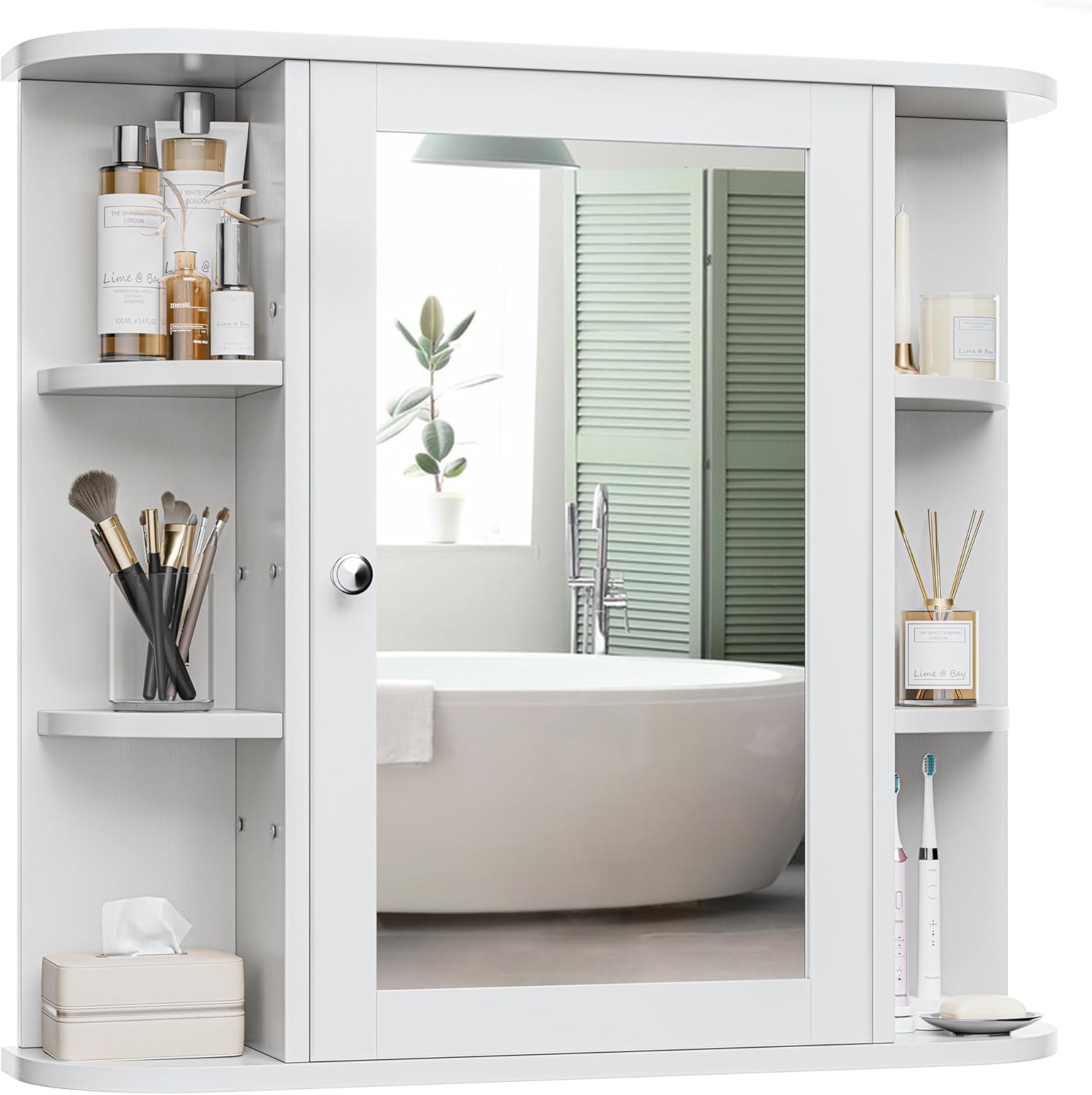
Meilocar Bathroom Medicine Cabinet with Mirror, Wall Mounted, 6 Open Shelves + Enclosed Storage, 26"W White MDF Cabinet
Pros
- Generous storage combining open and closed compartments in one unit
- Clean white finish pairs easily with most bathroom color schemes
- Low-emission MDF board is a healthier choice for enclosed indoor spaces
- At under $55, it delivers more storage features than most cabinets at this price point
Cons
- At 5.9 inches deep, the enclosed shelves have limited depth and may not fit larger bottles or first-aid boxes
- No customer reviews yet, so long-term durability and real-world assembly difficulty are unconfirmed
- MDF is less moisture-resistant than solid wood or PVC, so ventilation matters in high-humidity bathrooms
If your bathroom feels cluttered the moment you add one extra product to the counter, this cabinet is a genuinely useful fix. The combination of a mirrored door and six flanking open shelves means you get a functional mirror, a place to tuck away medicine or toiletries, and styled display space all in one footprint. That kind of multi-tasking is rare at this price.
The white finish is clean and understated rather than sterile. It photographs well in a bathroom with warm lighting, and the open shelves give you an easy way to add a small succulent or a stack of linen hand towels for that pulled-together spa look without overthinking it.
Installation is wall-mounted, which keeps your floor and counter completely clear. For small bathrooms, that visual breathing room makes a real difference in how the space feels day to day. If you want organized, display-ready storage without paying for a full vanity renovation, this one delivers.
Styles it works with: Minimalist, Scandinavian, Modern Farmhouse, Contemporary
Best placed in: Above the toilet in a main or guest bathroom, on an open wall in a small bathroom, or on a bedroom wall as a compact vanity-adjacent organizer
May not suit: Bathrooms with heavily ornate or traditional decor where a plain white MDF finish may look out of place; very high-humidity bathrooms without adequate ventilation since MDF is more moisture-sensitive than solid wood or PVC alternatives
Buy it if:
- You need both a mirror and wall storage but have limited bathroom space and do not want to mount two separate items
- You are furnishing a rental or guest bathroom and want a clean, affordable storage solution that looks intentional
- You want open shelves to style with plants or folded towels alongside closed storage for medications or personal care items
Consider waiting if:
- You prefer to read verified customer reviews before purchasing, since this listing currently has no user reviews to validate assembly difficulty or long-term quality
Skip it if:
- You need to store tall bottles, large first-aid supplies, or bulky items, as the 5.9-inch depth will be too shallow for many standard containers
- Your bathroom has poor ventilation or persistent high humidity, where MDF board is a risky long-term choice compared to moisture-resistant materials
Check the latest price and availability on Amazon before it sells out.
Frequently Asked Questions
Can a dripping faucet be fixed without replacing it?
Yes. If the washer, cartridge, or valve seat is the problem, a part swap under $20 often stops the drip. If the body is cracked or the handle won’t seat, replacement is the cleaner move.
Is a dripping faucet a big water waste?
Yes. A drip every 2 seconds can waste 10 gallons or more in a week. The faster the drip, the faster the waste climbs.
Should I replace the cartridge or the whole faucet?
It depends. Replace the cartridge if the faucet body is sound and the model still has parts available. Replace the whole faucet if the finish is corroded, the handle is loose, or the valve body is pitted.
Why does my faucet drip only after hot water?
Heat expands weak seals and can expose a worn cartridge faster. If the drip shows up within a minute of hot use, the cartridge or an internal O-ring is the first suspect.
Do hard-water homes get more faucet drips?
Yes. Water above 7 grains per gallon of hardness roughens valve seats and shortens seal life. Clean buildup with a 20 minute vinegar soak so the parts still seat properly.
Bottom Line
Most bathroom faucet drips come from a worn washer, a tired cartridge, or mineral buildup at the valve seat. Match the repair part to the faucet type and work from cheapest to priciest before replacing the fixture. If the handle won’t close fully or the body is corroded past a seat wrench’s reach, skip the patch and move to a new faucet. A clean seal is what stops the drip for good.




Write Your Review
No reviews yet. Be the first to share your experience!